Woman Pulled The Man Out Of His Seat, Frowning: “This Seat Isn’t For You.” The Flight Attendants Immediately Believed Her, Ignoring His Ticket. But When He Took Out His Phone
The first thing Marcus Washington noticed when he stepped into the cabin was the temperature.
It was always like this in first class—air chilled to a polite, controlled coolness that carried the faint scent of citrus cleaner and expensive fabric. The lighting was softer too, more flattering, as if even the bulbs had been selected to reassure people they belonged here.
He paused at the threshold between the jet bridge and the aircraft, letting the flow of passengers behind him press gently at his back. An attendant near the forward galley offered a practiced smile. Marcus returned it, quiet and brief. His face gave nothing away.
He moved forward without hurry, one hand on the worn leather of his carry-on, the other carrying a folded paper boarding pass that looked like it had already lived a day in someone’s pocket. It had. He’d kept it that way on purpose.
Seat 1A waited at the front like a promise: wide, clean, angled slightly toward the window. The leather looked untouched, the headrest crisp. He slid into it, letting the seat take his weight, and for a moment he simply sat—still, listening.
The cabin murmured with the small rituals of travel: overhead bins thudding shut, the metallic snap of seatbelts, the quiet arguments of couples over whose bag went where. Somewhere behind him, a child laughed too loudly and a parent hissed a warning. A man a few rows back cleared his throat in that nervous way people did when they didn’t want to appear nervous.
Marcus rested his forearms on the armrests and exhaled through his nose.
He wore a simple hoodie—dark, soft, unbranded—and jeans that had faded at the knees. Shoes chosen for comfort, not display. The kind of outfit that disappeared into a crowd.
That was the point.
He’d been on enough planes to know how quickly eyes sorted people. How efficiently.
A shadow passed over his lap, and then he heard it—the sharp sound of heels, fast and certain.
“Excuse me.”
The voice wasn’t loud at first. It didn’t need to be. It carried the crisp edge of someone used to being obeyed.
Marcus looked up.
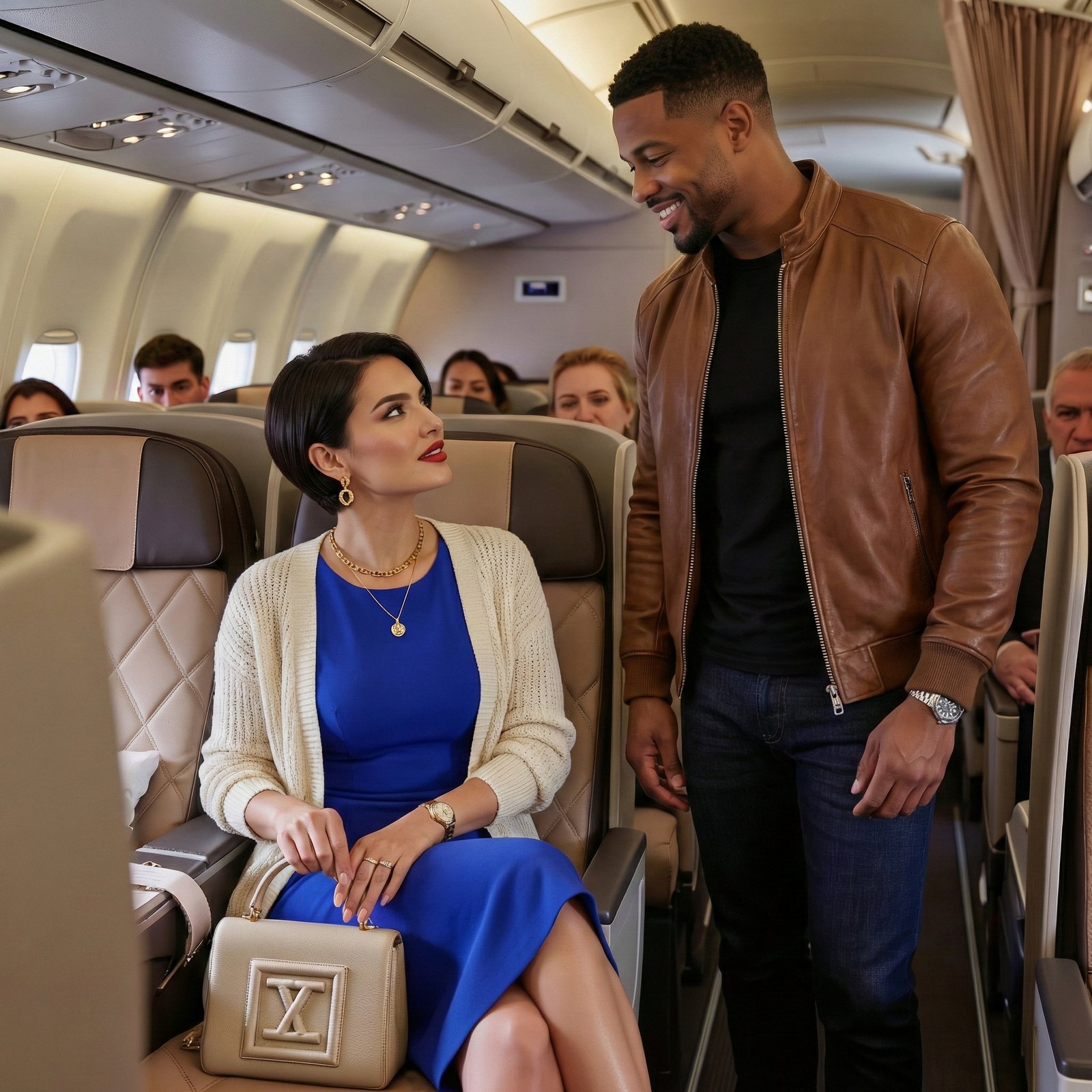
A woman stood over him, angled into the aisle like she’d already decided how this would end. Her hair was styled with intentional looseness, the kind that took time to look effortless. Her lips were a muted rose. A diamond bracelet caught the overhead light and threw it back in brief, cold flashes.
Her eyes dropped to him, then to the seat number, then back to him again, and her expression tightened—as if she’d tasted something sour.
“This seat isn’t for you,” she said.
Marcus blinked once. He didn’t move.
“I’m sorry?” he asked, calm.
The woman’s mouth lifted, not quite a smile. More like a correction.
“Get out of my seat. Now.”
Before he could respond, her manicured nails dug into the fabric of his hoodie. Not a light tap—pressure. A grab. The kind of touch that didn’t ask permission. She yanked his shoulder as if she could lift him out by force of entitlement alone.
Marcus rose instinctively, more out of surprise than compliance, and his coffee—balanced in his hand—tilted.
Hot liquid sloshed across the folded Wall Street Journal on his lap and splattered onto his jeans. The heat bit through denim. The paper darkened and warped.
The woman didn’t flinch.
She shoved him into the aisle with her hip, then slid into seat 1A as if reclaiming conquered territory. The leather sighed under her.
“That’s better,” she said, smoothing her skirt—Chanel, the stitching subtle but unmistakable to anyone who cared to notice—and claiming the armrest as if it were a border line.
Marcus stood there, slightly stooped under the low ceiling, coffee smell rising off his damp jeans. He could feel the warmth cooling into stickiness.
The woman glanced up at him again, then past him, to the rows behind.
“Some people forget where they belong,” she added, for the cabin to hear.
That did it.
He saw phones come up like sunflowers turning toward light.
A teenager near the aisle, not even trying to hide it, angled her camera toward him. The soft glow of her screen lit her face. Another passenger lifted his phone higher, framing the scene carefully, already thinking of captions.
Marcus looked down at his boarding pass. The paper was creased and smudged, the ink faint in places—deliberately imperfect. But the seat number was still there, still legible:
1A.
He felt something in his chest that wasn’t anger, exactly. More like a slow, familiar grief at how predictable this always was. How fast the world drew conclusions.
He could have ended it immediately. He could have done it with one sentence.
Instead, he held the paper in his fingers and waited.
From the galley, a voice called out, bright and rehearsed:
“Flight doors closing in ten minutes. All passengers must be seated.”
Footsteps hurried. A blonde flight attendant appeared, ponytail bouncing, her smile already set to “problem-solving.” Her name tag read Sarah Mitchell.
She took in the scene in one sweeping glance—woman settled confidently in 1A, man standing in the aisle with a hoodie and coffee stains—and her expression softened toward the woman instantly.
“Ma’am,” Sarah said, stepping close, her hand hovering near the woman’s shoulder in a comforting gesture, “I’m so sorry about this disruption. Are you okay?”
The woman’s shoulders relaxed as if she’d been waiting for that exact phrasing. She nodded, lips pressed together in a performance of patience.
Marcus extended his boarding pass.
“This is my assigned seat,” he said, voice even. “1A.”
Sarah’s eyes flicked toward the paper—but only briefly, like she was glancing at something irrelevant. Her gaze returned to Marcus’s face, then drifted downward, taking inventory: hoodie, jeans, scuffed sneakers.
Her tone changed. Not sharp—worse. Smooth. Assured.
“Sir, I think there’s been a misunderstanding,” she said. “Economy class is toward the back of the aircraft.”
A small sound escaped the woman in 1A, a satisfied exhale.
“Finally,” she said, loud enough for the phones. “Someone with common sense.”
Marcus kept his eyes on Sarah.
“Could you please look at my boarding pass?” he asked again, holding it closer.
Sarah’s smile tightened at the corners.
“Sir,” she said, her voice lowering into that customer-service firmness that meant don’t make me repeat myself, “please don’t make this more difficult. I’m sure your actual seat is very comfortable.”
Behind them, the cabin buzzed. Whispers threaded between rows like quick, nervous insects.
Marcus could feel the heat of attention on his skin—two hundred passengers, each one making their own quiet judgment, some filming, some pretending not to look.
The woman in 1A sighed theatrically and leaned back, crossing one leg over the other.
“I don’t understand the confusion,” Marcus said, still controlled. “My ticket clearly shows—”
“Look at him,” the woman interrupted, dismissing him with a flick of her hand. “Does he look like he belongs in first class? I’m Diamond Medallion status. Fifteen years with Delta.”
Sarah’s posture shifted immediately, like a soldier recognizing a higher rank.
“Of course, ma’am,” she said warmly. “We appreciate your loyalty.”
Marcus’s mouth twitched—not quite a smile, not quite a grimace.
“I have the same loyalty program status,” he offered. “If you could just verify—”
“Sir,” Sarah said, the patience now thinning, “I don’t have time for games.”
Games.
He looked at her for a beat, absorbing the word.
From two rows back, the teenager’s phone made a soft click sound. She’d gone live. Her eyes darted between her screen and the real world, thrilled and uneasy all at once.
Marcus’s own phone vibrated in his pocket, a familiar insistence. He didn’t take it out yet. He could guess the messages—calendar changes, meeting reminders, a dozen people trying to locate him.
He lifted the boarding pass again.
“Please,” he said simply.
Sarah stepped slightly closer to him, angling her body the way staff did when they were trying to direct someone without touching them—blocking access.
“Sir,” she said, “final warning. Move to your assigned seat or I’ll need to call security.”
“I am in my assigned seat,” Marcus repeated, his voice calm enough to be almost gentle.
“No,” Sarah replied, confident now, “you’re not. This is first class. You’re clearly in the economy section.”
The words landed like a slap not because they were loud, but because of how easily they were said—how unquestioned the assumption was.
Marcus glanced up toward the overhead bin above 1A. His leather briefcase was tucked there, sleek and heavy, his initials MW stamped discreetly in gold. It cost more than some people paid for rent in a month.
Sarah never looked at it.
An elderly passenger across the aisle leaned forward.
“Miss,” he called softly, “maybe you should check his ticket.”
Sarah didn’t even turn her head fully.
“Thank you,” she snapped, “but I can handle this.”
The woman in 1A examined her nails as if boredom itself were an insult.
“I can’t believe this is even a discussion,” she said. “Look at us. Look at him. It’s obvious who belongs where.”
Marcus felt his jaw tighten, just slightly. He released it immediately. His breathing stayed slow.
He could sense the way the crew’s certainty fed on itself. The longer they refused to check, the harder it became for them to admit they might be wrong.
A crackle came from the intercom.
“Eight minutes to departure,” the captain announced. “All passengers must be seated.”
Sarah’s eyes flicked toward the cockpit door, then back to Marcus. Her stress sharpened into irritation.
She pressed the call button.
“David,” she said into her headset, voice urgent. “I need assistance in first class. We have a passenger in the wrong seat who won’t comply.”
Marcus watched her do it with detached curiosity. Around them, the filming continued. The teenager’s live stream numbers climbed—he caught a glimpse when her screen tilted: five hundred, eight hundred, twelve hundred.
The comment feed was a blur.
He could almost hear the way the internet would split itself: outrage, doubt, cruelty, jokes.
Footsteps approached with authority. A man appeared—tall, neat, with the posture of someone who’d done this too many times. His name tag read David Torres.
He took in the situation instantly: well-dressed woman in seat 1A, casually dressed man standing in the aisle.
The mental math took him less than a second.
“What seems to be the problem?” David asked, his tone already weighted toward resolution.
“This passenger,” Sarah said, emphasizing the word like an accusation, “refuses to move to his assigned seat. He’s disrupting departure.”
David looked at Marcus. Not with curiosity. With judgment.
“Sir,” he said, “you need to find your correct seat immediately. We have a schedule to maintain.”
Marcus held out the boarding pass again.
“I am in my correct seat,” he said. “This is my documentation.”
David’s eyes skimmed the paper, barely. More a gesture than a check.
“Sir,” David said, voice cooling, “I don’t have time for fake documents or games. Move to economy now or I’ll call airport security.”
A ripple of sound moved through the cabin—a collective intake of breath. Phones lifted higher.
The teenager’s live stream jumped again: five thousand now.
Marcus looked around. He met eyes—some sympathetic, some hungry for drama, some already convinced he must be wrong. The boarding pass in his hand might as well have been blank.
“Six minutes to departure,” the captain announced.
“Perfect,” the woman in 1A said, settling deeper as if she’d been proven right by the passage of time. “I have a connecting flight. I can’t afford delays.”
Marcus nodded slowly, as if acknowledging a point. Then he reached into his pocket and pulled out his phone.
The screen lit his face faintly.
Sarah noticed it and narrowed her eyes.
“What’s he doing now?” she muttered.
“Probably calling someone to complain,” David said dismissively. “People always do.”
Marcus didn’t answer them. He opened an app. A familiar logo filled the screen: Delta Air Lines.
His thumb moved with practiced precision, tapping through menus that didn’t look like the standard passenger interface—though from where they stood, no one could see clearly.
David spoke into his radio.
“We have a code yellow in first class,” he said, voice clipped. “Need additional crew.”
Within moments, two more attendants arrived.
A younger man—fresh-faced, eager, hair too neatly combed—stepped in behind Marcus as if forming a barrier. His tag read James Mitchell.
Beside him came a woman in her forties with tired eyes and the posture of someone who’d stopped believing people were inherently good at least five years ago. Her tag read Michelle Rodriguez.
Michelle crossed her arms the second she saw Marcus.
“What’s the situation?” she asked.
“The passenger refuses to move to economy,” Sarah said quickly. “Won’t accept that he’s in the wrong seat.”
James angled his body so Marcus couldn’t easily step back.
“Sir,” James said, voice trying for polite but landing on smug, “we really need you to cooperate here.”
Four crew members now formed a semicircle in the narrow aisle. The woman in 1A watched it like theater, lips curled into satisfaction.
“This is embarrassing,” she announced loudly. “I’m trying to get to an important business meeting, and this man is holding up the entire flight with his story.”
Marcus’s phone vibrated again. Notifications stacked at the top of the screen. One message preview flashed briefly:
Board meeting moved to 4:00 p.m. Where are you?
The woman in 1A saw it and laughed.
“Oh, look,” she said, delight sharp. “He’s got a board meeting.”
Some passengers shifted uncomfortably at that cruelty. The crew seemed energized by it.
“Five minutes to departure,” the captain’s voice cut in again.
David stepped closer, voice hardening.
“You’re delaying two hundred passengers because you can’t accept reality.”
“Yeah,” James added, emboldened by the group behind him. “Just take your real seat and we can all move on.”
Michelle leaned in, her voice dropping into something like a threat.
“Listen carefully,” she said. “Move to economy now, or airport security will remove you. Your choice.”
Marcus looked at her. His gaze was steady, unreactive.
He could feel the moment expanding, ballooning beyond a seat dispute. He could feel the narrative being written in real time—by the crew, by the woman, by the phones.
The teen’s live stream count surged again. Marcus caught another glimpse: fifteen thousand. Then twenty-five.
The comments moved too fast to read, but he didn’t need to. He’d seen enough of the world to know what people were saying.
This is wrong.
Check his ticket.
He’s lying.
She’s right.
Racism.
Classism.
Get him off the plane.
A businessman in seat 2C finally lowered his laptop.
“Excuse me,” he said, voice controlled, “shouldn’t you at least look at his boarding pass?”
David’s head snapped toward him, irritation flaring.
“Sir, please don’t interfere,” David said. “We’re handling this professionally.”
“Professionally?” the businessman repeated. “You haven’t verified his ticket.”
Michelle turned sharply, eyes cold.
“Are you questioning our procedures?” she asked.
“I’m questioning why you won’t look at a piece of paper,” the man replied evenly.
Sarah’s face flushed.
“We don’t need to examine obvious forgeries,” she snapped.
“How do you know it’s forged if you haven’t looked?” asked an elderly woman in 1B, her voice small but firm.
The cabin shifted. The audience was turning.
The woman in 1A stood abruptly, raising her hands as if presenting evidence to a jury.
“Use your eyes,” she said. “Does anything about this man say ‘first class’ to you?” She pointed at Marcus’s hoodie. “That’s a cheap sweatshirt. I can tell.”
Marcus finally spoke directly to her.
“How can you determine the price of my clothes?” he asked, mild curiosity in his tone.
She blinked, irritated that he wasn’t playing his assigned role of anger or desperation.
“Because I know quality,” she snapped. “Your shoes are probably discount. Your jeans look like they came from a warehouse bin.”
James nodded along, eager.
“First-class passengers have certain presentation standards,” he said.
Michelle added, as if reciting something she’d decided was policy:
“We’re trained to identify passengers who might be out of place. It’s about maintaining the premium experience for legitimate customers.”
Marcus looked at each of them in turn. He said nothing. His silence seemed to aggravate them more than any argument would have.
David keyed his radio again.
“Security, what’s your ETA to gate A12?”
“Two minutes out,” came the crackling reply.
“Perfect,” the woman in 1A said, clapping once, delighted. “Finally.”
David pointed at Marcus as if he were labeling a problem.
“There he is,” Sarah said, loud enough for the cabin. “The passenger causing the disruption.”
Marcus held still. His phone was still in his hand. He hadn’t raised his voice once.
When the heavy footsteps finally came—two airport security officers stepping into the aircraft doorway—the cabin fell into a hush so sudden it felt like someone had switched off a radio.
Officer Williams, a Black man in his forties, scanned the scene with practiced calm. Beside him was Officer Carter, an Asian American woman whose expression balanced kindness with firmness.
“What seems to be the problem?” Officer Williams asked.
David launched into his explanation, rehearsed and confident.
“The passenger refuses to move to his assigned seat,” he said, gesturing at Marcus. “Claims this first-class seat belongs to him, despite obvious evidence to the contrary.”
Officer Carter’s brow furrowed.
“What obvious evidence?” she asked.
Sarah hesitated, caught off guard by the need for something real.
“Well,” she stammered. “I mean—look.”
Officer Williams’s expression hardened slightly.
“Ma’am,” he said, “I need specific evidence, not observations about appearance.”
The woman in 1A—Karen Whitmore, Marcus now knew from the way her name was spoken later—jumped in quickly, sensing the crew faltering.
“Officers, I’ve been patient,” she said, voice drenched in wounded dignity. “This man has been bothering me for ten minutes. I just want to sit in the seat I paid for.”
Officer Williams nodded once, then turned to Marcus.
“Sir,” he said, professional, “your boarding pass, please.”
Marcus handed over the paper.
Officer Carter examined it carefully, smoothing the crease with her thumb, reading the details twice. Her expression shifted from neutral to confused.
“This boarding pass says seat 1A,” she said slowly.
David stepped forward, desperate.
“Obviously forged,” he said, and then—still—he made the mistake of saying the quiet part out loud. “Look at him—”
Officer Carter cut him off.
“That’s not how we determine anything,” she said.
Karen pulled out her phone as if she’d been waiting to slam it down like a gavel.
“Here,” she said. “My boarding pass. Seat 1A.”
Officer Williams looked at her screen. Then back at Marcus’s paper boarding pass. The air thickened with uncertainty.
He turned back to Marcus, more cautious now.
“Sir,” Officer Williams said, “can you show some ID and explain how you obtained this boarding pass?”
Marcus reached into his pocket slowly, deliberately. He could feel the eyes on him like weight.
He withdrew his wallet, but instead of flipping to an ID, he set it in his palm and lifted his phone slightly.
“Actually,” Marcus said, his voice quiet—but carrying something new now. Not anger. Authority. “I think there’s something you all need to see first.”
His thumb tapped once.
The Delta app, which had looked ordinary from afar, shifted. Menus changed. Layers slid open like doors. The interface no longer resembled a passenger’s experience at all.
Officer Carter leaned in instinctively, her eyes scanning what she was seeing. Officer Williams leaned closer over her shoulder.
Marcus angled the screen so they could read it clearly.
For a moment, neither officer spoke.
Then Officer Carter’s breath caught—just a small inhale, but audible in the hush.
On the screen:
Marcus Washington — Chief Executive Officer
Authority Level: Executive
Employee ID: 0000001
Founder/CEO
Direct reports: 43,000 employees
Officer Williams straightened slightly, his posture shifting in a way Marcus had seen countless times: enforcement becoming deference.
“Sir…” Officer Williams said, voice lower now.
David frowned, confused.
“What?” he demanded. “What are you looking at?”
Marcus held the phone toward him.
David’s eyes moved across the display. Marcus watched the exact moment comprehension hit—confident authority draining into confusion, then horror.
David’s clipboard slipped from his hand and clattered to the floor.
Sarah leaned in, and when she read the screen, all color left her face.
“Oh my…” she whispered, and then again, softer, like a prayer. “Oh my.”
James and Michelle stared at the phone, their expressions tightening, then fracturing.
The cabin stayed silent, but the silence was no longer neutral. It was charged—like the second before thunder.
Karen, still seated in 1A, looked around, bewildered by the sudden change in energy.
“What is everyone staring at?” she demanded. “Can we please resolve this and take off?”
Marcus turned the phone screen toward her.
Her eyes scanned it, and her face went through something like stages of grief—disbelief, then recognition, then a dawning dread so complete it seemed to hollow her out.
“You…” she whispered. “You can’t be.”
Marcus’s voice stayed even.
“I own sixty-seven percent of this airline, Ms. Whitmore,” he said. “I don’t just have seat 1A. I’m responsible for every seat on this aircraft.”
Karen’s hands gripped the armrests as if the leather had turned unstable under her.
David found his voice again, but it shook.
“Sir,” he said, swallowing hard, “we had no idea. We were just following—”
“Standard what?” Marcus interrupted gently, and somehow that gentleness made it worse. “Standard procedure is to examine passenger documentation before making assumptions.” His gaze moved over Sarah, then James, then Michelle, then back to David. “Standard procedure is dignity.”
Sarah’s hands were trembling now. She looked like she might cry, but held it back through sheer effort.
“Mr. Washington,” she said, voice cracking, “I’m so sorry. We made a terrible mistake.”
“You made several,” Marcus said quietly. “But the biggest one was assuming respect is earned by appearance rather than humanity.”
Officer Carter’s voice was careful.
“Sir… this was planned,” she said, as if realizing something larger.
Marcus nodded once.
“I’ve been conducting unannounced assessments of our passenger-experience protocols,” he said. “Today’s test revealed failures at multiple levels.”
The words moved through the cabin like electricity. Even people who couldn’t see the screen understood the shift. The narrative the crew had written—man in hoodie causing trouble—collapsed instantly, replaced by a new one they couldn’t control.
Karen tried to stand, but her legs didn’t cooperate.
“I didn’t know,” she stammered. “I had no idea.”
Marcus’s eyes stayed on her.
“Would it have mattered?” he asked quietly. “If I were just Marcus Washington, passenger, instead of Marcus Washington, CEO—would that justify your behavior?”
Karen’s mouth opened. No sound came out. Her answer—her real answer—was already written in what she’d done.
Marcus looked down at his watch. Not to check the flight schedule.
He looked at his calendar alerts stacked neatly on his phone—meetings that didn’t exist by accident.
Emergency board meeting — Compliance Protocol Review, 4:00 p.m.
Legal Department — Federal Report, 4:15 p.m.
Media Relations — Press Conference Prep, 5:00 p.m.
Current time: 3:47 p.m. Eastern
He raised his gaze back to the crew.
“Officer Williams,” Marcus said, “I’d like you and Officer Carter to witness what happens next. Documentation matters.”
A shiver seemed to move through the people closest to him.
Marcus opened his contacts. The names were ordinary in their phrasing, but lethal in their implications:
Legal Department — Direct Line
Human Resources — Emergency Protocol
Media Relations — Crisis Management
Board Chair — Immediate Response
He tapped Legal and put the call on speaker.
It rang once.
“Marcus Washington’s office, legal department,” a woman answered briskly. “This is Patricia Hendris.”
“Patricia,” Marcus said, “this is Marcus. I’m currently on Flight 447. I need immediate documentation prepared for a formal discrimination case review.”
Silence—three seconds long, heavy as a door closing.
“Sir,” Patricia said finally, her voice sharper with urgency, “what’s the situation?”
“I was treated improperly by four crew members and a passenger,” Marcus replied, eyes on David as he spoke. “The incident is being recorded and is currently live-streaming.”
“Are you injured?” Patricia asked.
“Not physically,” Marcus said. “But our compliance status and reputation are in serious jeopardy.”
David made a broken sound, half a whisper.
“Sir, please…”
Marcus didn’t look away.
“Employee number 47,291 threatened to have me removed from my assigned seat,” Marcus said into the phone. “I need his employment file pulled immediately, along with recommended actions.”
David went pale. The number landed like a verdict.
Patricia didn’t hesitate.
“Yes, sir.”
“I also need a comprehensive review of our current anti-bias policies,” Marcus continued. “Clearly they’re failing if crew can’t distinguish between legitimate concerns and profiling.”
“Should I contact the FAA?” Patricia asked.
“Yes,” Marcus said. “And the Department of Transportation’s Office of Civil Rights.”
A murmur moved through the cabin—passengers reacting to the weight of federal oversight, to the reality that this wasn’t just drama anymore. This was consequence.
Marcus ended the call and tapped HR — Emergency Protocol.
“Marcus Washington’s office, HR emergency line,” a woman answered. “Director Janet Mills.”
“Janet,” Marcus said, “I need immediate employment actions reviewed for Flight 447 crew members.”
Behind him, someone sniffled—one of the attendants, trying not to sob.
Marcus’s tone stayed level, but every word was precise.
“Sarah Mitchell, employee 23,847,” he said. “Full investigation into protocol violations. Six-month unpaid suspension pending mandatory training completion and evaluation.”
Sarah’s knees nearly buckled. She grabbed the edge of a seat to steady herself.
“James Mitchell, employee 18,293,” Marcus continued. “One-year probation with mandatory counseling sessions. Monthly training certification. Any future incident results in immediate termination.”
James nodded rapidly, eyes wide, as if agreement itself might save him.
“Michelle Rodriguez,” Marcus said, “employee 31,456. Mandatory intensive training program, professional evaluation, demotion from senior flight attendant, and salary reduction for two years.”
Michelle’s face tightened, then crumpled.
“And David Torres,” Marcus said, the finality unmistakable, “employee 47,291. Immediate termination with cause.”
David made a sound that didn’t belong in first class—raw and pleading.
“Mr. Washington,” he choked out, “please. I have a family. I have a mortgage. I made a mistake—”
“You had eight years to learn,” Marcus said quietly, not cruelly. “Eight years of training. Eight years of opportunities to treat people with dignity.”
He turned back to the phone.
“Janet,” he said, “implement immediate policy changes: body-camera requirements for all crew interactions with passengers, effective tomorrow morning. Any complaint involving potential discrimination must be recorded and reviewed by a response team within twenty-four hours.”
Janet hesitated only long enough to acknowledge the magnitude.
“Budget allocation?” she asked.
“Fifty million annually for the first three years,” Marcus said. “Also establish a passenger-advocate position in every hub with direct reporting to my office. Create an anonymous reporting system with real-time alerts.”
“Sir,” Janet said carefully, “the operational changes will be significant.”
“The operational cost of discrimination is higher,” Marcus replied.
He ended the call.
Karen still sat in 1A as if she’d been nailed there.
Marcus turned to her, and the way he looked at her wasn’t triumphant. It was exact. Like a mirror held up without mercy.
“Ms. Whitmore,” he said, “now we discuss your situation.”
He tapped through a few screens. Her professional profile appeared—her name, her title, her polished corporate headshot.
Karen Whitmore — Senior Marketing Director
Corporate Diversity & Inclusion Committee — Chair
Recent post: Zero tolerance for workplace discrimination. We must all do better.
Marcus angled the phone slightly so the closest cameras could capture it. The teenager’s live stream numbers surged again, though Marcus didn’t need to see them to know.
Karen’s face drained.
“No,” she whispered. “Please—”
“You publicly advocate for inclusion,” Marcus said, “while privately telling another passenger to leave a seat that wasn’t yours.”
“I didn’t mean—” Karen began, voice shaking. “I’m not usually—”
“You meant every word you said,” Marcus replied, still calm. “The only question is what you choose now.”
He let the silence do its work.
“Option one,” Marcus said, “you record a public apology. You complete two hundred hours of community service with civil-rights organizations. You undergo six months of counseling. You accept monitoring status on future flights—your interactions documented.”
Karen’s mouth opened, then closed.
“You also speak at executive training sessions,” Marcus continued, “and tell the truth about what you did and why it was wrong. Your story becomes a case study for unconscious bias training.”
Karen’s eyes glistened.
“Option two,” Marcus said, “I refer this for civil litigation and notify your employer with the full video.”
The cabin felt like it leaned forward as one body.
Karen looked around—at the passengers filming, at the crew standing broken in the aisle, at the security officers watching quietly.
“I…” she tried.
Marcus’s expression didn’t change, but his voice sharpened just enough to make it clear this wasn’t theater anymore.
“Speak clearly,” he said. “So it’s documented.”
Karen swallowed hard.
“I choose option one,” she said, louder this time, tears spilling. “I choose to apologize publicly and complete the community service and counseling.”
Marcus nodded once toward Officer Williams.
“Please document that,” he said.
A beat passed. Then Marcus looked out over the cabin, meeting faces.
“Ladies and gentlemen,” he said, voice carrying without raising, “I apologize for the delay. What you witnessed today is exactly why systematic change is necessary.”
He didn’t sound proud. He sounded resolved.
The applause didn’t start immediately. It built slowly—one set of hands clapping, then another, until the cabin filled with it. Not celebration. Release.
Marcus stood still while it happened. He watched Sarah wipe at her cheeks. He watched David shake as if his body couldn’t contain what he’d done. He watched Karen stare at the floor like she was seeing it for the first time.
And then, quietly, Marcus stepped back into the space beside 1A and said, “We’re going to clear the aircraft.”
The rest unfolded with the speed of real consequence.
Part Two: The Weight of Consequences
The applause faded into an uneasy quiet, the kind that settles after something irreversible has occurred.
Marcus stood in the aisle while the cabin crew—what remained of it—waited for instruction that would never come from them again. The authority in the space had shifted completely, and everyone could feel it. The air itself seemed heavier, thick with the aftermath of words spoken too confidently and judgments made too easily.
“Ladies and gentlemen,” Marcus said, his voice steady but no longer conversational, “for everyone’s safety and comfort, this aircraft will be temporarily cleared. A replacement crew will board shortly.”
A ripple moved through the cabin—not outrage, not complaint, just understanding. No one argued. No one protested. People gathered their belongings quietly, eyes darting between Marcus, the trembling crew members, and Karen Whitmore, who still sat frozen in seat 1A as if gravity itself had abandoned her.
Security officers moved with calm efficiency. Officer Williams gestured toward the aisle.
“Ma’am,” he said to Karen, not unkindly, “we need you to step out.”
Karen stood slowly. The confidence that had once animated her movements was gone, replaced by something brittle and uncertain. She avoided eye contact as she stepped into the aisle, her heels suddenly too loud against the cabin floor.
Passengers filed out row by row, murmuring under their breath. Some glanced back at Marcus with something like reverence. Others looked away, uncomfortable with how exposed the truth had become.
The teenager—Amy—kept filming the entire time. Her hands shook, not from fear, but from the magnitude of what she was witnessing. The viewer count ticked upward relentlessly, a digital heartbeat pulsing in the corner of her screen.
On the jet bridge, David Torres collapsed onto a bench, head in his hands. His sobs were raw and uncontained now, stripped of dignity the way he had stripped it from someone else minutes earlier. No one comforted him. No one needed to. The lesson was already written in his body language.
Within twenty minutes, the aircraft was empty.
The Return to Order
The replacement crew boarded with a quiet seriousness. They had been briefed—thoroughly. Their movements were precise, respectful, almost ceremonial. Each passenger was greeted with the same warmth, the same tone, regardless of appearance.
When Marcus reboarded, there was no announcement. No spectacle. He moved down the aisle with the same unassuming presence he’d arrived with, hoodie still slightly damp from spilled coffee, jeans faintly stained.
Seat 1A waited for him again.
Karen Whitmore was escorted to 23F—middle seat, economy. The irony wasn’t lost on anyone. She didn’t protest. She didn’t speak. She simply sat, shoulders rounded, staring at the tray table as if it might offer forgiveness.
As Marcus settled into 1A, the leather warm beneath him, the captain’s voice came over the intercom.
“Ladies and gentlemen, this is Captain Rodriguez. I want to personally apologize for the delay and the unacceptable behavior witnessed earlier. Mr. Washington, it’s an honor to have you aboard.”
Marcus inclined his head slightly, though the captain couldn’t see it.
The plane pushed back from the gate.
At Cruising Altitude
The hum of the engines evened out as the aircraft climbed. Marcus opened his laptop, fingers moving with quiet urgency. The cabin lights dimmed slightly, casting a soft glow across faces still processing what they’d seen.
He drafted an email—concise, direct, unflinching.
Subject: Immediate Implementation: Dignity Protocol
The message went out to all 43,000 Delta employees before the plane reached cruising altitude.
He outlined the changes clearly. No euphemisms. No corporate softness.
Mandatory body cameras.
Independent passenger advocates.
Anonymous reporting systems.
Quarterly audits.
Zero tolerance for retaliation.
A $50 million annual budget.
He read it once more before hitting send.
Then he closed the laptop.
A man in 2C leaned forward slightly.
“Mr. Washington,” he asked carefully, “how do you make sure this actually changes anything?”
Marcus considered him for a moment.
“Systems,” he said. “Not intentions. Intentions fail under pressure. Systems don’t.”
Sarah Mitchell—now seated quietly in the back galley, eyes red, hands folded tightly—watched him from afar. When beverage service began, she approached slowly, hesitantly.
“Mr. Washington,” she said, voice barely above a whisper, “I know I don’t deserve to ask… but is there any way to earn back your trust?”
Marcus looked at her—not unkindly.
“You assumed I was lying based on how I looked,” he said. “You refused to examine evidence. How do you propose to undo that?”
She swallowed.
“I want to become part of the solution,” she said. “I want to help train others. I don’t want anyone to repeat what I did.”
He studied her face. The fear there wasn’t just for her job—it was for who she’d discovered she could be.
“That will be discussed during your suspension,” Marcus said finally. “Redemption requires work.”
She nodded, tears spilling freely now.
The Internet Reacts
By the time the plane began its descent into JFK, the video had exploded.
Twelve million views. Then fifteen. Then more.
News outlets scrambled. Headlines formed in real time:
Delta CEO Exposes Airline Bias in Viral Flight Incident
Passenger Profiling Sparks Corporate Reckoning at 30,000 Feet
A Hoodie, a Seat, and a Wake-Up Call for Corporate America
Marcus’s media director texted him mid-descent:
Stock up 3.2%. Investors responding positively to transparency.
He exhaled slowly.
Six Months Later
The training center in Atlanta buzzed with energy. Two hundred new flight attendants sat in neat rows, eyes fixed on the woman at the podium.
Sarah Mitchell stood straighter than she ever had before.
“I saw a man and decided he didn’t belong,” she said plainly. “I didn’t see his humanity. I saw my assumptions.”
The room was silent.
“That mistake cost me six months of my life,” she continued. “And it deserved to.”
She told them everything—every thought, every moment of dismissal, every excuse she’d told herself. Her honesty cut deeper than any corporate presentation ever could.
Across the industry, similar rooms echoed with similar stories.
The Fallout
David Torres had left Atlanta.
He took a job with a small regional airline in Montana, starting over at entry level. His termination from Delta was discussed in trade publications, dissected in HR seminars. He spoke now at corporate events—not as a success story, but as a warning.
“Ten minutes of assumptions destroyed my career,” he told rooms full of executives. “Don’t let it destroy yours.”
Karen Whitmore completed her 200 hours of community service at the Martin Luther King Jr. Center in Atlanta. The work was humbling. Transformative. She resigned from her corporate role and became an inclusion consultant, donating every speaking fee to civil rights organizations.
Amy Carter received a full scholarship for journalism. Her documentary on Flight 447 won awards she never dreamed of. She still remembered the way Marcus had stood—quiet, unyielding.
One Year Later
Marcus boarded the same route again.
Seat 1A waited.
The crew greeted every passenger with the same warmth, the same respect. Sarah—fully reinstated—met his eyes briefly and nodded, gratitude and resolve intertwined.
As the plane took off, Marcus looked out the window at the shrinking city below.
Dignity, he thought, wasn’t about power.
It was about what you did when you had it.
And this time, the system would remember.