When My Son’s Soccer Coach Walked Into My Life, I Never Imagined He’d Be The One Who Got Away
The autumn air carried the familiar scent of freshly cut grass as I pulled into the parking lot beside the community soccer fields. My hands gripped the steering wheel a moment longer than necessary, a habit I’d developed during the harder years—those quiet seconds of gathering strength before stepping into whatever came next.
Daniel, my fifteen-year-old son, had been through more than any teenager should endure. The past three years had been a journey neither of us anticipated. When his father walked out of our lives with little more than a hastily packed suitcase and even fewer explanations, something inside my boy seemed to dim.
The laughter that once filled our home became rare. School became a struggle. Friends drifted away as Daniel retreated into himself, building walls I couldn’t seem to break through no matter how hard I tried.
As a mother, watching your child hurt is a special kind of pain that burrows deep into your chest and stays there, a constant ache that colors every moment of your day.
I spent countless nights lying awake, wondering what I could have done differently, how I might help him heal, whether he would ever find his way back to the bright, joyful child he used to be.
Then, almost unexpectedly, something shifted. Daniel discovered soccer—or perhaps soccer discovered him. It started casually enough, a school friend inviting him to try out for a local youth team. I encouraged him gently, not wanting to push too hard and risk another disappointment. To my surprise and profound relief, he agreed.
Those first few weeks, I watched cautiously as Daniel began to change. He started waking up earlier, actually eager to get to practice. The sullen silence at dinner gradually gave way to stories about drills and scrimmages. His eyes, which had seemed dull for so long, started to sparkle again when he talked about the game. And he talked about it constantly.
More than anything else, Daniel talked about his coach. “Mom, Coach is amazing,” he’d say over breakfast, or during car rides, or while helping me with dishes. “He really listens to us. He makes everyone feel important, not just the best players.” My son would share how this coach encouraged him when he missed a shot, how he celebrated small victories, how he seemed to genuinely care about each player as an individual person, not just an athlete.
Hearing Daniel speak with such admiration and enthusiasm filled me with gratitude toward this man I’d never met. Whoever this coach was, he had given my son something precious—hope, confidence, a reason to believe in himself again. I felt indebted to a stranger who had managed to reach my child when I was struggling to do so myself.
For weeks, I resisted the urge to attend a game. My work schedule was demanding, and truthfully, I wanted to give Daniel something that was entirely his own. After his father left, I’d perhaps hovered too much, tried too hard to be both parents, to fill an absence that couldn’t really be filled. Soccer was Daniel’s space, his achievement, and I didn’t want to intrude.
But as the season progressed and Daniel’s transformation continued, my curiosity and desire to support him grew stronger. When he mentioned an important game coming up, I rearranged my schedule without telling him, planning to surprise him with my presence. I wanted to see this joy firsthand, to watch my son play, to finally meet this coach who had made such a difference.
The Saturday morning of the game arrived bright and clear. I drove to the fields with a mixture of excitement and nervousness, the kind you feel before witnessing something important. Parents and families were already gathering along the sidelines, unfolding lawn chairs and chatting easily with one another. I found a spot with a decent view and settled in, scanning the field for Daniel.
The team was warming up, players in their blue and white uniforms running drills and passing balls back and forth. I spotted Daniel quickly—a mother always knows her child, even from a distance—and felt my heart swell watching him move with an athleticism and confidence I hadn’t seen in years.
Then the coach walked onto the field.
Time seemed to slow in that peculiar way it does when your brain is trying to process something it can’t quite believe. My breath caught in my throat. My vision narrowed. The cheerful sounds of children playing and parents chatting faded into a distant hum.
The coach was Charles.
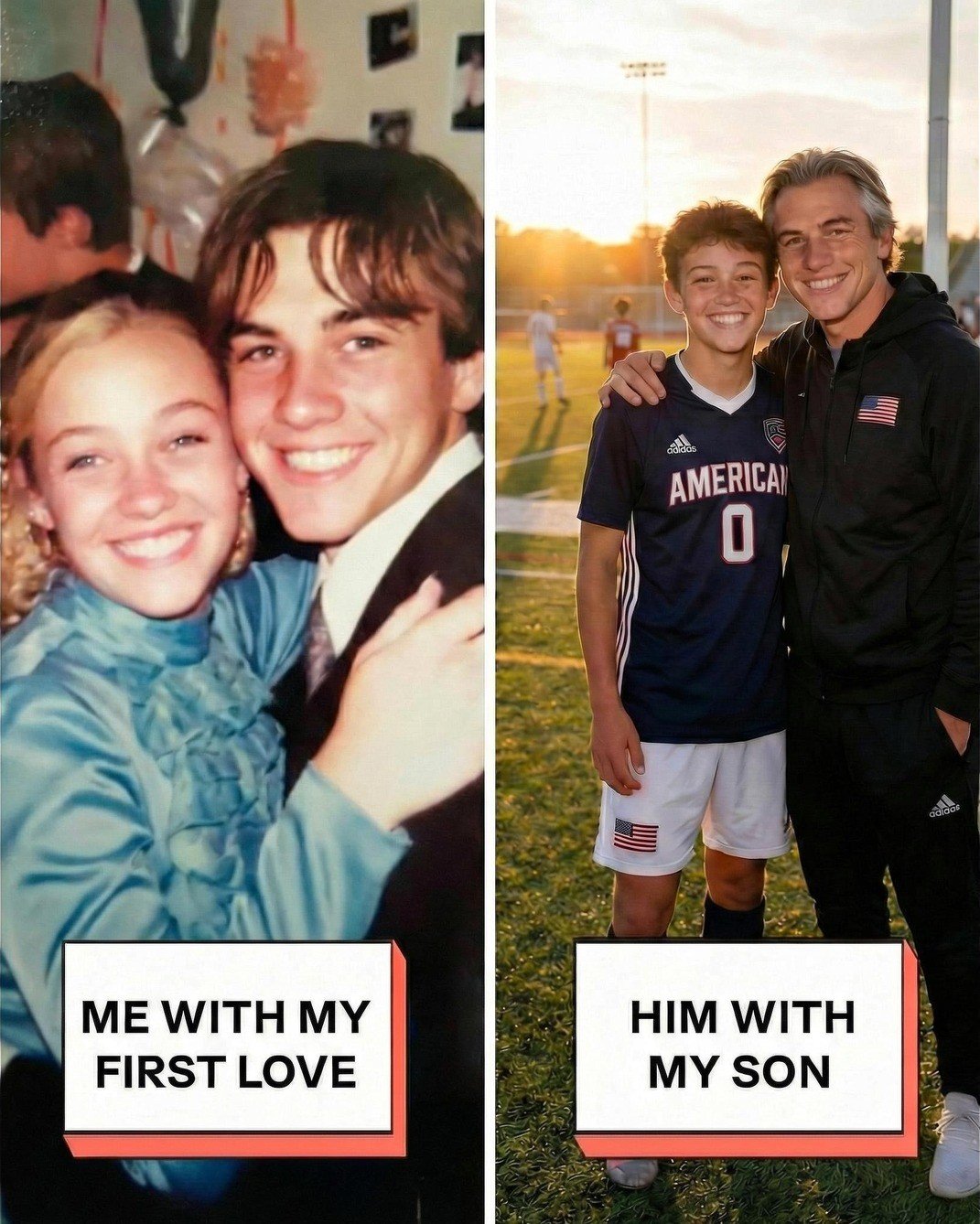
Charles Whitman. The name flooded back with such force it was almost physical. My first love. My high school sweetheart. The boy who had promised me forever and then vanished without a trace during the summer after graduation, sixteen years ago.
I sat frozen, unable to move, barely able to breathe. He looked older, of course—we both were. The boy I’d known had been lean and smooth-faced, full of youthful energy. The man before me was broader through the shoulders, his face more defined, with the first touches of gray at his temples.
But the way he moved, the gestures he made while talking to the players, the warmth in his expression—these were unmistakably Charles.
Memories crashed over me in waves. Late night phone calls that lasted until dawn. Study sessions in the library where we’d pretend to focus on homework but mostly just stole glances at each other. The way he’d hold my hand, his thumb tracing gentle circles on my palm.
The future we’d planned together, lying on a blanket under the stars, dreaming out loud about college and careers and the life we’d build side by side.
And then, without warning or explanation, he was gone. One day we were planning which colleges we might attend together, and the next, he’d left town.
His phone number was disconnected. His parents, when I finally worked up the courage to knock on their door, told me tersely that Charles had moved away and wouldn’t be returning. They wouldn’t tell me where he’d gone or why.
I was devastated. The pain was unlike anything I’d experienced before—sharp and consuming, the kind of heartbreak that makes you question everything you thought you knew about love and trust and the permanence of promises. I spent that entire summer in a fog of grief and confusion, replaying every conversation we’d had, searching for clues I’d missed, wondering what I’d done wrong.
Eventually, as summer turned to fall and I left for college, I forced myself to move forward. The hurt faded into something duller, a permanent scar rather than an open wound. I met other people, built a new life, tried to forget the boy who’d broken my heart by disappearing.
Years later, I met Daniel’s father. He was steady, reliable, present—everything Charles hadn’t been. We married quickly, perhaps too quickly. Had a beautiful son. Built what looked like a solid life from the outside. But looking back now, I wonder if I ever fully opened my heart to him the way I had with Charles. Maybe part of me had stayed closed, protected, unwilling to be that vulnerable again.
When Daniel’s father eventually left, walking away from our marriage and our son, it felt like a cruel echo of that earlier abandonment. History repeating itself in the most painful way.
And now here was Charles, sixteen years later, coaching my son’s soccer team.
I considered leaving immediately, slipping away before he noticed me, before this complicated past could intrude on Daniel’s present. But as I watched my son laugh at something Charles said, saw the easy rapport between them, I knew I couldn’t do that. Daniel’s happiness mattered more than my discomfort. This wasn’t about me and my old heartbreak. This was about my son and his healing.
So I stayed. I watched the entire game, my emotions churning between past and present. Daniel played beautifully, and Charles was everything my son had described—encouraging, attentive, fair, genuinely invested in each player’s growth. Whatever had happened between us years ago, he was clearly good at this, good with these kids, good for Daniel.
After the game, as parents filtered onto the field to congratulate their children, I hung back, hoping to avoid a direct encounter. But Daniel spotted me, his face lighting up with surprise and delight. “Mom! You came!” He ran over, sweaty and grinning, more animated than I’d seen him in years.
“I wouldn’t have missed it,” I said, hugging him tight. “You were wonderful out there.”
“Wait, you have to meet Coach,” Daniel said, already pulling me toward where Charles stood talking with other parents.
My heart hammered in my chest. There was no escape now.
“Coach! This is my mom,” Daniel announced proudly.
Charles turned toward us, and for just a second, I saw recognition flash across his face, followed by something that looked like shock, maybe even pain. But he recovered quickly, extending his hand with professional courtesy.
“It’s nice to meet you,” he said, his voice carefully neutral. “Daniel is a great kid. You should be very proud.”
I shook his hand, the brief contact sending an unexpected jolt through me. “Thank you for everything you’ve done for him,” I managed to say, keeping my voice steady. “He talks about you constantly.”
We stood there awkwardly for a moment, years of unspoken history filling the space between us, while Daniel beamed, oblivious to the tension. Other parents needed Charles’s attention, and I seized the opportunity to pull Daniel away, making excuses about errands we needed to run.
Over the following weeks, I continued to attend Daniel’s games and practices, determined not to let my past interfere with his present. Charles and I maintained a polite distance, our interactions brief and surface-level, focused entirely on Daniel and soccer. If he wanted to pretend we were strangers, I could play along. For Daniel’s sake, I could do anything.
Daniel continued to thrive. His confidence grew not just on the field but in other areas of his life. His grades improved. He made new friends. The withdrawn, hurting boy who’d emerged after his father left was gradually replaced by someone stronger, more resilient, more himself.
As a mother, watching this transformation was everything I’d hoped for. The gratitude I felt toward Charles was real, even as the confusion and old hurt simmered beneath the surface. Some nights, lying in bed, I’d find myself wondering about those lost years, about what might have been if he hadn’t left, if we’d followed through on all those starlit plans.
Then came the tournament weekend that changed everything.
It was a regional competition, and Daniel’s team had made it to the semifinals. The energy was electric, the stakes higher than any game they’d played before. I watched from the sidelines with other parents, all of us tense and excited, cheering for our kids.
The game was intense, both teams evenly matched. Daniel was playing particularly well, his skill and determination on full display. I felt such pride watching him, this young man who’d overcome so much.
Then, in the second half, it happened. Daniel and an opposing player went for the same ball. There was a collision, a tangle of legs, and Daniel went down hard. The sound he made—a cry of pain that no parent ever wants to hear—cut through all the other noise.
I was on the field before I even realized I was moving, my maternal instinct overriding everything else. Charles was already there, kneeling beside Daniel, his face creased with concern. Other coaches and the team medic rushed over.
Daniel’s face was pale, contorted with pain, tears streaming down his cheeks. “My knee,” he gasped. “Mom, something’s really wrong.”
The medic examined him carefully, asking questions, testing range of motion. The diagnosis, even before we got to the hospital, seemed clear—a serious knee injury, possibly torn ligaments, the kind of damage that requires extensive treatment and recovery.
The ambulance ride and emergency room visit passed in a blur of anxiety and forms and medical terminology. X-rays and MRIs confirmed what we feared. Daniel had suffered significant damage to his knee.
Surgery would be necessary. The recovery would be long and difficult. And competitive sports, at least at the level Daniel had been playing, were likely finished for him.
Watching my son process this news was heartbreaking. Soccer had given him back his joy, his confidence, his sense of purpose. And now it was being taken away. The unfairness of it made me want to scream at the universe. Hadn’t this child been through enough?
The days following the injury were among the hardest we’d faced. Daniel was angry, then depressed, cycling through grief for the loss of something he’d only just found. As his mother, I tried to stay strong for him, to remind him that he was more than just an athlete, that this setback didn’t define him. But my words felt hollow against his pain.
Charles visited the hospital the evening after the surgery. He brought the team’s signatures on a soccer ball and cards from all the players. More importantly, he sat with Daniel and talked to him not with empty platitudes, but with genuine understanding.
“I know this feels like the end of something important,” Charles said quietly. “And I won’t pretend it doesn’t hurt, because it does. But you’re going to get through this. You’re stronger than you know.”
Daniel, still groggy from medication, nodded slightly. “I was finally good at something,” he whispered.
“You’re good at lots of things,” Charles said. “Soccer just helped you see that about yourself. But that strength, that determination, that ability to work hard and improve—those are in you, not in the sport. You get to take those qualities anywhere you go.”
After Daniel drifted off to sleep, I walked Charles out to the hospital parking lot. The evening air was cool, and I wrapped my arms around myself, suddenly exhausted.
“Thank you,” I said. “For being here. For caring about him.”
Charles stopped walking and turned to face me. In the fluorescent glow of the parking lot lights, he looked tired, older, carrying his own weight of years.
“Can I talk to you?” he asked. “Really talk to you? There’s something I need to give you, something I should have given you a long time ago.”
My heart started beating faster. “Okay.”
He reached into his jacket pocket and pulled out an envelope, yellowed with age, my name written across the front in handwriting I recognized immediately—his handwriting from sixteen years ago.
“I’ve carried this for a very long time,” he said, his voice rough with emotion. “I think it’s time you finally read it.”
My hands trembled as I took the envelope. Inside was a folded piece of paper, and as I opened it, something small fell into my palm. A ring. Simple, delicate, with a small diamond that caught the light.
The letter was dated graduation day, sixteen years ago. I read it standing there in the parking lot while Charles waited, silent and still.
The words were a proposal. Charles had planned to ask me to marry him that day. Not immediately, of course, but as a promise for our future. He’d saved money from his part-time job for months to buy the ring. He’d written out everything he wanted to say about love and partnership and building a life together.
But there was more. Attached to the proposal was another letter, this one not in Charles’s handwriting. As I read it, my blood ran cold.
It was from my father.
The letter was brief and brutal. My father had discovered Charles’s plan somehow—perhaps Charles had asked for his blessing in the old-fashioned way. The response was clear: Charles was to leave town immediately, cut all contact with me, and never speak to me again. If he didn’t comply, my father would ensure he lost his college scholarship and would make certain I knew it was Charles’s fault, that Charles had sabotaged both our futures through his selfishness.
My father had believed, or claimed to believe, that marrying young would ruin my opportunities, that I needed to go to college unattached, to build a career, to experience life before settling down. He’d framed it as protection, as a father looking out for his daughter’s best interests.
So Charles had left. He’d sacrificed what we had because he thought it was the only way to protect my future. He’d carried this heartbreak and this secret for sixteen years, believing he’d done the right thing, the selfless thing.
I stood in that parking lot, the letters shaking in my hands, years of confusion suddenly making terrible sense. The abandonment I’d felt, the questions that haunted me, the belief that I’d been unworthy of explanation or closure—all of it had been orchestrated by someone I trusted most.
“I’m so sorry,” Charles said quietly. “I was young and scared, and your father was very convincing. He said you’d thank him someday, that you’d realize he saved you from making a mistake. I thought I was doing the right thing by stepping aside. I thought I was protecting you.”
Tears streamed down my face. Sixteen years of grief and anger and confusion poured out. “You should have told me. You should have let me choose.”
“I know,” he said, his own eyes wet. “I’ve regretted it every day since. But I was eighteen and terrified, and your father was so certain. I thought I was being noble. I thought I was giving you the future you deserved.”
We stood there in the fluorescent light, the weight of all those lost years between us. So much had happened. We’d become different people. We’d lived entire lives apart. And yet, holding those letters, feeling the anger toward my father and the grief for what might have been, I felt something shift inside me.
That night, after ensuring Daniel was settled and asleep, I drove to my father’s house. He answered the door surprised to see me so late, but his expression shifted when he saw my face.
“We need to talk,” I said, brushing past him into the living room where I’d grown up, where I’d spent countless hours as a child believing my father always had my best interests at heart.
I showed him the letters. Watched his face as he read his own words from sixteen years ago.
“You had no right,” I said, my voice shaking with anger I’d suppressed for too long. “You had no right to make that choice for me.”
My father sighed heavily, looking suddenly old and tired. “I was trying to protect you. You were so young, both of you. I knew if you tied yourself to him so early, you’d never pursue your education, never build your own career. You’d end up as just someone’s wife, all your potential wasted.”
“That was my decision to make,” I said. “You stole that choice from me. You let me believe he abandoned me, let me carry that hurt for years. And for what? Look how things turned out anyway. I married someone else, someone you approved of, and he left too. I ended up exactly where you feared, alone and raising a child by myself, except now I don’t even have the person who actually loved me.”
“I thought I was doing the right thing,” my father said, but his voice lacked conviction.
“You thought you knew better than me about my own life,” I said. “You thought your vision of what I should be was more important than what I wanted. You played God with my happiness, with Charles’s life, and you never once thought about the damage you were doing.”
The confrontation didn’t bring the satisfaction I’d imagined. My father was defensive, then apologetic, then defensive again. He couldn’t fully admit the magnitude of what he’d done, couldn’t truly see how his interference had shaped everything that came after.
By the time I left his house that night, I felt drained and sad, grieving not just for the past but for the relationship with my father that could never be the same.
The weeks following were complicated. Daniel’s recovery from surgery was slow and painful. He struggled with physical therapy and with the emotional adjustment of accepting his athletic dreams were over. Charles continued to visit, offering support and encouragement, his presence a comfort to my son during a difficult time.
Charles and I talked more during this period than we had in sixteen years. Not about us, not about what might have been, but about Daniel, about life, about the ways we’d both changed and grown. There was a gentleness between us now, a mutual understanding that came from shared pain and hard-won wisdom.
Then, unexpectedly, Daniel’s father reappeared.
He showed up at our door one evening without warning, looking nervous and contrite. He’d heard about Daniel’s injury through mutual acquaintances and wanted to see his son, he said. He talked about wanting to make amends, to rebuild the relationship he’d abandoned, to be part of our family again.
I listened to his words with a detachment that surprised me. Three years ago, when he first left, I would have done anything to hear him say these things. I’d blamed myself, wondered what I could have done differently, hoped desperately that he’d come back and make our family whole again.
But I’d learned something in the years since. I’d learned that you can’t build a solid relationship on the foundation of someone who’s already shown they’ll walk away when things get hard.
I’d learned that my son deserved better than a father who appeared and disappeared at his convenience. And I’d learned that sometimes the kindest thing you can do for yourself and your child is to close a door firmly rather than leave it perpetually ajar.
Daniel’s reaction to his father’s return was even clearer than mine. When his father came to his room to talk, trying to explain his absence with words that rang hollow and self-serving, Daniel listened quietly. Then, with a maturity beyond his fifteen years, he spoke his truth.
“You left when I needed you,” Daniel said, his voice steady despite the emotion behind it. “You didn’t call on my birthday. You didn’t check on me when I started struggling. You weren’t there for any of the hard parts. And now you show up because I got hurt and you feel guilty?”
His father tried to interrupt, to make excuses, but Daniel held up his hand.
“I’m not saying I hate you,” Daniel continued. “You’re my dad, and I guess some part of me will always love you because of that. But I don’t need you anymore. I needed you three years ago, and you chose to leave. Mom stayed. Coach helped me when I was struggling. Those are the people who showed up. Those are the people I trust.”
I’d never been more proud of my son than in that moment. He’d found his voice, his strength, his ability to set boundaries and protect himself. The injury that had seemed like such a devastating setback had somehow revealed just how much he’d grown.
After his father left that night—dejected but hopefully understanding—Daniel and I sat together in his room.
“Are you okay?” I asked.
He nodded. “Yeah. I think I am. It felt good to say what I needed to say.”
“You were very brave,” I told him.
“I learned from watching you,” he said simply. “You’ve been dealing with Dad leaving, with me being a mess, with everything, and you never gave up. You kept showing up even when it was hard. That’s what brave looks like.”
His words brought tears to my eyes. All those moments when I’d felt like I was failing, when I’d questioned whether I was doing enough or doing it right, and here was my son telling me he’d seen my strength all along.
The weeks turned into months. Daniel’s knee healed slowly. He wouldn’t be playing competitive soccer again, but he found other interests—photography, which let him stay connected to the team by documenting their games, and volunteering with younger kids, teaching them basic skills and discovering he had a talent for mentoring.
Charles and I continued our careful friendship, built on mutual respect and shared care for Daniel. We didn’t talk about what might have been or whether there was still something between us after all these years. The time wasn’t right, and maybe it never would be. We’d both learned that you can’t go backward, can’t reclaim lost time or undo the past.
But sometimes, watching Charles interact with Daniel or catching his eye across the soccer field, I felt something stir—possibility, perhaps, or simply the acknowledgment that the story isn’t always over when you think it is.
My relationship with my father remained strained. I’d forgiven him, or was working toward it, because holding onto anger was exhausting and ultimately hurt me more than him. But forgiveness didn’t mean forgetting or pretending the damage hadn’t been done. We saw each other less frequently, our conversations more guarded, both of us navigating a new dynamic where I no longer deferred to his judgment or sought his approval.
As I look back now on that unexpected reunion and all that followed, I’m struck by how much can change in a handful of months. Daniel, who’d been withdrawn and struggling, had found his strength and his voice.
I’d confronted painful truths about my past and made peace with doors that needed to close. And Charles, who’d been a ghost from my history, had become a real person again—complicated and flawed and genuinely kind.
Life doesn’t always give us the endings we expect or the closure we seek. Sometimes the people who leave come back, but not in the ways we imagined. Sometimes the healing we need comes from unexpected sources. And sometimes the most important thing we can do is simply show up, day after day, for the people who matter most, trusting that presence and persistence will eventually lead somewhere worth going.
Daniel’s happiness still matters more than anything else to me. Watching him navigate disappointment with grace, speak his truth with courage, and find new paths forward when old ones closed—that’s been the real gift of this entire journey. Not the reunion with Charles or the confrontation with my father, but witnessing my son’s resilience and growth.
Whatever comes next, I know we’ll face it together—Daniel and I, and maybe others too. The future isn’t written yet, and after spending so many years looking backward at what was lost, I’m finally ready to look forward at what might be found.