No One Came to My Graduation. Days Later, My Mom Asked Me for $2,100 for My Sister – So I Sent $1. Then the Police Showed Up
The University of Denver stadium looked unreal in the May sun, like somebody had turned the brightness up too high.
Heat shimmered off the metal railings. The sky was a hard, polished blue with not a cloud brave enough to interrupt it. Rows of graduates in navy gowns moved like a single living ribbon across the field, tassels swaying, programs fluttering. In the stands, families waved phones in the air like little beacons, trying to capture every second. The noise came in layers: cheers rising and falling, names called, music swelling, the occasional shriek of someone spotting their person.
I could feel my heartbeat in my throat as I shuffled forward in line, the diploma folder warm in my hands, the fabric of my gown sticking faintly to my forearms. My cap sat a little too snug, bobby pins biting into my scalp. The tassel brushed my cheek whenever I turned my head, soft and irritating.
I told myself I was fine. I told myself I was present. I told myself I was going to enjoy this.
Then the speaker boomed, the sound echoing off the stadium walls.
“Camila Elaine Reed, Master of Data Analytics, summa cum laude.”
For a second, my body forgot how to breathe.
That name was mine. It was the name I’d typed on grant applications and late-night lab reports and internship paperwork. It was the name I’d written in the corner of notebooks while my eyes blurred from exhaustion. It was the name I’d whispered to myself when I wanted to quit and didn’t.
I stepped onto the stage, smile ready, the kind you practice in mirrors so it looks natural. A photographer crouched near the edge, lens pointed up like a little mechanical eye.
And without thinking, without choosing, my gaze lifted toward the section I had reserved three months ago.
Family Reserved.
I had called the ticket office early, careful and polite, like politeness might guarantee love. I had paid for those seats myself. I had even sent my mother a screenshot with the row highlighted and a little message that said, I saved these so you wouldn’t have to look. You’ll be close.
Now the chairs stared back at me, empty and bright.
Not one person.
No mother in sunglasses waving too hard. No father leaning forward with his elbows on his knees. No teenage sister kicking her feet, bored but present. No familiar faces at all.
Just vacant plastic seats catching the sun and throwing it back in a glare that made my eyes water.
I kept smiling because the camera was still there.
I held the diploma folder too tightly. My fingers cramped around the edges. The muscles in my cheeks trembled from the strain, as if my face wanted to fall apart but had been trained not to.
Around me, joy burst like fireworks.
A graduate ahead of me jumped off the stage and ran straight into her father’s arms. I heard the smack of a kiss, loud and unembarrassed. Someone in the stands yelled a name that wasn’t mine with a kind of pride that felt like a warm blanket being wrapped around someone else. A woman nearby collapsed into a group hug so tight I could hear her grandmother sobbing, the sound raw and beautiful.
“I knew you could do it, baby,” the grandmother cried. “I always knew.”
I stood on the edge of that moment like a person watching through glass, wondering what it felt like to be someone’s reason for tears that sweet.
This wasn’t new, which was the worst part.
Hope had always been the most expensive thing in my life, and it always came with interest.
Four years earlier, my parents had skipped my undergraduate graduation at UC Boulder too.
I still remembered that morning with too much clarity. The early cold, the way the air smelled like damp grass and coffee. Me standing outside the stadium in my cap and gown at seven a.m., calling my mother because her car wasn’t anywhere in the lot.
“Where are you?” I’d asked, trying to make my voice casual, like I wasn’t already shrinking inside.
“Avery has finals,” my mother had said, as if this was obvious. I could hear my sister in the background, whining about mascara. “You understand, right? She’s only fourteen. High school matters.”
I had been twenty-two, graduating with honors, holding a computer science degree I earned while working fifty hours a week. I had studied while my coworkers at Target folded towels around me. I had done homework on breakroom tables. I had cried in library bathrooms when my brain felt too full.
And still, I’d swallowed the disappointment like bitter medicine.
“Of course, Mom,” I’d said. “I understand.”
They didn’t send a card. They didn’t call after. Three days later, I got a text.
Can you send $300? Avery needs new soccer cleats and the tournament fees are due tomorrow.
I had sent five hundred dollars.
Because that’s what good daughters did, I told myself. They understood. They took pressure off. They didn’t make family life harder. They didn’t demand attention.
That pattern didn’t start with college. It started long before I had words for it.
When I turned sixteen and got my first job at Starbucks, I thought I’d finally earned a small piece of independence. I loved the ritual of it: the hiss of steamed milk, the smell of espresso clinging to my hair, the steady rhythm of the morning rush. I liked that people needed me in a clear, uncomplicated way. Coffee order, name, smile, next.
My mother called it “little extras.”
Piano lessons for Avery.
Field trip money.
Dance class fees that always surfaced right after payday, timed so precisely it felt like someone watching my bank balance.
“You’re so responsible, Camila,” she’d say, voice warm, proud in a way I wanted to soak in. “Avery’s lucky to have a big sister like you.”
At first, it felt good. It felt like being useful meant being loved. It felt like I mattered because I could contribute.
I didn’t see the trap yet.
By eighteen, I was working two jobs. Starbucks at dawn, Target until close. Community college classes squeezed in between shifts. I learned how to nap in fifteen-minute pieces. I learned how to study with fluorescent lights buzzing above me. I learned how to smile at customers even when my feet felt like they were splitting open.
The requests shifted from “extras” to “needs.”
“Just two hundred for Avery’s birthday party. Nothing fancy.”
“Can you cover the car insurance this month? Your dad’s hours got cut.”
“The homecoming dress is four hundred, but you know how important these moments are. She’ll remember this forever.”
I remember standing in my bedroom with my laptop open, calculating hours. I remember subtracting grocery money from rent money from gas money. I remember telling myself it was temporary, that I’d catch up later.
Avery caught up just fine.
She had everything. Clothes that fit. Shoes that didn’t have holes. A social life with pictures. A childhood with events and memories and trips. I had a life that was mostly work.
When I got accepted to UC Boulder with a partial scholarship, I thought, for one bright moment, that maybe my mother would be proud in a way she couldn’t hide.
“That’s wonderful, honey,” she’d said, voice bright for a breath. Then the pivot came, as clean as a practiced move. “By the way, can you help with Avery’s braces? The orthodontist says she needs them immediately. Insurance won’t cover the ceramic ones she wants. It’s three thousand.”
Three thousand.
I remember staring at the wall after that call, listening to the silence in my room as if the room might have an opinion.
I took out loans to cover what the scholarship didn’t.
Then I took out more loans to send money home.
I told myself it was an investment in the family. That this was what families did. That my turn would come.
It didn’t.
When I got accepted to the University of Denver’s data analytics master’s program, one of the top programs in the country, something inside me tried to bloom again. This time was bigger. This time was harder. This time, surely, it meant something.
My mother congratulated me for three seconds.
Then she asked, “Will you still be able to help with Avery’s college fund? We’re trying to save five hundred a month and with your father’s situation…”
I should have said no. I should have said, Mom, I can’t. I’m taking on more tuition. I’m already carrying loans. I’m drowning.
Instead, I said, “I’ll figure it out.”
I always figured it out.
I picked up weekend shifts doing data entry. I took freelance projects building small databases for local businesses. I did tutoring sessions online. I took any work I could manage without collapsing. There were weeks I felt like a machine built to output results and money, nothing else.
During those two brutal years, I sent home about fifteen thousand dollars.
I know the number because I tracked it in a private spreadsheet. It started as a way to keep organized, then became something else. A secret ledger of love given. Every transaction labeled and dated like evidence.
Avery needs a new laptop for AP classes. $1,200.
Family vacation, Avery needs memories before college. $800.
Application fees and campus visits. $600.
Every time, I told myself it was the last time. Every time, I pressed send anyway because being called selfish felt like a worse wound than being broke.
I set one boundary, small and quiet.
I didn’t tell them what I really earned from freelance work or my graduate assistant position. I opened a separate bank account they didn’t know about. I called it my emergency fund.
If I’m being honest, it felt more like an escape fund every time I added to it.
When I defended my thesis, my advisor called it publication-worthy. She shook my hand and smiled at me the way I’d seen mentors smile at their protégés, like they were genuinely impressed.
I called home anyway, still foolish enough to want to share it.
“That’s great, honey,” my mother said, distracted, traffic noise blaring. “Listen, I can’t talk right now, but Avery’s Sweet Sixteen is coming up. We’re planning something really special. I’ll need to talk to you about helping.”
Not I’m proud of you.
Not tell me about it.
Not we’ll come to your graduation.
Just the next request, already lined up like a bill waiting on the counter.
Even then, part of me hoped.
So, on graduation day, I made sure my phone was charged. I sent reminders. I told them where to park. I told Avery she could borrow my fancy lipstick if she wanted to take pictures. I pictured them waving from the stands.
Then my name was called.
And the seats were empty.
After the ceremony, the stadium emptied slowly. Heat rose from the concrete. The smell of sunscreen and flowers hung in the air. Graduates clumped together for pictures. Families crowded around, holding balloons, passing out water bottles, fussing with tassels.
I lingered near the courtyard fountain, scrolling on my phone to look busy. To look like I was waiting for someone who was simply delayed, not someone who never came.
Ruby Chen found me there.
“Camila!” she squealed, throwing her arms around me. She smelled like shampoo and sunshine and relief. “We did it. We actually did it. I swear Statistics Three almost ended me.”
I laughed, because Ruby’s joy was contagious, because she deserved it, because laughter was easier than admitting my chest felt hollow.
Her parents appeared behind her like a scene from a movie. Her mother held an armful of flowers, roses and lilies spilling over. Her father’s face was bright with pride, the kind that makes people look younger.
He stepped toward me and said, “You’re Camila, right? Ruby talks about you constantly. We have to get photos.”
He handed his phone to someone and insisted on taking pictures of Ruby and me together. He positioned us like we were both equally important. Like my achievement mattered.
Ruby scanned the thinning crowd. “Where’s your family? Are they still looking for parking?”
“Yeah,” I lied smoothly. It didn’t even hurt to lie anymore. It was muscle memory. “Traffic from Littleton is probably terrible.”
Ruby’s mother looked at me for a moment. Her eyes were kind, and they held a softness that felt like someone seeing straight through my words and deciding to be gentle anyway.
“Well,” she said, squeezing my shoulder, “we’re claiming you until they arrive. Let’s get dinner. Our treat. No arguments.”
My throat tightened. I made excuses about meeting my family at a restaurant, said I didn’t want to keep Ruby from her celebration. I hugged them goodbye and walked to the parking lot.
The sun had started to sink behind the mountains, turning the edges of the world gold.
My beat-up 2012 Honda Civic sat in the far corner, away from the shiny SUVs with balloons and “Congrats” painted on the windows. I climbed in, closed the door, and sat.
I didn’t start the engine.
I just sat there with both hands on the steering wheel, staring at the empty space in front of me.
For one brief moment, I let myself imagine it anyway.
My mother waving, camera in hand, grinning.
My father holding flowers, looking at me like he was actually proud.
Avery bouncing with excitement, happy for me instead of annoyed that attention wasn’t on her.
It lasted maybe three seconds before it shattered under the sound of car doors slamming and laughter echoing across the lot, everyone going somewhere to celebrate someone they loved.
I drove home in silence with the diploma on the passenger seat like a quiet witness. I didn’t cry. Crying had never changed anything. It only made my face puffy and made other people uncomfortable, and somehow their discomfort always became my responsibility.
Three days later, I sat at my small kitchen table in my studio apartment, updating my resume and applying for data analytics roles. My laptop fan hummed softly, warming my wrists. A mug of coffee sat near my elbow, growing cold.
My phone buzzed.
Mom: Need $2,100 for your sister’s Sweet 16. Can you Venmo it by Friday? The venue needs the deposit.
No how was graduation.
No congratulations.
No apology.
Just a number, a deadline, and the familiar expectation that I would comply.
I stared at the message until the screen dimmed. Then I tapped it awake and read it again.
Something rose in me that felt like anger, yes, but also something clearer.
Like stepping out of a fog and realizing the fog had been there on purpose.
For the first time in my life, the story rearranged itself.
I wasn’t their daughter in the way I had always tried to be.
I was their emergency plan. Their buffer. Their hidden budget line.
I opened my banking app with hands that shook only slightly.
$3,247.89.
Money I’d scraped together from freelance work, skipped dinners, and the quiet refusal to tell them everything. It represented so many nights of choosing survival over softness.
I opened Venmo.
Typed my mother’s username.
Entered $1.00.
In the note field, I wrote: Congrats on the Sweet 16. This is all you’re getting from me. Ever.
My finger hovered for a second, then pressed send.
The moment after was oddly quiet.
My studio was still. The hum of my fridge. A car passing outside. The faint rustle of leaves against the window screen.
Then my phone buzzed again.
Mom: Is this a joke? Camila, I’m serious. We need that money. The venue deposit is due tomorrow. Stop playing around.
I inhaled slowly and typed:
I’m serious too. I just graduated with a master’s degree. You didn’t show up. You didn’t call. You didn’t even send a text. The only time I hear from you is when you want money. That ends today.
Her reply came fast, sharp.
How dare you. After everything we’ve done for you. We raised you. Fed you. Clothed you. And this is how you repay us? By abandoning your sister on her special day?
My fingers didn’t pause this time.
I’ve been repaying you since I was sixteen. I’m twenty-six. I’m done.
She called immediately. I declined. She called again. Declined. Then the texts poured in.
Selfish.
Ungrateful.
Think about your sister.
Family helps family.
You’ll regret this when you need us.
That last one made me laugh out loud in my empty apartment.
Need them.
I thought about needing them at sixteen, when my back ached from early shifts and my mother still asked for money like it was normal.
Needing them at eighteen, when I was balancing jobs and classes and still sending cash home.
Needing them three days ago, when I walked across a stage and the only thing waiting for me was sunlight on empty seats.
They had never shown up when I needed them.
So I did something I should have done years ago.
I went to the drawer by my front door and took out the spare key my mother had insisted on keeping “for emergencies.”
I dropped it into the trash.
Then I called a locksmith.
He arrived within an hour, an older man with salt-and-pepper hair and calm hands. He worked efficiently, the metallic clink of tools oddly soothing.
“Upgrading security?” he asked lightly as he installed the deadbolt.
“Something like that,” I said. “Peace of mind.”
He nodded as if he understood more than I was saying. “Good lock,” he said when he finished, testing it. “This one holds. If someone tries to force it, they’ll make a lot of noise.”
When he handed me three new keys, I stood there and tested the lock again and again.
Click.
Solid.
Final.
For the first time in my life, I had a boundary that didn’t rely on my mother’s mood.
That night, I slept better than I had in years.
The next morning, sunlight streamed through my small window. I made coffee. I opened the window and let in Denver’s cool May air. I sat at my table without reaching for my phone.
I breathed.
For a few quiet minutes, I felt almost free.
Then came the knocking.
Firm. Rhythmic. Persistent.
The kind of knocking that doesn’t ask, but expects an answer.
My stomach tightened as I stood and walked to the door.
I looked through the peephole.
Two uniformed officers stood in the hallway, faces professional and neutral.
My hand stayed on the doorknob for a second, fingers cold against the metal.
Then I unlocked it.
The door opened with a soft click that sounded far too loud in the narrow hallway.
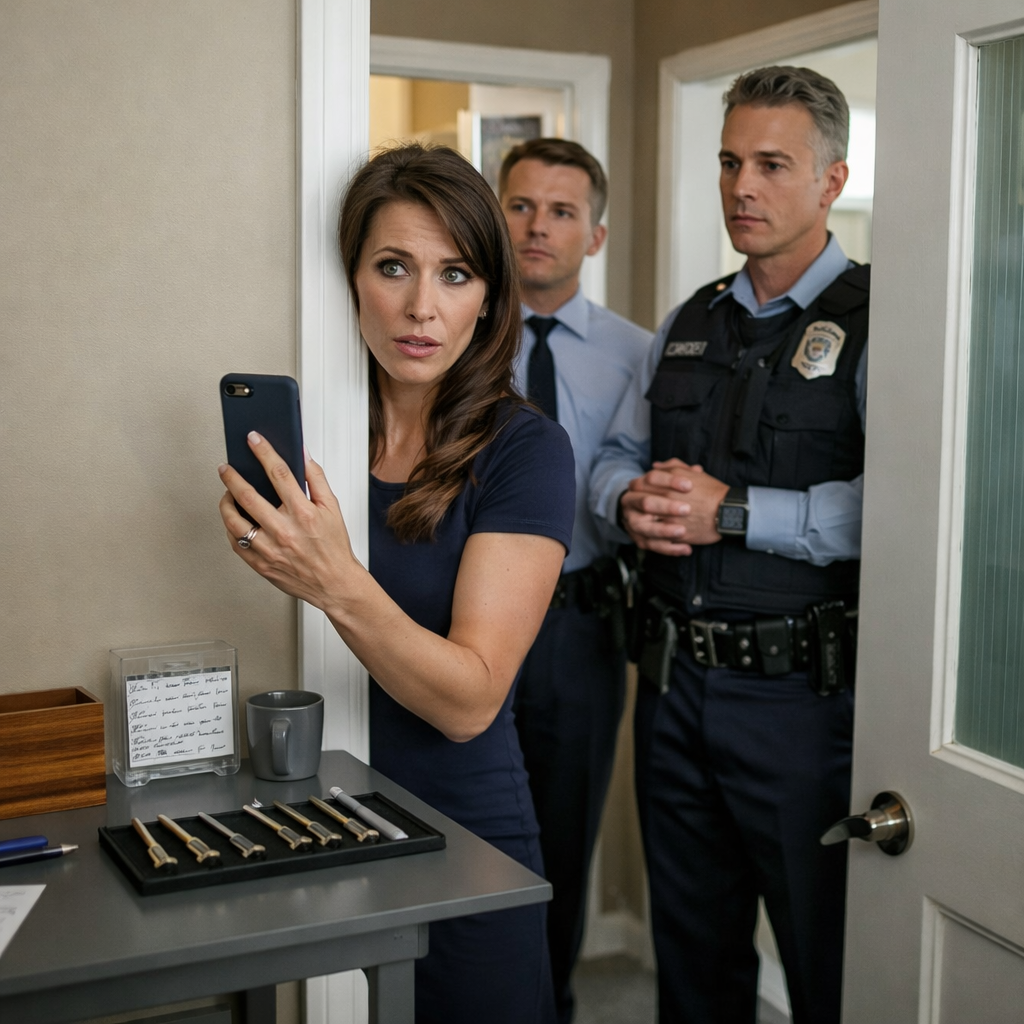
Two Denver police officers stood just outside my apartment. Their uniforms were crisp, their posture neutral, the kind of calm that immediately made my pulse spike because it meant something official. The taller one, a Black man in his thirties with a neatly trimmed beard, gave a polite nod. The second officer, a woman with sharp eyes and her hair pulled back tight, scanned the doorway without trying to hide it.
“Are you Camila Reed?” the taller officer asked.
“Yes,” I said, my throat suddenly dry. “Is something wrong?”
“We received a request for a welfare check,” he said evenly. “From your mother, Linda Reed.”
For a moment, the words didn’t land.
A welfare check.
I blinked at him. “A welfare check?”
“She told dispatch she was concerned about your mental state,” the female officer added, her tone careful but firm. “She reported that you’d been acting erratically, changed your locks without notifying her, stopped responding to calls, and she was worried you might be a danger to yourself.”
The audacity hit me like a delayed shockwave.
My own mother had called the police and told them I was unstable because I said no.
I felt heat rush to my face, a mix of anger and disbelief so sharp it almost made me dizzy. “She called the police,” I repeated, slower now, like saying it again might make it make sense. “Because I changed the locks on my apartment. That I pay for. By myself.”
The taller officer held up a placating hand. “We understand this can feel invasive. But when someone requests a welfare check, we’re required to follow up.”
“May we come in?” the female officer asked. “We just need to verify that you’re safe and not in immediate distress.”
I stepped aside without arguing. There was nothing to hide.
They walked into my studio apartment, their boots quiet against the laminate floor. The space was small but orderly. My laptop sat open on the kitchen table with job applications pulled up. A legal pad beside it held a neat list of companies and follow-up dates. My diploma hung on the wall in a simple black frame, still smelling faintly of fresh wood. A couple of plants leaned toward the sunlight at the window, green and alive.
The female officer’s gaze moved slowly, taking it all in. She glanced at the diploma, then at me.
“You just finished graduate school?” she asked.
“Yes,” I said. “Three days ago.”
“Congratulations,” she said, and there was no trace of sarcasm in it. Just plain, human acknowledgment.
“Thank you.”
The taller officer took out a small notebook. “We need to ask a few questions. Are you currently feeling depressed or overwhelmed?”
“I’m stressed,” I said honestly. “But not in a way that puts me in danger.”
“Any thoughts about harming yourself or anyone else?”
“No.”
“Any history of mental health crises we should be aware of?”
“No.”
“Are you employed?”
“I’m actively job hunting. I have interviews scheduled. I also do freelance work.”
He nodded, jotting something down. “And can you tell us why your mother believes you’re unstable?”
I let out a slow breath and decided there was no point in minimizing it anymore.
“Because I set a boundary,” I said. “She asked me for twenty-one hundred dollars for my sister’s birthday party. I said no. I sent her one dollar instead. Then I changed my locks because she had a spare key and I wanted privacy. That’s it.”
The female officer’s eyebrows lifted just slightly. Not in surprise. In recognition.
“That happens,” she said quietly.
The male officer looked at her, then back at me. “How often does your mother ask you for money?”
“Constantly,” I said. “Since I was sixteen.”
“And when you say no?”
“She guilt-trips me. Threatens me. And now apparently calls the police.”
The room fell silent for a beat.
The female officer asked, “Has she ever used official channels like this before to try to get you to comply?”
“No. This is new.”
She nodded slowly. “That escalation is pretty common when someone realizes they’re losing control.”
The taller officer closed his notebook. “We’re going to document this as a completed welfare check with no concerns found. You’re clearly oriented, stable, and functioning.”
He handed me a card with a case number written on it. “If she calls again and requests another welfare check, reference this number. Multiple unfounded reports can lead to consequences for misuse of emergency services.”
The female officer lingered near the door. “Miss Reed,” she said gently, “setting boundaries can provoke extreme reactions from people who benefit from crossing them. Don’t let this make you doubt yourself.”
After they left, the hallway felt too quiet.
I closed the door and locked it, leaning my forehead against the wood for a moment. My hands were shaking now, the adrenaline finally catching up. My mother hadn’t just ignored my achievement or demanded money. She had tried to brand me as unstable. Dangerous. Someone who couldn’t be trusted with her own life.
That was the moment something shifted permanently.
If she was willing to do this, there was no line she wouldn’t cross.
The next morning, I woke with a knot in my stomach that coffee didn’t touch. The apartment felt normal, but something inside me buzzed with unease. On impulse, I opened my laptop and logged into my credit monitoring account, a habit left over from a data breach years ago.
The page loaded.
Then my vision tunneled.
Two new credit inquiries glared back at me.
Capital One. Discover.
Both dated three weeks earlier.
Both tied to my name and Social Security number.
But the address listed wasn’t mine.
It was my parents’ house in Littleton.
My fingers went numb as I clicked deeper into the report. Two new credit card accounts. Both opened within the last month. Both already carrying balances.
Capital One: $1,847.
Discover: $1,293.
My breathing went shallow.
I clicked into the transaction details, dread settling into my bones with each line item.
Cherry Creek Events Center.
Platinum DJ Services.
Glam Studio Makeup & Hair.
Custom cake bakery.
Party supply rentals.
Floral arrangements.
Every single charge was for Avery’s Sweet Sixteen.
My mother’s text replayed in my head with sickening clarity.
Need $2,100 for your sister’s Sweet 16.
It hadn’t been a request.
It had been a bill.
I grabbed my phone and called Capital One, my hands shaking so badly I had to switch to speaker.
“Capital One Fraud Department, this is Marcus. How can I help you today?”
“My name is Camila Reed,” I said, forcing my voice to stay steady. “I need to report identity theft. Someone opened an account in my name without my permission.”
There was a pause while he pulled up the file. “I see the account was opened at our Littleton branch. The co-applicant listed is Linda M. Reed. Is that a family member?”
“Yes,” I whispered. “She’s my mother. And I never authorized this.”
The tone of the call shifted immediately.
“I’m flagging this as potential fraud,” Marcus said. “The account is frozen effective immediately. You’ll receive dispute documentation within twenty-four hours.”
I repeated the process with Discover. Same outcome. Same quiet shock on the other end of the line.
When the calls ended, I sat at my kitchen table and stared at my hands.
She hadn’t just asked me for money.
She had stolen my identity.
She had forged my signature.
She had committed a felony to throw a party.
I called her.
I started recording before she answered.
She picked up on the third ring. “So you’re alive,” she said sharply. “The police said you were fine. Just being dramatic, as usual.”
“Mom,” I said, my voice low and controlled, “there are two credit cards in my name. Capital One and Discover. Both used to pay for Avery’s party. Do you want to explain that?”
Silence.
Then a dismissive sigh. “Oh, that. I was helping you.”
“Helping me how?”
“You’re young. You need to build credit. This was doing you a favor. And Avery needed the party.”
“You opened accounts without my permission,” I said. “That’s identity theft.”
She laughed. “Don’t be ridiculous. You’re my daughter. What’s yours is mine. That’s how family works.”
“No,” I said. “What you did is a felony.”
“You’re overreacting,” she snapped. “I did this for the family. For Avery. She deserves one nice thing.”
“I paid for my education,” I said. “With loans I’m still paying off. With jobs I worked while you kept asking for money. And now you’ve stolen my identity. This ends today.”
Her voice went cold. “If you do this, you’ll destroy this family.”
“You destroyed it,” I said quietly. “I’m just reporting the damage.”
I ended the call and saved the recording.
Within a week, both banks confirmed fraud. The handwriting didn’t match mine. Security footage showed my mother at the branch. The evidence was airtight.
When Capital One asked if I was willing to cooperate with prosecution, I said yes without hesitation.
That was when the police stopped knocking politely.
And that was when my mother realized one dollar had cost her far more than twenty-one hundred.
The call from Capital One came on a Wednesday afternoon while I was eating leftover pasta straight from the container, standing at my kitchen counter in sweatpants.
I almost ignored it.
Something in me was tired of phones, tired of conversations that shifted my life sideways without warning. But I answered anyway.
“Miss Reed,” the representative said, her voice calm and practiced, “we’ve completed our preliminary investigation.”
I leaned my hip against the counter, suddenly unable to stand upright. “Okay.”
“The account was opened in person at our Littleton branch. The identification used does not match your signature on file. Security footage confirms the individual was not you.”
I closed my eyes.
“We’ve flagged the account as confirmed fraud,” she continued. “You will not be held responsible for any charges. We’ve also notified law enforcement. For the case to proceed, we’ll need your cooperation. Are you willing to press charges?”
I didn’t hesitate.
“Yes.”
There was a pause, the kind that carries weight even through a phone line. “I understand this is difficult when it involves a family member. But you’re doing the right thing.”
After I hung up, I sat down at the table and stared at the wall for a long time. I wasn’t shaking anymore. I wasn’t crying. What I felt was a strange, hollow steadiness, like something heavy had finally been set down after years of carrying it.
The Discover call followed the same pattern. Same evidence. Same conclusion. Same question.
“Yes,” I said again.
Two days later, a detective from the Littleton Police Department called to schedule an interview. He was professional, neutral, almost gentle. He asked me to walk through my relationship with my mother, the history of financial requests, the text messages, the recorded call.
“Do you have documentation showing you didn’t authorize these accounts?” he asked.
“I have everything,” I said. “Texts. Bank records. The recording where she admits she opened them.”
“That helps,” he replied. “A lot.”
When I hung up, I finally let myself cry. Not loud, not dramatic. Just tears sliding down my face while I sat on the floor with my back against the couch, arms wrapped around my knees. It wasn’t grief for my mother. It was grief for the version of her I’d kept hoping existed. The one who would show up. The one who would be proud without asking for something in return.
That version had never been real.
The legal process moved faster than I expected.
My mother was charged with identity theft, a class four felony in Colorado. Faced with clear evidence, she didn’t try to fight it. She took a plea deal. Probation. Restitution. Mandatory financial counseling. Community service.
I didn’t go to the hearing.
I didn’t need to see her standing there, looking small or angry or betrayed. I’d spent my entire life watching her frame herself as the victim in stories where she was the one holding the knife. I didn’t need one more image burned into my memory.
What I did see was the fallout.
Her employer, a small accounting firm, terminated her quietly but firmly for ethical violations. Her name disappeared from the website. Her phone number stopped being answered. People she’d known for years stopped inviting her to things.
Someone posted a video of police cars outside their house on the night of Avery’s Sweet Sixteen. It spread through their suburban Facebook groups like a brush fire. The comments were brutal. Speculation. Judgment. Distance.
The party still happened, but the pictures stopped appearing online. Avery’s social circle thinned. Her college applications suddenly came with explanations attached, whispers following her into interviews.
I felt bad for her.
Not bad enough to undo what I’d done. But bad in a quiet, human way.
She was sixteen. She had grown up watching our parents take from me and call it love. She hadn’t asked to be the golden child. She’d just been handed the benefits of a system I’d paid for.
A year passed.
I moved into a one-bedroom apartment with a view of the mountains. I worked remotely for a data analytics firm that valued my skills and paid me fairly. Ninety-one thousand dollars a year. Benefits. Respect. A calendar that belonged to me.
On my wall hung my diploma, my first performance award from work, and a photo from Ruby’s wedding. I stood between Ruby and her parents in that picture, all three of them smiling like I belonged there.
Because I did.
The old lock from my studio apartment sat on a shelf, heavy and useless now, a reminder of the first boundary I’d ever enforced without apologizing.
My mother sent one final letter.
Inside was a check for the full restitution amount. No note. No apology. Just money.
I deposited it, paid down my student loans, and donated the same amount to a nonprofit that helps young adults escape financial abuse from family members. It felt like closing a loop.
In therapy, Dr. Morrison helped me put words to what I’d lived.
“You weren’t their daughter,” she said gently. “You were their resource. Stepping away doesn’t make you cruel. It makes you free.”
On the one-year anniversary of my graduation, I took myself out to dinner. White tablecloth. Expensive wine. No rushing. No guilt.
The server asked if I was celebrating something.
I smiled. “Yeah. Freedom.”
That night, no one texted me. No one called. No one asked for anything.
And for the first time in my life, the silence felt like peace.
Because I finally understood this.
The only person who had to show up for me was me.
And I did.
Front row. Standing ovation. Loud enough to hear myself at last.