My Son Begged Me Not To Leave Him At Grandma’s, And I Still Drove Away
The sun sat low and hard in the sky, the kind of late afternoon light that turned every speck of dust on the windshield into a tiny, glaring flaw. It poured through the glass like a spotlight. William Edwards kept his eyes on the road, but it felt as if the day itself was watching him, judging him, waiting for him to make a mistake.
From the back seat came the raw, uneven sound of a child trying to breathe through panic.
“Daddy,” Owen cried, the word breaking apart around a sob. “Daddy, please. Please don’t leave me there.”
William tightened his grip on the steering wheel until his fingers ached. The leather felt slick beneath his palms. He could feel the pulse in his wrists, the faint tremor that came when his body wanted to do something his mind was still arguing against.
Beside him, Marsha sat with her shoulders squared, chin lifted. She wore sunglasses even though the sun was to her side. Her mouth was a thin line, her posture so rigid it was almost theatrical.
Owen’s feet kicked the back of William’s seat in frantic little taps, as if he could kick his way out of what was coming.
“I’ll be good,” Owen pleaded. “I promise I’ll be so good. I won’t cry, I won’t… I won’t do anything. Please don’t leave me at Grandma’s.”
William glanced in the rearview mirror.
Owen’s face was crumpled and blotchy, tears dragging tracks down his cheeks. His nose ran. His small hands were clenched into fists so tight his knuckles looked pale. His whole body seemed to fold inward, like he was trying to disappear into the car seat.
William’s chest tightened so sharply it stole a breath. He had spent years teaching students how to recognize distress, how to hear what wasn’t being said, how to see fear not as misbehavior but as information. And yet his own son was in the back seat, begging with a desperation that didn’t belong in a five-year-old’s voice.
William looked to Marsha, hoping, still hoping, to find a crack of softness in her expression. A flicker of hesitation. Something that said she heard it too.
Marsha’s lip curled.
“Stop babying him,” she snapped, as if Owen’s fear was an annoying song stuck in her head. “He cries because you let him. He needs to toughen up. My mother will straighten him out for the weekend. God knows you never will.”
The words landed with a familiar sting. William had heard versions of them for months. Maybe longer. It was always the same argument in different clothing: William was too gentle, too cautious, too easily manipulated by a child’s tears.
But this time the tears were not a tantrum. This time, Owen sounded like a cornered animal.
“Mommy,” Owen choked. “Please tell Daddy no. Please.”
Marsha turned her head just enough to look over her shoulder, her sunglasses reflecting Owen’s small face back at him like a cold mirror.
“Enough,” she said. “You are going. And you are going to stop acting like this.”
Owen’s sobs sharpened into a thin, high sound. William felt it in his bones. His stomach churned, and the road ahead wavered for a moment, blurred by the sudden burn behind his eyes.
He forced his voice to stay steady. “Owen, buddy, we talked about this. It’s just two days.”
Owen’s breath hitched. “But Grandma scares me.”
The words were small, almost whispered, as if saying them out loud might make them real.
William’s throat tightened. He had tried to tell himself the same things over and over: it was only a weekend, Sue was strict but not dangerous, Marsha was the one being dramatic, he was the one being overly protective because of his own history. He had said it so many times he could recite it like a prayer.
But the truth was, every time Owen had gone to Sue’s, he had come back different. Quieter. Watchful. Jumpier. Like a child listening for footsteps.
William swallowed. “What do you mean she scares you, buddy?”
Owen’s eyes darted toward Marsha, then back down to his lap as if the question itself was forbidden.
Marsha’s jaw set. “Don’t start interrogating him. You always do this. You make everything into a big psychological experiment.”
William flinched at the accusation, even though he should have been immune to it by now. He’d been a psychology instructor at a community college for most of his adult life. He taught childhood development. He spent his weekends and evenings buried in research on trauma responses in children, the ways fear could get under the skin and live there, shaping the body and mind long after the danger was gone.
His colleagues teased him for his focus. Obsessive, they called it. William didn’t mind. He had grown up in foster care, bouncing from home to home where kindness was uncertain and cruelty was common enough to become background noise. He had learned early that adults could smile at you while hurting you, that safety was not guaranteed by a roof and a warm meal.
He had promised himself he would never let his child grow up with that kind of fear.
And yet here he was, driving Owen toward it.
Marsha’s voice cut in again, sharp and impatient. “He’s acting like this because you’ve taught him it works. Watch. The minute you stop reacting, he’ll stop doing it.”
Owen’s crying didn’t stop. It deepened, as if something in him understood his father’s hesitation and was clinging to it with both hands.
“Daddy,” Owen said again, and the word sounded like it hurt to say. “Please don’t.”
William’s heart beat so hard he could feel it in his throat. He tried to picture Sue Melton’s house and tell himself it was just a place. A normal house in a normal neighborhood. But the image that came to mind was Sue’s face, her eyes like flint, the way she spoke to Owen like he was a recruit who needed breaking.
Sue Melton, retired military nurse, sixty-eight years old and still carrying herself like a drill sergeant. The sort of woman who used the word discipline as if it were holy.
William had met Marsha seven years ago in a classroom. She had been sitting in the back row, auditing his course on childhood development. He remembered thinking she was confident. Independent. Magnetic. She had asked pointed questions, argued with him in a way that felt lively rather than hostile. He had mistaken her sharpness for strength and her detachment for composure.
He didn’t realize how quickly that composure could turn into cruelty until later, after the wedding, after the pregnancy, after the life they’d built together was too tangled to step out of cleanly.
Now, in the front seat of the car, her presence felt like a wall.
Owen’s sobs broke into hiccupping gasps. “I’ll be good. I promise. I’ll be good forever.”
William’s throat stung. “Owen, you don’t have to be good forever. You’re already good.”
Marsha let out an exasperated sound. “See? Listen to you. You make him think crying gets him rewarded. Stop.”
Owen suddenly unbuckled his seat belt.
William’s eyes flicked to the mirror and widened. “Owen, no, buddy. Buckle back up.”
Owen scrambled forward in a burst of desperate movement. His little hands reached out, grabbing at William’s shoulder, his fingers digging through the fabric of his shirt.
“Daddy, please,” Owen cried, his breath hot and wet against William’s neck. “Please don’t make me go. Please.”
The car drifted an inch toward the line before William corrected it. He felt his pulse spike, his brain firing warnings in every direction.
Marsha twisted around with a sudden, angry motion. Her hand shot out and clamped around Owen’s wrist.
Owen yelped. A sharp, startled sound.
“Sit down,” Marsha hissed, her voice low and deadly. “Now.”
William’s stomach dropped. “Marsha,” he said, and there was a warning in his voice he rarely used. “Let go.”
Marsha released Owen’s wrist, but the damage was done. Red marks bloomed on Owen’s skin like finger-shaped bruises waiting to happen.
Owen collapsed back into his car seat. His crying changed then, softening into something exhausted and defeated. His small shoulders shook, but the sound was quieter, as if he’d learned that louder didn’t mean safer.
William swallowed hard. He couldn’t stop staring at those red marks. His mind, trained to notice patterns, to track behavior, to connect dots, began to spin too fast.
This was not normal. None of this was normal.
But he had been backing down for months. Maybe longer. Giving in because the fights with Marsha left him drained and hollow. Giving in because she knew exactly how to twist his own past against him.
You’re paranoid because you grew up damaged, she’d say.
You’re projecting, she’d say.
You’re controlling, she’d say.
You’re smothering him, she’d say.
And sometimes, in the quiet after she said it, William wondered if she was right.
They drove in tense silence for the last stretch. The suburbs of Hartford slid by, neat lawns and winter-bare trees, driveways dotted with cars. The world outside the window looked calm, ordinary, safe.
Owen pressed his face to the glass, tears still moving, but his mouth clenched shut, as if he didn’t dare speak again.
William’s hands were damp on the steering wheel.
When they finally pulled up to Sue Melton’s house, William’s stomach tightened so violently he thought he might be sick.
The house was a tired colonial with peeling paint, but the yard was kept with almost frightening precision. The grass was trimmed. The shrubs were shaped. The walkway was swept clean. It had the feel of a place where mess was not tolerated.
Sue stood on the porch, arms crossed, gray hair pulled back tight. She had the posture of someone who had spent her life ordering others to move.
Even from the car, William could feel her disapproval like heat.
Owen went still. Not calm, not relaxed, but frozen. His face remained turned toward the window. Tears slid silently down his cheeks.
William killed the engine. The sudden quiet in the car felt loud.
Marsha was already reaching for the door handle. “Finally,” she muttered, as if arriving here was relief.
William’s voice came out rough. “Marsha, maybe we should talk about this.”
Marsha shot him a look that made his words shrivel. “We already did. For weeks. Don’t start.”
She climbed out, slammed the door, and walked around to the back seat.
William followed, his legs heavy, his body moving like it was dragging against an invisible current.
Marsha yanked open the back door. “Come on,” she said, and her voice was falsely bright in a way that made William’s skin crawl. “Out you go.”
Owen didn’t move fast enough, so Marsha reached in and tugged him by the arm. Owen’s legs buckled as he slid out of the seat, his shoes scraping the pavement. He made a small, helpless sound.
William stepped forward instinctively. “Hey, easy.”
Marsha didn’t look at him. She leaned in close to Owen’s ear and hissed something William couldn’t hear. Owen’s face tightened further, as if her whisper was a rope pulling his fear even tighter around his chest.
Sue descended the porch steps with slow, deliberate movements. Her eyes swept over William with a flat, curt acknowledgment.
“William,” she said, like his name was a task she’d rather not bother with. “You’re late.”
“Traffic,” William said automatically, though he wasn’t sure it was true. Time had distorted on the drive. Forty minutes had felt like a confession.
Sue’s gaze slid to Owen. “Look at him,” she said to Marsha, as if Owen wasn’t standing right there. “Crying like a baby.”
Owen’s hands clung to Marsha’s coat, his face pressed into the fabric, as if hiding his expression might hide him.
William crouched. “Owen,” he said softly. “Hey, buddy. Look at me.”
Owen’s head lifted just enough. His eyes were wide, pupils enlarged, his breathing too fast. His fear felt physical, like a thing you could touch.
William held out his arms. Owen moved into them instantly, burying his face against William’s neck.
“I love you,” William whispered, squeezing him tight. Owen smelled like shampoo and the faint sweetness of the fruit snacks he’d eaten in the car. He felt so small in William’s arms that it made something inside William ache.
“I don’t want to stay,” Owen whispered into his collar. “Please.”
William closed his eyes for a second. He could feel Marsha’s stare, cold and impatient, drilling into the side of his head.
He pulled back just enough to look Owen in the eyes. “I’m picking you up Sunday evening,” he said. “Okay? Just two days. I promise.”
Owen’s mouth trembled. “Promise?”
“I promise.”
The word tasted bitter as soon as he said it, because he wasn’t sure he deserved Owen’s trust anymore.
Sue cleared her throat, impatient. “That’s enough. You’re coddling him. He needs structure.”
Marsha’s voice snapped in, too. “Tell Daddy goodbye.”
Owen’s eyes darted again, frightened. His voice was tiny. “Bye, Daddy.”
William hugged him again, quickly, like he was trying to pour all the protection he hadn’t managed into a single embrace.
Marsha stepped between them. “That’s enough,” she said. “You’re making it worse.”
William stood slowly. The air felt cold. His body felt wrong, like his skin was too tight around his bones.
Sue reached for Owen’s hand.
Owen flinched so hard it looked like a reflex. Sue’s eyes narrowed, but she grabbed him anyway and turned toward the front door.
William took a step forward. “I can stay for a while,” he said. “Just to make sure he settles in.”
Marsha turned, her expression sharp. “No. You’ll only make it worse. Mom and I have things to talk about. You go home.”
Something about the phrasing made William’s unease spike. Things to talk about. Owen settles in. The words felt like code.
Sue didn’t look back. “Go,” she said. “He’ll be fine.”
Owen twisted his head over his shoulder as Sue pulled him toward the house. His face was wet, his eyes wide. There was no hope in that look. Only fear.
William’s feet felt glued to the walkway. Every instinct in him screamed to grab Owen, get back in the car, drive anywhere else.
But Marsha’s hand pressed against his back, guiding him toward the car with quiet insistence, like she was steering a stubborn animal.
“I’ll stay for dinner,” she said. “Mom wants to talk. I’ll Uber home later.”
William’s mouth opened, but nothing came out.
He got into the driver’s seat like a man moving through water. He started the car. He backed out.
In the rearview mirror, he saw Sue pulling Owen through the doorway. Owen looked back once more, and then the door shut.
It felt final.
The drive home was forty minutes, but William’s mind turned it into a lifetime.
He kept hearing Owen’s voice. Daddy, please don’t leave me there.
His hands shook on the steering wheel. He tried to tell himself he was being dramatic, that Owen was just afraid of change, that Sue was old-fashioned, that Marsha was strict, not dangerous.
But each rational thought crumbled under the memory of Owen’s eyes.
At home, the silence hit him like a wall.
Their house in West Hartford was small, familiar, filled with the ordinary evidence of family life. Shoes by the door. Owen’s little jacket hanging low on the hook. A crayon drawing taped to the refrigerator.
It should have comforted him. Instead it felt suffocating, because Owen wasn’t in it.
William tried to grade papers. The words blurred and slid off his mind. He made coffee, poured it, forgot it. The mug cooled on the counter untouched.
By six o’clock he’d checked his phone so many times the action felt like a tic. There was no message. No call.
At 6:47, his phone buzzed.
Staying for dinner. Mom wants to talk. I’ll Uber home.
William stared at the screen, the blue glow bright in the dim kitchen. His thumb hovered, then typed quickly.
How’s Owen?
The reply came ten minutes later.
Fine. Stop hovering.
William sat down hard at the kitchen table. His chest felt tight. He stared at the wall clock, listening to it tick as if it were counting down to something.
He turned on the television for noise. Every commercial with a child’s laughter made his skin crawl. Every sitcom joke about family sounded like it belonged to someone else’s universe.
At 8:30, the phone rang.
Unknown number.
William’s heart jumped violently, as if it already knew.
He answered. “Hello?”
A woman’s voice came through, breathless and trembling. “Is this William Edwards?”
“Yes,” William said, and his voice sounded far away to him. “Who is this?”
“This is Genevieve Fuller,” the woman said. “I live next door to Sue Melton.”
William’s mouth went dry. “Okay. What’s going on?”
A pause, and in that pause William heard something that made his blood turn cold. Not just fear. Horror.
“Your son,” Genevieve said, her voice cracking. “Your son ran to my house. Mr. Edwards, he’s covered in blood.”
The room tilted. William’s hand tightened around the phone so hard it hurt.
“What?” he whispered.
“He came through the backyard,” Genevieve said quickly, as if words were tumbling out faster than she could hold them. “He squeezed through a gap in the fence. He’s hiding under my bed right now. He won’t calm down. He won’t let me touch him. He’s shaking so hard, I… I called 911, but I thought you should know. There is so much blood.”
William’s body moved before his mind caught up. He grabbed his keys from the counter so hard they clattered. “Is he conscious?” he demanded. “Is he talking?”
“He keeps saying, ‘Don’t let them find me,’” Genevieve whispered. “Mr. Edwards, what happened to your little boy?”
William’s throat burned. His eyes stung. “I’m coming,” he said, voice breaking. “Keep him safe. Don’t let anyone take him. Don’t let anyone near him. I’m on my way.”
He didn’t remember leaving the house. He didn’t remember locking the door. He only remembered the engine roaring to life and the streetlights blurring past as he drove too fast, hands locked on the wheel, breath coming in sharp, panicked bursts.
His mind tried to build possibilities and each one was worse than the last.
Blood.
Owen covered in blood.
His vision blurred with tears he refused to let fall. Rage climbed up his spine like heat, hot enough to make his hands shake harder.
He ran a red light. Then another. Somewhere deep in his brain a rational voice told him to slow down, that he couldn’t help Owen if he crashed, but that voice drowned beneath the single, pounding thought.
My son is bleeding.
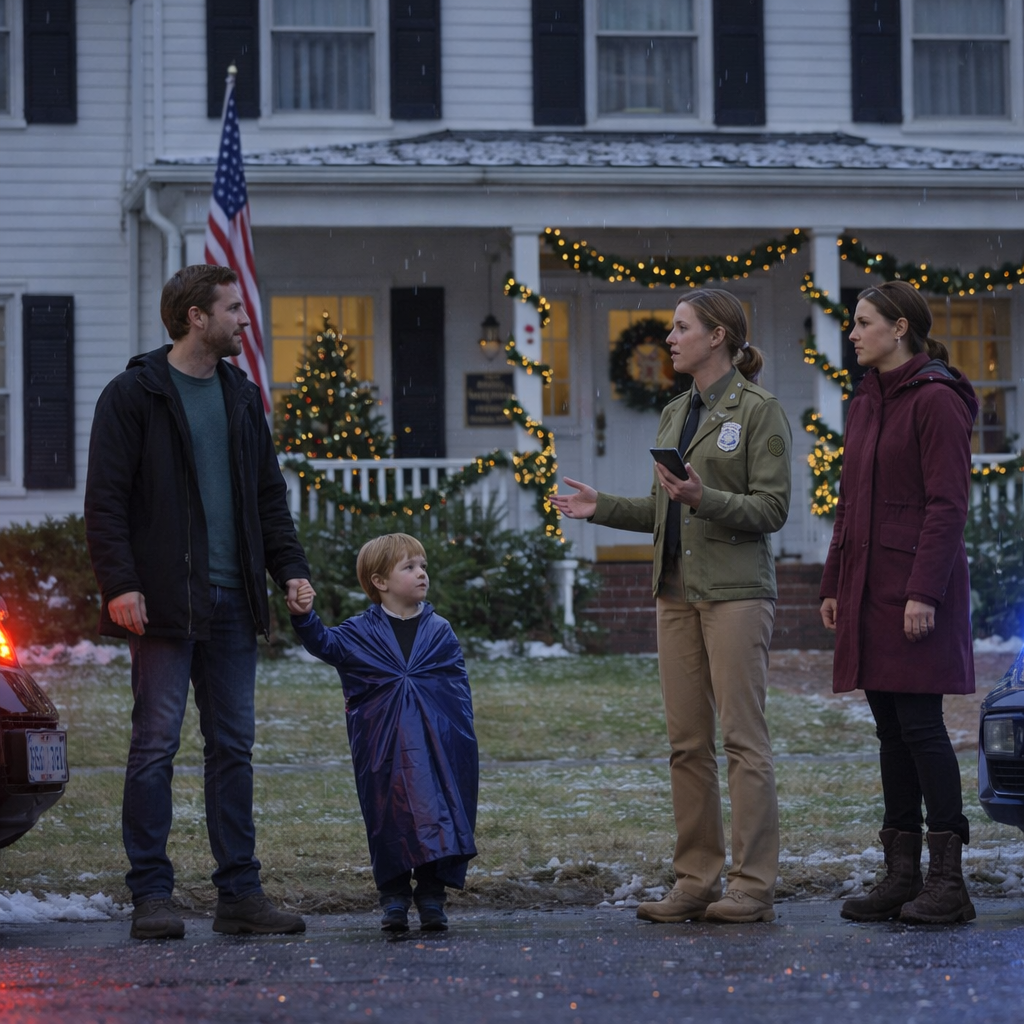
When he pulled up to Genevieve Fuller’s house, the street was lit like a crime scene.
Police cars crowded the driveway. Flashing lights painted the front of the house in harsh red and blue. An ambulance had just arrived, its back doors opening as paramedics hurried out.
William’s tires squealed as he stopped too fast. He stumbled out, legs weak, and ran toward the house.
An officer stepped in front of him, hand up. “Sir, you can’t just…”
“That’s my son,” William shouted, the words tearing out of him. “My son is in there.”
The officer’s expression shifted, recognition of something real and human flickering through the professional mask. “Mr. Edwards?”
“Yes,” William rasped. “Let me through.”
“Come with me,” the officer said, and his voice softened.
Inside, the house smelled like laundry detergent and something faintly sweet, like baked goods that had been abandoned mid-task. But layered over that was the sharp, metallic scent of blood.
The hallway was crowded. Paramedics spoke in low, urgent voices. A woman stood near the kitchen doorway, pale and shaking, flour dusting her apron as if she’d been interrupted while cooking.
Genevieve Fuller.
Her eyes met William’s and filled with relief and fear at the same time.
“He won’t come out,” she said, voice trembling. “He’s under my bed. He asked for you. I tried to talk to him, but he’s terrified.”
William didn’t answer. He pushed past the cluster of people, down the hallway, toward the bedroom door that stood slightly ajar.
He dropped to his knees.
Through the crack, he saw a small shape wedged beneath the bed.
A Spider-Man shirt, soaked so dark it looked black in places, but it was blood. It shone wetly where the light hit it.
William’s vision tunneled.
“Owen,” he whispered.
The small shape jerked.
William’s voice broke. “Buddy. It’s Dad. I’m here.”
A thin sob came from under the bed, the sound of a child trying not to be heard.
William leaned closer, his forehead nearly touching the carpet. He could see Owen’s little hands, curled tight, trembling so hard they vibrated against the floor.
“I promised I’d come back,” William said softly. “Remember? I’m here now. You’re safe.”
“Don’t let them find me,” Owen whispered. His voice was ragged, hoarse from crying.
“No one’s going to take you,” William said, and he meant it so fiercely it scared him. “I need you to come out so we can help you, okay? You’re safe with me.”
Owen didn’t move.
William took a shaky breath. “Owen, look at me.”
Silence. Then Owen’s voice, tiny and broken. “They’ll be mad.”
William’s stomach dropped.
“Who will be mad?” he asked, though he already knew.
Owen’s breathing hitched. “They said I can never tell.”
William’s blood went cold.
He forced his voice to stay gentle, even as something inside him sharpened into a hard, focused edge. “No one is going to be mad at you,” he said. “Whatever happened, it is not your fault. Do you hear me? Not your fault.”
Owen made a small sound that might have been agreement, might have been pain.
William pressed on. “Come to me, buddy. I’m right here. I will protect you.”
There was a pause, long enough that William’s heart pounded in his ears.
Then Owen began to crawl out.
Slowly. Hesitantly.
When Owen’s face emerged into the light, William’s breath left him in a broken gasp.
Blood smeared Owen’s cheeks, streaked across his forehead, clung in wet patches to his eyelashes. His arms were slick with it. His shirt was soaked. The sight was so wrong, so violent, that William’s body reacted before his mind could, nausea rising hard in his throat.
Paramedics moved forward, hands out, voices soft. Owen flinched and scrambled closer to William instead, climbing into his lap with desperate force, burying his face against William’s chest.
William wrapped his arms around him. His hands shook as they pressed against Owen’s back. He could feel the blood soaking into his own shirt, warm and sticky.
“Easy,” one paramedic murmured, kneeling. “Hey, sweetheart, you’re okay. We just need to check you.”
Owen’s body trembled violently. He clung to William as if letting go would mean dying.
Another paramedic gently lifted the edge of Owen’s shirt, scanning for wounds. “He doesn’t look injured,” she said, voice quiet with confusion. “No visible lacerations.”
William blinked, disoriented. “What do you mean?”
The paramedic met his eyes. “The blood… it might not be his.”
William’s mind stalled.
If the blood wasn’t Owen’s, then whose was it?
Owen lifted his head slightly. His eyes looked too old, too heavy for a child. “I fought back,” he whispered.
William went rigid. “What?”
Owen’s lips trembled. “I fought back, Daddy,” he said again, almost as if he needed to convince himself. “Like you taught me.”
William’s chest tightened painfully. He had taught Owen about boundaries. About saying no. About finding an adult you trust. About using your voice. But he had never imagined Owen would use those lessons in something that left him covered in blood.
A police officer stepped closer, his face careful. “Son,” he said gently, crouching to Owen’s level. “Can you tell us who hurt you? Who did you fight?”
Owen’s eyes darted. His body stiffened. Then he buried his face back into William’s chest and went silent.
Genevieve Fuller stood in the doorway, her hands twisting together. Her voice was shaky. “I have cameras,” she said. “Security cameras. They cover my backyard.”
The officer turned to her. “Ma’am?”
Genevieve swallowed hard. “I saw what happened. At least… I saw part of it. I saw why he ran.”
The air in the room changed, thickening. William’s pulse roared.
The officer took Genevieve’s phone as she offered it, her fingers trembling. He watched the screen for a few seconds, and the color drained from his face so quickly it was startling.
“Mr. Edwards,” he said, voice tight. “I need you to see this.”
William didn’t want to let go of Owen. Every muscle in him screamed to keep his son wrapped in his arms, to shield him from everything, including video evidence of what had been done to him.
But the paramedic had Owen now, carefully lifting him into her arms, wrapping him in a blanket that looked painfully white against the dark red smears.
William rose on unsteady legs. His hands felt numb as he took the phone.
The screen showed a backyard. Genevieve’s yard, bright under harsh floodlights. Along the fence line, through a gap in the boards, the camera captured part of Sue Melton’s backyard.
A timestamp glowed at the corner: 8:17 p.m.
William’s breath caught.
On the video, Sue appeared.
She moved with purpose, dragging something across the yard toward a small shed. For a split second William’s mind refused to process what he was seeing. Then his stomach dropped.
It wasn’t something.
It was Owen.
His son’s body looked limp, pulled by the arm as if he were a sack of laundry. Sue’s face was set, expressionless.
William’s mouth opened, but no sound came out. His vision narrowed, the edges going dark.
Sue yanked open the shed door and shoved Owen inside.
Then, with calm efficiency, she swung the door shut and locked it with a padlock.
Sue stood there for a moment, arms crossed, as if waiting for silence. Then she turned and walked back toward the house.
William’s hands began to shake so badly the phone trembled.
The video continued.
Minutes passed. The shed was still.
Then it shook.
Owen was awake. He was banging from inside. The door rattled. The small building trembled. The sound wasn’t captured clearly, but William could imagine it. He could imagine the desperate pounding of tiny fists, the muffled cries trapped behind wood.
William felt something in him splinter.
The banging intensified, then stopped.
For a heartbeat, the shed was silent.
Eight minutes later, the shed door burst open.
Owen stumbled out, wild with panic, hair disheveled, body moving like a frightened animal. He ran a few steps, then stopped short as Sue came back into frame, moving fast now.
She grabbed Owen by the front of his shirt, yanking him around.
Sue’s arm lifted.
A striking motion.
William’s knees buckled. He couldn’t breathe.
Owen moved.
It was quick, instinctive, like a child with no other option. He grabbed something from the ground.
A garden spade.
The metal flashed in the light. Owen swung it with desperate strength, his whole body twisting into the motion.
The blade connected with Sue’s face.
Sue fell hard, collapsing in a heap.
Owen dropped the spade and ran.
He ran toward the fence, toward the gap, toward Genevieve’s yard.
His small body disappeared through the boards.
William stared at the screen as if his eyes could force it to show something else.
The phone slid from his numb fingers and clattered to the carpet.
He swayed, and an officer caught his arm to steady him.
William’s voice came out rough and broken. “Where is she?”
The officer’s radio crackled. Another voice spilled through, urgent. “We’ve got a medical emergency at 247 Maple, female, late sixties, severe facial trauma. Need transport.”
William’s stomach turned. He looked toward the hallway where Owen sat in the paramedic’s arms, wrapped in a blanket, his face buried against her shoulder now, too exhausted to fight the comfort.
Blood on his skin. Blood that wasn’t his.
“Where is my wife?” William demanded suddenly, the question burning through him. “Where’s Marsha?”
The officer’s face tightened. “Units are at the Melton residence now, sir.”
The world felt unreal as William moved outside, guided by officers. Night air hit his face, cold and sharp, and for a moment it helped him breathe.
Sue Melton’s house sat next door, its porch light glowing, police vehicles clustered around it. The lawn that had been so neat now looked like a stage for something ugly.
Marsha stood on the porch.
Her hair was slightly mussed, her coat open. Her face, instead of fear or concern, held something else. Fury. Shock. And beneath it, something calculating that made William’s skin crawl.
When she saw William, she rushed down the steps.
“What did you do?” she screamed, her voice slicing through the night. “What did you tell him to do?”
William stared at her, stunned by the accusation. Not “Is Owen okay?” Not “Where is he?” Not “What happened?” Only blame, flung at William like a weapon.
“You think this is about me?” William’s voice shook. “You think this is about what I told him?”
Marsha’s eyes flashed. “He attacked my mother!”
“Your mother locked our son in a shed,” William said, and the words felt like glass in his mouth. “What was she doing to him?”
Marsha’s mouth opened, then closed. A fraction of hesitation, as if she had to choose which lie to wear.
Detective Alberta Stark stepped in then, a woman with tired eyes and a steady presence. She moved between William and Marsha with the ease of someone who had stepped between worse things before.
“Mrs. Edwards,” Stark said evenly, “we need you to come with us. We have questions.”
“I’m not going anywhere,” Marsha snapped. “I’m going to the hospital. My mother is hurt.”
Detective Stark’s expression didn’t change. “Your mother is being transported to Hartford Hospital. Severe facial lacerations. Possible skull fracture. You will have an opportunity to get information, but right now, you’re going to answer questions about why your five-year-old son was locked in a shed.”
Marsha’s face tightened. For a split second, the fury slipped and something else showed through. Not grief. Not fear. Calculation.
“I want a lawyer,” Marsha said abruptly.
Detective Stark nodded once, a small, controlled movement. “You can have one.”
An officer guided Marsha toward a patrol car.
As she passed William, Marsha leaned in close, voice low enough that only he could hear. Her breath smelled faintly of wine.
“You’ll regret this,” she whispered. “You have no idea what you’ve done.”
William’s skin went cold. He watched her get into the car, watched the door shut, watched the red and blue lights wash over her face in flashes, making her look like a stranger.
He turned back toward Owen, who was being loaded into the ambulance. The paramedic kept her voice soft, her hands gentle, like she understood that Owen’s nervous system was still trapped in terror.
William climbed into the ambulance with them. He sat close enough that Owen could see him, close enough that Owen’s small hand found his and clung tight.
The ride to the hospital was a blur of sirens and fluorescent light. Owen’s breathing came in shallow bursts. Every time a door slammed or a voice rose, he flinched.
William kept one hand on Owen’s blanket-covered shoulder, as if touch could anchor him back to safety.
At the hospital, the smell of antiseptic hit William like a wave. Bright lights, white walls, the constant hum of machines. Nurses moved quickly, their shoes squeaking on polished floors.
Owen was admitted for observation. Doctors examined him, asking gentle questions, scanning his body for injuries.
William stood at the edge of the bed, his heart lodged in his throat, watching every movement of every gloved hand.
A doctor finally looked up and spoke quietly. “He’s not bleeding,” she said. “No wounds that explain the amount of blood. We’ll run tests, but right now it appears the blood is not his.”
William exhaled a shaky breath he didn’t realize he’d been holding. Relief surged, sharp and dizzying, but it didn’t last. Not when he remembered the video. Not when he remembered Owen’s words.
I fought back.
Owen’s eyes kept flicking toward the door as if expecting someone to walk in and drag him away. Even in a hospital, even surrounded by people who wanted to help, he couldn’t unclench. His body didn’t believe in safety.
Later, close to midnight, a familiar face appeared at the doorway.
Dr. Isaac Dicki.
William knew him from professional conferences, from panel discussions and quiet hallway conversations about trauma research. Seeing him here, in this context, made William’s stomach tighten.
Dicki stepped into the room, his expression grim.
“William,” he said quietly.
William’s voice came out hoarse. “They asked for a psychologist.”
Dicki nodded. His gaze flicked briefly to Owen, who had finally fallen into a light, restless sleep. Owen’s hand still clung to William’s finger like a lifeline.
“I need to talk to you,” Dicki said.
William’s throat tightened. “Is he… is he okay?”
Dicki’s expression softened, but only slightly. “His vitals are stable,” he said. “But the physical exam revealed some concerns.”
William’s heart seemed to stop. “What concerns?”
Dicki lowered his voice. “Old bruises. In various stages of healing. Some scarring on his back consistent with being struck with a belt or something similar. And behavioral markers that suggest prolonged psychological abuse.”
William stared at him, not understanding, then understanding too quickly.
Old bruises.
Scars.
Prolonged.
His mind flashed through memories with brutal clarity: Owen flinching when Marsha raised her voice. Owen refusing to change clothes in front of William, turning his back, hurrying. Owen’s sudden fear of the dark. Owen’s reluctance to go to the bathroom alone. The way he startled at footsteps.
William’s stomach rolled.
“How long?” he whispered. “Based on the healing patterns, how long?”
Dicki’s voice was careful. “Months, at least. Possibly longer.”
Months.
William’s hands shook. He looked down at Owen’s small sleeping face and felt something in him crack open. A deep, sickening grief mixed with rage, not wild and loud, but cold and focused.
He had missed it.
He had been teaching people how to recognize trauma while his own son carried it in his skin.
William swallowed hard. “I need to see the shed.”
Dicki hesitated. “That’s a crime scene.”
“I don’t care,” William said, and his voice sounded strange to him, like it belonged to someone else. “I need to know what they did to him.”
As if summoned by the intensity in the room, Detective Stark appeared in the doorway.
“Mr. Edwards,” she said quietly.
William turned to her, his eyes burning. “Did you see it? The shed? Did you see what she did?”
Stark’s face was tight. She stepped into the room and held out her phone.
“We processed it,” she said. “I think you should see this.”
William’s hands trembled as he took the phone.
The first photo showed a small shed, cramped, the kind of place meant for lawn tools and old paint cans.
But inside, it wasn’t a storage shed.
The walls were padded.
A metal ring was bolted into the floor with a chain attached, thick and heavy for a child’s space. A plastic bucket sat in the corner like an afterthought. The air in the photo looked stale, even through the screen.
William’s vision blurred.
He swiped to the next image.
Marker on the wall.
Large letters, uneven, as if written fast and without care for beauty.
Rules for bad boys.
His mouth went dry.
He swiped again.
No crying.
No talking back.
No telling Daddy.
Punishment makes you strong.
Mommy knows best.
William’s breath hitched. The room around him faded. All he could see was that wall, those words, those rules carved into his son’s world like commandments.
His hands curled into fists so tight his nails bit his palms.
Stark’s voice came softly, cutting through the roar in William’s head. “We found a calendar hidden in the main house,” she said. “Marsha’s handwriting. Dates marked ‘Owen time’ going back eight months. Every weekend you were away at conferences or workshops.”
Eight months.
William felt like he’d been punched. His mind flashed through every conference email, every weekend he’d spent in a hotel room reading research articles while his son was… while his son was chained to a floor.
He lowered the phone slowly, his whole body shaking.
Owen stirred in the bed, making a small whimper in his sleep, and William’s throat tightened so painfully he could barely breathe.
“I want full custody,” William said, voice raw. “I want her arrested.”
Stark nodded. “We’re building the case,” she said. “But I need to be honest with you, Mr. Edwards.”
William’s eyes snapped to her. “What?”
“Sue Melton is in surgery,” Stark said. “Severe injuries. If she doesn’t make it…”
William’s stomach dropped.
Stark continued, steady and blunt. “If she dies, the situation becomes more complicated. Your son could face serious charges.”
William looked at Owen, at the blanket tucked around his small body, at the way his fingers still curled as if holding onto something invisible even in sleep.
“He was defending himself,” William said, and his voice hardened. “He was trying to survive.”
Stark studied him for a moment. “The DA may see it differently,” she warned. “A five-year-old caused significant damage.”
William’s jaw tightened. His voice came out low, dangerous in its certainty. “Then I’ll make them see it the right way.”
Silence hung between them. The fluorescent lights hummed. Somewhere down the hall, a monitor beeped steadily, indifferent to the collapse of a family.
William felt something inside him settle into place, like a door locking.
He leaned down and pressed his lips to Owen’s forehead, careful, gentle, as if touch could rewrite the last eight months.
“I’m here,” William whispered, so softly it was almost silent. “I’ve got you now.”
Owen’s fingers tightened around his.
And William stayed there, keeping watch, while the night outside the hospital windows stretched on, dark and cold, and the truth, finally exposed, began to take its shape.
William did not leave the hospital that night.
He sat in the stiff vinyl chair beside Owen’s bed, one hand wrapped around his son’s small fingers, the other resting uselessly in his lap. Every few minutes Owen twitched in his sleep, his face tightening as if he were running again in some half-remembered nightmare. Each time, William leaned forward instinctively, whispering soft reassurances Owen could not hear.
You’re safe. I’m here.
The words were as much for himself as for the boy.
Sometime after two in the morning, Detective Stark returned. Her jacket was off now, sleeves rolled up, exhaustion etched into her face. She closed the door quietly behind her and stood for a moment, watching Owen breathe.
“We finished processing the shed,” she said softly.
William didn’t look up. “You already showed me.”
“There’s more,” Stark replied.
William’s hand tightened around Owen’s fingers. “How much more can there be?”
Stark exhaled slowly. “Enough that I need you to prepare yourself.”
She pulled up a chair and sat across from him, lowering her voice. “The shed was not improvised. It was intentional. Reinforced. Modified. Whoever designed it knew exactly what they were doing.”
William closed his eyes. The images burned behind his lids anyway.
“We also interviewed your neighbors,” Stark continued. “Several of them reported hearing crying late at night over the past year. They assumed it was a dog. Or a television.”
William’s stomach twisted. Crying that no one recognized as a child.
“And Marsha?” he asked quietly.
Stark’s jaw tightened. “She’s not cooperating. She requested counsel immediately. But we obtained a warrant to search her phone and computer.”
William looked up then. “What did you find?”
“Messages,” Stark said. “Between her and Sue. Discussions about ‘correcting behavior.’ About isolation. About endurance.”
William let out a hollow breath. Every word felt heavier than the last.
Stark hesitated. “Mr. Edwards, I need to be clear. This investigation is expanding.”
William nodded slowly. “I assumed it would.”
“She wasn’t just sending Owen there,” Stark said. “She was participating. Coordinating.”
The room felt too small. William stared at the floor, his mind replaying every moment he had ignored. Every time Marsha insisted on private discipline. Every time she sent him away.
“I trusted her,” he said, the admission tasting like ash. “I trusted my wife with my child.”
Stark did not try to soften it. “Abusers rely on trust,” she said. “It’s how they operate.”
William swallowed. “What happens now?”
“For now, Owen stays here,” Stark said. “Protective custody, medically speaking. Social services will be involved, but given the circumstances and your background, we’re moving to grant you emergency custody pending a hearing.”
Relief washed over him so fast it left him dizzy. “She can’t take him,” he said. “She can’t come near him.”
“No,” Stark agreed. “She can’t.”
Owen stirred again, murmuring something incoherent. William leaned closer, brushing a thumb gently over his son’s knuckles until his breathing evened out.
“I won’t fail him again,” William said quietly.
Stark studied him for a moment. “Then don’t,” she said simply. “Because this isn’t over.”
—
By morning, the hospital room felt like a war zone disguised as calm.
Doctors came and went. A child services representative arrived with a clipboard and a carefully neutral expression. Forms were signed. Statements were taken. Owen slept through most of it, exhausted in a way no child should ever be.
Marsha did not come.
William tried not to think about what that said.
Late that afternoon, Dr. Isaac Dicki returned, closing the door behind him and sitting on the edge of the bed. Owen was awake now, clutching his stuffed dinosaur, his eyes following every movement in the room.
“Hey, Owen,” Dicki said gently. “I’m Dr. Isaac. I talk to kids about big feelings.”
Owen did not respond. He shifted closer to William instead.
“That’s okay,” Dicki continued, unbothered. “You don’t have to talk to me today. I just want to help make sure you’re okay.”
Owen glanced up at William.
William nodded. “You’re safe,” he said softly. “Dr. Isaac is here to help.”
Owen’s voice came out quiet but steady. “I don’t want to go back.”
“You won’t,” William said, without hesitation. “I promise.”
Dicki watched the exchange closely, then nodded once. “That promise matters,” he said. “Keep it.”
After Dicki left, William sat alone again with his thoughts. He replayed the drive to Sue’s house over and over, hearing Owen’s pleas like a soundtrack he could not turn off.
Daddy, please don’t leave me there.
The guilt was crushing, but beneath it, something harder was forming. Resolve. A sense of clarity he had never felt before.
If Marsha and Sue had thought they could hide behind tradition, behind words like discipline and toughness, they had underestimated him.
He was not the man who backed down anymore.
—
Owen was released from the hospital two days later.
A judge granted William emergency sole custody with no contact permitted between Owen and Marsha pending the investigation. When William read the order, his hands shook so badly he had to sit down.
They went home together, father and son.
The house felt different without Marsha’s presence. Quieter. Lighter. The tension that had lived in the walls seemed to have evaporated overnight.
Owen hovered close to William at first, trailing him from room to room like a shadow. William let him. He cooked simple meals, kept the lights on at night, slept on the floor beside Owen’s bed when the nightmares came.
They began therapy immediately.
With Dr. Dicki’s help, the story came out slowly, piece by piece. The shed had not been the beginning. It had been the end point.
Before that, there had been slaps. Being locked in closets. Standing for hours facing a wall. Being told he was bad, broken, weak. Being warned that if he told Daddy, Daddy would leave him forever.
William listened without interrupting, his jaw clenched, his heart splintering and rebuilding with every word.
“I thought I deserved it,” Owen whispered one afternoon. “Because Mommy said so.”
William pulled him into his arms, holding him tight. “You never deserved any of it,” he said fiercely. “Not one second.”
—
The legal storm came quickly.
Sue Melton survived surgery but remained hospitalized, her face reconstructed with plates and stitches. Marsha was formally charged with child abuse, false imprisonment, and conspiracy.
Her lawyer went on the offensive immediately.
They claimed Owen was violent. Unstable. That William had manipulated him with psychological language. That the shed was merely a timeout space misrepresented by an overprotective father.
William responded with evidence.
Photos. Videos. Medical records. Expert testimony. His own research. Sue’s past.
A deeper investigation into Sue Melton’s history uncovered formal complaints from her years as a military nurse. Abuse allegations that had never stuck. Transfers that now looked suspicious.
Patterns emerged.
The story broke locally, then statewide.
Neighbors came forward. Teachers remembered Owen’s sudden withdrawal. Parents recognized signs they had ignored in their own children.
Marsha’s image collapsed under scrutiny. Her workplace placed her on indefinite leave. Friends stopped answering her calls.
She sent William a message from jail.
You’re ruining our family.
William deleted it without replying.
—
The trial began in September.
William sat in the courtroom every day, hands folded, eyes steady. He never looked at Marsha when she entered. He did not acknowledge her tears or her performance of heartbreak.
Sue Melton appeared smaller now, frailer, her face marked by scars that never quite healed. She spoke of discipline, of love, of tradition. She said children needed to learn obedience.
Then the prosecution played the video.
The shed. The lock. The spade.
The courtroom went silent.
Other victims testified. Adults now, some trembling, some angry, all carrying the same language of fear Owen had used.
By the time the jury deliberated, the outcome felt inevitable.
Guilty on all counts.
Sue Melton received twenty-five years.
Marsha received fifteen.
William did not feel triumph when the verdict was read. Only a heavy, exhausted relief.
They could not hurt him anymore.
—
Life after the trial was quieter.
Healing was slow, uneven, sometimes painful. Owen still flinched at sudden noises. Still woke from nightmares. Still asked questions that had no easy answers.
But he laughed again.
He played.
He slept through the night more often than not.
William returned to teaching with a new focus. He developed programs for educators and medical professionals on recognizing abuse disguised as discipline. He spoke publicly, carefully anonymizing Owen’s story, using it to illuminate warning signs others had missed.
The impact spread wider than he expected.
Laws were reviewed. Policies were questioned. Other parents came forward.
One afternoon, a letter arrived.
It was from a woman who had testified against Sue. She wrote about the years she had spent believing she deserved the pain. About how seeing Owen survive had given her permission to seek help.
William read it twice, then showed it to Owen when he felt the boy was ready.
“I helped someone?” Owen asked, brow furrowed.
William smiled softly. “You helped a lot of people.”
Owen thought about that for a long moment. “I’m glad I ran,” he said finally.
“So am I,” William replied, his voice thick.
—
Years later, on a quiet evening, William stood on the porch watching Owen ride his bike up and down the driveway. The air was warm. The sky pink with sunset.
Owen laughed as he wobbled, then caught his balance, stronger now. Confident.
William felt something settle in his chest. Peace, finally.
He thought back to that drive, the sun cutting through the windshield, his son’s voice breaking in fear.
He would carry that memory forever.
But it no longer defined them.
They had built something new in its place.