They Showed Up With 20 Suitcases and Claimed “Family Has Rights” – Until the Property Manager Checked the Names
The first thing I noticed wasn’t my parents’ SUV grinding its way up the gravel drive.
It was the luggage.
Twenty suitcases stood in a rigid line just outside my gate, arranged with unsettling care, like they’d been staged for effect. Hard-shell rollers reflected the afternoon sun. Overstuffed duffel bags slumped beside garment carriers. There was even a large wheeled cooler parked at the end, as if someone had anticipated extended occupancy. The scene looked less like a visit and more like an invasion with a packing list.
For a few disoriented seconds, my mind scrambled for reasonable explanations. A neighbor’s family must have mistaken the address. A wedding party got lost. A rental mix-up. Anything except what my gut already knew.
Then I saw the sticky note taped to the handle of the largest suitcase.
We’re here. Open up.
The handwriting was unmistakable. My mother’s. Tight loops. Heavy pressure. No greeting. No name. No question. Just assumption.
Something cold slid through my chest, that familiar sinking sensation I’d learned to associate with my parents’ “surprises.” When something they do feels absurd on the surface, it’s never accidental. It’s strategy. Shock first. Compliance second.
I parked slowly, gravel crunching beneath my tires, and stayed seated longer than necessary. The lake behind my house shimmered under the sun, blue and calm and expansive, like it belonged to a completely different world than the one unfolding in front of me. That contrast made everything feel surreal, like my life had split into parallel realities.
Then more engines approached.
Not one. Several.
My parents’ SUV rolled in with proprietary confidence, as if they were arriving at a property they owned outright. Behind it came a sedan. Then another. Then a minivan so full it sagged slightly on its axles. Doors opened. Trunks popped. Voices burst into the air.
Laughter. Complaints. Kids whining. Someone shouting about the bathroom. Bags were hauled out and stacked beside the others, multiplying the spectacle. It looked like a family reunion unloading into a vacation rental, not a group of people trespassing on private property.
My father stepped out first.
His face was already set, jaw rigid, eyes sharp with that particular look that meant he’d rehearsed this confrontation and expected obedience. My mother followed close behind, her expression carefully arranged into her public smile, the one she used at church fundraisers and charity luncheons. The smile of someone convinced they were morally correct.
And then came the rest.
Cousins I barely recognized. An aunt who still forgot my birthday. Two teenagers glued to their phones. Someone’s boyfriend dragging a Bluetooth speaker. Children racing each other in circles, screaming with unchecked energy. They spilled out of the vehicles until my quiet drive felt claustrophobic, crowded, loud.
My father didn’t greet me.
He didn’t ask how I was or acknowledge that showing up unannounced with twenty suitcases might warrant an explanation. He simply jabbed a finger toward the luggage and said, loudly and decisively, “You’re cooking. You’re making up rooms. We’re staying a month.”
A month.
He delivered it like a fact, like gravity or weather, something I was supposed to accept without comment. Heat flared behind my eyes, but I forced my face to stay neutral. Years of dealing with my parents had taught me one critical rule.
The first person who gets emotional loses.
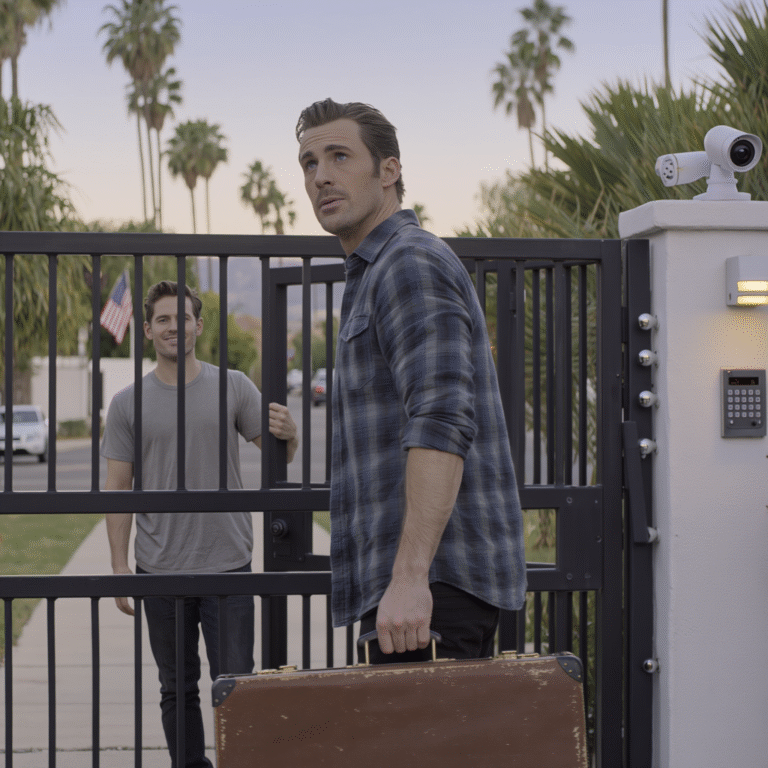
My mother strode straight to the gate and grabbed the latch as if it were hers. Her hand closed around it with possessive ease, like the lock was merely decorative.
“Open it,” she said lightly, her voice pitched just loud enough for others to hear. “Don’t start your drama, Claire. Just open the gate and let your family in.”
I didn’t touch the gate.
I didn’t argue.
Instead, I pointed to the sign bolted neatly to the fence. Clean lettering. Official. Installed by the property management company for exactly this kind of situation.
Entry by guest list only.
My father squinted at it like reading was an insult. My mother’s smile tightened, barely holding. Then she raised her voice, projecting outward toward the neighboring house where someone had stepped onto their porch.
“Family has rights,” she announced. “You can’t lock family out of family property. That’s not how family works.”
It was a performance, polished and intentional. The wounded mother. The unreasonable daughter. The injustice laid bare for any audience within earshot.
I met her gaze calmly. “Family doesn’t have keys,” I said. “And this isn’t family property. It’s mine.”
That was all it took.
My father stepped forward, face reddening fast. “You think you’re better than us?” he snapped. “You refuse to pay our debt and now you want to punish everyone. You want to watch your parents suffer because you’re selfish.”
There it was.
Two weeks earlier, he’d called me with a number designed to terrify me into submission. One hundred eighty thousand dollars. He’d said it like it was my responsibility by default. Like my existence alone made me liable.
“Put it under your name,” he’d demanded. “You have credit. You have that lakehouse. You can afford it.”
I’d said no.
One word. Calm. Final.
And ever since, they’d been escalating.
My mother stepped closer to the gate, lowering her voice so only I could hear. “You’re going to let us drown,” she whispered. “So we’ll take what we need. You owe us.”
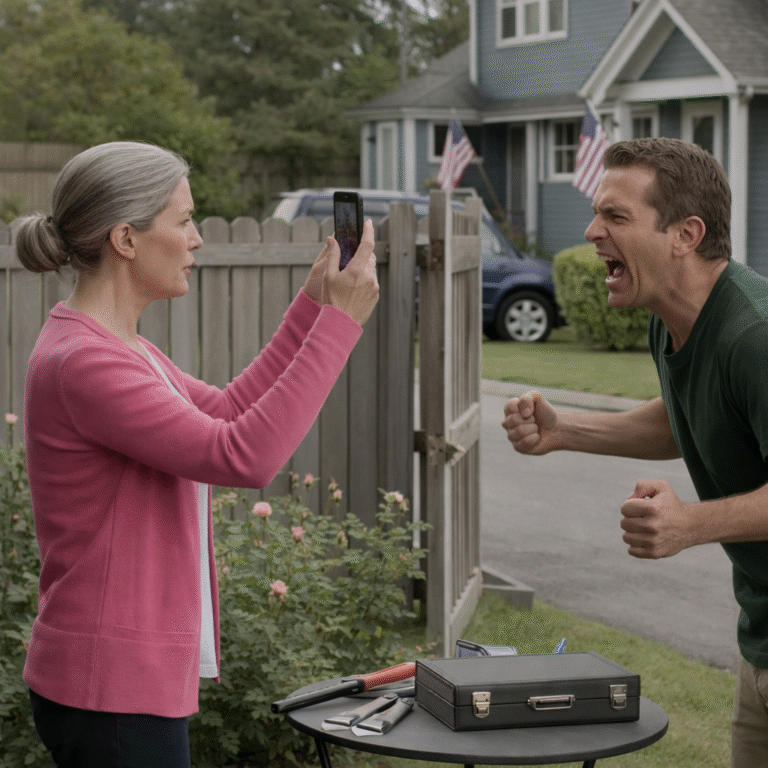
I didn’t flinch. I pulled out my phone instead, opening the folder I’d created weeks ago. Screenshots. Voicemails. Messages. Demands. Threats. I’d learned long ago that documentation wasn’t paranoia. It was protection.
My father turned to the relatives, voice booming. “This is our family’s lakehouse now,” he declared. “She doesn’t get to keep it while we lose everything.”
Some people murmured. A few laughed uncomfortably. Others looked at me with judgment already formed, convinced by volume alone.
My mother yanked the latch again. It didn’t budge.
My father’s voice dropped, dangerous and quiet. “Open it,” he said. “Or I’ll make you.”
I lifted my phone and tapped the call I’d queued up before I ever got out of my car.
“Lakeside Property Management,” a man answered.
“This is Claire Carter,” I said evenly. “I’m at the property. Unauthorized individuals are attempting entry. I need you here immediately.”
“I’m five minutes out,” he replied.
My father exploded. “You called strangers on your own parents?”
“They’re not strangers,” I said. “They manage my property. And you’re not authorized.”
My mother’s smile cracked. “You’re humiliating us.”
“You brought twenty suitcases uninvited,” I replied. “You did that yourself.”
Four minutes later, a black sedan pulled up. A man in a charcoal suit stepped out, clipboard in hand, movements precise and unhurried.
My mother straightened instantly.
“Ms. Carter?” he asked.
“Yes.”
“And you are?” he asked my father.
“Her father,” my father said proudly.
The man flipped a page. “Guest list only. Let’s verify names.”
“All of us,” my mother chirped. “We’re family.”
“That’s not a name.”
He scanned the list, then paused. His expression shifted.
“Sir,” he said carefully, “your name is flagged.”
My father blinked. “For what?”
The man glanced at me, then back at him. “Documentation filed this morning.”
My mother grabbed my arm. “Don’t you dare.”
The property manager opened his folder. “A guest access request was submitted under the owner’s name. Month-long stay. Twenty guests. However, the owner denied submitting it.”
My pulse spiked. They hadn’t just shown up. They’d tried to forge authorization.
“When verification failed,” he continued, “the system restricted access. Currently, there are zero approved guests.”
“You can’t lock out family,” my mother snapped.
“We can,” he said. “And we did.”
“I want the access code,” my father demanded.
“I can’t issue one to someone flagged for suspected fraudulent authorization.”
The word fraud rippled through the group.
My father turned to the crowd. “She’s calling her own father a forger.”
“I didn’t,” I said calmly. “The system did.”
My mother’s tears appeared on command. “We have nowhere else to go.”
I raised my phone. “This is the message where you demanded I take on your debt. And this is where you said you’d take what you need.”
The property manager lifted a hand. “Everyone step back.”
My father refused.
“If you continue,” the man said evenly, “I will call law enforcement for trespass.”
“Call them,” my father sneered.
The man didn’t hesitate.
When the sheriff’s car arrived minutes later, the deputy took in the scene quickly. The luggage. The gate. The paperwork.
My mother tried again. “She’s confused.”
I handed over my phone. “This email address impersonates mine. One letter difference.”
The deputy read. Then looked up.
“Did you create this account?” he asked my mother.
My father interrupted. “She’s lying.”
The deputy’s patience thinned. “This isn’t about family debt. This is potential identity fraud.”
He radioed dispatch and read my father’s name aloud.
The response crackled back.
My father’s face went white.
“Sir,” the deputy said, “step back from the gate.”
“For what?”
“There’s an active warrant under your name.”
The silence that followed was absolute.
As my father was led away, cuffs clicking shut, the relatives quietly loaded their suitcases back into cars, eyes downcast, whispers sharp with embarrassment.
I stood by my locked gate, watching order reassert itself.
Not angry. Not triumphant.
Just steady.
Because boundaries work when you build them properly.
And showing up with twenty suitcases doesn’t create rights.
It creates evidence.
The sheriff’s deputy guided my father toward the patrol car without drama, his grip firm but professional. The metal cuffs clicked closed around wrists that had spent decades pointing, demanding, controlling. My father kept talking the entire walk, his voice bouncing between outrage and disbelief, insisting this was all a misunderstanding, a setup, an act of betrayal by his own child.
My mother followed two steps behind, wringing her hands, her face pale beneath hastily applied makeup. She kept repeating my name like it was a spell she could cast to undo everything unfolding in front of her.
“Claire, tell him. Tell them this is a mistake. Tell them to stop.”
I didn’t move. I didn’t speak. I stood beside my car, phone still in my hand, watching the consequences finally arrive without my interference.
The relatives scattered the moment the handcuffs came out. The confident energy they had arrived with collapsed into quiet panic. People avoided eye contact. Suitcases were dragged back toward trunks with less enthusiasm than they had been unloaded. A cousin muttered something about gas prices. Someone’s boyfriend shoved the Bluetooth speaker into the backseat like it was evidence of poor judgment.
The deputy paused before placing my father in the back of the patrol car. “Sir, you have the right to remain silent,” he began.
My father laughed bitterly. “She planned this,” he said loudly, twisting his head to look at me. “She’s always been vindictive. Always thought she was better than us.”
The deputy shut the door before he could finish.
The sound echoed across the lake.
My mother rushed toward me then, stopping just short of my personal space, her voice low and frantic. “You didn’t have to do this,” she hissed. “You could have handled this privately.”
“I tried,” I replied calmly. “You didn’t listen.”
“You let them take him away,” she said, eyes wild. “You let your own father get arrested.”
“He let himself get arrested,” I said. “By submitting fraudulent documents and refusing to leave private property.”
Her mouth opened, then closed. The words she wanted were not the ones that would help her now.
The property manager stood nearby, speaking quietly with the deputy, exchanging copies of documentation and timestamps. Everything was orderly. Precise. Recorded. Exactly how my parents hated situations to be handled.
The deputy returned to me. “Ma’am, do you want to press charges for the attempted fraud?”
I took a breath. The lake air felt cool now, grounding. “I want a report filed,” I said. “And I want formal trespass warnings issued to everyone here.”
He nodded. “That can be done.”
My mother’s head snapped up. “Trespass warnings?”
“Yes,” the deputy replied. “Which means if you return to this property without authorization, you will be arrested.”
Her face crumpled. “You can’t mean that.”
I met her eyes steadily. “I do.”
The deputy began issuing warnings, one by one. Names were taken. IDs checked. Each person received the same calm explanation. This was private property. You are not welcome here without explicit permission. Return and there will be consequences.
By the time he finished, the driveway was nearly empty.
Only my mother remained.
She stood alone near the gate, arms wrapped around herself, looking smaller than I had ever seen her. Without an audience, without allies, without control, she looked lost.
“You’ve ruined us,” she said quietly.
“No,” I replied. “I refused to save you from choices you made.”
She shook her head. “You used to be such a good daughter.”
I thought about that. About how being a good daughter had always meant being quiet, useful, compliant, available. About how love had always come with conditions.
“I grew up,” I said.
The deputy cleared his throat gently. “Ma’am, you need to leave now.”
My mother looked at the lakehouse one last time. At the gate. At me. Her eyes lingered like she expected something to change at the final second.
Nothing did.
She turned and walked to her car.
The silence that followed felt unreal.
No shouting. No engines. No demands.
Just the soft sound of water against the shore and wind moving through the trees.
The property manager closed his folder and offered a professional nod. “We will add an additional security note to the system,” he said. “No guest access without direct confirmation by phone. If anyone attempts to submit documentation again, we will notify law enforcement immediately.”
“Thank you,” I said. “For handling it properly.”
“That’s what we’re here for,” he replied, then left.
When I finally unlocked my gate and drove onto my own property, the relief hit me all at once. My hands shook as I parked. Adrenaline drained, leaving exhaustion in its wake.
Inside the house, everything was exactly as I had left it. Quiet. Clean. Safe.
I poured myself a glass of water and sat on the edge of the couch, staring out at the lake as the sun dipped lower. My phone buzzed once.
A message from an unknown number.
You didn’t have to humiliate us like this.
I stared at the screen, then blocked the number without responding.
That night, sleep came easily for the first time in weeks.
But the fallout was only beginning.
The fallout arrived quietly at first.
No shouting. No dramatic confrontations. Just a steady drip of consequences that my parents had never learned how to manage, because for most of their lives, consequences had always landed on someone else.
The sheriff’s report circulated faster than I expected. Small towns thrive on shared information, and a scene involving twenty suitcases, a locked gate, and a man led away in handcuffs does not stay private for long. By the end of the week, distant relatives had stopped texting entirely. The group chat went silent. Invitations I’d never planned to attend anyway evaporated.
My mother tried new tactics.
First came the emails, long and emotional, sent late at night. Subject lines like “Please Read” and “We Need to Talk.” Inside were familiar refrains. How stressed she was. How embarrassed she felt. How my father’s arrest had been blown out of proportion. How families forgive.
I read them once, calmly, and archived them without replying.
Then came the voicemails. Her voice would start controlled, almost reasonable, and then crack halfway through as she slipped into accusation. She never apologized. She never acknowledged the forged documents. She never mentioned the threat to take what she needed. Instead, she focused on how difficult everything had become for her.
When guilt didn’t work, she tried fear.
“You’re going to regret this,” she said in one message, her voice low and trembling. “You think you’ve won, but you’ve just made enemies you don’t understand.”
I blocked that number too.
A week later, my father was released pending his court date. The warrant turned out to be tied to an older financial issue he’d ignored, something he’d assumed would disappear if he avoided it long enough. It hadn’t. It had waited.
He never contacted me directly. That silence told me more than any rant ever could.
The property management company followed through exactly as promised. My file was flagged with additional security protocols. Any attempted access change now required voice confirmation and in-person verification. The gate code rotated automatically. Cameras were added along the drive.
Not because I was afraid.
Because I was done pretending that boundaries were negotiable.
Neighbors stopped by over the next few days under the polite pretense of checking in. Some were curious. Some were supportive. One older woman down the road brought over lemon bread and said quietly, “You handled that better than I ever could have.”
I thanked her and meant it.
A month passed.
Then two.
The lakehouse returned to what it was meant to be. Quiet mornings. Coffee on the deck. Evenings where the water reflected the sky so perfectly it felt like staring into another world. The kind of peace that settles in your bones when you stop bracing for impact.
One afternoon, my phone buzzed with a notification I hadn’t expected.
A court summons.
Not for me.
For my father.
He was being charged with attempted fraud related to the forged authorization request, along with the outstanding financial violation tied to the warrant. The evidence was clean. The documentation was thorough. The case was not dramatic.
It was procedural.
Which, I realized, was the most fitting outcome of all.
My mother sent one final message after that.
“I don’t recognize you anymore.”
I stared at the screen for a long moment before typing back my only response.
“I finally recognize myself.”
I blocked her number and felt nothing but relief.
The following summer, I hosted friends at the lakehouse. People who asked before arriving. People who brought wine instead of demands. People who left when they said they would and thanked me for the invitation.
At one point, we laughed about the idea of someone trying to claim a house just by showing up with luggage.
“Can you imagine,” someone said, shaking their head.
I smiled, quiet and steady.
Yes. I could imagine.
And I could imagine the alternative too. A life where I’d opened that gate. Where a month turned into forever. Where debt and entitlement consumed everything I’d worked to protect.
I had chosen differently.
On a warm evening near the end of the season, I walked down to the gate alone. The sign was still there. Entry by guest list only. Clean. Clear. Unapologetic.
I ran my fingers over the metal and felt grounded in a way I never had before.
Because family does not have rights to your home, your money, or your peace.
They have the right to be decent.
And when they choose not to be, you have the right to lock the gate.