They Let a Child Humiliate Me at the Birthday Table. By Morning, the Car Was Gone and Someone Was Knocking
I stood on my mother’s porch longer than necessary, fingers curled tightly around a velvet box that had already warmed from my grip. The late afternoon sun slanted across the familiar wood planks, highlighting the crack near the step I used to trip over as a child. Through the closed front door came the muffled sounds of laughter and overlapping voices, the kind of easy noise that suggested everyone was already settled, already comfortable, already complete without me.
Inside the box was a gold lily pendant. I had spent weeks choosing it. Not because my mother needed another necklace, but because the flower mattered. Lily. My daughter’s name. I had told myself it was symbolic, thoughtful, generous. I had told myself this was what a good daughter did. She showed up. She brought something beautiful. She tried.
At thirty six, you would think I would have perfected the smile by now. The polite one. The harmless one. The one that said I am fine, everything is fine, please do not look too closely. The smile that slid easily into photos and let people believe I belonged.
I lifted my hand to knock.
The door flew open before my knuckles touched wood.
Tyler stood there, filling the doorway with teenage confidence and indifference. Fourteen years old, already taller than me, already carrying himself like the world owed him something. His hoodie was a brand I could not afford. His sneakers were spotless, white soles untouched by real pavement. I knew exactly who paid for them. I also knew exactly who had signed the paperwork that made those purchases possible.
He looked me up and down.
“Oh,” he said flatly. “You came.”
Not hello. Not happy birthday to Grandma. Just that.
I stepped inside, and the house swallowed me whole.
The smell hit first. Artificial vanilla frosting mixed with cheap cologne and something fried. The dining room was crowded, loud, cluttered. Chairs scraped, glasses clinked. The table overflowed with half eaten cake, crumpled wrapping paper, opened gift boxes. My mother sat at the head, her posture proud and relaxed, one hand wrapped around a glass of wine as she laughed at something Tyler had said.
“His teacher says he might be gifted,” my mother was telling her friend Irene, her voice ringing with delight. “Not just smart. Gifted. She said you do not see kids like him every year. Maybe every five.”
Irene gasped theatrically. “A genius in the family.”
My mother touched her chest, eyes shining. “Inherited from his grandmother, obviously.”
They laughed together, heads tilted toward one another like co conspirators.
I cleared my throat.
“Hi, Mom.”
She turned, startled, as if I had materialized out of thin air rather than walked through the front door. “Oh. Stephanie. You made it.”
Made it. As though attendance had been optional. As though my presence was a pleasant surprise rather than an expectation.
I leaned down and kissed her cheek, breathing in the same floral perfume she had worn my entire childhood. It brought back memories I did not ask for. School mornings. Church Sundays. Her voice correcting my posture, my tone, my everything.
“Of course,” I said. “It is your birthday.”
She patted my arm absently, already turning back toward Irene. “Put that somewhere. We are about to do presents.”
It was not true. The table was already littered with opened gifts, ribbons trailing like shed skins. I carried my bag to the sideboard and set it down carefully. Between two oversized cakes and a stack of greeting cards, the small velvet box inside suddenly felt foolish. Too quiet. Too thoughtful for a room that rewarded flash.
My brother Mike appeared beside me with a beer in his hand. His shirt was unbuttoned at the collar, his cheeks flushed, his voice already loose.
“You look tired,” he said. Not concerned. Assessing. “Store keeping you up nights?”
“It has been busy,” I replied.
He guided me toward a chair squeezed tightly between two women I did not know. “No seats left, but we made space for you. Did not we, Mom?”
My mother smiled vaguely. “We always make space for family.”
I sat down slowly.
So long as they are convenient, I thought.
The woman beside me switched forks with me without asking, sliding mine toward herself as if it had always been hers. “Thanks,” she said, eyes already elsewhere.
“It is fine,” I murmured. I had been saying that for years. Small accommodations. Small disappearances. Little cuts you do not notice until you realize you are bleeding everywhere.
My mother stood and raised her glass. The room quieted.
“I just want to say how proud I am of my family,” she began. “My son, who works so hard for his business. My grandson, who is going to be the first one of us to go to a really good college.”
Her gaze moved deliberately around the table. Mike. Tyler. Mike’s wife. Irene. It passed over me without slowing, like I was furniture.
“You are my legacy,” she finished, voice thick with emotion. “My heart.”
People clapped. Someone wiped away a tear.
My gift sat untouched on the sideboard.
It does not matter, I told myself. She will open it later. I had learned in grief counseling after my daughter died three years ago that you could only control what you offered, not how it was received.
“Grandma says she is buying me a used Mustang when I am sixteen,” Tyler announced to the table, grinning. “Right, Grandma?”
My mother laughed, pleased. “We will see, sweetheart.”
I thought of the rusted sedan my father had helped me buy at seventeen. The way my mother had shrugged and said, “That is more your father’s thing than mine.” No talk of Mustangs then. No indulgent laughter. That had been my role. Practical. Limited. Grateful for scraps.
No one asked about my store. About the fundraiser I had hosted two weeks ago that raised ten thousand dollars for the local shelter. No one asked how it felt to wake up every morning and pass the closed door of my daughter’s room, still untouched, still too quiet. The silence they wrapped around her name still hurt like a fresh bruise.
“You still doing that candle thing?” Mike asked suddenly.
“The store?” I began. “Yes, I am still running it full time.”
“That is nice,” he said dismissively. “You should talk to Tyler about business sometime. He has a real brain for it.”
Tyler snorted loudly. “I would never sell candles.”
Laughter followed. Easy. Effortless.
I let my gaze drift over the room. The clutter. The noise. The way my mother’s voice softened whenever Tyler spoke. The way my presence was tolerated like an obligation already fulfilled.
I did not know then that this would be the last time I ever stepped into my brother’s house.
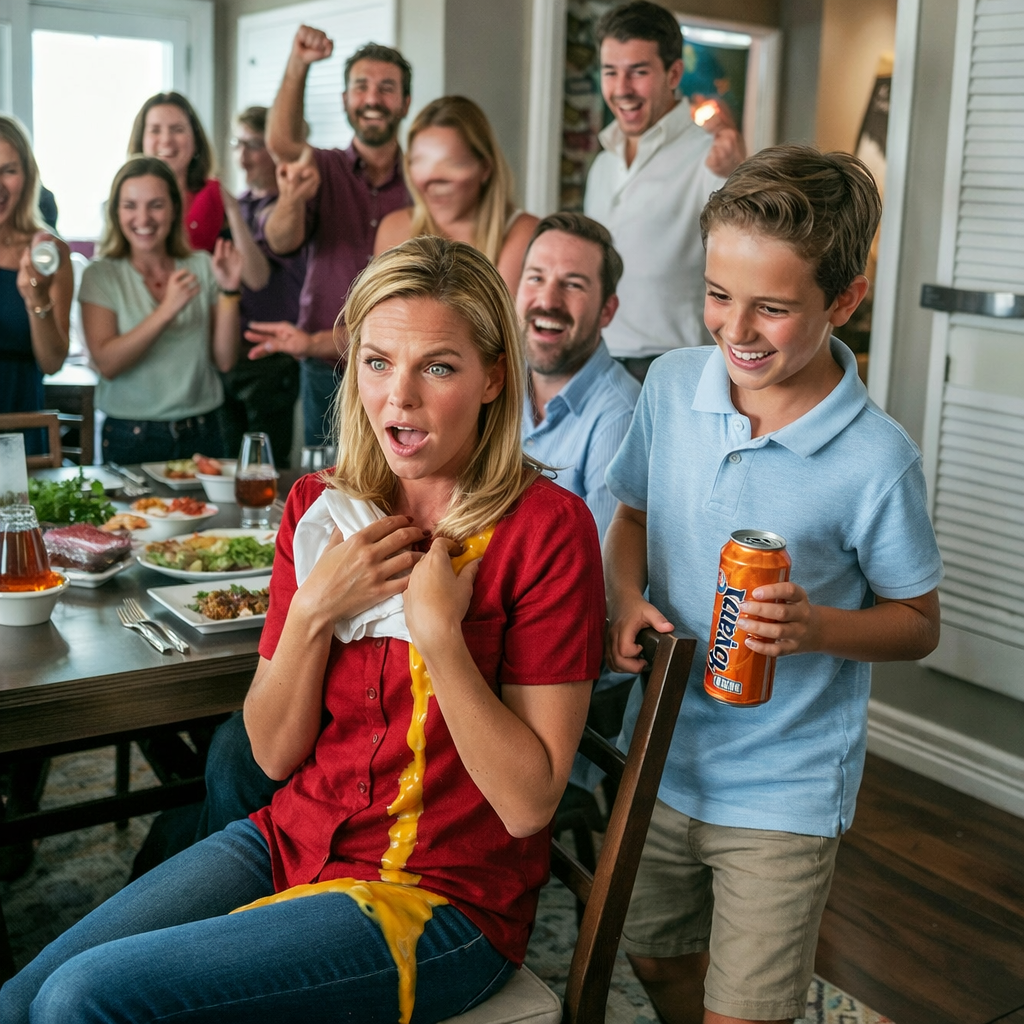
It began when Tyler stood up with a full cup of soda in his hand. He moved around the table with careless swagger, bumping shoulders, making side comments that drew laughs. He was performing. Everyone was watching. Everyone was encouraging it.
I watched from the corner of my eye.
At the last second, he pivoted and walked directly toward me.
“Tyler,” my mother called fondly. “Do not spill that, sweetheart.”
He stopped beside my chair. His eyes locked onto mine. He was smiling, but there was something sharp underneath. The same sharpness I had heard months earlier when he told his friends, “She used to be a mom, but she failed.”
“Hey, Aunt Steph,” he said now, voice light and singsong. “Grandma says you do not belong here.”
The words landed cleanly. Precisely.
Then he tipped the cup.
Cold soda poured into my lap, soaking the front of my dress instantly. I gasped as the shock hit my skin. Sticky sweetness spread down my thighs and dripped onto the floor.
For a single heartbeat, the room was silent.
Then it erupted.
Laughter. Loud. Unrestrained.
“Oh, Tyler,” Irene cackled.
“That is my boy,” Mike said proudly. “Savage.”
I grabbed a napkin with shaking hands. It tore immediately, leaving scraps of white clinging to the wet fabric. That only made them laugh harder.
I looked at Tyler. He stood there, chin lifted, eyes bright, waiting. Waiting to see if he would be rewarded.
I looked at my mother.
She was smiling. Not cruelly. Not kindly. Amused. As if she were watching a show she enjoyed.
Something inside me shifted.
I smiled.
Not the polite smile I had practiced my entire life. Something smaller. Sharper.
“Excuse me,” I said quietly.
I pushed my chair back, stood, and walked toward the bathroom. The fabric of my dress squelched with every step. In the mirror, my reflection looked like someone I almost pitied. Damp. Streaked mascara. Mouth pressed into a thin line.
“You do not belong here,” I whispered to myself.
The truth of it did not hurt. It felt clarifying.
When I stepped back into the hallway, the party had already moved on. Tyler was retelling the story with exaggerated gestures. “She did not even get mad. She just stood up.”
I walked past them toward the door.
My gift bag still sat on the sideboard, untouched. I stared at it for a moment. At the neat tissue paper. At the card that read, To Mom, with love.
I left it there.
“Heading out?” Mike called.
“Yes. Long day tomorrow.”
“Night, Mom,” I said.
“Mm hmm,” she replied without looking.
I stepped into the night air and closed the door on their laughter.
The humiliation should have crushed me.
Instead, I felt something else. A deep, steady tiredness. Not the exhaustion that followed my daughter’s death. A different kind. A tired that came with clarity.
By the time I got home and showered, my mind had settled. I sat at my dining table, opened my laptop, and pulled up my brother’s loan documents.
They were all there.
The business loan. The lease. The co signer forms.
My name, written carefully, everywhere.
I remembered my mother wringing her hands. “Family takes care of each other.”
Why was my name still holding up people who thought my humiliation was funny?
I clicked Contact Bank.
Less than an hour later, my name was gone.
I went to bed and slept better than I had in months.
At eight o clock the next morning, someone knocked on my door.
The knock came again before I finished my coffee.
Three sharp raps, impatient and heavy, like whoever stood on the other side already felt wronged. I set my mug down slowly, not startled so much as unsurprised. There was a calm in me that had not existed the day before, a strange steadiness that made even this feel inevitable.
When I opened the door, Mike stood on the landing, shoulders tense, jaw clenched so tightly I could see the muscle jumping beneath his skin. He looked like he had not slept. His hair stuck up in odd places, and his shirt was half buttoned, one sleeve rolled, the other forgotten.
He did not say hello.
“You need to fix this,” he said, stepping inside without waiting to be invited.
I did not move to stop him. I closed the door behind us and leaned against it, arms crossed loosely, watching as he paced my small living room like a trapped animal.
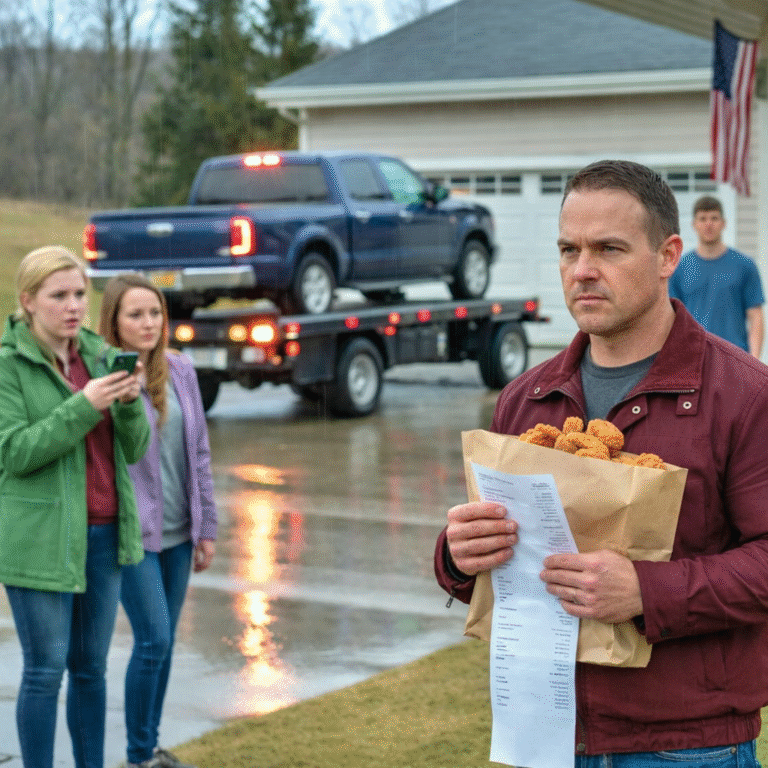
“The loan is frozen,” he said, waving a handful of papers. “They said the co signer pulled out. Payments bounced. They took the car this morning. A tow truck showed up while Tyler was getting ready for school.”
I pictured it instantly. The shiny car he bragged about at Thanksgiving. The one my name had helped secure. Hooked up and dragged away in front of neighbors. Tyler watching from the window, humiliated in a way he had clearly learned to enjoy inflicting on others.
“I am sorry that happened publicly,” I said.
He stopped pacing and stared at me. “Publicly? That is all you have to say? I am about to lose the shop. I have payroll. Tyler’s football fees. Mom’s insurance.”
There it was. The familiar list. Responsibilities presented like weapons. Proof that my needs were always secondary to everyone else’s emergencies.
I waited.
“You did this over a joke?” he demanded. “Over a stupid prank? He is a kid. You are really throwing us under the bus because you cannot take a joke?”
My stomach tightened, but my voice did not. “This is not about soda.”
“Then what is it about?” he snapped. “Because from where I am standing, you woke up and decided to destroy your own family. Over feelings.”
I thought of the graffiti Tyler had sprayed on my building last year. FAKE MOM, jagged and red. I thought of my mother saying he was just acting out. Boys will be boys. Grief makes people sensitive.
“This is about me not being financially responsible for people who think humiliating me is entertainment,” I said. “It is about boundaries.”
He laughed harshly. “Boundaries? You sound ridiculous. We are family. We do not do this to each other.”
“You do,” I said quietly. “You just do it to me.”
His face flushed. “You are ungrateful. Mom was right. You never got over losing her. You are stuck. And now you are taking it out on us.”
The words hit, but they did not break me. I had heard variations of them for years. My grief used as a convenient explanation for any resistance. Any discomfort I caused by existing.
“Get out,” I said.
He blinked. “What?”
“Get out of my apartment.”
“You are cutting us off?” he demanded. “Just like that?”
“My family turned its back on me a long time ago,” I replied. “I am just finally walking away.”
“You will regret this,” he said.
“Maybe,” I said. “But I already regret every time I stayed quiet.”
He left in a storm of muttered curses.
My phone lit up within minutes. Calls. Messages. Voice mails piling on top of one another. Pleading turned to bargaining turned to anger. Tyler posted a video mocking fake tears. Someone sent it to me with laughing emojis.
I blocked the numbers.
Instead, I went to my store.
The bell chimed as I unlocked the door and flipped the sign to OPEN. Morning light poured through the windows, catching on the shelves, the glass jars, the hand poured candles arranged carefully by scent and color. This place had started as a coping mechanism after my daughter died. Something small. Something quiet. Now it was mine, entirely.
Over the next two weeks, I untangled myself from everything.
The lease on Mike’s second location. The accounts connected to his wife’s boutique that used my credit. The vendor agreements signed in my name. One by one, I pulled myself free.
The fallout was immediate.
The boutique shut down. An eviction notice appeared on the second shop. Someone sent me a photo of it taped crookedly to the door.
Mike left seventeen voice mails in one day.
“You are going to end up alone,” one said. “You think that store is going to keep you warm when no one wants you?”
I forwarded everything to my lawyer.
Then came the sound of breaking glass.
I was closing up late when it happened. A sudden crash, sharp and violent. I froze, heart pounding, then grabbed my phone and pulled up the security feed.
The front window was shattered. Glass glittered across the floor. A rock sat in the center, a note wrapped around it.
You will be alone forever.
I called the police. I called my Uncle Ray.
Ray arrived within minutes, broad shouldered and steady, carrying plywood like it weighed nothing. He stood in the broken doorway while officers took photos.
“We press full charges,” he said calmly.
That night, I slept poorly but resolutely. The threat echoed in my head, but it no longer sounded like a curse. It sounded like projection.
The court date came faster than I expected.
I dressed carefully, choosing clothes that felt like armor without pretending to be anything else. Ray drove me, humming along to the radio like it was any other errand.
Inside the courtroom, the air was stale and heavy. Mike sat across the aisle, smaller than I remembered, his confidence stripped away. His lawyer shuffled papers nervously.
The evidence spoke clearly.
Video of Tyler with spray paint. Invoices with my forged signature. Screen recordings of the live stream where Mike ranted about my grief. Witness statements. Bank documents.
The judge listened patiently.
“This is not a simple family disagreement,” she said finally. “This is a pattern of exploitation and harassment.”
The ruling was swift. Damages awarded. Mandatory counseling. Community service.
When it was over, I walked out into the sunlight feeling lighter than I had in years.
The attacks did not stop immediately. Flower beds destroyed. Mailbox bent. Each time, I documented. Each time, the file grew thicker.
But life went on.
The store thrived. I hired help. I partnered locally. I was nominated for a regional award. Peace settled in slowly, replacing the constant tension I had mistaken for normal.
I did not hear from my mother directly. Only through whispers. She said I had turned cold. That grief had hardened me.
One afternoon, my employee told me a woman had stood outside the store for a long time earlier.
I checked the footage.
My mother stood there, clutching her purse, staring at the sign above the door. HART AND LILY.
My daughter’s name.
She did not come in. She turned and walked away.
I watched, then returned to work.
Because I finally understood something I had spent years trying to earn.
Belonging is not something you secure by enduring humiliation.
It is something you build where respect exists.
And for the first time, I knew exactly where I stood.
The harassment slowed, then sputtered out, the way a fire does when it finally runs out of oxygen.
Not because they apologized. Not because they understood. But because every attempt to reach me now hit a wall they could not push through.
Legal letters replaced phone calls. My lawyer handled them with methodical calm. Each envelope that arrived was another reminder that I was no longer reacting. I was responding. On my terms.
The last voicemail from Mike came two weeks after the court ruling. His voice was hoarse, stripped of its bluster.
“You don’t get it,” he said. “Mom’s not doing well. She doesn’t sleep. She barely eats. This whole thing broke her.”
I listened once. Then I deleted it.
I had spent years confusing responsibility with guilt. I was done carrying emotions that were never mine to manage.
Spring arrived quietly.
The boards came down from my storefront window, replaced with fresh glass that caught the sunlight and reflected the street back at itself. The scars were gone, but I kept the security cameras. Not because I lived in fear, but because I had learned the difference between trust and self-protection.
One afternoon, while I was rearranging a display, Uncle Ray stopped by with coffee. He leaned against the counter, scanning the shelves with approval.
“You look lighter,” he said.
“I feel quieter,” I replied.
He nodded, like that made perfect sense.
The lilies outside my apartment bloomed again that year. Brighter. Fuller. I knelt in the dirt one evening, replanting them carefully, pressing soil around the roots. I added one more bulb. Not for a year lived, but for a year survived.
I did not tell anyone why.
Tyler completed his community service over the summer. I heard about it through distant channels. Park cleanups. Graffiti removal. Mandatory counseling sessions he skipped until the court intervened again. I did not check his social media. I did not ask for updates.
Whatever he became was no longer my responsibility.
Mike’s second shop closed permanently. The first limped along for a while before being sold off. His wife moved back in with her parents. They stopped using my name when applying for anything. That, more than any apology, felt like progress.
Once, months later, Mike sent a message.
I hope you’re happy.
I stared at it for a long time before replying with a single sentence.
I am at peace.
That was the last exchange we ever had.
My mother never reached out directly.
Through relatives, I heard fragments. That she told people I had “changed.” That grief had “hardened” me. That I was no longer the daughter she recognized. At a distant cousin’s gathering I did not attend, someone mentioned she’d said my father would be ashamed.
The cousin who told me this looked uncomfortable. “I don’t believe that,” she said quickly. “Your dad was proud of you. Everyone knew that.”
I did know that. The certainty sat deep in my chest, solid and unmoving.
Late one afternoon, my employee Lila mentioned a woman had stood outside the shop again.
“She didn’t come in,” Lila said. “Just looked for a while.”
I waited until closing, then pulled up the camera feed.
There was my mother.
She stood on the sidewalk, purse clutched tightly in both hands, shoulders slightly hunched. She looked older than I remembered. Smaller. Her eyes moved slowly over the shelves, the counter, the framed photo near the register that customers sometimes asked about.
HART & LILY.
She stood there for nearly five minutes.
Then she turned and walked away.
I felt something loosen in my chest. Not forgiveness. Not grief. Just acceptance.
I went back to counting inventory.
Life settled into a rhythm that felt like my own.
Mornings began with coffee and quiet. Evenings ended with locking the shop door, checking the lights, and climbing the stairs to my apartment. I hosted monthly gatherings for women-owned businesses. The room filled with laughter, shared frustrations, shared victories. We traded advice. We traded numbers. We showed up for each other.
No hierarchy. No scapegoats. No one pouring soda in anyone’s lap for sport.
Sometimes, late at night, I thought back to the birthday table. To the moment Tyler looked at me and said I did not belong. The certainty in his voice. The approval in the room.
For years, I had believed belonging was something you earned by enduring enough discomfort. Enough silence. Enough humiliation.
I had been wrong.
Belonging is not granted by people who benefit from your erasure.
It is built where your presence is respected.
On quiet evenings, I sometimes sat at my dining table with a cup of tea, the window cracked open to let in the city air. I thought about my daughter. About the life she would have lived. About the woman I had become in the aftermath of losing her.
I no longer measured my worth by who stayed.
I measured it by how fully I showed up for myself.
The night Tyler poured soda into my lap, he thought he was exposing me. Embarrassing me. Putting me back in my place.
What he actually did was make something undeniable visible.
That table had never been mine.
And once I accepted that, I was free to build one of my own.
Now, when I lock the shop and turn off the lights, when I walk past the lilies blooming outside my building, when I sit in the quiet of my apartment and feel the steady peace of a life no longer negotiated away, I know something with complete certainty.
I belong here.
And that is enough.