The Sunday Dinner That Changed Everything
The taxi smelled like peppermint gum and old upholstery, the kind of worn-in scent that clings to fabric after years of strangers sliding in and out with winter coats and fast-food bags. The driver kept the heat too high, and the windows fogged at the edges while Chicago moved past in soft blurs of gray and amber streetlights.
I watched the city like it might offer me a way out.
My phone sat in my lap, dark and silent. I’d turned it face down as soon as I got in the cab, because I couldn’t stand the thought of another message from my mother arriving like a needle. Another casual demand. Another cheerful little shove that pretended not to be violence.
By the time we turned onto Maple Street, my stomach had settled into that familiar knot, the one that always showed up before Sunday dinner at my grandparents’ house. Not because I disliked them. I loved my grandparents. They were the only people in my family who made “How are you?” sound like it wasn’t code for “How are you performing?”
No, the knot came from the rest of it. The expectation. The roles. The way my parents brought their version of reality with them like a fog that filled every room.
The taxi slowed near the curb, tires crunching lightly over old salt and gravel. The meter beeped and the driver twisted around just enough to catch my eye in the mirror.
“That’ll be twenty-eight fifty,” he said.
I handed him cash. My fingers felt clumsy. I’d been that way all week, like my body didn’t trust my brain anymore.
When I stepped out, the cold hit the inside of my nose and made my eyes sting. The air smelled like damp leaves and chimney smoke. Somewhere nearby, a dog barked once and then stopped, like it remembered there were rules about noise in this neighborhood.
The taxi pulled away, yellow body gliding down the street, taillights shrinking into the bend. I watched it disappear and felt, stupidly, as if I’d just watched my last escape route vanish.
I turned toward my grandparents’ house.
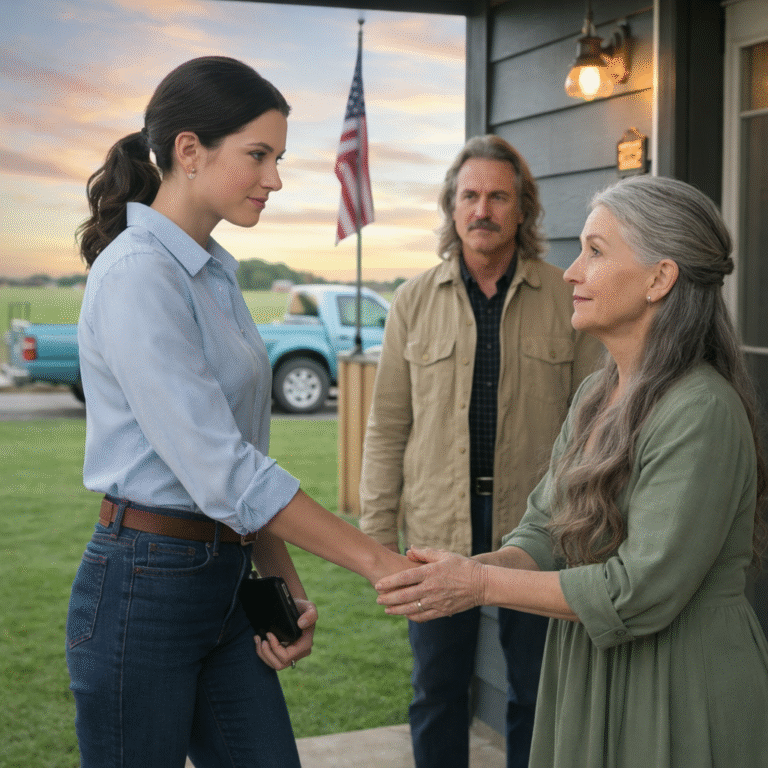
It sat exactly the way it always had, calm and solid, with the porch light glowing warm against the dusk. The porch railings were painted white, though the paint had chipped in places where time insisted on showing itself. A wreath hung on the door even though it wasn’t quite the season yet. Grandma Dorothy loved early decorating. She said it made the house feel “ready.”
Ready for what, I wasn’t sure.
I climbed the three wooden steps. The boards creaked under my shoes with a sound I’d known since childhood. I lifted my hand to knock.
The door swung open before I touched it.
Grandpa Walter stood there in a dark cardigan, sleeves pushed up slightly like he’d been washing dishes or sorting something in the kitchen. His face was weathered in a way that made him look carved rather than aged, lines deep around his mouth and eyes, gray eyebrows always slightly raised as if he was silently evaluating the world.
He broke into a smile that looked real for the first second, and then his expression shifted.
Confusion.
His eyes flicked past me to the curb.
Then back to me.
“Buddy,” he said, still smiling but now squinting, as if he was trying to bring something into focus. “Why did you come by taxi? What happened to the BMW we gave you for your twenty-second birthday?”
The question hung in the air like it had weight. Like it wasn’t just a question about transportation but about something much bigger.
My throat tightened. I could feel the heat rise in my chest, that panicky warmth that always came when someone asked a reasonable question and I didn’t have a clean answer.
I opened my mouth to speak.
Before I could, my mother’s voice floated from deeper inside the house, bright and sweet and sharpened at the edges.
“That car belongs to his sister now.”
Her words carried like she’d intended them to. Like she was proud of how casually she could drop a bomb.
I stood there on the porch with the cold creeping through my shoes and my grandfather’s eyes fixed on me, and I felt something inside me tilt.
Grandpa Walter’s smile faded slowly. Not dramatically. Just… gone. The way sunlight disappears behind a cloud.
He looked past me again, as if the BMW might be parked behind the taxi like a trick. Then he looked back at me, and the confusion on his face transformed into something deeper. Something that made my stomach twist with both hope and dread.
I stepped inside, because that’s what you do. You walk into the family house. You walk into the warmth. You walk into whatever is waiting for you.
The air smelled like roast chicken and gravy and Grandma’s lemon cleaner. The familiar scent hit me with a sudden ache. My grandparents’ house always smelled like safety.
My mother appeared in the hallway, wiping her hands on a dish towel she didn’t need. Her hair was styled like she’d been preparing for company, and she wore a pleasant expression that didn’t match the sharpness of her words.
My father stood behind her, hands in his pockets, shoulders set. He didn’t smile. He never smiled at Sunday dinners unless Emma did something amusing.
“Jared,” my mother said, as if nothing unusual had happened. “You made it.”
I nodded. My mouth felt dry.
Grandpa Walter didn’t move from the doorway. He stayed there, still, like his body had decided it needed a second before it could step forward into whatever this was.
“The BMW,” he said again, and his voice had changed. It wasn’t confused now. It was measured. “Belongs to Emma.”
My mother’s smile widened. “Yes. Emma needed it more.”
Grandpa blinked slowly.
I could see him thinking. It was in the way his jaw tightened, the way his eyes narrowed slightly, the way his gaze traveled over my mother’s face as if he was trying to read the truth beneath her performance.
And in that moment, I felt something that surprised me.
Not just anger.
Not just humiliation.
Relief.
Because for the first time, someone else had heard it said out loud. Someone else had witnessed the casual theft. Someone else had been forced to confront it in real time, without my mother’s careful framing.
Six months ago, that BMW had felt like proof that fairness was possible in my family.
I remembered the day they gave it to me with a clarity that still made my chest tighten. March fifteenth. My twenty-second birthday. A Sunday dinner just like this, the living room lit by a lamp with a faded shade, Grandma Dorothy’s apple pie cooling on the counter. The smell of cinnamon mixing with the faint scent of old furniture polish.
Grandpa had called me into the living room with a grin like he was letting himself enjoy a secret. Grandma stood beside him, hands clasped, her cheeks flushed.
“There,” Grandpa had said, pointing through the window to the driveway. “Look outside.”
I’d gone to the window and seen it. Black paint shining, clean lines, the car sitting there like it belonged in a better life than mine.
I’d turned around, stunned.
Grandpa had held out the keys. They’d felt heavy in my palm. Not heavy like metal. Heavy like meaning.
“Every grandchild deserves something special when they come of age,” he’d said. “Your sister got her car at eighteen for graduation. This is yours. Fair and square. Fair and square.”
He’d repeated it, like he wanted the words to sink into the walls.
Fair and square.
It had lodged in my brain because fairness wasn’t the language my parents spoke.
My parents had their own system, one built around Emma’s orbit. Emma’s needs. Emma’s dreams. Emma’s sensitivities. Everything else revolved around keeping her comfortable, keeping her uplifted, keeping her from feeling the weight of consequences.
I didn’t blame Emma when we were kids. Not at first. When we were little, it was just… the way things were. Emma cried, and my mother rushed in. Emma demanded, and my father figured out a way. Emma got praised for small wins, and I got told to stop fishing for compliments.
By the time we were teenagers, the pattern had grown teeth. Emma learned how to weaponize it. Learned how to tilt her head, how to let her voice wobble, how to say, “I’m just trying my best,” while she took whatever she wanted.
And my parents reinforced it, again and again.
“She’s sensitive,” my mother would say.
“She needs support,” my father would add, as if support meant unlimited access to everyone else’s resources.
I became “the easy one,” which was just a prettier phrase for “the one who won’t cause trouble.”
When I got into the engineering program, my parents acted pleased in the way people act pleased when something is expected. Like it was not a triumph, just the natural outcome of me being “the smart one.” When I mentioned tuition, my father said, “You’ll figure it out.”
Emma, meanwhile, announced a marketing program and immediately had family money arranged around it like a cushion.
I worked. I borrowed. I lived on cheap meals and late nights. I told myself it was fine because I had a plan. Engineering paid well. I would graduate, pay off loans, become independent.
And then the BMW arrived like a strange blessing, a symbol that at least my grandparents saw me as worth something.
I drove it carefully at first, terrified someone would tell me it wasn’t really mine. I kept the interior spotless. I parked far away from other cars. I did everything right.
Then three weeks ago, everything changed.
Emma crashed her red Honda Civic into a telephone pole while texting. That’s what I was told, at least. The story arrived in bits, as these stories always did. First a frantic call from my mother.
“Emma had an accident,” she’d said, voice trembling with drama.
I’d pictured blood. Ambulances. Hospitals.
Then, after a pause that felt too long, she added, “She’s fine. Just shaken up.”
The next day, Emma showed up at my apartment near campus with tears streaming down her cheeks. She looked beautiful even while crying, which was part of her talent. Mascara in soft smudges that somehow made her eyes look bigger. Lip gloss still intact. Hair in that casual, styled mess that looked effortless but wasn’t.
“Jared,” she’d said, and her voice had that tremor I knew too well. “I need your help.”
I stood in my small living room with my backpack still on the floor, textbooks stacked on the coffee table, my whole life arranged in a cramped space that smelled like laundry detergent and stale coffee.
“Help how?” I’d asked, already knowing.
“My car is totaled,” she said, sniffing. “Insurance is being awful. They’re dragging their feet. And I can’t get to work. I can’t get to my program. I can’t… I can’t do anything.”
She looked at me like I was the only pillar holding up her world.
“Mom says you should let me borrow the BMW,” she added quickly. “Just temporarily. Just until the insurance comes through.”
Temporarily.
The word landed, and I felt that old, familiar pressure in my chest. The pressure of being the one expected to solve the crisis.
“Emma,” I’d said, trying to sound reasonable, “that car was a gift. From Grandpa. It’s mine.”
“I know,” she’d said, too quickly. “And I’m not taking it. I’m borrowing it. Please, Jared. I’m your sister.”
She’d reached for my hand. Her fingers were cold. She squeezed like she was anchoring herself to me.
“It’s just for a little while,” she’d whispered. “I swear.”
My brain had flashed through images. My mother’s anger if I refused. My father’s disappointment. The family narrative: Jared won’t help his sister. Jared is selfish. Jared thinks he’s better than us.
I’d been raised on that narrative like it was air.
So I handed her the keys.
I told myself I was being kind. I told myself it was temporary. I told myself it was what a good brother did.
And then the BMW didn’t come back.
At first, it was excuses.
“Work has been crazy.”
“Insurance is still pending.”
“I’ll drop it off this weekend.”
Then my mother stopped even pretending it was temporary. She started referring to the BMW as Emma’s, casually, in conversation, like she was rewriting reality by speaking it.
I should have acted sooner. I know that now. But when you grow up inside a system like mine, you don’t always recognize theft when it’s dressed up as family obligation. You don’t always recognize fraud when it’s wrapped in a smile.
Three days ago, something shifted. I got a notice in the mail. An official-looking envelope from the state.
I opened it with a strange feeling, like my skin knew before my brain did.
Inside was paperwork about title changes. Ownership. Transfer. My name, printed, and beneath it a signature that looked like mine, but wasn’t. The strokes were too smooth. Too confident. Like someone who had practiced.
My stomach had dropped so hard I thought I might throw up.
I went to the DMV the next morning, because denial only lasts so long when paper tells you the truth.
The DMV smelled like old carpet and tired breath. The fluorescent lights made everyone look washed out. I waited in line behind a man arguing about plates, behind a woman bouncing a crying baby on her hip, behind a teenager staring at his phone like he was trying to disappear.
When it was finally my turn, I slid the paperwork across the counter and asked the clerk, voice tight, “Can you tell me what this is?”
She typed, clicked, frowned slightly.
Then she looked up and said, “The vehicle is registered to Emma Patterson.”
My pulse roared in my ears.
“That’s not possible,” I whispered.
She shrugged in that bored way people shrug when they see things all day that aren’t their problem. “Title transfer was processed three weeks ago. Signature matches file.”
“It’s forged,” I said, and my voice shook. “I didn’t sign anything.”
She raised her eyebrows, finally attentive. “Then you’ll need to file a fraud report.”
A fraud report.
The words felt unreal. Like they belonged to someone else’s life.
I walked out of the DMV feeling like I wasn’t fully in my body. I sat in my taxi afterward because I didn’t know where else to go. I stared at my hands and tried to understand how my family had turned my life into a crime scene.
And now I stood in my grandparents’ hallway, and my mother was saying, casually, “That car belongs to his sister now,” like she was talking about a sweater she’d loaned out.
Grandma Dorothy’s voice floated from the dining room. “Dinner’s almost ready. Come in, all of you.”
Her voice had that gentle authority that always made people behave, at least on the surface. I loved her for it. I also hated that she had to use it.
Grandpa Walter finally stepped forward, ushering me inside with a hand on my shoulder. His palm was warm through my jacket.
He didn’t say anything else yet. But I could feel his silence like a presence.
We moved into the dining room.
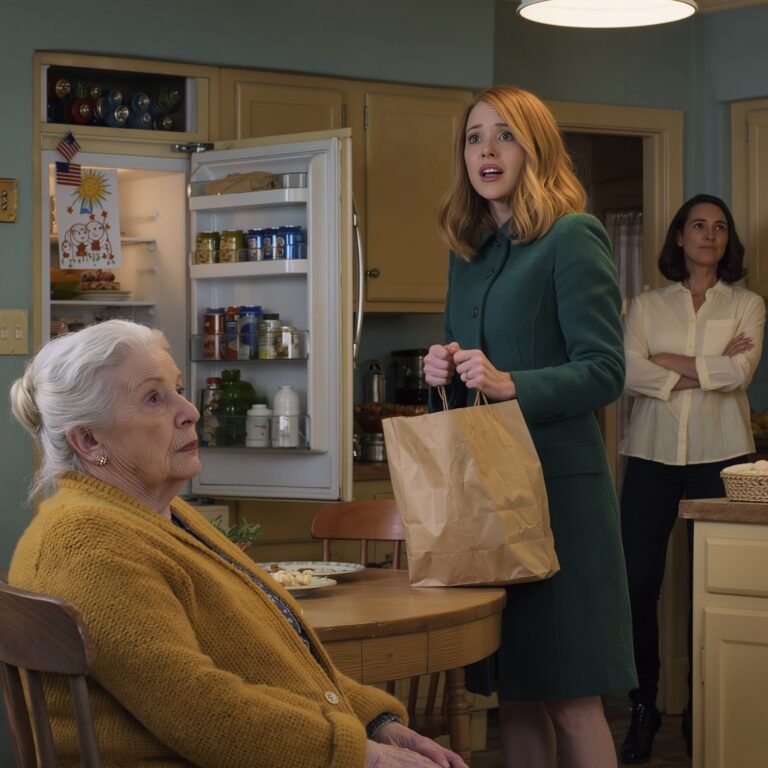
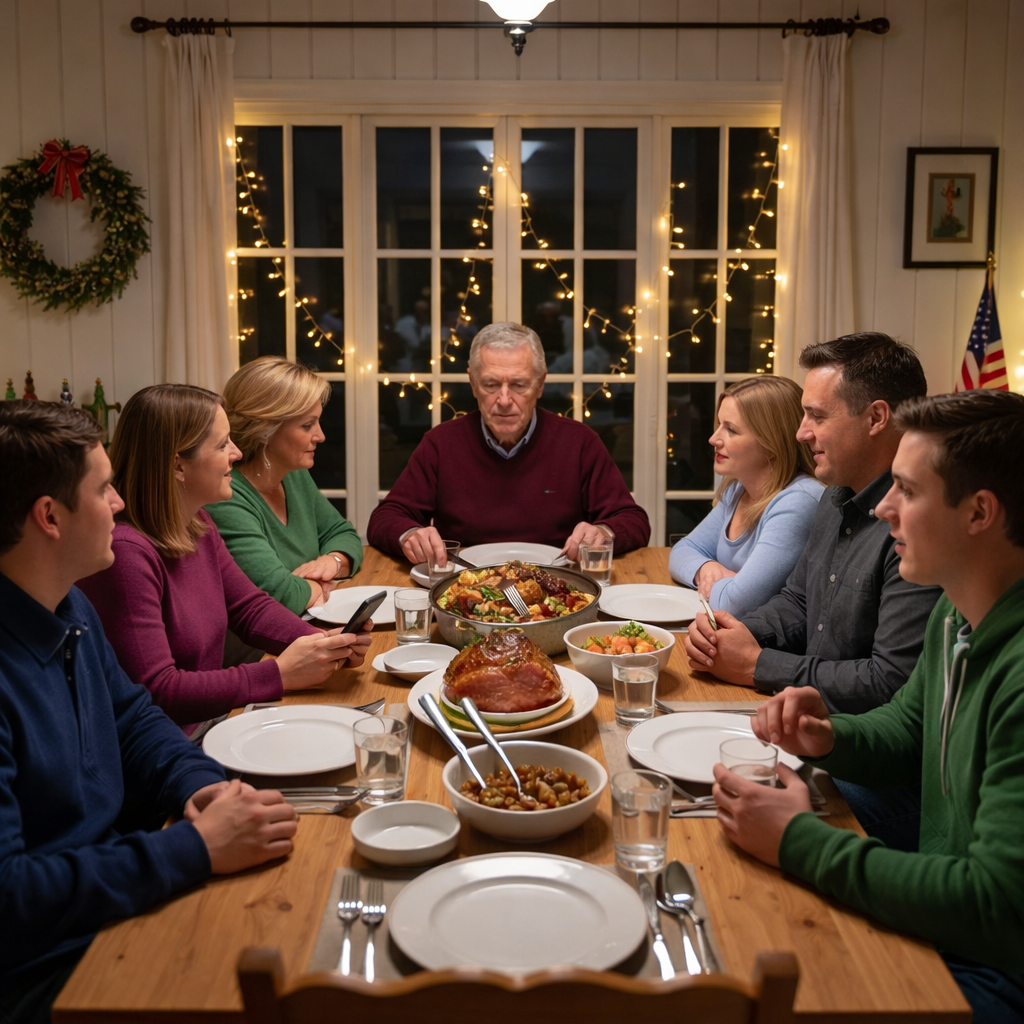
The table was set with Grandma’s good china, cream-colored plates with tiny blue flowers. Silverware lined up neatly. A bowl of mashed potatoes steaming in the center. Roast chicken shining under the overhead light. The whole room smelled like butter and thyme and the kind of home cooking that makes you want to believe everything will be okay.
My parents sat as if nothing was wrong.
My mother smoothed her napkin across her lap. My father poured himself water. They had always been excellent at pretending their choices were normal.
Emma’s chair was empty, which wasn’t unusual. Emma operated on her own schedule. When she was late, it was because she was busy, important, living. When I was late, it was because I was inconsiderate.
I sat down and tried to steady my breathing.
Grandpa Walter sat across from my parents, posture straight. Grandma Dorothy sat beside him, hands folded for a moment before she reached for the serving spoon.
“So,” Grandpa said, voice mild, passing the mashed potatoes toward me first, which was a small kindness I noticed sharply. “How’s school, Jared? Engineering still treating you like a punching bag?”
I almost smiled. It was one of his jokes, the kind he delivered deadpan.
“It’s good,” I said. “Hard. Expensive. I’m managing.”
My father looked up, chewing slowly. “Engineering pays well. You’ll be fine.”
There it was. The assumption. The dismissal. The idea that because I was capable, I was also responsible for absorbing whatever was taken from me.
“The loans are pretty brutal,” I added, careful. “I’m working, but it’s a lot.”
My mother waved a hand as if brushing away a fly. “You’re smart, Jared. You always figure things out.”
Grandpa Walter’s fork paused midair. “Student loans,” he repeated, and his eyes sharpened slightly. “I thought the college funds were set up.”
My mother’s shoulders stiffened, just a fraction. “They were.”
“And?” Grandpa asked.
My parents exchanged a look, the kind married couples exchange when they’re choosing a script. Their faces settled into the same expression, neutral and united.
“Well,” my mother said, voice careful, “Emma needed more support. Her graduate program is expensive. Marketing is competitive. We used family funds to help her.”
My fork slipped from my hand and clattered against the edge of my plate. The sound rang too loudly in the quiet.
Grandma Dorothy’s eyes flicked to me. Concern, immediate and soft.
“What family funds?” Grandpa Walter asked, and his voice was quiet now. Too quiet.
My mother’s smile returned, tight. “The college fund.”
Grandpa Walter stared at her. “Which college fund.”
She hesitated, then said it like it was obvious, like she didn’t understand why anyone would question it.
“The one you set up for both of them,” she said. “Twenty-five thousand each. Emma used hers, and… she needed Jared’s too.”
My throat went tight. The room felt suddenly too warm, like the air had thickened.
“My college fund,” I said, and my voice sounded strange, like it belonged to someone else. “You used my college fund for Emma.”
My father set his fork down with a small click. “Jared, you’re in engineering. You’ll pay off loans easily. Emma needed the advantage.”
“The advantage,” I repeated, tasting the bitterness.
Grandma Dorothy leaned forward slightly. “Sarah,” she said softly, “did you tell Jared about this?”
My mother’s chin lifted. “We’re the parents. We make decisions about what’s best.”
Grandpa Walter’s face didn’t change much, but I saw his jaw tighten. His hand, the one holding his fork, trembled slightly, as if he had to actively keep it steady.
“And the car?” he asked.
My mother’s eyes flicked toward me, then away. “Emma needed transportation.”
“She crashed her car,” I said, and my voice sharpened despite my effort. “While texting. And instead of making her deal with the consequences, you took mine.”
My father’s expression hardened. “Don’t speak about your sister like that.”
“Speak about her like what?” I asked. “Like someone who makes choices and then expects everyone else to pay for them?”
“Jared,” Grandma Dorothy murmured, warning and pleading at the same time.
I pressed my lips together and forced myself to inhale slowly. My heart was pounding so hard it made my ears ring.
A few seconds passed. The grandfather clock in the hallway ticked steadily, counting out the silence.
Then we heard the front door open.
Keys in the lock. A gust of outside air. Emma’s voice already rising in the entryway, bright and breathless.
“Sorry I’m late!”
She appeared in the dining room like she always did, taking up space as if it belonged to her. Her blonde hair looked perfectly styled in a way that suggested she’d been at a salon, not rushing over. Her outfit was effortlessly expensive, jeans that fit like they’d been tailored, leather boots that made a confident sound against the hardwood.
“Traffic was insane,” she said, not sounding sorry at all. “But guess what? Madison and I planned the most amazing thing. Like, life-changing.”
My parents’ faces lit up instantly. My mother practically glowed. My father’s mouth softened into something that might have been pride.
Emma dropped into her chair and started serving herself food as if she hadn’t just walked into a room crackling with tension.
“Three months,” she announced, waving her fork like a wand. “Three months in Europe. Paris, Rome, Barcelona, London. Everything. It’s going to be incredible.”
Grandma Dorothy’s eyebrows lifted. “Three months is a long time.”
Emma laughed. “It’s an investment in myself. My boss totally gets it. She said travel is basically professional development.”
Grandpa Walter didn’t smile. He watched her like he was studying a spreadsheet.
“And how are you funding this?” he asked.
Emma’s face brightened even more, as if this was the best part. “Oh, that’s the genius thing. I’m selling my BMW.”
The words landed like a dropped plate.
My mother took a sip of water too quickly. My father’s eyes snapped to Grandpa, then back to Emma.
Emma continued, oblivious. “I found a buyer who’s offering thirty-two thousand. Which is perfect because I calculated I need about twenty-eight for the whole trip, so I’ll have four left for a down payment on something fun when I get back. Maybe a convertible. I’ve been looking at these adorable little Mercedes.”
Silence.
Not the polite kind. The kind that makes your skin prick.
“My BMW,” Grandpa Walter repeated, very quietly.
Emma finally looked up, sensing the room’s temperature. “Well, technically it’s Jared’s name on some old paperwork,” she said with a dismissive wave, “but Mom explained it was always meant to be mine anyway. I mean, Jared barely drives it. He’s always taking the train or biking. It just sits there.”
I felt something hot and sharp in my chest. Rage, yes, but also disbelief at her confidence. At the way she could rewrite reality and truly expect everyone to nod along.
“I barely drive it because you’ve had it for three weeks,” I said.
Emma smiled triumphantly like she’d caught me proving her point. “See? You don’t even miss it. Plus, I already promised the buyer we’d close tomorrow. He’s coming with cash. Noon. Done.”
Grandpa Walter stared at her, expression unreadable.
“And you believe you have the legal right to sell this car,” he said.
Emma’s lips pursed. “Mom handled the title transfer. It’s fine.”
My mother jumped in quickly, voice bright. “We took care of it weeks ago. It was simpler for Emma to have clear ownership rather than dealing with borrowing paperwork.”
“Without consulting Jared,” Grandma Dorothy said, her voice still gentle but now edged with something firmer.
“Jared understands,” my father said. “He’s always been reasonable about family decisions.”
Reasonable.
The word hit me like a bruise pressed too hard.
Emma scrolled through her phone and turned it so Grandpa could see pictures of convertibles. “Look at this one. Isn’t it gorgeous? Red is my favorite.”
Grandpa didn’t look at the phone.
He looked at me.
And in that glance, I felt the question he wasn’t asking out loud yet.
Is any of this true?
Are you okay?
How deep does this go?
I swallowed hard.
Grandma Dorothy set her fork down. “Emma,” she said softly, “have you already spent money from the sale?”
Emma shrugged. “I booked my flight to Paris. First class. Life’s too short to be cramped for eight hours.”
My stomach twisted. First class. Europe. Thirty-two thousand in cash from a car she hadn’t earned, from a title she didn’t legally have.
“You spent money you don’t have yet,” Grandma Dorothy repeated, incredulous.
“It’s called planning ahead,” Emma said, as if Grandma were being childish. “The buyer is totally reliable. Madison’s dad knows him.”
Grandpa Walter pushed his chair back. The legs scraped against the floor, loud in the silence.
“Excuse me,” he said. His voice was calm, almost too calm. “I need to check something in my office.”
He stood and walked down the hallway, footsteps steady.
As he disappeared, I caught Grandma Dorothy’s eye.
She looked at me with something I’d never fully seen from her before. Not just concern.
Recognition.
Like she was finally seeing the shape of the pattern. The cost.
My mother tried to fill the space with forced normalcy.
“So, Jared,” she said brightly, reaching for the gravy, “how are classes?”
I didn’t answer. I couldn’t. The room felt like it was vibrating.
Emma kept talking, undeterred, about museums and train passes and how she wanted to “find herself” in Italy. My father nodded along as if she were describing a scholarship she’d earned.
I sat there with my hands clenched under the table, nails biting into my palm, and waited.
Fifteen minutes passed. Maybe more. The grandfather clock kept ticking.
Then Grandpa Walter returned.
He carried a thick manila folder.
The kind you don’t casually carry to the dinner table unless you’re bringing something that will change the room.
He set it down beside Grandma’s good china with deliberate care.
My mother’s nervous laugh popped out too fast. “Walter, what’s that?”
“Documentation,” he said simply.
He opened the folder.
Inside were neatly organized papers, arranged in sections with tabs. Bank statements. Photocopied checks. Official forms. A ledger in Grandpa’s handwriting.
My father’s fork clinked against his plate.
Emma stopped scrolling.
Grandpa put on his reading glasses like he was about to do taxes, and his voice stayed calm as he said, “Let me show you what I’ve discovered.”
And for the first time all night, I felt truly proud of him before he’d even finished the first sentence.
Grandpa Walter didn’t rush.
That was the first thing I noticed as he sat back down at the table, adjusted the folder so it was perfectly aligned with the edge of the placemat, and folded his hands on top of it. He didn’t look angry. He didn’t look smug. He looked focused, the way he used to when I was a kid sitting in the waiting room of his accounting firm, watching through the glass as he calmly dismantled someone else’s financial disaster with nothing but a calculator and patience.
The room had gone very still.
Even Emma had stopped moving.
“Over the past few months,” Grandpa began, “I’ve noticed a few inconsistencies. Nothing dramatic at first. Just… patterns. And patterns are hard to ignore when you’ve spent four decades looking for them.”
My father shifted in his chair. My mother crossed her arms, the dish towel still clutched in one hand like a shield.
“Walter, if this is about the car—” my mother started.
“It’s not just about the car,” Grandpa said gently, cutting her off without raising his voice. “The car was simply the most visible symptom.”
He opened the folder and pulled out the first document.
“Let’s start small,” he said. “Birthday checks.”
He slid a photocopy across the table toward my parents, then another toward Emma, and finally one toward me.
“Every year since Jared turned seventeen, Dorothy and I have sent him a birthday check. Five hundred dollars. You’ll notice the endorsement signature on the back.”
My eyes dropped to the page.
The handwriting wasn’t mine.
It was Emma’s.
Clear as day.
My stomach flipped.
“I… what?” I whispered.
Grandpa nodded. “I had the same reaction when I noticed it. At first I assumed it was a banking error. So I checked the next year. And the year after that.”
He laid them out in a neat row. Five checks. Five endorsements. All signed “E. Patterson.”
My mother inhaled sharply. “That’s ridiculous. Emma would never—”
“Mom said it was easier,” Emma blurted out, color flooding her cheeks. “She said Jared hated going to the bank and that she’d give him cash later.”
I stared at her.
“You never gave me cash,” I said.
Emma looked away. “I… I forgot.”
Grandpa didn’t react. He simply reached back into the folder.
“Christmas money orders,” he continued. “Two hundred fifty dollars each December. Intended for Jared’s textbooks.”
More papers slid across the table.
Every single one endorsed by Emma.
Grandma Dorothy covered her mouth with her hand. A soft sound escaped her, not quite a gasp, not quite a sob.
My father’s face had gone gray.
“That’s not how it happened,” my mother said, too quickly. “We were managing things. It was family money.”
“Money intended for Jared,” Grandpa corrected.
He flipped another page.
“College funds. Twenty-five thousand dollars per child, set aside years ago. Sarah, David, you were trustees. That came with responsibilities.”
My father leaned forward now, elbows on the table, voice tight. “We redistributed it where it was needed.”
“Without consent,” Grandpa said. “And without disclosure.”
He turned to me.
“Jared,” he said, “do you remember signing anything authorizing the transfer of your college fund?”
“No,” I said immediately. “I didn’t even know it was gone until tonight.”
Grandpa nodded as if confirming a calculation.
“That aligns with what I found.”
He pulled out another document, this one thicker, stamped, official.
“This,” he said, “is the title transfer for the BMW.”
My chest tightened.
“The transfer date is three weeks ago,” he continued. “The signature appears to be Jared’s.”
Emma’s chin lifted. “Because it is.”
Grandpa looked at her calmly.
“On that date, Jared was admitted to Northwestern Memorial Hospital with acute appendicitis.”
The room froze.
“I have the medical records,” Grandpa added, almost conversationally. “Time-stamped. Surgery under general anesthesia.”
My mother’s mouth opened. Closed.
“That’s impossible,” Emma whispered.
“On the contrary,” Grandpa said. “It’s quite possible when someone forges a signature.”
The word forge landed like a dropped glass.
My father pushed his chair back slightly. “Walter, you’re blowing this out of proportion.”
“Am I?” Grandpa asked.
He turned the folder around so everyone could see the ledger inside.
“I added it all up,” he said. “Birthday checks. Christmas funds. The college account. Smaller gifts. Money orders. Transfers.”
He paused.
“Sixty-three thousand, four hundred dollars.”
The number echoed in my head.
Sixty-three thousand dollars.
Money I’d worked around. Borrowed around. Stressed around. Money that could have erased my debt, my anxiety, my constant fear of one emergency ruining everything.
My vision blurred.
“That’s not possible,” my father said weakly.
“It is,” Grandpa replied. “And that’s before penalties and interest.”
Emma’s hands trembled. “I didn’t know it was that much.”
“But you knew it wasn’t yours,” Grandpa said quietly.
Silence swallowed the room.
My mother’s composure finally cracked.
“You’re acting like she robbed a stranger!” she cried. “She’s our daughter!”
“And he’s your son,” Grandma Dorothy said for the first time in a voice that shook with anger. “And you let this happen.”
My father stood abruptly.
“This conversation is over,” he said. “Walter, Dorothy, you’ve crossed a line.”
Grandpa didn’t flinch.
“No,” he said. “You did. Years ago.”
He reached into the folder one last time.
“There’s something else you should know,” he said. “I contacted the authorities.”
Emma gasped.
“You what?”
“I filed a report,” Grandpa said. “Financial crimes division. Fraud. Forgery. Identity theft.”
My mother staggered back a step as if struck.
“You can’t do that,” she whispered. “She’s your granddaughter.”
“She’s also an adult,” Grandpa replied. “And adults face consequences.”
My father’s voice rose. “You’re tearing this family apart!”
“No,” Grandpa said evenly. “I’m stopping the rot.”
He turned to me then, his eyes softening.
“I asked Jared if he wanted to proceed,” he said. “I didn’t do this behind his back.”
All eyes swung to me.
My throat closed.
I thought of the DMV clerk. The forged signature. The loans. The nights awake calculating how to survive.
“Yes,” I said quietly. “I agreed.”
Emma looked at me like she didn’t recognize me.
“You’d let them arrest me?” she whispered.
“I’d let you face what you did,” I replied. “For once.”
The doorbell rang.
Sharp. Loud.
Everyone flinched.
Grandpa glanced at his watch. “Right on time.”
Through the front window, the blue and red reflection pulsed against the wall.
Emma’s breath came in short, panicked bursts.
“No,” she said. “No, no, no.”
My mother collapsed into a chair.
My father stared at the door as if sheer will might make it disappear.
Grandpa stood.
“I’ll get it,” he said calmly.
As he walked down the hallway, Emma turned to me, eyes wild.
“Jared,” she said, grabbing my arm. “Please. I’m your sister.”
I gently removed her hand.
“And I’m done protecting you from yourself.”
The door opened.
Voices. Calm. Professional.
Grandpa stepped aside.
Three months later, the BMW sat in my apartment building’s garage, legally mine again. The title rested in my desk drawer. My loans were shrinking. My life felt… quiet.
Emma took a plea deal. Restitution. Community service. Mandatory counseling.
My parents faced civil penalties and mandatory financial counseling. Their anger burned hot for a while, then cooled into something like shame.
Family dinners changed.
Smaller. Quieter. Real.
One night, Grandpa and I sat on his porch, watching the sun dip low.
“You did the right thing,” he said.
I nodded.
For the first time in my life, I believed it.