The Day My Parents Sold My Daughter’s Precious Heirloom and Built a Pool With the Money
Something felt wrong the moment we pulled into my parents’ driveway that humid June afternoon in suburban Indianapolis.
You can sense change in a house before you even step inside. Fresh paint, sawdust, that sharp chemical smell from home improvement stores lingering in the air. The cicadas screamed in the trees along the quiet cul-de-sac where American flags hung on porches and someone was already firing up their grill for the weekend.
My eleven-year-old daughter Lucy climbed out of the car with her backpack, music binder, and a small tin of rosin. Everything felt light and normal because the most important thing, her cello, was already inside waiting for her in my grandmother’s old music room.
Waiting. That was the word I didn’t yet understand would become painful.
Lucy had been looking forward to practice all day. Not in the way kids look forward to chores they have to complete. In the way that said this is mine, this matters to me. She’d been humming softly in the passenger seat during the drive, tapping rhythms on her knees, already halfway into that focused world she disappears into when she plays music.
“Do you think Great-Grandma will be there today?” she asked as we walked up the path, pulling her ponytail tighter with nervous energy.
“She’s at her new place,” I said gently. “Not today, sweetheart. We’ll call her later though.”
Lucy nodded, but her eyes stayed hopeful, like maybe my grandmother had changed her mind overnight and returned to the house because she missed the familiar rhythms of family life there.
We stepped onto the wide front porch with its rocking chair my mom had bought from a catalog because she liked how traditionally American it looked. I unlocked the front door with my key. I have one, not because I’m especially trusted by my parents, but because I’m useful to them.
There’s an important difference between those two things.
One gets you genuine love and respect. The other gets you access codes and errand requests.
The second I opened the door, I heard it. A muffled whine of power tools somewhere in the back of the house. And that smell. Absolutely fresh paint and something chemical, something that announced very clearly that someone had spent significant money they hadn’t mentioned to anyone.
Lucy’s face brightened with innocent excitement. “Are they fixing up the music room?”
I didn’t answer right away. My brain was doing that slow processing thing it does when reality doesn’t match what you expected.
We stepped inside. A protective tarp covered the hallway runner like the house was being prepped for surgery. Cardboard boxes lined the walls. Someone had taped off the entryway with blue painter’s tape, which is the polite way of saying don’t touch anything while we make changes you have no say in.
Lucy tiptoed down the hall carefully like she was in a museum where she wasn’t quite sure of the rules.
“Mom?” I called out, loud enough to reach whatever part of the house my mother was currently managing from.
No answer came back.
Lucy drifted toward the back windows that overlooked the yard. A second later I heard her gasp in surprise.
“Whoa.”
I walked over and followed her gaze through the glass. My stomach dropped hard.
The backyard looked like it had been surgically opened and rearranged. A large rectangle had been carved out where grass used to grow. Piles of dirt sat like small brown mountains waiting to be hauled away. Wooden forms ran along the edges, metal rebar stuck up in organized grids, and stacks of stone pavers waited on wooden pallets. It wasn’t finished yet, but it also wasn’t subtle.
A swimming pool.
A full-sized, in-ground, suburban dream swimming pool. Because why quietly improve your property when you can broadcast your success to the entire neighborhood with heavy machinery, contractor trucks, and a massive concrete hole in your yard?
Lucy blinked several times, processing. “Is that for us?”
There was so much innocent hope in her young voice that in that moment, I hated everyone I was related to.
“I don’t know, honey,” I said carefully. “Let’s get your cello first.”
We walked down the hall toward the music room, the space that had always been my grandmother’s territory even when she lived with my parents. That room had been her sanctuary in this Midwestern split-level home. Temperature controlled, carefully maintained. The humidifier hummed quietly in the corner. Shelves were packed with old sheet music and scores from orchestras in Chicago and St. Louis decades ago. There was even a lock on the storage cabinet because my grandmother understood human nature better than most.
Lucy loved that room. She said it smelled like wood polish and peppermint tea. I always thought it smelled like someone who still believed in setting boundaries.
I pushed open the door to the music room.
The humidifier was still running its gentle hum. The music stand was still positioned in the corner. But the spot where the cello case always rested, where Lucy’s cello had lived like it belonged to her, was completely empty.
Not moved to another location. Not shifted to make space. Not temporarily put away somewhere safe.
Empty.
Lucy didn’t scream or cry out. She didn’t even take a breath. She just froze completely still.
Then she walked slowly to the corner like she was approaching something fragile that might break if she moved too quickly. She looked down at the bare spot in the carpet, then up at the shelf, then behind the chair, as if a full-sized cello might have somehow fallen and no one had noticed for days.
She turned to face me.
“Did Great-Grandma change her mind about letting me use it?” she asked. Her voice was small and careful, like she was trying not to disturb the air around us.
My throat tightened painfully. “No, sweetheart.”
Lucy swallowed hard. “Then where is it?”
She didn’t sound angry, which would have been easier to handle. She sounded careful, like asking the question itself might get her in trouble somehow.
Her fingers drifted toward the edge of the music stand, like she expected to feel the familiar curve of polished wood there. Something real and solid. When she found nothing, she pulled her hand back quickly, as if she’d touched something hot.
Her eyes were glossy with unshed tears, but she didn’t let anything fall. She just nodded once, too hard, like she was forcing the moment to behave and make sense.
I didn’t answer her question because I didn’t know the answer for certain yet. But I could already feel where this situation was heading, and I hated that my child was standing in the middle of it.
“I’ll be right back,” I said firmly. “Stay here for a second, okay?”
Lucy nodded again without speaking.
I left her in the music room because I needed her not to see my face when I found out the truth.
The Kitchen Confrontation
I marched toward the kitchen with purpose.
My mom was there, exactly where I expected. She is always in the kitchen when she wants to look like she’s holding the family together with her bare hands and endless patience. The open-plan space looked like something straight out of a home design magazine. Granite countertops, stainless steel refrigerator covered in my sister’s kids’ artwork, a big farmhouse table that had never actually seen a farm.
She had a coffee mug in one hand and her phone in the other. Her gray-streaked hair was pulled back like she’d been busy all morning, which in my family usually means busy ignoring something important.
My dad sat at the table scrolling through something on his tablet, calm as a man who believes the world will always make room for his decisions. He wore his Indianapolis Colts t-shirt, the one he considers proof that he’s just a regular, down-to-earth guy.
My sister Rachel was perched on a barstool sipping something green and expensive-looking through a reusable straw. Probably a smoothie from that organic place by the shopping center. She didn’t even look up when I walked into the room.
“Where’s Lucy’s cello?” I asked directly.
My mom blinked slowly, like she was confused why I’d bring up something inconvenient during her peaceful morning coffee.
“Good morning to you too, Emily,” she said with false pleasantness.
I just stared at her, waiting.
My dad sighed heavily. “What’s the problem now?”
I could feel my heart doing that uncomfortable thing where it tries to climb out of my chest and find a quieter, healthier family in another state.
“Lucy’s cello,” I repeated clearly. “Where is it?”
Rachel snorted without looking up from her phone. “Oh, please.”
My mom took a casual sip of her coffee. “Your father handled it.”
“Handled it?” My voice was already sharpening with tension. “Handled it how exactly?”
That phrase, “handled it,” has always been a warning sign in my family, usually written in cursive on disaster.
My dad finally looked up from his tablet.
“We sold it,” he said simply.
The room went strangely quiet, like the house itself wanted to hear what happened next.
I blinked hard. “You sold it?”
“Yes,” my dad said in the same casual tone you’d use to discuss weather. “It was valuable. It was just sitting there unused. Your grandmother wasn’t even playing it anymore.”
“It wasn’t hers to use,” I said, my voice rising. “It was Lucy’s.”
Rachel laughed, finally glancing up from her phone screen.
“She’s eleven years old,” she said, as if that age explained and justified everything.
My mom set her coffee mug down with a soft clink against the granite.
“Emily, don’t start creating drama.”
“Don’t start?” I repeated incredulously. “You sold my daughter’s cello without asking.”
My dad leaned back in his chair like he was settling into a business negotiation at work.
“It was a family asset,” he said matter-of-factly.
“No,” I snapped. “It was specifically set aside for Lucy. Grandma was completely clear about that.”
Rachel rolled her eyes dramatically.
“And what about my kids?” she said. “Ben and Olivia deserve something nice too, don’t they?”
Ben and Olivia weren’t even in the room at that moment, and somehow they were still being positioned as the main characters in this story.
My mom waved a hand vaguely toward the backyard, where construction sounds thudded faintly through the glass.
“We’re doing something wonderful for the children,” she said primly.
I stared at her in disbelief. “The children,” I repeated.
“Ben and Olivia deserve space to play and make memories,” my mom said with that self-satisfied tone.
“And Lucy doesn’t deserve anything?” I cut in sharply.
My dad rubbed his forehead, already exhausted by the mere fact that I was being a person with opinions and feelings.
“Lucy will be perfectly fine with a student cello,” he said dismissively. “You can rent one. Plenty of kids do it. She’ll adjust fine.”
Lucy will be fine.
That’s my family’s favorite prayer, their go-to mantra. It actually means we did what we wanted and we’re not dealing with your inconvenient feelings about it.
My hands were shaking with anger. I forced them to stay still against the counter edge.
“Where is it right now?” I asked quietly, dangerously. “Who did you sell it to?”
My dad shrugged carelessly.
“Some collector guy. He paid by wire transfer. It was a quick, clean sale.”
Of course it was.
My mom’s eyes sharpened with warning.
“And before you get any dramatic ideas, you are absolutely not telling your grandmother about this,” she said firmly.
I stared at her, stunned by the audacity.
“She doesn’t need unnecessary stress right now,” my mom continued, her voice clipped and controlled. “She’s settling into her new facility. Professionals are taking good care of her there. Let her have some peace in her new situation.”
“You mean let you have peace,” I said coldly.
My dad’s expression hardened into something uglier.
“Don’t make this about you, Emily,” he said.
I laughed once, sharp and completely humorless.
“It’s about my child,” I said clearly.
Rachel leaned forward with that fake-sweet voice that makes you want to check if your wallet is still in your pocket.
“Emily, honestly, you’re always acting like Lucy is some tragic orphan,” she said. “She’s completely fine. She has you, doesn’t she?”
The way she said “you” made it sound like a punishment instead of a blessing.
I turned and walked back down the hall without another word.
Lucy was still standing in the music room, waiting in that empty corner like she was hoping someone would tell her she mattered.
I knelt down and took both her hands in mine.
“We’re going home now,” I said gently.
Lucy nodded without arguing or asking questions.
That was the absolute worst part. She didn’t fight or protest. She just folded inward, like she’d been trained her whole life for exactly this kind of disappointment.
As we left, my mom called after me from the kitchen.
“Emily, do not call your grandmother about this. Do you hear me?”
I didn’t answer her.
Because I did hear her clearly.
I just didn’t care anymore what she wanted.
And that’s when I knew with absolute certainty that I was going to tell my grandmother everything.
The Painful Reality
That night, back in our small two-bedroom apartment on the edge of town, Lucy practiced on the battered student cello her music teacher kept for emergency situations. The apartment complex was typical American middle-class housing with vinyl siding, a cracked basketball hoop in the parking lot, kids’ bikes leaning against railings. You could hear someone’s television through the thin walls, a baseball game humming in the background.
The student cello sounded like a cardboard box with strings attached.
Lucy didn’t complain once. She adjusted her posture carefully the way her great-grandmother had taught her, focused intensely, and tried again. Every single time the sound came out thin and wrong, she blinked hard like she was physically trying to hold something painful inside.
I stood in the doorway of her room pretending I was just casually watching, like this was normal, like my child hadn’t just been robbed of something precious.
“I can still practice,” she said finally, setting the bow down with exaggerated care. “It’s just harder with this one.”
“I know, sweetheart,” I said softly.
She nodded and stared down at her hands.
“Maybe Great-Grandma didn’t really mean for it to be mine yet,” she murmured quietly.
Something inside me went very still and cold.
Lucy had spent countless hours in that music room with my grandmother, her great-grandmother, learning in a way I could never teach her. Not because I didn’t love her enough, but because love doesn’t automatically come packaged with musical talent or knowledge.
My grandmother had that gift. Lucy had it too. It skipped right over me entirely. Like the universe looked at my family tree and decided not to put all the gifts in the same genetic basket.
Grandma used to sit beside Lucy during practice and correct her grip with just two gentle fingers and a meaningful look.
“Your left hand is talking too loudly,” she’d say with a slight smile.
It made Lucy giggle first, then fix the problem anyway.
Grandma praised her the way children genuinely need praising. Specific and honest.
“Better. That was much better.”
Not the empty kind of praise. Not the kind that says “good job” while the adult is still checking their phone and not really paying attention.
Lucy felt truly seen when she was with her great-grandmother in a house where she usually had to make herself smaller and quieter.
In my parents’ home, my sister’s kids Ben and Olivia could shout, spill juice everywhere, run through the hallway in their cartoon pajamas like tiny kings and queens holding court. It was always “adorable.” It was “kids being kids.” It was “they’re so spirited and full of life.”
Rachel, her husband, and their two children were living there temporarily. One of those family arrangements that was supposed to last a few months but had somehow grown roots and become permanent. Lucy, meanwhile, was expected to be quiet, polite, endlessly grateful for any attention. If she laughed too loudly, my mom would smile tightly and say “inside voice, sweetheart” in that tone that didn’t reach her eyes. If Ben yelled at the top of his lungs, my dad would laugh heartily and say “he’s got strong lungs on him.” If Olivia demanded immediate attention, Rachel would scoop her up like she was a tiny celebrity deserving of worship.
If Lucy needed anything at all, anything whatsoever, it was treated like an inconvenience.
Lucy learned to take up less space the way other children learn basic math facts.
My grandmother noticed this dynamic. She didn’t always intervene directly because she was still my mom’s mom, and family politics are their own kind of dangerous minefield. But she did something quieter and more meaningful.
She carved out a protected space where Lucy didn’t have to apologize for simply existing.
That space was the music room.
It made practical sense too. My apartment wasn’t designed for antique instruments and long practice sessions. It was safe, clean, and mine, but definitely small. Sound carried easily through the walls. Neighbors complained about noise. And a cello like my grandmother’s, now Lucy’s, wasn’t something you could just leave in a corner near the radiator and hope for the best.
So we stored it there safely, in that carefully climate-controlled room, in the locked cabinet with the little humidifier running like a quiet promise.
My grandmother had been extremely careful about everything. Not just emotionally careful, but legally careful with proper paperwork. She’d had the cello professionally appraised, photographed from every angle, documented thoroughly. She’d shown me the complete file once, not because she wanted to brag, but because she wanted me to fully understand the situation.
“This is not just sentimental value,” she’d said seriously, tapping the papers. “It’s genuinely valuable. People get strange and unpredictable around valuable things.”
I’d nodded at the time, because yes, people definitely get strange around valuable things. I just never imagined that “people” would mean my own parents.
My grandmother had moved out of my parents’ house less than a week before all this happened, into an assisted independent living community my mom described enthusiastically as “perfect for her” and “so much safer” and “so much less stressful for everyone.” That might have been genuinely true for my grandmother’s wellbeing. It was definitely true for my mom’s convenience. The move had been preceded by months of pointed comments like “this living situation is getting really hard” and “she needs professional care now” and “it’s not fair to expect all of us to manage this.”
“All of us” meaning my mom, my dad, Rachel, and somehow never including me, the one who actually showed up consistently to help.
Grandma didn’t leave kicking and screaming in protest. She left the way she did everything important in life, with a straight spine and a quiet, dignified decision. But once she was gone from the house, the entire energy shifted noticeably.
The last set of eyes that really mattered had left the building.
And my family did what they always do when no one can actually stop them.
They took what they wanted.
Grandmother’s Response
Lucy went to bed early that night. She didn’t ask to call my grandmother. She didn’t ask permission to complain about the situation. She just hugged me tightly before she fell asleep, like she was physically holding herself together using my presence.
After she was safely asleep, I sat at our little kitchen table under the yellow overhead light and stared at my phone. Outside the window I could see the glow from the gas station across the road and the flicker of someone’s television in the next building. Somewhere in the distance, a train horn blew its lonely call.
I kept thinking about the way my mom had said “don’t tell your grandmother.” Not don’t upset her with bad news. Not really.
Don’t tell her the truth.
Like the truth itself was a dangerous weapon and they expected me to keep it holstered for their comfort and convenience.
I realized something in that moment, and it wasn’t a pretty realization.
I’d spent most of my adult life trying not to be difficult. I genuinely thought being easy and accommodating was the same thing as being loved.
It isn’t.
It’s just easier for everyone else.
And I absolutely wasn’t going to teach Lucy that painful lesson.
The next morning, I drove directly to my grandmother’s new residence.
Her building was one of those modern senior communities you see advertised in glossy brochures. Brick and beige siding, neatly trimmed shrubs, a small American flag positioned near the main entrance. Inside, it smelled like lemon cleaner and expensive hand soap instead of hospital disinfectant. It wasn’t depressing in the slightest. It was controlled and professional.
There’s an important difference.
At the front desk, a staff member in a navy polo shirt smiled warmly at me.
“Good morning. Who are you here to visit today?”
“Margaret,” I said. “Margaret Haines.”
“Oh, wonderful,” she said warmly. “She’s in the main lounge right now. She mentioned you might be stopping by.”
Of course she had known I was coming.
My grandmother sat in a comfortable armchair near the window with a book open in her lap, reading glasses perched on the end of her nose like she was personally judging the author’s choices. A small vase of fresh flowers, probably from the local grocery store, sat on the side table next to her crossword puzzle book and the same familiar tin of peppermint tea that used to live in the music room.
She looked up the instant I walked into the lounge.
“Sit down,” she said immediately. “Your face is doing that thing it does when something’s wrong.”
I sat down across from her without arguing.
“They did it,” I said simply.
My grandmother didn’t flinch or look surprised. She just waited patiently for me to explain.
So I told her everything.
I kept it straightforward and factual. The missing cello from the music room. The massive excavation project in the backyard. The exact words my parents had used to justify their actions. “Family asset.” “Lucy will be fine.” “Don’t tell Grandma.”
She listened without interrupting once, the way people do when they’re carefully collecting evidence for later use.
When I finished speaking, she closed her book very slowly and deliberately.
“And how is Lucy handling this?” she asked quietly.
“She went completely quiet,” I said, my voice catching slightly. “She asked if you had changed your mind about giving it to her.”
My grandmother’s expression didn’t crumple into sadness. It hardened into something sharper. Not rage exactly. Clarity.
“She thought it was somehow her fault,” my grandmother said softly, understanding immediately.
I nodded, unable to speak.
My grandmother exhaled sharply through her nose. One precise, controlled breath.
“When did you last see the documentation file?” she asked.
“What file?”
“The cello documentation,” she said clearly. “The appraisal, photographs, all the identifying information.”
“I saw it several months ago,” I said. “You showed it to me.”
She nodded once, satisfied. “Good.”
She leaned forward slightly in her chair.
“Emily, do you have any text messages about the pool construction? Any photographs? Anything concrete that shows the renovations started immediately after I moved out?”
“I can screenshot Rachel’s social media posts,” I said, because of course Rachel had posted multiple times. Rachel would probably post live updates from her own funeral if the lighting was good enough.
My grandmother nodded decisively.
“Do that immediately.”
I stared at her. “Grandma, are you okay? What are you planning?”
She looked at me steadily over her reading glasses.
“I am not the person who should be worried right now,” she said calmly.
Then she reached for her phone with purpose.
“I’m going to make a phone call.”
I didn’t ask who she was calling. My grandmother had always kept her cards extremely close to her chest. My family had always treated that tendency as sweet and old-fashioned.
It wasn’t sweet at all.
It was strategic.
She made the call, spoke quietly but firmly for several minutes, then hung up.
“I will handle this situation,” she said with finality.
“How?” I asked. “What can you possibly do?”
She gave me a small, knowing smile.
“Not with yelling or drama,” she said, which in our family was basically a miracle.
She reached across the small space between our chairs and squeezed my hand firmly. Her fingers were warm and strong.
“Lucy is going to get her cello back,” she said with absolute certainty.
My throat tightened with emotion. “How do you know that for sure?”
“Because it was never theirs to sell in the first place,” my grandmother said clearly.
I froze completely.
She watched my face carefully, like she was deciding exactly how much to reveal at this moment.
“Not today,” she said gently, as if she could read my thoughts perfectly. “I’ll explain everything when it matters most. Go home now. Be with your daughter. Let her practice as best she can. Let her feel as normal as possible where you can provide that.”
“What about Mom and Dad?” I asked nervously.
My grandmother’s smile didn’t reach her eyes at all.
“Let them enjoy their pool project,” she said.
The Pool Reveal
I drove home feeling like I’d walked into a room where the air pressure had fundamentally changed.
And then nothing obvious happened.
Not publicly. Not immediately.
Weeks passed slowly. Six, give or take. Indiana slid from humid summer weather into that early autumn stretch where high school football games took over Friday nights and pumpkin displays appeared in every single grocery store.
Lucy practiced diligently on the student cello and then on a rental instrument we managed to scrape together money for after her teacher found one at a discount from a music shop near the mall. It wasn’t terrible quality, but it absolutely wasn’t hers. The sound didn’t bloom and resonate the same way at all.
Lucy adjusted anyway, because she is the kind of child who adapts even when she shouldn’t have to.
The worst part was that she didn’t complain once. She just became quieter and more withdrawn.
Meanwhile, my parents posted construction progress photos on social media like they’d personally invented concrete and water. Rachel posted pictures of Olivia holding a tiny inflatable flamingo in the half-finished pool, Ben wearing oversized goggles on completely dry land, with captions like “making memories” and “worth every penny.”
No apology ever came. No acknowledgment of the cello.
Just smiles and concrete and a giant hole where Lucy’s precious instrument used to be.
The invitation didn’t even come to me personally and directly. It landed in the family group chat like a flyer stapled to a telephone pole.
“BBQ. Saturday 2 pm. Pool reveal party. Bring a side dish if you’re coming.”
No “hope you can make it.” No “we’d love to see you.” Just cold logistics.
Because in my family, feelings are completely optional, but potato salad is apparently mandatory.
I stared at my phone screen.
Lucy glanced over my shoulder where she sat at our kitchen table doing homework.
“Are we going?” she asked quietly.
I opened my mouth and realized I didn’t have an answer ready yet.
The next morning, my grandmother called me.
“We’re going to that party,” she said firmly.
I swallowed hard. “Grandma, what exactly are you planning to do?”
“I’m doing what I should have done much earlier,” she said calmly.
I started to ask more questions, but she cut me off gently.
“Emily,” she said seriously. “I don’t want Lucy watching you swallow this injustice silently.”
My chest tightened painfully. “Okay.”
There was a brief pause. Then she said, “It’s in motion now.”
“What is?”
“The cello,” she said.
My heart kicked hard against my ribs.
“What do you mean exactly?”
She just made a small noise that might have been a quiet laugh.
“You’ll find out very soon,” she said.
Saturday arrived hot and heavy, the air thick and sticky, absolutely perfect pool weather. Perfect look-how-successful-we-are weather.
Lucy wore her swimsuit under her clothes because she’s eleven years old and hope is incredibly stubborn at that age. She didn’t talk much during the drive to my parents’ subdivision, where every third house looked like an exact copy of the previous one and American flags fluttered on porches like a homeowners association requirement.
When we pulled up to the house, cars lined the entire street. Pickup trucks, SUVs, a couple of sedans. People I vaguely recognized from holiday gatherings filled the space. Midwestern aunts and uncles, neighbors who’d known me since I had braces, distant cousins, children running around with melting popsicles.
The backyard looked like it had been lifted straight from a magazine.
Bright blue water shimmered beautifully under the summer sun. The stone deck was absolutely spotless. A new pergola stood over an expensive outdoor dining set, string lights crisscrossed overhead like my parents had watched exactly one home improvement show and decided they were design experts. Someone had set out a large cooler stocked with sodas and beer, and the grill smoked gently in the corner.
Ben was already splashing in the pool like an excited shark. Olivia sat on an inflatable float wearing tiny sunglasses, because of course she did.
Rachel stood near the shallow end holding a drink in a plastic cup, laughing too loudly at something someone had said, like she was hosting her own talk show. My mom hovered near the grill with that carefully practiced “I am the family matriarch” posture. My dad stood beside her with his polo shirt tucked in neatly, smiling like a man whose life choices had just been validated by chlorinated water.
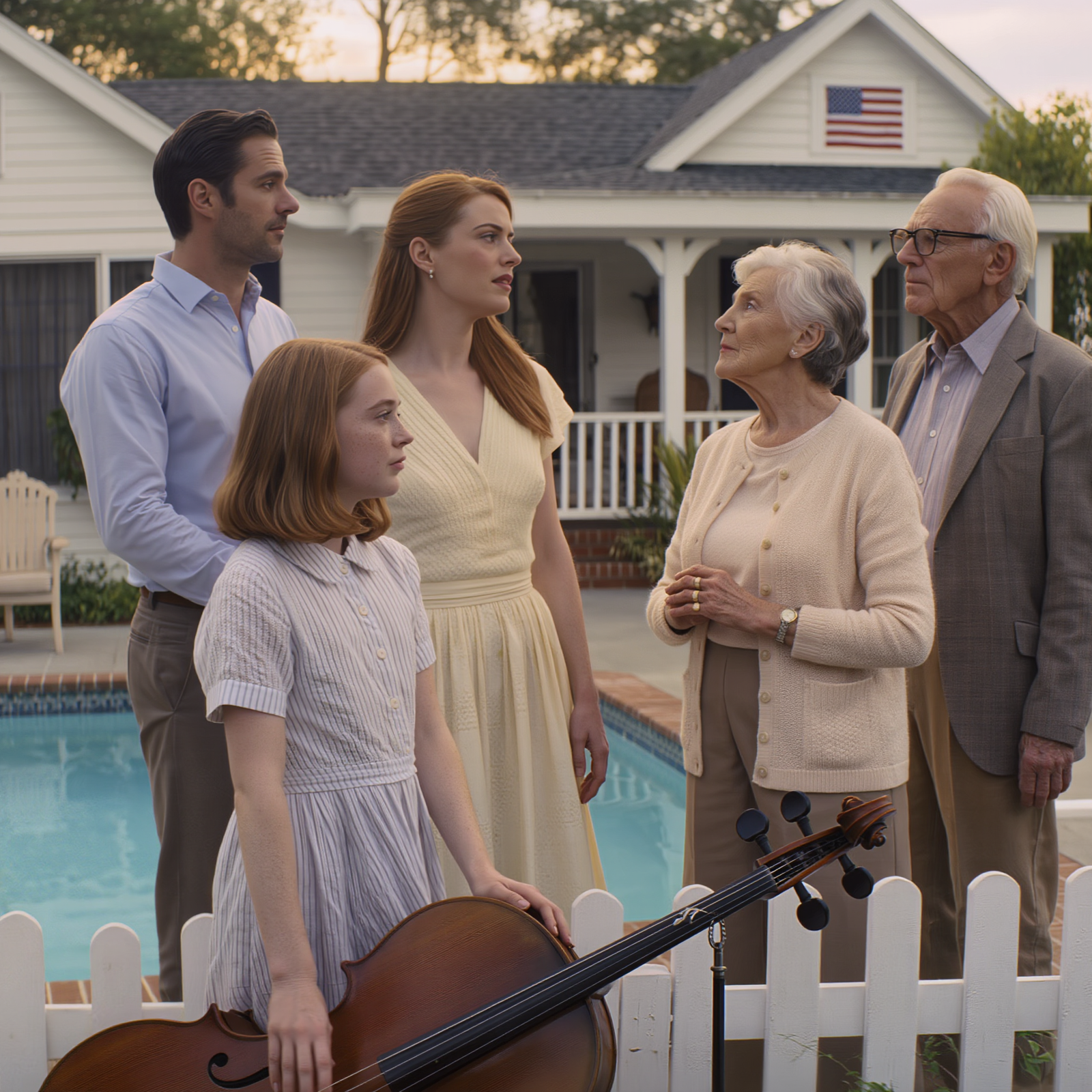
Lucy and I walked through the gate together.
My mom’s practiced smile flickered slightly. Not because she was surprised we came, but because she was irritated that we’d had the audacity to show up at all.
“Emily!” she said with bright, fake enthusiasm. “You actually made it.”
“Hi, Mom,” I said flatly.
Rachel glanced at Lucy, her eyes sweeping up and down critically.
“Hey,” she said dismissively.
Lucy nodded politely and quietly, exactly the way she’d been trained.
Ben cannonballed dramatically into the deep end. Everyone laughed. Olivia shrieked happily. Rachel beamed with maternal pride.
Lucy stood beside me with her towel folded carefully in her hands, clearly not knowing where to put herself or how to belong.
Her eyes drifted slowly over the sparkling pool, over the fancy pergola, over the brand-new loungers with their expensive cushions. And I watched her look at everything her precious cello had been turned into.
She swallowed hard, trying to hold something painful inside.
I put my hand gently on her shoulder. She leaned into me without looking up.
That’s when I knew with absolute certainty that I wasn’t here for personal revenge.
I was here because my child deserved to witness what happens when you don’t let people take from you and then demand your grateful applause.
My dad clapped his hands together loudly.
“All right, everyone,” he called out. “Food’s almost ready.”
My mom laughed with her hostess voice cranked up to maximum volume.
“And before we eat,” she announced, “we just want to say this pool has been a long time coming. We’re so incredibly happy to finally have a backyard space the children can really enjoy properly.”
Applause rippled politely through the assembled guests.
Rachel raised her cup theatrically.
“To family,” she said meaningfully.
More applause followed.
Lucy’s fingers tightened visibly around her folded towel.
Then someone near the grill asked casually, “Where’s Margaret? Isn’t she coming to this?”
My mom’s smile tightened like a spring.
“She’s busy today,” she said quickly, too quickly. “She couldn’t make it.”
Right on perfect cue, the side gate clicked open.
I turned around.
My grandmother walked purposefully into the backyard.
She wasn’t in a wheelchair. She didn’t look frail or confused. She wore a crisp white blouse and dark slacks and a calm expression that made the humid air feel suddenly cooler and more serious.
Beside her walked Andrew, her longtime lawyer and trusted friend, carrying a slim professional folder.
The entire backyard went quiet in that specific way crowds do when they sense a fundamental shift but don’t yet know what kind.
My mom’s face went pale. My dad’s practiced smile froze awkwardly. Rachel’s mouth fell open, then snapped shut.
My grandmother stepped forward confidently, her eyes sweeping slowly over the pool, the expensive stonework, the decorative pergola, like she was assessing a poorly executed paint job.
“Well,” she said pleasantly. “You’ve certainly been busy.”
“Mom, this is a party,” my mother said, forcing an uncomfortable laugh.
“I know exactly what it is,” my grandmother replied calmly. “That’s precisely why I came.”
She looked directly at me, then at Lucy standing beside me.
Lucy straightened her spine instinctively, as if recognizing safety.
My grandmother’s expression softened for just a fraction of a second.
Then she looked back at my parents.
“I heard you sold the cello,” she said clearly.
My mom’s lips pressed together into a thin line.
“We didn’t want to upset you with unnecessary details,” my mom said weakly.
My grandmother held up one hand to stop her.
“You didn’t want consequences,” she said.
The word landed like a heavy stone dropped into deep, still water.
My dad cleared his throat nervously.
“Let’s discuss this privately inside,” he muttered.
My grandmother smiled. It was absolutely not a warm smile.
“Oh, Thomas,” she said. “You’ve had plenty of private time already.”
A nervous chuckle flickered through the assembled crowd. Someone shifted their drink awkwardly from one hand to the other. Someone else bent down to adjust a sandal that didn’t really need adjusting.
My grandmother turned slightly, addressing the entire backyard the way someone might address an important community meeting.
“I won’t keep you long,” she said. “I know you’re all here to enjoy the pool.”
Rachel snapped defensively, “This is completely insane.”
My grandmother ignored her completely.
She looked straight at my parents and spoke with absolute calm.
“The cello was,” she said, and you could feel everyone in the yard leaning in to listen, “held in trust for Lucy.”
The silence that followed felt sharp enough to cut glass.
My mom blinked in confusion. “What are you talking about?”
“I am the legal trustee,” my grandmother stated clearly. “Lucy is the beneficiary. That cello was never a family asset. It was absolutely not yours to sell.”
My dad stared at her like she’d suddenly started speaking an incomprehensible foreign language.
Rachel’s face flushed red with anger.
“You can’t just—” she started.
“I can,” my grandmother said firmly. “And I did.”
Andrew stepped forward smoothly, opening the professional folder. Documents with yellow tabs peeked out visibly. He didn’t look at my parents. He didn’t need to. My grandmother held their shocked gaze.
“I documented that instrument thoroughly,” she said. “Professional appraisal, detailed photographs, serial identifiers, insurance documentation. Everything. Because I’ve been alive a very long time, and I’ve met all kinds of people.”
She paused meaningfully.
“Apparently, I’m related to some of them.”
A few soft, nervous laughs slipped out from the crowd.
My mom’s voice shook noticeably.
“We didn’t know anything about any trust,” she said.
My grandmother nodded once.
“Correct,” she said. “You didn’t know.”
My dad finally found his voice.
“Where is the cello now?” he demanded.
My grandmother’s small smile returned.
“Safe,” she said simply.
Lucy’s head snapped up with hope.
My grandmother looked directly at her great-granddaughter.
“It was recovered this morning,” she said gently, “after Andrew made several phone calls and filed the appropriate report.”
Lucy’s breath caught audibly. Not a sob, not a scream, just a small sound like relief desperately trying to escape.
My grandmother turned back to face my parents.
“You sold something you did not legally own,” she said. “You took the money and put it directly into this.” She gestured lazily at the glittering pool water.
Rachel’s eyes flashed with defensive anger.
“It’s for the children,” she snapped.
My grandmother’s gaze sharpened like a knife.
“Lucy is a child,” she said.
Rachel’s mouth opened, then closed without sound. She looked at Ben and Olivia splashing happily in the shallow end like she wanted them to somehow be a protective shield.
They weren’t.
Andrew cleared his throat gently and professionally.
“Margaret?” he said.
My grandmother nodded once.
Andrew stepped closer to my parents and Rachel, holding out the papers like a waiter presenting an unwanted check.
“I have legal documents for you,” he said calmly.
My mom took an actual step backward.
“No,” she said.
Andrew didn’t raise his voice at all.
“Notice to vacate the property,” he said calmly. “Sixty days.”
My mom stared at the papers like they were physically poisonous.
My dad’s face went from pale to gray.
Rachel’s voice went shrill with panic.
“You’re actually kicking us out?” she demanded.
My grandmother tilted her head slightly.
“You’re acting surprised,” she said. “That’s the part I genuinely don’t understand.”
My mom’s hands shook visibly.
“Mom, you can’t do this to us,” she said desperately. “This is my home.”
“It is the house you currently live in,” my grandmother replied. “The difference in those two sentences is a cliff.”
Lucy pressed closer to my side. I felt her small shoulder against my hip.
Rachel’s eyes flashed dangerously.
“This is all because of Emily,” she hissed.
“No,” my grandmother said, cutting her off sharply. “This is because you sold a child’s instrument and poured the money into a swimming pool like it was Monopoly money.”
“We improved the property value,” my dad said weakly.
“You improved your personal comfort with stolen money in a house you don’t even own,” my grandmother said.
My mom looked like she might actually faint.
Around us, the backyard full of people suddenly remembered they had other places to be. Drinks were set down. Conversations died mid-sentence. Someone laughed a split-second too late, then stopped abruptly.
“Mom,” Lucy whispered beside me.
I looked down at her.
Her eyes were wet with unshed tears, but she wasn’t crying. She was holding everything in carefully, the way children do when they don’t want to make adults uncomfortable.
I squeezed her shoulder gently.
Then I looked at my parents, at Rachel, at the sparkling pool, at the way they’d built something shiny for Ben and Olivia and expected Lucy to clap and be grateful for it.
“I’m going to say this once,” I said clearly, not loudly, but clearly enough for anyone who was still pretending not to listen.
“Lucy isn’t second-tier family.”
My mom’s face twisted with emotion.
“Emily, you don’t understand—” she started.
“No,” I said firmly. “I’m not doing this today.”
Rachel scoffed.
“So what happens now?” she said bitterly. “Lucy gets everything?”
I let out a dry laugh.
“She was getting one cello,” I said. “That’s all. One instrument that was meant for her.”
My grandmother took a deliberate step toward Lucy.
Her voice softened completely.
“Sweetheart,” she said. “You didn’t lose it. It was taken from you.”
Lucy’s lip trembled.
“I thought I did something wrong,” she whispered.
My grandmother’s eyes flashed with anger so quick it was almost invisible.
“You did absolutely nothing wrong,” she said firmly.
Andrew still held the papers out.
My dad didn’t take them.
My mom didn’t take them.
Rachel finally snatched her copy like she could tear reality in half if she ripped hard enough.
“Sixty days,” my grandmother repeated. “You will leave this house.”
“You can’t be serious about this,” my dad said. His voice came out thin and desperate.
“Try me,” my grandmother said.
That was it.
Not yelling. Not a dramatic meltdown.
Just a clear line, drawn in permanent ink.
The backyard began to dissolve around us. Relatives gathering their belongings, children being called out of the pool, someone quietly turning down the music volume. People carefully avoided my parents’ eyes. A few guests squeezed my arm as they passed, the quick, guilty squeeze of people who had watched a line finally get drawn and were both horrified and strangely relieved.
Ben and Olivia kept splashing for a few more minutes because children don’t understand adult consequences until adults force them to.
Lucy watched them quietly, then looked up at my grandmother.
“Do I really get it back?” she whispered.
“Yes,” my grandmother said with certainty.
Lucy let out a breath I hadn’t realized she’d been holding for six entire weeks.
And I realized something profound too.
My parents weren’t pale because my grandmother had found out the truth. They were pale because she’d finally done the one thing my family couldn’t survive.
She’d stopped letting them pretend.
Justice and Healing
Lucy got her cello back.
It arrived the very next day in a hard protective case that looked like it had traveled through several questionable hands. Andrew delivered it himself, carefully wheeling it up the stairs to my apartment like it was a fragile, precious guest.
My grandmother came too.
She opened the case with Lucy like it was a sacred ceremony.
Lucy ran her fingers over the polished wood like she was touching something alive and breathing.
She didn’t say much at all. She just hugged my grandmother so tightly that I saw my grandmother close her eyes for a long second, like she was finally letting herself feel everything now that the danger had passed.
My parents, meanwhile, discovered an unpleasant fact about selling things you don’t legally own.
People want their money back.
The buyer came after them exactly the way you’d expect. Angry, embarrassed, and absolutely not interested in my mom’s “we didn’t know” excuses. The phrase “repayment plan” entered my parents’ vocabulary like an unwelcome disease.
They couldn’t pay it all back at once. Most people can’t, especially not people who pour stolen money into concrete and chlorine.
Sixty days went faster than they thought possible.
My mom tried bargaining. My dad tried guilt. Rachel tried rage and accusations.
My grandmother didn’t move an inch.
They packed up their life in a house they’d treated like it was theirs and moved into something smaller, something cheaper, something without a swimming pool. Rachel and her husband didn’t end up helping my parents financially, not because they couldn’t afford it, but because they wouldn’t.
Rachel suddenly remembered how to distance herself when real consequences showed up.
One minute it was “we all agreed to this plan.”
The next minute it was “I told you this was a bad idea from the start.”
Families like mine have a special talent for rewriting history on the fly.
Ben and Olivia adjusted to the change. Children always do eventually.
Lucy adjusted too, but in a completely different way.
She started speaking up more confidently.
Small things at first.
“Actually, I was sitting there first.”
“I don’t like that joke.”
“No, I’m not okay with that.”
The first time she did it in front of my mom during a tense family gathering, my mom’s mouth tightened like she’d tasted something bitter.
Good.
My grandmother updated her estate plans after everything settled, quietly and thoroughly, the way she handles everything important. She didn’t give speeches about it. She just slid a folder across my kitchen table one evening while Lucy was doing homework and the local news played softly from the television.
“Andrew’s handling all the paperwork,” she said. “I’m putting the house into a trust. I’ll be the trustee for now. You’ll be the beneficiary eventually. So it’s completely protected. And it will be yours in the end.”
I stared at the folder in shock.
“Grandma, you don’t have to do this—”
“Yes, I do,” she said simply. “I should have done it much sooner.”
The day my parents moved out of the house, Lucy and I packed up our small apartment. No ceremony or fanfare, just cardboard boxes from the liquor store, rolls of packing tape, and the constant shuffle of belongings you own but never meant to carry so many times.
We drove across town in my aging car, the trunk crammed full, the cello case buckled carefully in the backseat like a precious passenger.
When we unlocked the front door of the house, it felt completely different.
No contractor trucks in the driveway. No performative string lights on timers. No fake laughter echoing from the backyard.
Just genuine quiet.
The kind that feels earned through struggle.
We slept there that first night on mattresses placed directly on the floor. The house creaked in new, unfamiliar ways. The heater kicked on with a gentle hum. Somewhere in the distance, a train passed through. But the place itself felt like it was breathing easier, more freely.
A week later, my grandmother moved back in properly.
Not as someone being “taken care of” reluctantly. Not as an inconvenience squeezed into a spare room.
As the person who belonged there all along.
Lucy helped her unpack like it was a celebration worth having. Carrying sweaters, books, framed photographs, and that little tin of peppermint tea like each item was a vote for a better future.
And then, like it was the most natural thing in the world, my grandmother sat in the living room while Lucy practiced her cello.
No shrine of tense silence. No tight, forced smiles. No “inside voice, sweetheart” corrections.
Just music filling a house that finally knew exactly who it was for.
When spring returned and the maple trees in the neighborhood budded out fresh and green again, Lucy auditioned for the regional youth orchestra in the city.
She wore her best dress and the same small necklace my grandmother had once worn at her own recitals decades ago. We drove downtown past the stadium and the courthouse, parked in a crowded lot, and walked into a building that smelled like rosin and concentrated nerves.
She got accepted.
But this time, she had her proper instrument.
And something else even more valuable.
Proof.
Proof that when someone tried to take her future and turn it into a swimming pool for someone else’s convenience, the adults who truly mattered didn’t tell her to swallow it silently.
They showed up for her.
They told the truth.
And they made absolutely certain she never had to apologize for wanting a place at the table.