She Drove Home From a Double Shift to Find a Police Officer Holding Her Toddler – What She Learned Next Stopped Her Cold
There is a specific kind of fear that only a parent knows.
It lives somewhere beneath the ordinary worries. Beneath the grocery lists and the overdue bills and the exhaustion of too many early mornings. It sits quietly most of the time, but it never fully goes away.
It is the fear that something will happen to the people you love on the days when you are not there to stop it.
For Carol, that fear had been her constant companion for three years. Ever since she became the only parent her boys had left.
The Life She Was Holding Together Alone
Carol is forty-three years old. She works double shifts at the hospital because there is no other way to make the numbers work. Some days she genuinely cannot remember the last time she stood in sunlight for more than a few minutes at a stretch. The schedule is relentless and the exhaustion is real, but she does not allow herself to dwell on either of those things for very long.
She does what needs to be done. That is simply who she is.
Since her husband passed away three years ago, it has been just the three of them. Carol, her seventeen-year-old Logan, and her two-year-old Andrew.
Andrew is at the age where everything in the world still feels soft and manageable. He reaches for her in his sleep. He says her name like it is the most reliable word he knows. His cheeks are still round with the particular softness of very young children, and watching him discover ordinary things for the first time is one of the few reliable sources of joy in days that are otherwise very long.
Logan is something else entirely.
He is tall and quiet and stubborn in the specific way that makes Carol’s chest ache sometimes, because it is exactly the way his father was stubborn. He carries things internally rather than saying them. He has his father’s jaw and his father’s silences and his father’s way of looking at you steadily when he is deciding whether or not to trust you with something.
He has also, in the past couple of years, made some choices that put him on the radar of the local police department.
Nothing catastrophic. A fight at school. Being present with the wrong group of people at the wrong moment. An incident involving a broken streetlight that he maintained he had nothing to do with. None of it had led to serious consequences, but in a small town, a name that appears in certain contexts has a way of staying in certain memories.
The officers had developed a habit of stopping Logan on the street. Checking in, they called it. Sometimes bringing him home in a patrol car as a form of reminder.
Each time it happened, something in Carol went a little quieter.
She had sat him down after the most recent incident, gripping her coffee mug hard enough to feel the ceramic pressing into her palms, and told him plainly what she needed from him.
He was her rock, she said. She was counting on him.
He had not rolled his eyes. He had not made a defensive argument. He had looked at her the way he looked at her when something genuinely reached him.
He said he promised.
And she believed him. Because whatever else Logan was, he was not someone who said things he did not mean.
The Morning That Felt Ordinary
The day started the way most of her days start.
Andrew was in his high chair with oatmeal on his cheeks and the cheerful energy of a toddler who has no idea yet that mornings can be difficult. Logan was leaning against the kitchen counter with his phone, still in the process of waking up.
Carol grabbed her keys and told Logan to keep an eye on his brother.
He said he had it.
She hesitated for just a moment at the door. Something small and wordless moved through her, the kind of feeling that arrives without explanation and disappears just as quickly when life does not allow you to slow down and examine it.
She left. She did not have the option of staying.
By midday, the hospital floor was running at full demand.
Short-staffed, as usual. The particular organized chaos of a medical environment where everyone is moving quickly in multiple directions and the sound of monitors is simply the background to every conversation. Carol had slipped into a supply room for sixty seconds of quiet when her phone rang.
Unknown number.
She almost let it go to voicemail. She did not.
The voice on the other end identified itself as a police officer and told her she needed to come home immediately for an important matter.
No further details. No reassurance. Just that.
The fear that lived quietly underneath everything else rose to the surface all at once.
She asked whether everyone was okay.
There was a pause she will not forget.
The officer said please come as soon as you can.
The line disconnected.
The Drive She Cannot Fully Remember
She does not recall exactly how she arranged to leave work. She does not recall the route home. What she remembers is the inside of her own chest during those minutes, the specific quality of the fear when you do not know which of your worst possibilities has just become real.
Had Logan broken his promise? Had something happened to Andrew? Had she put too much weight on a seventeen-year-old’s shoulders and finally reached the moment where that weight had caused something to give?
She pulled into the driveway still mid-thought.
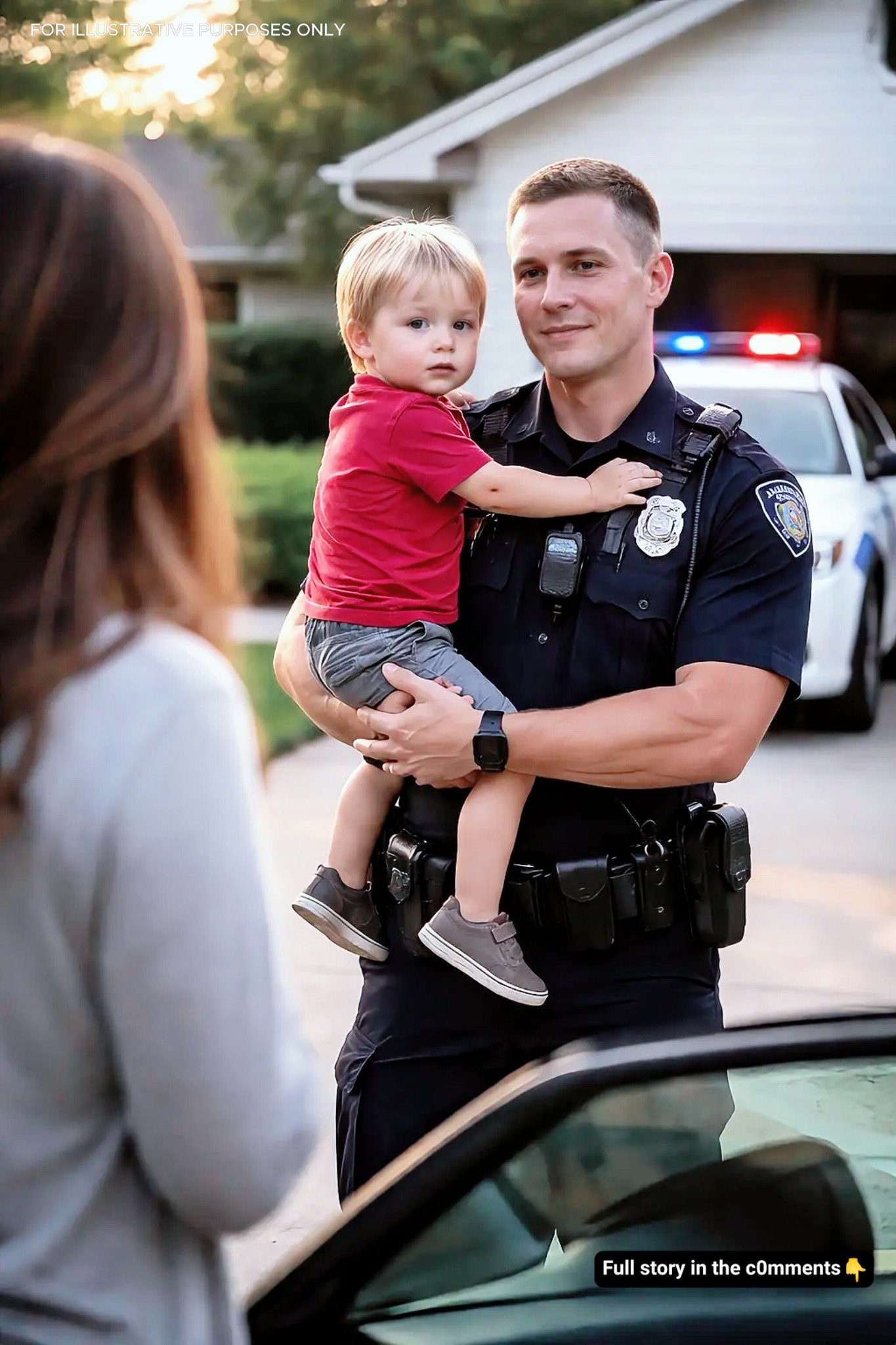
And she saw a police officer standing in front of her house.
Holding Andrew.
Her two-year-old was resting against a uniformed stranger’s shoulder, calm and sleepy, one small hand curled around the officer’s sleeve. He was not crying. He did not appear to be hurt.
None of that information reached Carol’s nervous system with any useful clarity. She was out of the car before she had fully registered stopping it.
What the Officer Said Standing in Her Living Room
She demanded to know what was happening. She asked where Logan was.
The officer told her calmly that he needed to talk to her about her older son. Then he said the words that reorganized her fear into something more complicated.
He said it was not at all what she was expecting.
He walked her inside. Logan was already in the living room, his face pale, his expression a mix of confusion and something that looked like dread.
Carol’s fear converted immediately to anger the way fear often does when the people we love are at the center of it.
She asked Logan what he had done this time.
He said he had not done anything, his voice carrying the edge of someone who has been on the receiving end of that question too many times and is tired of it.
The officer stepped between them and asked for one minute.
He explained what had happened with the steadiness of someone who has delivered difficult information many times and understands that the delivery matters.
Two hours earlier, his department had received a call reporting a toddler walking alone near a busy intersection on Maple Street. A car had been forced to swerve to avoid him.
Carol reached for the wall.
The toddler had been Andrew.
The officer said he had found him and had been in the process of contacting child services when something else happened.
Logan had appeared at the end of the street.
Barefoot. Running. Calling his brother’s name at full volume, not caring who heard him or what it looked like.
The officer let a moment of silence sit before he continued.
Logan had not hesitated when he saw the patrol car. He had not turned around. He had not tried to disappear, which was the response the officer had half-expected based on their history together.
He had run directly toward the officer and the first words out of his mouth were not about himself at all.
He kept asking whether Andrew was okay. He kept asking someone to please just tell him his brother was okay.
The Story Logan Told
Carol turned to look at her son.
His jaw was set. His eyes were on the floor.
He told her what had happened in the flat, careful voice of someone reporting facts he wishes were different.
He had been in the kitchen. He had assumed Andrew was in the living room playing, because that was where he had been. He had turned his back for what felt like a very short time.
When he checked, Andrew was gone.
The front door was standing open.
He said the rest without finishing the sentence, because the sentence did not need finishing. Anyone who has ever been responsible for a very small child who suddenly cannot be found understands what the inside of that moment feels like.
He had not stopped to put on shoes. He had not considered what it would look like to be a teenager with his particular history running down a street toward a police officer. He had run because his brother was somewhere out there and that was the only thing that mattered.
His hands were shaking as he stood in the living room telling his mother about it.
The officer spoke again.
He said he had been doing this work for fifteen years. He said that when the call came in and he heard the name Logan, he had formed a set of expectations about what he was going to find.
He paused.
He said that today, Logan had shown him something different.
He acknowledged clearly that a serious mistake had been made. A two-year-old should not have been able to reach an open front door. The lapse in attention had placed a child in genuine danger and that was not a small thing.
But then he said something that Carol had not anticipated from this particular officer in this particular doorway.
He said what mattered was what Logan had done next.
He handed Andrew back to Carol.
Her little boy settled immediately into her shoulder, soft and warm and entirely unaware of how close the afternoon had come to going a completely different way.
The officer said there would be no charges filed. Child services would not be contacted. He said he had wanted to come and deliver that information personally, because in his experience, people sometimes deserved to be seen for who they were becoming rather than only for what they had done before.
He looked at Logan one final time and said that today, he had done the right thing.
Then he left.
The Hug in the Quiet House
The door closed and the house went very still.
Carol put Andrew down in his crib and walked back into the living room.
Logan was standing by the window looking out at the street, his posture carrying the particular weight of someone who has been through something and is still in the process of understanding what it means.
She crossed the room and put her arms around him.
He went rigid for a moment, the way teenagers do when affection arrives unexpectedly. Then his arms came up and he held on.
He said he was sorry.
She said she knew.
She pulled back far enough to look at his face. She told him that he had frightened her more than she had words for. And that he had also, on the same afternoon, made her proud in a way she had not expected.
He looked at her with an expression that was not quite ready to believe it.
She told him why.
Because he had not run away from his mistake. He had run straight toward it.
Something moved through his expression that he was working hard to keep contained. She recognized it because she had seen it on his father’s face more than once. The particular expression of someone who has been seen more clearly than they were expecting.
What She Sat With That Night
After both boys were asleep, Carol sat alone in the kitchen with the quiet of a house that has settled for the night and the particular kind of thinking that only happens when there is finally no one who needs anything from you.
She thought about the fear she had been carrying since Logan’s first encounter with the police. The fear of a specific trajectory, of watching her son move toward a version of himself that she could not reach and could not redirect.
She thought about how long she had been holding that fear alongside everything else she was holding.
And then she thought about a barefoot teenager sprinting down a street calling his brother’s name without a single thought for how it looked or what it might cost him.
She thought about the words he had kept repeating to a police officer who had every reason to expect something worse from him.
Is he okay. Please just tell me he’s okay.
Logan was not defined by his worst moments. She had known that, or believed she knew it, in the way that parents know things about their children that the rest of the world cannot always see. But knowing something and feeling it settle into certainty are different experiences.
That night, for the first time in a long time, she felt it settle.
Her son made a serious mistake. She was not minimizing that. A two-year-old had wandered into a busy street, and that had happened on her son’s watch, and they would talk about it seriously and directly and more than once.
But her son had also done the thing that matters most when a mistake has been made. He had faced it. He had not calculated an exit or considered his own position. He had run toward the problem with bare feet on pavement and asked only whether his brother was safe.
That was not the action of someone who did not care. That was not the action of someone who was heading somewhere she needed to be afraid of.
For Parents Who Are Raising Someone They Are Still Learning to Trust
There are parents reading this who know what it is to love someone and be frightened of them at the same time.
Not frightened of the person themselves. But frightened of the choices they might make. Frightened of the influences around them. Frightened of the gap between who you know them to be and who they are still in the process of becoming.
That fear is not a failure of love. It is a consequence of it.
But it can also, if you hold it too tightly and for too long, become the only lens through which you see them.
Carol had spent three years carrying everything her family needed and doing it largely alone.
She had trusted Logan because she had to, and she had feared for him because she loved him, and on an ordinary Wednesday afternoon those two things had landed in her living room at the same moment and sorted themselves out in a way she had not anticipated.
Her son is not finished becoming who he is going to be. Neither are any of our children, at any age.
But the direction a person runs when something goes wrong tells you something real about them.
Logan ran toward his brother.
That is the thing Carol will hold onto.
Not the open door. Not the intersection. Not the patrol car in her driveway or the moment her knees nearly gave out when she heard what had happened.
She will hold onto a seventeen-year-old boy who did not stop to put on his shoes.
Because that is who her son is, underneath everything else.
And she is no longer afraid to see it.