She Demanded $900,000 In Support, Until The DNA Report Was Read In Court
The judge had asked Lenora a question that didn’t leave room for performance.
Is this true?
For eight months she’d lived inside a story where she was the wounded wife, the exhausted mother, the woman brave enough to escape a neglectful husband and demand what she was “owed.” In that story, I was a man who worked too much, loved too little, and would now be punished in payments and paperwork until the end of time.
Now her story had a crack running straight down the center.
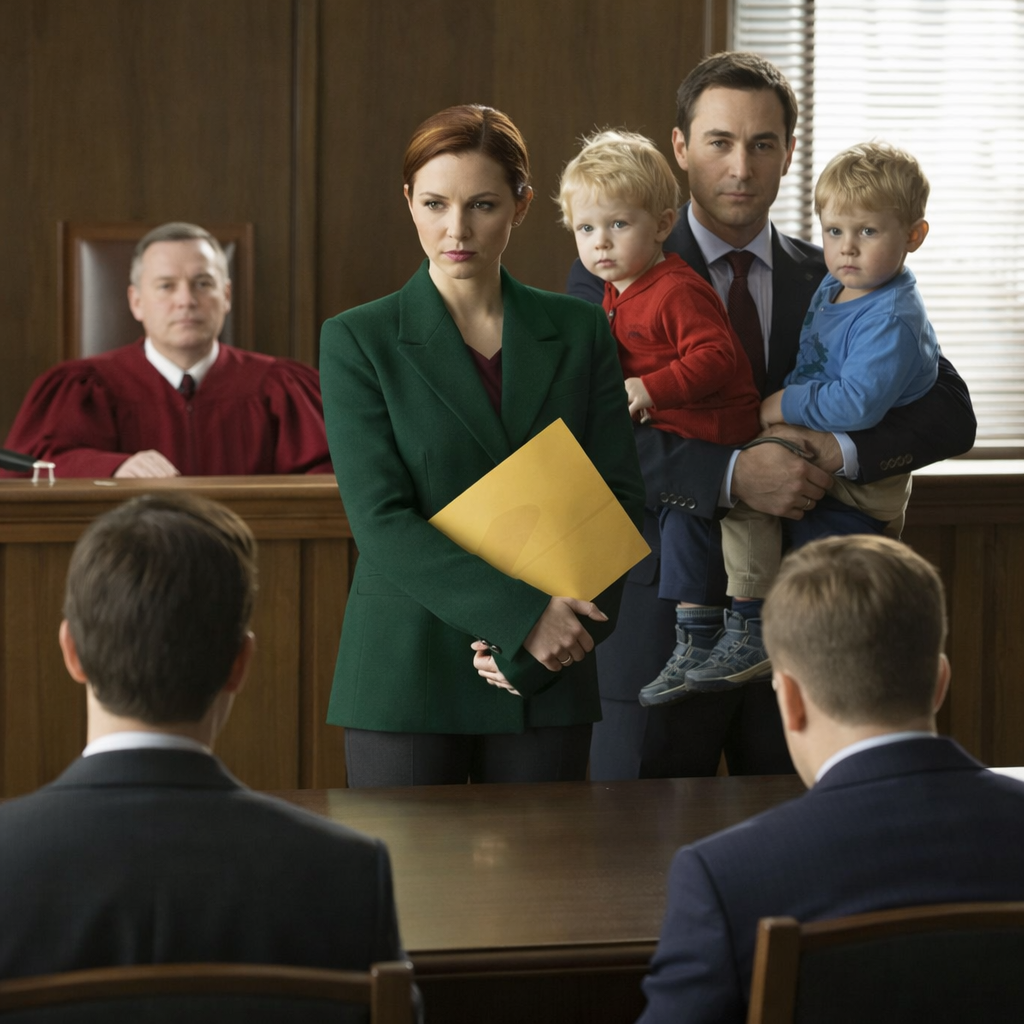
Lenora’s eyes darted to Desmond Pratt as if his expensive suit could become a shield. Pratt’s hand, still holding the pen, hovered awkwardly above the final decree, frozen like a man unsure whether to sign his name to a sinking ship. My own lawyer, Hector Molina, stared at the manila envelope on the judge’s bench like it had grown teeth.
Judge Rowan Castellan didn’t look at Pratt. He didn’t look at Hector. He stared directly at Lenora.
“Mrs. Chandler,” he said again, slower, as if he’d learned over decades that truth sometimes needed to be spoken twice before it stuck. “Is this accurate?”
Lenora’s mouth opened. Closed. The smirk that had lived on her lips for months drained away, leaving something raw behind it. Her face was suddenly too human, too soft, like the mask had slipped and revealed panic underneath.
“Your Honor,” Pratt began, stepping forward with the smooth urgency of a man trying to regain control. “We object. This is beyond the scope of today’s hearing. These documents were not produced in discovery—”
“Counselor,” Judge Castellan cut in, voice flat. “Sit down.”
The words weren’t shouted, but they carried weight. Pratt’s shoulders tightened as he obeyed, lowering himself into his chair like someone forced to take a knee.
Lenora swallowed hard. Her throat moved visibly. Her hands gripped the table edge so tightly her knuckles looked bleached.
“I don’t know what those are,” she said, attempting a laugh that came out brittle. “He’s… he’s trying to embarrass me. He’s angry. He’s always been angry.”
The judge didn’t blink. He lifted the first page of the DNA report, eyes scanning quickly, then lifted the second, then the third. He read like a man familiar with lies and bored by their creativity.
When he looked up, his expression had changed. Not to outrage. Outrage was too emotional. It was something colder. A controlled disgust that made Lenora’s breath catch.
“Mrs. Chandler,” he said, “these are results from an accredited lab. Each one indicates a zero percent probability of paternity.”
Lenora’s chair scraped as she shifted. A tiny sound in a room that suddenly felt too still.
The judge leaned forward slightly. “You are under oath. I am going to ask you a direct question. Did you have sexual relationships with men other than your husband during this marriage?”
Lenora stared at him as if he’d spoken a foreign language.
“I… I need to speak with my attorney,” she whispered.
“You can speak with him later,” the judge replied. “Answer the question.”
Pratt’s face had gone pale around the mouth, the way people look when they realize the ground beneath them isn’t ground at all. His eyes flicked to the reports again and again as if he could will the numbers to change.
Lenora drew in a breath that shuddered. Her gaze flicked toward me, and for the first time that day she didn’t look triumphant.
She looked afraid.
“No,” she whispered, and the word didn’t make sense until she said it again, louder. “No.”
The judge’s eyebrow lifted slightly. “No what, Mrs. Chandler?”
“No,” she said, voice shaking. “They’re not his. They’re not Crawford’s biological children.”
The air in the room shifted, like a door had opened to a storm.
Hector made a sound that was half gasp, half choke. Pratt muttered something under his breath that the stenographer typed without pause. Even the clerk behind the judge sat up straighter, eyes widening as she processed the implications.
Lenora’s composure finally broke. Tears spilled, darkening the foundation beneath her eyes and turning her carefully drawn lashes into streaks.
“But he raised them,” she cried quickly, scrambling for the only ground left. “He’s been their father their whole lives. He can’t just abandon them over biology. Over… over a technicality.”
“A technicality,” the judge repeated softly, and the way he said it made it sound like a condemnation. “Mrs. Chandler, paternity fraud is not a technicality.”
Lenora’s voice rose, frantic. “He was never home! He worked all the time! I was lonely!”
The judge’s tone went colder. “So your defense for infidelity and deception is that your husband was providing for what he believed was his family.”
Lenora’s sobbing turned jagged. She looked from the judge to Pratt to me, desperate for someone to rescue her from the truth she’d finally been forced to speak aloud.
Judge Castellan turned to me.
The shift in his gaze wasn’t soft, exactly, but it was different. Less contempt. More focus.
“Mr. Chandler,” he said, “what relief are you seeking?”
I had rehearsed a dozen versions of what I might say if this moment ever arrived. In the diner, in the car, staring at my ceiling at three in the morning. I’d imagined my voice strong, my words ruthless. I’d imagined the satisfaction of watching Lenora’s world collapse under the weight of her own lies.
But the second the judge asked, my mind filled with faces that weren’t Lenora’s.
Marcus at twelve, lanky and serious, the boy who had started calling me Dad before he could pronounce his own name. Jolene at nine, delicate and stubborn, who only wanted me to bandage her knee because “you do it better.” Wyatt at six, still small enough to climb into my lap and fall asleep with his fist curled in my shirt.
I could feel Clyde Barrow’s warning in my ear, rough and steady. The kids didn’t ask for any of this.
I swallowed hard. My throat felt raw.
“Your Honor,” I said, voice rough, “I’m requesting termination of all child support obligations. Immediately. And retroactively. I am not their biological father, and I should not be ordered to pay nearly a million dollars based on fraud.”
Lenora let out a sound that wasn’t a sob so much as a collapse.
“But,” I continued, before the room could breathe again, “I’m also requesting visitation.”
Pratt blinked. Lenora looked up sharply, confused through tears.
“I love those children,” I said, forcing the words out cleanly. “I raised them. They know me as their father. They’re innocent. They didn’t choose any of this. If they want me in their lives, I want to stay.”
The judge studied me for a long moment. He removed his glasses, cleaned them slowly, then put them back on with deliberate care.
“That is a measured request,” he said. “Given what has been revealed.”
I nodded once, unable to speak around the pressure in my chest.
Judge Castellan looked at Lenora again, and his voice went hard as stone.
“Given Mrs. Chandler’s admission under oath, I am setting aside the proposed settlement in its entirety. This agreement is void.”
Pratt started to rise. “Your Honor—”
“Sit down,” the judge snapped.
Pratt sat.
“I am rescheduling this matter for a new hearing in sixty days,” the judge continued. “Both parties will submit revised proposals. Additionally, I am referring this matter to the District Attorney’s office for review. Perjury and fraud are not courtroom strategies.”
Lenora’s face twisted in panic. “I can’t go to prison. I have children.”
“You should have thought about that,” the judge said, voice flat, “before you came into my courtroom seeking financial obligations based on deception.”
He raised his gavel.
“This hearing is adjourned.”
The gavel struck wood with a sound that felt like a door slamming shut.
I left the courthouse feeling both lighter and hollowed out, as if the same moment had freed me and erased me.
In my truck, hands on the steering wheel, I sat without starting the engine, trying to understand what I’d just done. The financial trap was gone. The decree wasn’t signed. Lenora’s plan had cracked open in public.
But the kids were still out there.
My phone buzzed.
A text from Marcus’s number.
This is Marcus. Mom is crying and won’t tell us what happened. She locked herself in her room. Jolene is scared and Wyatt keeps asking where you are. Are you coming home?
Home.
The word hit me so hard I had to blink against sudden tears.
I typed back slowly.
I’ll be there in an hour. We need to talk. All of you. It’s important.
OK. Please hurry.
The drive to the house blurred into red lights and asphalt and the steady thump of my heart. Every mile felt like I was moving toward a conversation that could either break us or bind us tighter than blood ever could.
When I pulled into the driveway, the house looked the same. Light blue siding. The garden half-neglected. The porch light still working. It looked like every memory I had, like every lie I had lived inside.
Marcus opened the door before I knocked. He stood there tall for twelve, eyes red-rimmed, jaw tight. He looked older than he should have.
“Dad,” he said, and the relief in his voice made my chest ache. “What’s going on?”
“Let’s get everyone,” I said gently. “We need to sit down together.”
The living room felt like a museum. Family photos on the wall, frozen smiles. Birthdays. Holidays. Me holding Wyatt in the hospital. Marcus on a bike with training wheels. Jolene in a dance costume.
Lenora’s lie framed in glass.
Jolene came down clutching her stuffed elephant. Wyatt ran straight to me and climbed into my lap, burying his face in my shirt like he could hide there.
Marcus stood by the window, tense, watching me like he was bracing for impact.
“Do you know what DNA is?” I asked, hating the words before they left my mouth.
Marcus nodded, too quick. “Genes. The stuff inside us.”
“Right,” I said. I took a breath that didn’t feel big enough. “I took a DNA test. And I learned something today that’s going to be really hard to hear.”
Three faces turned toward me. Trusting. Waiting.
“I found out I’m not your biological father,” I said.
Silence flooded the room.
Wyatt lifted his head, confused. “But you’re Dad.”
“I am your dad,” I said fiercely, hugging him close. “I raised you. I love you. Nothing changes that. But biologically, we aren’t related by blood.”
Marcus’s face tightened. “So Mom cheated on you.”
“Yes.”
“More than once.”
“Yes.”
He stared toward the stairs, where Lenora’s bedroom door remained closed. Anger rose in him like a tide.
“And she let you think we were yours?” he whispered. “For our whole lives.”
“Yes,” I said again, and the word tasted like ash.
Jolene began crying quietly, tears sliding down her cheeks. Wyatt clung harder to me.
From upstairs, a door opened.
Lenora appeared at the top of the stairs, face swollen, hair disheveled, looking nothing like the woman who’d walked into court that morning expecting to win.
“What are you telling them?” she rasped. “They’re children. They don’t need to know.”
“They deserve the truth,” I said, standing. “Something you should’ve given them a long time ago.”
Marcus’s voice cracked. “Did you cheat on Dad?”
“It’s complicated,” Lenora started, reaching for excuses like ropes.
“Yes or no?” Marcus demanded.
Lenora’s mouth trembled.
“Yes,” she whispered.
The disappointment on Marcus’s face was so profound it looked like grief.
He turned back to me, tears in his eyes.
“You worked double shifts,” he said. “You missed things. You did everything. And the whole time…”
I stepped toward him. “I’m still here,” I said softly. “I’m still your dad. That doesn’t change.”
Marcus stared at me, shaking, then lunged forward and hugged me hard, sobbing into my shoulder.
“I don’t care about DNA,” he choked out. “You’re my dad.”
Jolene and Wyatt joined, arms wrapping around me, small bodies pressed close, the four of us clinging together while the truth settled into the cracks like mortar.
Behind us, Lenora stood frozen on the stairs, watching what she couldn’t buy.
Not the house. Not the money. Not the victory.
She had wanted to take my identity as a father and turn it into a payment plan.
But in that moment, holding the kids who had been my life, I understood something with aching clarity.
Love wasn’t a genetic marker.
Love was the choice you made at three in the morning when someone cried out for you, the choice you made to show up again and again even when no one applauded.
And whatever happened next, I was going to keep choosing them.
I didn’t leave after that hug.
For a while we just stayed tangled together in the living room, breathing in uneven bursts, the kind of breathing that happens when your body is trying to catch up to a shock your mind can’t fully hold yet. Wyatt’s fingers kept twisting the hem of my shirt. Jolene’s face was wet against my shoulder. Marcus stood tight and rigid for a moment longer, then sagged again, pressing his forehead to my collarbone like he was trying to anchor himself.
Behind us, Lenora remained on the stairs, one hand clamped around the banister, the other hovering near her mouth as if she could stuff the truth back inside. Her eyes were swollen, but there was still something sharp behind the tears. Not remorse. Calculation. The habit of looking for angles even when the room was on fire.
“Marcus,” she said finally, voice cracking like she meant it to sound fragile. “Baby, come here. Let me explain. This isn’t what it looks like.”
Marcus lifted his head slowly. The anger in his eyes was bright and clean, the kind that comes from first betrayal. “You already explained,” he said, and his voice held a flatness that scared me more than shouting would have. “You lied.”
Lenora flinched as if he’d slapped her.
“I didn’t mean to,” she whispered, making the lie softer so it could slip in easier. “It just… happened. Your father wasn’t around. He worked so much. I was alone.”
Marcus’s jaw clenched. “Dad was working for us.”
Lenora’s gaze snapped to me, and for an instant her expression was pure venom.
“Working,” she spat, dropping the fragile-wife tone. “Always working. You want to talk about what he did? He missed everything. He missed parent conferences, birthdays, anniversaries. He was never here when I needed him.”
I felt my hands tighten around Wyatt instinctively, as if she might reach down and snatch him away like property.
“You filed for divorce eight months ago,” I said carefully. “You didn’t file because I missed a birthday party.”
Lenora’s nostrils flared. “I filed because I was done,” she said. “Because I deserve better than a husband who treats his family like a chore.”
Marcus turned toward her fully now, shoulders squared. “Stop blaming him,” he said. “This is you.”
Jolene made a small whimper and buried her face in my side. She was too young to organize this into neat moral categories. She only knew that something enormous had cracked and everyone was shouting.
Wyatt, still in my arms, looked up at me with wet eyes. “Are you leaving?” he asked, voice tiny.
The question hit like a hammer.
“No,” I said instantly, and the speed of my answer surprised even me. “I’m not leaving you.”
His shoulders loosened a fraction, and he laid his head back down against me. I rocked him gently, the way I had when he was a baby, when the world was still uncomplicated enough to be soothed by rhythm.
Lenora’s voice rose again. “You can’t promise that,” she snapped. “You’re not even their father.”
Marcus took a step toward her, fists clenched at his sides. “He is my dad,” he said, louder now. “He’s always been my dad.”
Lenora’s eyes flicked to me again, calculating. I could see the pivot coming. The shift from emotional appeal to legal threats.
“This is exactly what I was afraid of,” she said, tone suddenly composed, practiced. “He’s manipulating them. He’s poisoning them against me.”
Hector’s earlier advice echoed in my head. Just sign and rebuild. It would’ve been easier. Cleaner. But I’d have left these kids to be shaped entirely by Lenora’s version of events.
I took a slow breath. “We’re not doing this in front of them,” I said. “Marcus, take Jolene and Wyatt to the kitchen. Get them some water.”
Marcus hesitated, torn between fury and responsibility. Then he nodded and gently guided his siblings away. Jolene clung to his hand. Wyatt slid off my lap and followed, glancing back at me like he needed visual confirmation that I wasn’t disappearing.
When the kitchen door swung closed, silence settled in the living room, broken only by the faint clink of glasses from the kitchen.
Lenora descended the stairs slowly, each step deliberate, like she was choosing a stage mark.
“You think you won,” she said softly.
“I’m not thinking about winning,” I replied. “I’m thinking about them.”
“You’re thinking about yourself,” she countered. “You always have.”
I stared at her, trying to locate the woman I’d married in the stranger standing in front of me. Fifteen years. A thousand mornings. A million small moments that I thought were shared.
“How long?” I asked quietly.
Her gaze flicked away. “That doesn’t matter.”
“It matters to me,” I said. “How long have you been lying to my face?”
Lenora’s laugh was sharp. “You want a timeline? Fine. Marcus happened when you were always at the warehouse, chasing promotions. Jolene happened when you were too busy to notice I was drowning. Wyatt…” She hesitated, just a fraction too long.
My stomach turned.
“Wyatt happened when your brother was living here,” I said, voice low.
Lenora’s eyes snapped back to mine. For the first time, real fear surfaced. Not because she cared how it hurt me, but because she realized I knew more than she expected.
“I don’t know what you’re talking about,” she said quickly.
I let the silence stretch.
Then I said, “His name is Dennis.”
Her face went blank.
The mask fell completely.
“You hired someone,” she whispered.
“Yes.”
Her lips parted, then pressed together. “You had no right.”
“I had every right,” I said. “You were about to take my entire life and make me pay for it. Nine hundred thousand dollars for children who aren’t mine biologically. You were going to walk away with the house, the cars, my savings, and you were going to keep lying.”
Lenora’s eyes glistened, but there was no softness in them. “So what now?” she asked. “You’re going to ruin me?”
“I didn’t ruin you,” I said. “You did.”
She stepped closer, voice dropping into something almost intimate, like the woman I once loved was trying one last time to reach me. “Crawford, listen to me. They need stability. They need one home. One routine. You walking in and out is going to confuse them.”
“That’s rich,” I said, unable to stop the bitterness. “You’ve been confusing them since the day they were born.”
Lenora’s face hardened. “You don’t get to take them from me.”
“I’m not trying to take them,” I replied. “I’m trying to stay. There’s a difference.”
Her gaze narrowed. “The judge hasn’t ordered anything yet. Without child support, you’ll have to fight for visitation. You’re not their father legally if paternity is challenged.”
“I signed their birth certificates,” I said.
“And now you have proof you’re not their father,” she snapped. “You think the court is going to just hand you rights out of pity?”
“I’m not asking for pity,” I said. “I’m asking for what’s right.”
Lenora gave a humorless laugh. “Right. You think courts care about right. They care about biology and paperwork. You’re a name on a certificate, Crawford. If the state decides you’re not the father, you’re gone.”
I saw what she was doing. She was trying to scare me into backing off, into leaving, into making it easier for her to rebuild her narrative.
But I wasn’t alone now. Not really. I had evidence. I had a judge who looked like he’d had enough of her lies. And I had three kids in the kitchen who had just clung to me like I was the last stable thing in the room.
“I’m not disappearing,” I said quietly.
Lenora’s voice sharpened again. “Then what are you going to do? Sue me? Call the police? Tell the whole neighborhood?”
“I’m going to tell the kids the truth,” I said. “In a way they can handle. I’m going to get them therapy. I’m going to show up consistently. And I’m going to fight in court for visitation, because they deserve at least one adult who doesn’t use them as leverage.”
Lenora’s cheeks flushed with rage. “You’re acting like a hero.”
“No,” I said. “I’m acting like their dad.”
For a moment, we stared at each other, and I understood something that had been hidden from me for years. Lenora didn’t want the kids for love. Not in the way love is patient and selfless. She wanted them for power. They were her evidence, her leverage, her story.
And now the story had collapsed.
From the kitchen, Wyatt’s voice floated out. “Dad?”
The word hit both of us.
Lenora flinched as if it burned.
I stepped away from her and opened the kitchen door. The kids stood clustered near the table, three small faces tense with fear and uncertainty. Marcus was trying to look brave for his siblings. Jolene’s eyes were red. Wyatt held his stuffed dinosaur like it could protect him.
“I’m here,” I said gently. “I’m not going anywhere tonight.”
Wyatt ran to me and wrapped his arms around my waist. I rested my hand on his head and looked at Marcus.
“Can you help me?” I asked. “We’re going to make a plan.”
Marcus nodded, swallowing hard.
That night, after I got them settled, after I read Wyatt a bedtime story with my voice steady even though my heart wasn’t, after I sat on Jolene’s bed while she asked questions I couldn’t fully answer, I went out to my truck and called Clyde.
He answered on the first ring. “You did it,” he said.
“She admitted it,” I replied, staring up at the dark sky above the quiet neighborhood. “In front of the judge.”
“Good,” Clyde said. “Now the hard part starts.”
“What’s next?” I asked.
Clyde’s voice was firm. “You protect the kids. You protect yourself. You don’t make moves out of anger. You make them out of strategy.”
I closed my eyes. “My brother,” I said.
Clyde sighed. “Yeah. That piece is ugly.”
“I want him out of my life forever.”
“Then make sure you cut him clean,” Clyde said. “No confrontations in parking lots. No fists. You want him gone, you do it through paper. Through courts. Through consequences.”
Consequences.
The word felt like steel.
I hung up and sat in my truck for a long time, staring at the house where my children slept upstairs under a roof that no longer felt secure.
The truth had detonated in court, but the blast wave was still moving.
And I was standing in it, trying to keep three kids from getting burned.