Pet Owner Blames Feline for Sleep Disruption, Medical Testing Reveals Life-Saving Behavior
The cat woke his owner every single night and insisted she relocate to the couch. She attributed the problem to insomnia until medical tests revealed a completely different explanation.
People enjoy calling veterinarians at unusual hours for some reason. They seem to assume that if you treat animals professionally, you’re automatically responsible for solving every mystery in the universe.
Especially at two in the morning, when you’re barely awake with a cat sprawled comfortably across your chest.
However, this particular call came during normal business hours. Still, the exhaustion in the woman’s voice sounded so profoundly nocturnal that I instinctively glanced at the clock.
“Good morning, is this Dr. Miller’s clinic?” she asked carefully.
“Yes, this is the clinic. Dr. Miller speaking.”
“My name is Linda. I have an appointment scheduled for today. It’s regarding my cat. He absolutely won’t let me sleep properly.”
The phrase “won’t let me sleep” can cover a remarkably wide range of issues. Fleas, anxiety, boredom, or something far more medically complicated.
“Come in for your appointment,” I told her. “We treat animals here, and sometimes we help solve insomnia too.”
Meeting a Woman at the End of Her Patience
Linda entered my office the way people walk into a chapel. Quietly, almost apologetically.
She appeared to be in her early fifties. Neatly styled hair. A tailored coat clearly meant for important appointments, not casual errands.
She clutched her handbag tightly, as though it carried her entire life inside.
She set the pet carrier down carefully on the examination table. Inside, something large shifted position.
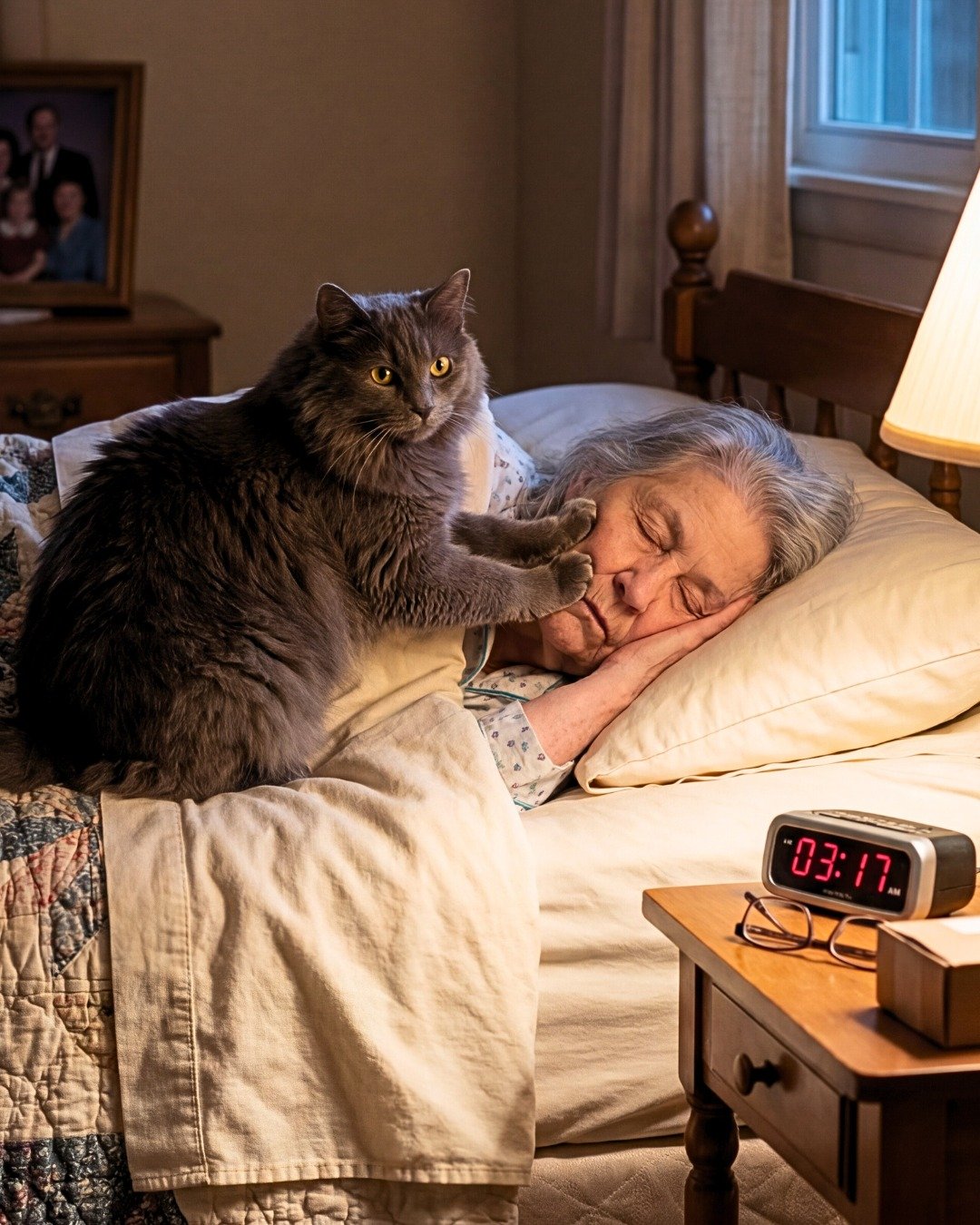
“This is Oliver,” she explained. “Though at nighttime, he’s less of a gentleman and more like a night-shift nurse who won’t take no for an answer.”
Two enormous yellow eyes stared directly at me from inside the carrier.
A big gray cat with a thick coat and the unmistakable expression of someone who has witnessed everything and already judged it all.
He sized me up professionally, decided I wasn’t worth the effort, and turned his head away with tremendous dignity.
“Let’s hear about this ‘nurse’ behavior,” I said, preparing to take notes.
Linda sighed deeply before beginning her explanation.
Describing a Pattern That Had Become Unbearable
“He wakes me up every single night without fail. Around three or four in the morning. Not gently either, but insistently.”
“First he taps my face with his paw. If I ignore him, he claws harder, nips at me, pulls the blanket off, runs back and forth across me.”
“He absolutely doesn’t stop until I physically get up and go sleep on the couch in the living room.”
“And what does he do then?” I asked.
“He stays in the bedroom! The exact moment I leave the room, he curls up on my pillow and sleeps peacefully until morning. Meanwhile, I’m stuck on the uncomfortable couch.”
“I used to sleep there occasionally when my husband snored badly, back when he was alive. Now the cat has completely taken over.”
Oliver pretended none of this conversation concerned him in the slightest.
“How long has this behavior pattern been happening?”
“Approximately three months now. I initially thought maybe seasonal changes were affecting him. But the behavior hasn’t stopped at all. He used to sleep beside me peacefully like a normal cat. Now he actively evicts me from my own bed.”
She hesitated briefly, then added more quietly, “I have high blood pressure. I’m on medication for it. I genuinely need my sleep.”
“I manage an apartment building full of constant complaints. I’m completely exhausted. I’ve even locked him in the kitchen a few times out of desperation.”
“He screamed so loudly that the neighbors started hitting the walls in protest.”
That particular sentence often signals when pets end up being rehomed to new families.
Conducting a Thorough Physical Examination
I examined Oliver carefully and systematically.
Healthy, shiny coat. Strong, steady heartbeat. Regular breathing patterns. Calm, stable temperament.
Nothing appeared medically abnormal about this cat.
Except for one notable thing. The way he looked at Linda.
Not like she was simply a source of food and comfort. But like someone he felt personally responsible for protecting.
“Has Oliver always had this calm temperament?” I asked.
“Yes, completely. When my husband was still alive, they used to watch baseball games together on television. After my husband passed away, Oliver started sleeping beside me every night.”
“I used to say to friends, ‘At least someone’s still breathing next to me.'”
“And now he doesn’t want you breathing next to him?” I said lightly, trying to ease the tension.
“Exactly!” she burst out with frustration.
“Does he wake you at approximately the same time every night?”
“Almost always between three and four in the morning. Very consistently.”
“And what happens before that time?”
“I fall asleep around eleven o’clock. I take my blood pressure pill. Then it feels like I sink into something very deep. And he drags me back out of it forcefully.”
Drags me back out. That particular phrase lingered in my mind.
Asking Questions That Went Beyond Veterinary Medicine
“How do you feel physically when you wake up?”
“Terrible, honestly. Heavy head. Heart racing uncomfortably. Extremely dry mouth. Sometimes short of breath. I assume it’s related to my blood pressure issues.”
“I take another pill and relocate to the couch. After about twenty minutes, I start feeling better.”
I asked additional questions about pauses in breathing, sudden gasps, irregular heartbeats.
It wasn’t technically my medical field. But sometimes people end up in a veterinarian’s office because no one else has actually listened to them.
“I’m afraid,” I finally said carefully, “that your cat isn’t the patient here who needs treatment.”
She blinked in confusion. “What do you mean?”
“Oliver is completely healthy. He’s not trying to evict you from the bedroom. I think he’s reacting to something medical that’s happening to you during the night.”
“But I’m asleep during those hours.”
“You think you are sleeping normally. But if you stop breathing temporarily, choke, or move suddenly in distress, he notices immediately. He doesn’t understand medical concepts like sleep apnea or cardiac episodes.”
“He just recognizes that something is wrong with you. So he wakes you up insistently until you change position and recover somewhat.”
She stared at me in complete silence.
“So you’re saying he’s actually saving my life?”
“I can’t prove it definitively without medical tests. But the behavioral pattern is extremely hard to ignore. You need proper medical testing for heart function and breathing patterns.”
“And when you go to the doctor, tell them exactly this: ‘My cat wakes me every night and I feel unwell afterward. Please run comprehensive tests.'”
She remained silent for a long time, stroking Oliver absentmindedly.
“All right,” she said at last. “I’ll schedule the appointment.”
Waiting to Hear What the Tests Revealed
Three weeks passed without any communication. I nearly forgot about Linda and Oliver entirely.
Then my phone rang during office hours.
“Dr. Miller? This is Linda calling.”
Her voice sounded noticeably different. Not overly cheerful or dramatic, just steadier and more grounded.
“You went to see your doctor,” I said, already knowing the answer.
“Yes, I did. I insisted on comprehensive testing. I told them everything you suggested. They diagnosed severe sleep apnea. And they also discovered some cardiac irregularities.”
“The specialist told me directly that if I’d ignored these symptoms much longer, it could have ended very badly for me.”
I closed my eyes briefly, grateful for the outcome.
“I have a CPAP machine now for the sleep apnea,” she continued. “The first few nights were strange and uncomfortable. Oliver watched the mask and tubing like it was some kind of alien invasion.”
“But he didn’t wake me up. He stayed close beside me instead.”
“And now? How are things currently?”
“I sleep properly now. All night long. In my own bed. And Oliver? He’s back beside me every night. Not on the pillow anymore, but close to my face. Like he’s still checking on me.”
She paused thoughtfully.
“It’s as if he was waiting patiently until it was safe for me.”
A Follow-Up Visit That Provided Confirmation
One week later, they returned to the clinic for Oliver’s annual check-up examination.
Unofficially, I suspect Linda needed reassurance and closure more than Oliver needed medical attention.
Oliver jumped confidently onto the examination table. Same big gray guardian cat, but somehow he seemed lighter in spirit.
“He hasn’t woken me up even once since I started using the CPAP machine,” Linda said softly.
“He doesn’t need to wake you anymore,” I replied. “The problem has been addressed.”
“The doctor told me that many people live with sleep apnea for years without knowing it exists. Some people don’t wake up at all.”
She looked down at Oliver with unmistakable gratitude.
“If it weren’t for him detecting the problem…”
She didn’t finish the sentence. She didn’t need to.
Oliver leapt down from the table and headed confidently toward the door. Mission accomplished.
After they left the clinic, I reflected on something remarkably simple about animals.
They don’t offer verbal explanations. They don’t have medical degrees or deliver dramatic speeches about their intentions.
But they notice patterns that humans miss. They sense when something is medically wrong. And they don’t hesitate to wake you at three in the morning if it means keeping you alive.
Changing How I Approach Unusual Pet Behavior
Since that experience with Linda and Oliver, when someone tells me “my cat’s acting strange,” I don’t smile dismissively anymore.
I ask one critical question first.
“And you, how are you sleeping at night?”
Because sometimes the animal isn’t the one with the problem. Sometimes they’re trying desperately to tell us that we have a problem we haven’t recognized.
Cats have extraordinary sensory abilities that we don’t fully understand scientifically.
They can detect subtle changes in breathing patterns. They notice irregular movements during sleep. They sense distress even when the person experiencing it isn’t consciously aware.
Oliver didn’t have any veterinary training. He couldn’t have explained what sleep apnea was or how it threatens someone’s life.
But he recognized on some instinctive level that Linda was in danger during those nighttime hours.
And he took action in the only way he knew how. By being persistently annoying until she moved to a different position where she could breathe properly.
Understanding the Bond Between Pets and Owners
The relationship between Linda and Oliver represents something deeper than simple pet ownership.
Oliver had lived with Linda and her husband for years. He had observed their routines and behaviors closely.
When Linda’s husband passed away, Oliver became even more attuned to Linda as his remaining family member.
He wasn’t just a pet sharing her space. He was a companion who felt responsible for her wellbeing.
That sense of responsibility manifested in behavior that seemed annoying and disruptive on the surface.
But underneath the irritating nighttime wake-up calls was genuine concern expressed in the only way available to him.
Linda initially interpreted Oliver’s behavior as selfishness. As him claiming the comfortable bed for himself while banishing her to the couch.
That interpretation made perfect sense from a human perspective. Cats are often stereotyped as selfish creatures who prioritize their own comfort.
But once the medical diagnosis revealed the truth, everything about Oliver’s behavior made complete sense.
He wasn’t being selfish. He was being protective in the most literal way possible.
Lessons for Pet Owners Everywhere
This story contains important lessons for everyone who shares their life with animals.
First, don’t immediately dismiss unusual pet behavior as mere annoyance or misbehavior.
Consider whether the animal might be responding to something you haven’t noticed about your own health or environment.
Second, trust your veterinarian to look beyond the obvious. Good veterinary medicine sometimes means recognizing when the pet’s human needs medical attention.
Third, understand that animals communicate differently than humans do. They can’t explain what’s wrong in words.
But their persistent behavior often contains important information if we’re willing to interpret it correctly.
Linda could have easily rehomed Oliver out of frustration. Many people would have made that choice after months of sleep disruption.
But by bringing him to the veterinarian and being willing to explore the situation further, she discovered information that likely saved her life.
Sleep apnea is a serious medical condition that many people don’t recognize in themselves.
It causes repeated pauses in breathing during sleep. These pauses can last from seconds to minutes.
Each pause reduces oxygen to the brain and heart. Over time, untreated sleep apnea significantly increases the risk of heart attack, stroke, and sudden cardiac death.
The cardiac irregularities Linda’s doctor discovered were likely related to or worsened by the untreated sleep apnea.
Without Oliver’s intervention, Linda might have continued ignoring these dangerous symptoms until something catastrophic happened.
The Science Behind Animal Awareness
Scientists have documented numerous cases of animals detecting medical conditions in their human companions.
Dogs have been trained to alert diabetic owners before blood sugar drops dangerously low. Cats have reportedly detected cancer by persistently sniffing specific areas of their owner’s body.
Animals possess sensory capabilities that exceed human abilities in many ways.
They can hear frequencies we can’t detect. They can smell chemical changes in our bodies that signal disease or distress.
They observe our behavior patterns closely and notice subtle changes we might dismiss or not consciously recognize.
Oliver’s ability to detect that something was wrong with Linda during sleep isn’t supernatural or magical.
It’s simply an example of natural animal awareness applied to protecting a valued companion.
He probably noticed changes in her breathing sounds. Perhaps subtle movements or sounds that indicated distress.
Whatever the specific trigger, his response was consistent and purposeful. Wake her up. Make her move. Don’t stop until she’s safe.
Gratitude for Unexpected Protectors
Linda’s gratitude toward Oliver after the diagnosis was profound and genuine.
She had spent months resenting him for disrupting her sleep. Feeling angry that he wouldn’t let her rest in her own bed.
Discovering that he had been trying to save her life completely transformed how she viewed those nighttime disturbances.
The frustration dissolved instantly, replaced by deep appreciation and love.
Now when Oliver sleeps close to her face, she doesn’t find it annoying. She finds it comforting.
She understands he’s still watching over her. Still checking to make sure she’s breathing properly and safely.
The CPAP machine has resolved the immediate medical crisis. But Oliver’s vigilant presence provides additional reassurance.
He’s her early warning system. Her guardian who never sleeps quite as deeply as she does.
A Reminder About Listening to Our Animals
I share this story with other veterinarians and pet owners whenever the opportunity arises.
Because it perfectly illustrates why we should pay attention when animals behave unusually.
They’re not being difficult or stubborn without reason. They’re responding to something real, even if we can’t immediately identify what that something is.
The next time your pet displays persistent unusual behavior, consider all the possible explanations.
Don’t just assume they’re misbehaving or being annoying. Ask yourself what they might be trying to tell you.
Sometimes the message is simple. They’re bored and need more stimulation. They’re anxious and need reassurance.
But sometimes, like in Linda’s case, the message is critical and potentially life-saving.
Your pet might be detecting something medically significant that you haven’t recognized yet.
They might be responding to environmental dangers you haven’t noticed.
They might be trying desperately to communicate something important in the only way they know how.
Final Thoughts on an Extraordinary Ordinary Cat
Oliver is, in most ways, a completely ordinary cat.
He eats, sleeps, occasionally demands attention, and lives a comfortable domestic life.
But his ordinary feline senses and instincts combined with his attachment to Linda created an extraordinary outcome.
He saved her life without understanding medical terminology or having any formal training.
He simply paid attention, noticed a problem, and took consistent action until someone finally understood what he was trying to communicate.
That’s the remarkable thing about the animals who share our lives.
They don’t need to be specially trained service animals to provide crucial assistance.
Sometimes they just need to care enough about us to be persistently annoying when something’s wrong.
Oliver went back to being a regular cat after Linda’s treatment began.
He sleeps peacefully through the night now. He doesn’t need to wake her anymore.
But I suspect he’s still listening. Still monitoring. Still ready to sound the alarm if needed.
Because that’s what family does. Even when that family member has four legs and can’t speak human language.