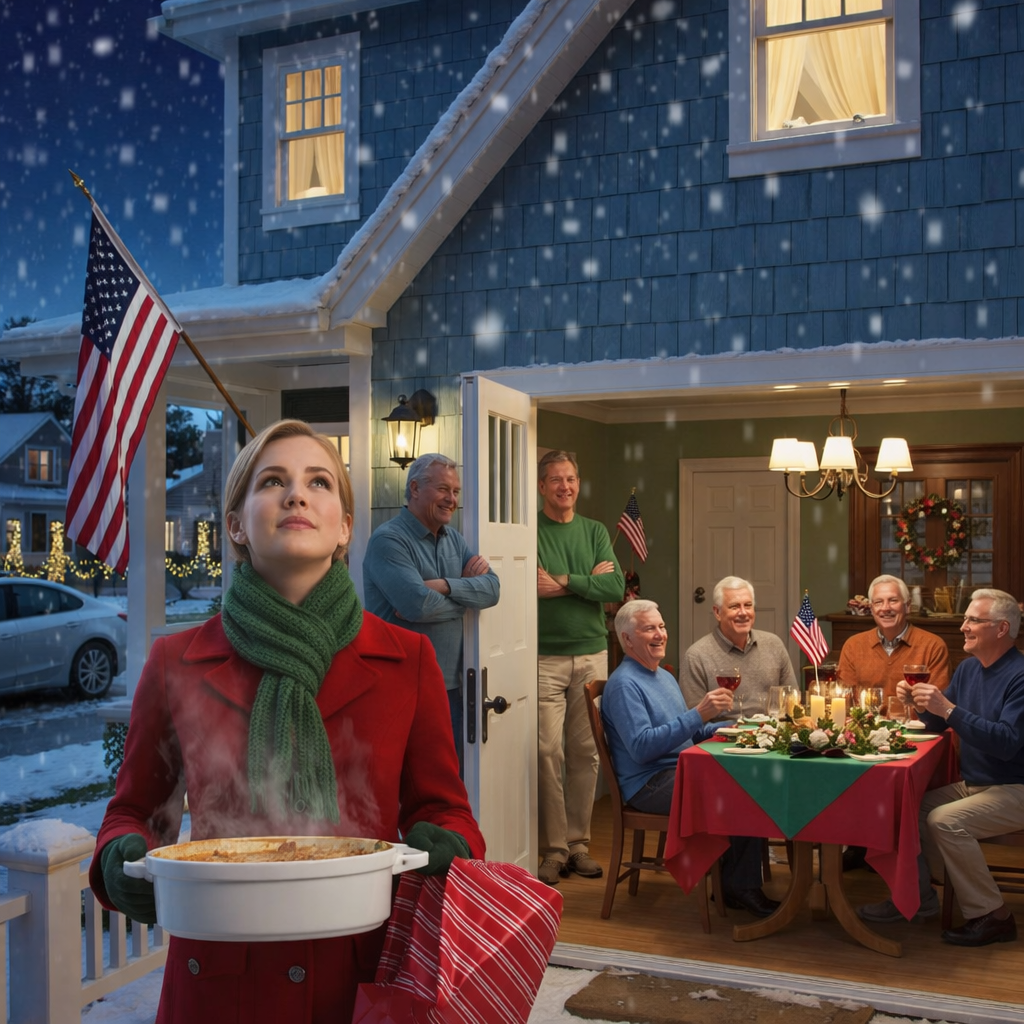
One Door Slam, One Quiet Phone Call, And The Fallout They Never Saw Coming
My name is Hannah Reed, and last Christmas I learned exactly where I stood in my own family.
Not in a metaphorical way, not in a “sometimes families are complicated” way. I mean literally, physically, in the cold, with my boots on a porch mat I’d stepped on a thousand times, holding a gift I’d chosen carefully, staring at a door that should have opened for me the way it always had.
I drove to my parents’ house just after sunset.
Minneapolis in late December has a particular kind of darkness, the kind that comes early and stays like it’s made a decision. The sky was a dull slate and the streetlights cast soft circles on the snowbanks. Every house on the block looked warm and alive. Wreaths on doors. Trees glowing through windows. The faint, muffled sound of music somewhere down the street. It was the kind of night that tries to convince you the world is gentler than it really is.
I had my coat zipped up to my chin, hair tucked behind my ears, and the car heater blasting because my hands never fully warmed up anymore. That’s what stress does. It steals small comforts you don’t notice until they’re gone.
On the passenger seat was the gift.
Wrapped in thick paper with a ribbon I’d tied and re-tied until it looked right. I’d even added a small card, my handwriting careful, the way it always got when I was trying not to show how much I cared.
The gift wasn’t extravagant. My family didn’t need another expensive object to prove a point. They had plenty of those. This one was meaningful. It was chosen to say, I still know you. I still see you. I’m still trying.
Even as I turned into their driveway, a part of me knew I was walking into a room where trying had become my full-time job.
Their house looked exactly the way it always did on holidays. Bright in the windows. Warm light spilling onto the front steps. The porch decorated just enough to be tasteful. My mother’s style was never loud. It was controlled, polished, designed for photos.
I sat in my car for a moment, engine idling, watching my breath fog the windshield.
Somewhere inside, people were laughing.
I could hear it faintly when I rolled down the window, and that sound, the easy warmth of it, made my chest tighten. For a heartbeat I felt like I was thirteen again, walking home from school, hoping the house would feel safe when I stepped inside.
I picked up the gift, checked my reflection in the rearview mirror, and got out.
The cold hit hard, sharp on my cheeks. Snow squeaked under my boots as I crossed the driveway and climbed the steps. I didn’t even have time to raise my hand to knock.
The door opened fast.
Not warmly.
Fast, like someone had been waiting behind it.
My father stood there, framed by the light of the entryway. He wasn’t smiling. His posture was rigid, shoulders squared like he’d prepared himself. My mother was right behind him, one hand on the inside of the doorframe. She looked over his shoulder at me as if she was watching something she couldn’t stop.
Before I could say a single word, my father lifted his arm and blocked the doorway.
“You’re not invited,” he said.
His voice was low, controlled, and that was almost worse than shouting. It was the voice he used in business meetings when he wanted everyone to understand a decision had already been made.
Then he added, even more bluntly, “Go home.”
For a second I truly thought I’d misheard him.
Because it didn’t make sense. It didn’t match the lights, the decorations, the sounds coming from inside. It didn’t match the idea of Christmas, of family, of obligation even. My parents cared deeply about obligation. They loved it. They used it like a shield.
I blinked once. The porch light buzzed faintly above my head. The world felt muffled, as if my ears were trying to protect me.
“Dad,” I started, and my voice sounded small.
My father didn’t move. His arm stayed across the doorway.
My mother’s eyes flickered toward the living room behind them, then back to me. She didn’t say my name. She didn’t say, Let’s talk. She didn’t offer even a token softness. Her lips pressed together in that familiar way that meant she was trying to keep control of her face.
And then, because my brain needed confirmation that reality was actually this sharp, I looked past him.
There was a line of sight through the narrow gap between my father’s shoulder and the hallway.
I could see the dining room table.
Not all of it, just enough.
My brother was there, sitting back in his chair like he owned the room, laughing at something someone said. My aunt was across from him, a glass in her hand, smiling wide. And beside her, tucked into the group like she belonged there as naturally as any Reed, was Paige.
My best friend.
Paige Miller.
She had her hair curled the way she did for special occasions. She was wearing the sweater I’d complimented her on last month. And she was laughing, head tilted back, completely relaxed.
Like the night was normal.
Like I had never existed.
No one looked toward the door.
No one paused their conversation. No one turned and said, Hannah’s here. No one asked why the front door had opened and closed so quickly.
They didn’t even glance in my direction.
It was as if my presence outside was irrelevant. Like I was a delivery that had arrived at the wrong address.
My stomach turned, not with dramatic nausea but with that slow, sinking feeling you get when the bottom drops out of something you didn’t realize you were standing on.
I felt the gift in my hands suddenly become too heavy.
My father’s face didn’t change. He watched me the way you watch someone you want to hurry along. My mother kept her eyes on mine, but there was no warmth there. Only discomfort.
Like I was making things inconvenient by existing on the porch.
I could have asked why.
I could have demanded an explanation.
I could have tried to push past his arm, forced myself into the warmth of the entryway and made them deal with me.
But something in me went still.
A calm, strange and almost weightless calm.
I nodded once.
Not in agreement. Not in acceptance.
Just… acknowledgment.
Then I stepped back.
My father didn’t follow. He didn’t call my name. He didn’t soften. The door closed with a click that sounded polite and final, like closing a file.
I stood on the porch for a moment staring at the door.
Snow clung to the edges of the doormat. The porch light hummed. Somewhere inside, laughter continued.
I turned and walked down the steps.
Each step felt unreal, like I was floating just slightly above my body. The cold air stung my lungs, and when I reached my car and got inside, the interior smelled faintly of pine from the little air freshener hanging on the mirror. It was the only holiday thing that belonged to me in that moment.
I set the gift on the passenger seat.
I put my hands on the steering wheel.
And I didn’t cry.
That surprised me.
For years, I’d cried in private. In bathrooms. In my childhood bedroom. In my car after family dinners that left me feeling like a guest in my own life.
But that night, something else took over.
Not rage. Not despair.
Clarity.
I picked up my phone and scrolled to a number I’d been avoiding.
I didn’t hesitate.
I pressed call.
The line rang once.
Then twice.
Then a calm voice answered. “This is Caleb.”
“Caleb,” I said, and my voice was steady enough that it startled me. “It’s Hannah Reed.”
A pause, brief. I could hear a shift in his breathing, like he knew the tone meant this wasn’t a casual holiday hello.
“Hannah,” he said. “Are you okay?”
I looked at my parents’ front door through the windshield. The warm glow from inside leaked around the curtains. Shadows moved. Someone walked past the entryway.
“I’m ready,” I said.
Another pause.
“Where are you right now?” he asked.
“In their driveway,” I answered. “I just got turned away.”
His voice didn’t change into pity. It changed into focus.
“Drive somewhere safe,” he said. “Somewhere you can talk without being overheard.”
“I already am,” I said.
I started the car and pulled away, tires crunching over snow. I didn’t even know where I was going at first. Just away.
Caleb stayed on the line. He didn’t fill the silence. He let it exist until I reached a small overlook near a park and pulled into an empty space. The engine idled, vibrating faintly through the steering wheel.
“Okay,” he said gently. “Tell me what you mean by ready.”
I closed my eyes.
Because the truth was, the door didn’t shut on me that night. It just made it impossible to keep pretending.
“I have documents,” I said. “From Reed Development Group. Things I saw before I left. Things that don’t match what they show clients.”
Caleb didn’t gasp. He didn’t react dramatically. He simply asked the next question, the way people do when they work with realities that other people avoid.
“What kind of documents?”
“Reports,” I said. “Spreadsheets. Emails. Internal decks. I copied what I could before my access got restricted.”
“Why did you copy them?” he asked.
“Because I knew,” I said. “I didn’t want to know, but I knew.”
He let that sit for a moment.
“Are you willing to provide them?” he asked.
“Yes,” I said, and the word felt like stepping onto solid ground.
“Okay,” Caleb replied. “Here’s what we’ll do. You’ll send them through a secure channel. I’ll walk you through how. Then we’ll schedule a formal statement. I want you to understand the process and your rights. This won’t be fast, but it will be thorough.”
I stared at my hands on the steering wheel, noticing the faint trembling in my fingers. Not from fear exactly. From adrenaline. From finally moving.
“I don’t want this to be messy,” I said quietly.
Caleb’s voice softened just slightly. “It will be uncomfortable,” he said. “But it doesn’t have to be chaotic. You’re allowed to do this carefully.”
Carefully.
That was a language I understood.
We ended the call after less than a minute more. Short, focused, no drama. Just steps. Just structure.
When I put my phone down, the car felt too quiet.
The reality of what I’d done sat in my chest like a stone.
I had called someone connected to the Minnesota Attorney General’s office. Someone who worked in corporate compliance. Someone I’d met at a professional seminar months ago, back when I’d still been trying to convince myself that leaving the company would be enough.
Back then, Caleb had given me his card and said, If you ever feel like something isn’t right, keep records. Even if you don’t know what you’ll do with them yet.
I’d smiled politely and tucked the card into my wallet like it was just a networking exchange.
I didn’t realize it was a lifeline.
I drove home with the radio off. The city looked festive and indifferent. People crossed streets carrying shopping bags. A couple stood outside a bakery sharing something warm. A bus rolled by with holiday ads on its side.
I carried my gift inside my apartment like it still mattered, set it on the coffee table, and stared at it for a long time without opening it.
Then I opened my laptop.
The folder was where I’d left it, buried inside another folder labeled CLIENT WORK, because even after I left Reed Development Group, a part of me still hid from my own fear.
Inside were files I hadn’t looked at in weeks.
The first time I’d seen irregularities, I’d told myself they were normal timing issues. Accounting shifts. Forecast adjustments. The kind of things businesses explain away with jargon.
But as I reopened the documents that night, the pattern showed itself again. Clean, polished projections that didn’t reflect the raw numbers beneath them. Funds shifting between projects with explanations that sounded reasonable until you tracked them across time. Emails that nudged teams to “refine the story” before client meetings.
“Refine” was my father’s favorite word.
It sounded artistic. It sounded harmless.
It wasn’t.
I organized everything into a timeline, not because I enjoyed it but because my brain needed order to stay calm. I created folders by month. I labeled emails with dates. I pulled screenshots of dashboards that no longer existed under my old login.
And then I opened a set of messages I had avoided because I didn’t want the answer they contained.
Paige.
My best friend.
The person I’d trusted most outside my family.
There were emails with her name on them that weren’t meant for me. Updates sent to my aunt Monica. Notes about my access. About the questions I’d asked. About which folders I’d reviewed.
It wasn’t framed as betrayal in the subject line. It was framed as “concern.”
Hannah is digging again.
She’s asking about the investor packet.
She’s fixated on details outside her scope.
Keep an eye on her this week.
I stared at the screen until my eyes burned.
The laughter I’d seen through the doorway at my parents’ house came back to me. Paige’s head tilted back, her smile easy. My aunt’s relaxed posture. My brother’s confident grin.
They weren’t just excluding me.
They were comfortable doing it.
Because, in their minds, I was already the problem.
I sat back in my chair, breathing slowly.
When you find out someone you trusted has been feeding your movements to the people you feared, the pain isn’t sharp. It’s quiet. It’s the sound of something inside you folding in on itself.
I didn’t message Paige. I didn’t call her. I didn’t demand an explanation.
I kept working.
I sent the files to Caleb through the secure channel he provided.
Then I drafted a short summary for Edward Collins, the major investor representative I’d worked with during my time at Reed Development Group. I didn’t make grand accusations. I didn’t write emotionally. I simply said I believed internal reporting didn’t align with what was being presented, and he deserved to be aware.
When I hit send, my hand hovered over the trackpad for a moment.
This was the point of no return.
The apartment was quiet except for the hum of the fridge.
I stood up and walked to the window. The city lights looked like scattered glass.
I waited.
I didn’t have to wait long.
At first, it was one notification.
Then another.
Then a rapid cascade, like a dam breaking.
Texts stacked on missed calls. Email alerts. Calendar requests. Numbers I didn’t recognize. Names I did.
My father. My mother. Lucas. Monica.
Paige.
My phone vibrated so much it skated slightly across the coffee table. It looked frantic, desperate, like an animal trying to escape.
I didn’t answer.
Because I knew exactly what this meant.
They had found out.
Not about the files, not yet, not fully. But they had felt the shift. They had realized the story they controlled so carefully had moved outside their hands.
I walked to the door as if I could sense them through the hallway wall.
And then I heard it.
Footsteps.
Multiple.
Fast, uneven, carrying urgency.
A knock hit my door, sharp and insistent. Not polite. Not patient.
The kind of knock that assumes you’ll open because you always have.
I rested my hand on the doorknob and took one steady breath.
I wasn’t on their porch anymore.
They were at mine.
And for the first time, I understood that the real shouting wasn’t beginning in their dining room.
It was about to begin right here, in the narrow hallway outside my apartment door.
I didn’t open the door right away.
The knocking came again, harder this time, uneven and impatient, the sound carrying down the hallway like it was meant to summon me rather than ask permission. Voices followed, overlapping and tense, the careful holiday tones already gone. I recognized them instantly. My father first, sharp and controlled. My mother after him, breathless and strained. Someone else spoke over them, words tumbling out too fast to separate.
I stood there with my hand resting on the doorknob, not frozen, not afraid. Just listening.
For most of my life, I had been trained to respond immediately. To smooth things over. To step in before tension escalated. Silence, in my family, was treated like disobedience. But standing there in the quiet of my apartment, I realized something with startling clarity.
Silence was the first boundary I had ever truly held.
“Hannah,” my father called again. “Open the door. This is not appropriate.”
Not appropriate.
The phrase landed almost gently this time, stripped of its authority by repetition.
I unlocked the door and opened it just enough to step into the hallway, pulling it closed behind me so they couldn’t follow. The overhead lights buzzed faintly, casting a flat glow that made everyone look tired and slightly unreal, like actors caught between scenes.
They stood clustered together, coats still on, faces tight with urgency.
My father was at the front, posture rigid, jaw set. My mother hovered close to him, one hand gripping her purse as if it were something solid she could hold on to. My brother stood a half step behind them, shoulders tense, eyes darting as if calculating outcomes. My aunt lingered just off to the side, expression composed but alert.
Paige stood at the end of the group.
She wouldn’t meet my eyes.
“What did you do?” my father demanded, his voice low but vibrating with contained anger.
I leaned back against my doorframe and crossed my arms, feeling the cool wood through my coat. “Good evening,” I said calmly.
“This is not a game,” he snapped. “We are getting calls. From people who should not even know how to ask these questions.”
My mother reached toward me, then stopped herself. Her hand hovered in the air before dropping back to her side. “Hannah, please,” she said. “If this is about Christmas, we can talk about that later. Right now, you need to fix this.”
Fix this.
The words were so familiar they barely registered at first. Fix this. Fix the tension. Fix the perception. Fix whatever made them uncomfortable, even if it meant erasing myself in the process.
“I didn’t break anything,” I said evenly. “I stopped pretending nothing was wrong.”
My brother stepped forward, his voice tight. “Do you have any idea what you’ve started? This could take down everything.”
I looked at him carefully, really seeing him in a way I never had before. Not as the confident executive, not as the golden child, but as someone who had spent his entire life staying inside lines drawn by other people.
“Everything was already unstable,” I said. “I just stopped holding it together.”
My aunt spoke next, her tone measured, precise, the way it always was when she wanted to redirect control back into her hands. “Hannah, this could have been handled internally. You escalated unnecessarily.”
I met her gaze. “I tried to handle it internally.”
She didn’t argue. She didn’t deny it. Her silence confirmed more than any explanation could have.
Paige shifted at the back of the group. When she finally spoke, her voice sounded smaller than I had ever heard it. “You didn’t have to do it like this.”
I turned toward her fully.
“Like what?” I asked. “Quietly? Carefully? With documentation instead of accusations?”
Her eyes flickered. “You know what I mean.”
“Yes,” I said. “I do. You mean without consequences.”
The hallway went still.
My father let out a sharp breath. “You’re acting like you’re some kind of hero,” he said. “But you’re hurting your own family.”
I shook my head slowly. “I’m hurting your image. That’s not the same thing.”
“We gave you everything,” he shot back.
“No,” I replied. “You gave me conditions.”
My mother’s composure finally cracked. Her voice trembled as she spoke. “What do you want from us? An apology? Control? To watch us fall apart?”
I looked at her and felt something soften inside my chest, not forgiveness, but clarity.
“I wanted honesty,” I said. “A long time ago. Tonight, I just want you to leave.”
They stared at me like I had spoken something impossible.
“You cannot shut us out,” my father said.
“I didn’t,” I answered quietly. “You did. On your porch.”
That landed harder than shouting ever could.
For a moment, no one spoke. My father’s certainty wavered. My mother’s eyes filled with tears she did not wipe away. My brother looked down at the floor. My aunt recalculated silently. Paige swallowed, her shoulders sinking inward.
I opened my door just enough to step back inside.
“Please go,” I said evenly. “If you contact me again, it will be through formal channels.”
Paige lifted her head. “Hannah…”
I met her eyes. “I trusted you,” I said. “That’s over.”
I closed the door before anyone could respond and turned the lock.
The silence afterward felt enormous.
I leaned my forehead against the door and stood there for a moment, breathing slowly, feeling the echo of their presence fade down the hallway. My hands were steady. That was the part that surprised me the most.
That night, I slept.
Not deeply, not peacefully, but without the constant tightness in my chest that had followed me for years.
The next morning, my phone was full again. But this time, it was different.
Caleb called just after eight. “We received the materials,” he said. “They are consistent and clear. You did exactly what you needed to do.”
“What happens now?” I asked.
“Now the process moves forward,” he replied. “And you are no longer responsible for carrying it.”
That sentence shifted something fundamental inside me.
For the first time, I was not managing the fallout. I was not buffering reactions or smoothing damage. I had told the truth, and it no longer belonged to me alone.
The days that followed moved in a strange rhythm. Some things happened quickly. Meetings were canceled. Projects stalled. People stopped responding the way they used to. Other things took time, unfolding quietly behind closed doors.
Reed Development Group did not collapse overnight. It fractured slowly, the way structures do when stress has been hidden for too long.
My parents stopped calling.
My brother sent one message two weeks later.
I didn’t know how else to stop it.
I stared at the words for a long time before replying.
You could have.
That was all.
Paige sent an email that sat unopened for days. When I finally read it, it was not defensive or dramatic. It was uncertain. Apologetic without asking to be forgiven.
I did not respond.
Not because I hated her, but because responding would have pulled me back into a role I no longer occupied.
Work became my anchor.
Northline Creative grew steadily, not explosively, but with intention. Kayla and I built systems we could stand behind. We chose clients carefully. We said no when something felt wrong. We slept better because of it.
I started therapy, not because everything had fallen apart, but because I finally had the space to look at it honestly.
My therapist asked me one day, “When did you learn that love was conditional?”
I answered without hesitation. “At Christmas.”
Understanding that changed everything.
By spring, the investigation became public.
I did not celebrate. I did not feel vindicated.
I felt calm.
Because truth does not need applause.
My mother reached out months later. Not to argue. Not to defend. She simply said, “I should have protected you.”
I believed her.
That did not fix everything. But it acknowledged something real.
My brother and I met once, briefly, in a park. We talked about neutral things. At the end, he said, “You were right.”
That was enough.
As for Christmas this year, I spent it differently.
Not at a long table filled with tension. Not under a spotlight of expectations.
I spent it with people who chose me without conditions. We cooked too much food. We laughed loudly. We did not perform.
And when I stood at my door that night, locking up after everyone left, I realized something important.
Being turned away taught me where I was never meant to stay.
Walking away taught me where I finally belonged.