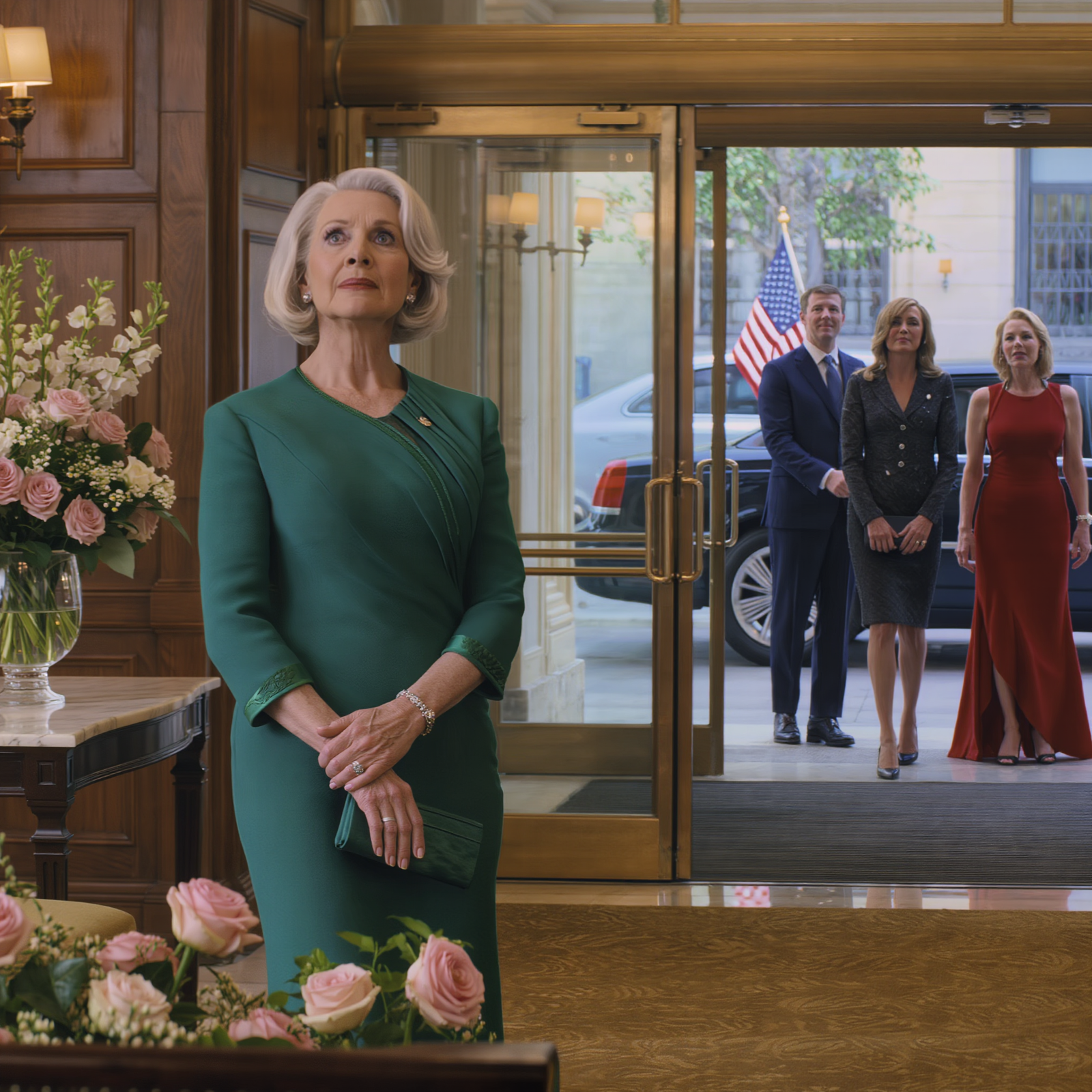
My Son Spent $15,000 on His Mother-in-Law’s Diamond Bracelet While I Waited in My Best Dress
The morning sun in Naples, Florida has a particular quality that exposes everything. It finds every fingerprint on glass doors, every particle of dust floating through shafts of light, every imperfection you’ve been too tired or too lonely to address. That Sunday morning, though, I didn’t mind the brightness pouring through my sliding glass doors. The light felt different somehow. Warmer. Almost hopeful.
It was Mother’s Day.
My name is Suzanne Hubard. I turned sixty-seven last month, and for the first time in what felt like years, I wasn’t dreading a Sunday. Most Sundays in this house are quiet in the way that makes your chest feel tight. My husband Frank passed away five years ago, and after he died, silence moved in like an unwanted houseguest. It spread out, claimed territory, grew heavier with each passing season. You adapt to it eventually. You learn to treat the hum of the refrigerator and the soft ticking of the wall clock like companionship, like voices that still remember you exist.
But that morning felt different. The quiet felt temporary, like the pause before music starts, like holding your breath before good news arrives.
I sat at my kitchen table with my coffee, watching through the window as my neighbors across the street received visitors. A young man had pulled up in a minivan an hour earlier, unloading an enormous bouquet of pink lilies for his mother. The arrangement looked almost comically large, too perfect, like something staged for a greeting card commercial.
I smiled into my coffee mug, and for once the smile felt genuine. For once, I wasn’t pretending not to watch. For once, that familiar pang of jealousy didn’t twist in my chest like a knife.
Today I had plans of my own.
My son Louis was coming to get me. He had promised. He had called on Tuesday with such enthusiasm in his voice, such energy I hadn’t heard since he was a boy, and told me to keep Sunday completely clear.
I glanced at the microwave clock. Nine in the morning. Seven hours until he arrived. Seven hours to prepare, to transform myself into someone worthy of being seen with at a nice restaurant.
I must have replayed that Tuesday phone call a hundred times in the days since. It had been my lifeline all week, the thing I reached for mentally whenever doubt tried to creep in.
Louis isn’t a bad man, not in the way people use that phrase. He’s just busy. Life happens. Priorities shift. He has Valerie, his wife, and his career, and I understand that I can’t be the center of his universe anymore. That’s natural, isn’t it? That’s what parenting prepares you for. You raise them to leave, to build their own lives, to need you less.
But lately, busy had started feeling less like natural independence and more like deliberate distance.
He forgot my birthday entirely last year. No call. No card. Just a text message three days late that said “Sorry Mom, things have been crazy.” Last Christmas, he and Valerie stopped by for exactly twenty minutes because they “had to get to her parents’ house for the real celebration.” Real celebration. Those words had stung more than he probably realized.
So when I saw his name appear on my phone screen Tuesday afternoon, I braced myself for the usual. The rushed voice. The distracted tone. The favor he needed or the excuse for why he couldn’t make time.
Instead, his voice boomed through the speaker, full of warmth I hadn’t heard in months.
“Mom, don’t make any plans for Sunday. I’m handling everything.”
I remember gripping the phone tighter, pressing it against my ear like I could hold onto those words physically.
“Everything?” I asked carefully. “You mean dinner?”
“I mean a real outing,” he said, and I could hear the smile in his voice. “I made reservations at that new place downtown, you know the one with the white tablecloths and the ocean view everyone’s talking about. Be ready at four o’clock sharp. I’m taking you somewhere special, Mom. You deserve to be spoiled for once.”
You deserve to be spoiled.
Those five words lodged themselves somewhere deep in my chest, warm and solid like a good meal on a cold day.
When you reach sixty-seven and you’re living alone, people stop talking about spoiling you. They talk about managing you instead. Managing your medications. Managing your doctor’s appointments. Managing your finances. Managing the decline they all see coming but nobody wants to name directly.
But to be spoiled? To be treated like someone precious rather than someone who requires careful handling? That felt like being seen as a person again instead of a problem waiting to happen.
After I hung up the phone, I stood in my kitchen for a long moment, still holding it like the warmth of his words might leak out if I set it down too quickly. I walked to the hallway mirror and studied my reflection, running one hand over my gray hair. I wanted to look perfect for this. If my son was going to take me out, going to show me off at an expensive restaurant, I wasn’t going to embarrass him.
But if I’m being completely honest, and I think honesty matters here, there was a small knot of worry coiling in my stomach beneath all the excitement.
It was about money. It always comes back to money eventually, doesn’t it?
Louis has a good job. Good on paper, anyway. But he and Valerie live expensively. New cars every few years. Designer clothes. Weekend trips to Miami with glossy Instagram photos proving they’re living their best life. And I knew, because I’d looked it up online, that the restaurant he mentioned was the kind of place where dinner for three could easily cost six or seven hundred dollars.
My mind drifted, as it often did, to the emergency joint account.
A few years ago, after a scare with my blood pressure that landed me in the hospital overnight, I added Louis’s name to my primary savings account. It was supposed to be for emergencies only. If I ended up unconscious or incapacitated, if there were medical bills that needed immediate payment, I wanted him to have access without having to navigate legal red tape while his mother was in crisis.
It was about trust. About being a responsible parent who plans ahead.
It was my safety net, the nest egg Frank and I had built over forty years of marriage through careful saving and sacrifice.
I trust Louis. I do. He’s my son.
But sometimes the boundaries get blurry for him. Sometimes he borrows without asking, takes without explicit permission, assumes access means ownership.
I reminded myself firmly that he wouldn’t be reckless. Not today. Not on Mother’s Day. He had promised he was treating me, which surely meant he had saved up for this, budgeted properly, planned ahead like a responsible adult.
He wouldn’t use my own money to take me out to dinner, would he? That would be tacky beyond belief, cruel even.
I pushed the worry away like swatting at a persistent fly.
Stop it, Suzanne, I scolded myself internally. Don’t ruin this day before it even starts.
I looked out the window again. The neighbor was hugging her son on the front lawn now, both of them laughing about something.
I took a deep breath and held it for a count of five.
Today wasn’t about bank accounts or past disappointments or the small resentments that accumulate over years. Today was about a promise my son had made. He promised to pick me up at four. He promised it would be special.
For the first time in a very long time, I decided to let myself believe that things were changing for the better.
I wasn’t asking for the world. I wasn’t demanding grand gestures or expensive gifts. I just wanted a few hours where I wasn’t invisible, where I mattered enough to be included, where being a mother meant something more than being useful when convenient.
I went to my bedroom and carefully laid out my dress on the bedspread. Soft blue silk, the color of the Gulf of Mexico on clear days. I smoothed the fabric with both hands like I was preparing for something sacred.
I was going to look beautiful today. I was going to be ready. I was going to believe my son when he said I deserved to be spoiled.
I just hoped, with everything I had left to hope with, that he would be on time.
Getting Ready for a Son Who Promised to See Me
By two-thirty that afternoon, my house was quiet but my bathroom had transformed into command central for a campaign I was waging against my own invisibility.
I laid everything out on my bed like artifacts of the woman I used to be, the woman I was trying to resurrect for just one evening. The blue silk dress. Nude pumps with a modest heel. Pearl earrings Frank had given me for our thirtieth anniversary, the ones I only wore for special occasions. A small clutch purse that held nothing but lipstick and a folded tissue.
I took my time in the shower, letting the hot water run longer than necessary, steam fogging the mirror until my bathroom felt like a sanctuary separate from the rest of the world. I wasn’t rushing through this. Today wasn’t about efficiency or crossing tasks off a list.
This was about ritual. This was about remembering what it felt like to be a woman preparing for something important rather than just an elderly person going through motions.
When you live alone, days bleed into each other until they’re indistinguishable. You stop wearing good perfume because who’s going to notice? You stop putting on jewelry because you’re just going to the grocery store or the pharmacy. You stop trying because trying feels like performing for an empty theater.
But that afternoon, I reached behind the clutter on my bathroom counter and pulled out the expensive bottle of perfume I’d been saving. Jasmine. The scent filled the small space immediately, and for a moment I closed my eyes and let it transport me back to years when my calendar was full and my house was loud with family.
Getting into the dress proved to be a battle with my own body and the limitations of living alone. That’s the thing nobody warns you about when you’re young and taking for granted that there will always be someone around to help with difficult zippers. I did that awkward dance, twisting my arm behind my back at an uncomfortable angle, holding my breath, fingers searching blindly for the zipper tab that seemed determined to evade capture.
When it finally zipped all the way up, I released a long breath and turned to face the full-length mirror hanging on the back of my bedroom door.
I stood there for a long time, studying the reflection looking back at me.
The woman in the mirror wasn’t the same person who had worn this dress ten years ago. The silk still fit, technically, but it draped differently now over softer curves. My arms weren’t as firm as they’d been. The lines around my eyes had deepened into permanent fixtures, roadmaps of decades. My neck showed every one of its sixty-seven years.
For a split second, that familiar voice of insecurity tried to rise up and drown me. The voice that whispers cruel things when you’re vulnerable. Who are you trying to fool, Suzanne? You’re an old woman playing dress-up.
But I stopped that voice mid-sentence.
I straightened my spine deliberately. I lifted my chin. I looked myself directly in the eyes.
“No,” I said aloud to the empty bedroom. “Not today.”
These wrinkles weren’t flaws that needed apologizing for. They were evidence. They were proof of survival. They mapped out a life that had weathered raising a child, burying a husband, and maintaining a household alone through five years of widow
hood. Each line told a story of laughter or worry or determination.
I looked dignified standing there. I looked like a woman with stories worth hearing.
I smoothed the blue silk over my hips one more time.
Today, I reminded myself, I am not just a widow. I am not just someone waiting for grandchildren who may never arrive. I am certainly not just an emergency bank account that exists for other people’s convenience.
Today I am a mother, and my son is coming to honor that.
I felt good looking at my reflection. I felt visible. I felt like I mattered.
At three forty-five, I moved into the living room. I didn’t want to sit on the couch and risk wrinkling the dress, so I stood near the front window like a teenager waiting for prom, pulling back the curtain slightly every time a car engine sounded in the distance.
My heart was doing something strange in my chest, a fluttery nervous energy I hadn’t experienced in years. Anticipation. Hope. The dangerous feeling of expecting something good.
I checked my phone for the hundredth time. Three fifty-five.
“He’ll be here any minute,” I said to the empty living room, and the sound of my own voice startled me. The house had been so quiet for so long that even a whisper felt like shouting.
I checked my purse one more time. Driver’s license. Lipstick. Credit card tucked into the back slot just in case, though I desperately hoped I wouldn’t need it.
The digital clock on my cable box clicked over from three fifty-nine to four o’clock exactly.
I stared out at my empty driveway, expecting to see Louis’s silver sedan any second now.
Nothing appeared. Just the quiet street and Mrs. Henderson’s sprinkler system clicking rhythmically as it watered her lawn.
“That’s fine,” I told myself quickly. “It’s exactly four. He’s probably just turning onto the street right now.”
I started pacing in small circles near the window, my heels clicking softly against the tile floor.
Five minutes passed.
Then ten.
Four-ten.
My palms began to sweat. I wiped them carefully with a tissue, terrified of leaving damp marks on the silk dress.
The excitement that had been bubbling in my chest started curdling into something else. Anxiety. Doubt. That terrible familiar feeling of being forgotten.
My mind did what it always does when I’m waiting too long. It started inventing explanations, constructing elaborate scenarios to protect my heart from the truth it didn’t want to face.
Did I get the time wrong somehow? I unlocked my phone with shaking fingers and scrolled back through our text messages even though I had already memorized every word.
There it was in black and white.
“Pick you up at 4, Mom. Be ready.”
I wasn’t wrong. I hadn’t misunderstood. Four o’clock meant four o’clock.
Four-fifteen.
I returned to the window, pressing my forehead against the glass like the physical proximity might somehow summon him.
The sun was beginning its descent toward the horizon, casting longer shadows across my lawn.
The silence in my house began changing quality. It stopped feeling peaceful and anticipatory. Now it felt suffocating, pressing in from all sides.
The fear of being forgotten is a particular kind of cold. It starts in your stomach and spreads outward to your fingertips and toes. It’s the fear that you’re standing there in your best clothes, wearing perfume, heart open and vulnerable, and the person you’re waiting for hasn’t thought about you even once.
I checked my phone’s volume settings irrationally, as if I might have somehow missed a call.
No. The ringer was turned all the way up. The screen showed no missed notifications.
“Traffic,” I said aloud, forcing optimism into my voice and catching my reflection in the dark television screen. “It has to be traffic.”
Naples traffic during tourist season is legitimately terrible. If there was an accident on US 41 or construction near Fifth Avenue South, he could easily be stuck in gridlock with no way to call safely.
He’s probably stressed right now, I told myself. Gripping the steering wheel. Checking the dashboard clock. Frustrated that he’s running late.
He’s a careful driver. He wouldn’t text and drive just to send an update.
I refused to sit down because sitting down would mean admitting he was late. Standing by the window meant I was simply ready and waiting, patient and understanding.
A dark car slowed in front of my house.
My entire body went tense with hope.
I grabbed my purse from the hall table.
But the car accelerated and kept driving past.
My hand dropped slowly back to my side.
Four-twenty.
“He’s coming,” I insisted to the empty room, but my voice sounded smaller now, less certain.
He promised. He wouldn’t break a promise on Mother’s Day. Not my Louis.
I turned away from the window and walked to the kitchen, throat suddenly dry. I poured myself a glass of water and drank it standing at the sink, watching my own hands shake slightly.
I wouldn’t let doubt poison this day. I wouldn’t let past disappointments ruin present hope.
It was just traffic. Just the chaos of a holiday weekend. Just the normal complications of life.
He was coming. He had to be coming.
I set the glass down and returned to my post by the window.
But with every minute that passed, with every car that wasn’t his, the certainty I’d been clinging to began developing cracks.
The Arrival That Broke My Heart
At four-thirty-five, the sound of an engine finally shattered the oppressive quiet of my street.
Relief flooded through my body like cold water on a hot day.
See? I told myself triumphantly. He’s here. You worried for nothing.
I grabbed my purse from the hall table with hands that suddenly felt clumsy with happiness. I checked my lipstick one final time in the entryway mirror, pressing my lips together to even out the color. I opened my front door before he could even knock, eager to show him I’d been ready, that I hadn’t made him wait.
A gleaming silver Lexus SUV sat idling in my driveway, sunlight bouncing off its polished surface.
It wasn’t Louis’s usual car, which confused me momentarily, but then I remembered he’d mentioned something about upgrading their vehicle. This must be it. This must be the new purchase he’d been excited about.
The SUV looked expensive. It looked like success.
I stepped out onto my small porch and locked the door behind me, tucking the key into my purse. I put on my brightest smile, the one mothers wear when they’re proud of their sons.
The driver’s door opened and Louis emerged wearing a navy suit that made him look professional and handsome. His hair was freshly cut. He looked confident and successful, and my heart swelled with that particular pride only mothers understand.
“That’s my boy,” I thought, emotion tightening my throat.
“Hi, honey,” I called out, raising one hand in a small wave.
But before Louis could respond, before he could even look at me properly, the passenger door swung open.
Valerie stepped out wearing a fitted cream-colored cocktail dress that probably cost more than my mortgage payment.
My smile faltered slightly but held. Okay, I thought, adjusting expectations rapidly. It’s a group dinner. The more the merrier.
Then the back door opened.
And Bessie climbed out.
Now, I want to be clear here. I have nothing against Bessie in principle. She’s Valerie’s mother. She’s technically a grandmother to any future grandchildren, same as me. We occupy similar roles in this family structure.
But seeing her there on Mother’s Day, on what I’d been told was my special day, felt jarring in a way I couldn’t immediately process.
Louis hadn’t mentioned bringing other people. He had said he was taking me somewhere special. He had said I deserved to be spoiled.
I tried to adjust my expectations again, faster this time. Joint celebration, I told myself. Maybe they’re honoring both mothers. That’s thoughtful, actually. That’s inclusive.
But then I really looked at what Bessie was wearing, and my stomach dropped.
She wasn’t dressed for dinner. She was dressed for the Met Gala.
A shimmering gold gown that caught every ray of Florida sunlight. Heavy gold earrings that swung when she moved her head. A thick gold necklace that looked like it weighed several pounds. Makeup applied with professional precision.
And on her right wrist, impossible to miss, flashing like a warning beacon, was a diamond tennis bracelet so brilliant it actually hurt to look at directly.
I know jewelry. This isn’t arrogance. This is simply fact. Frank was a jeweler for thirty years before he retired. I grew up learning to distinguish cubic zirconia from real diamonds by sight alone. I know what genuine stones do when light hits them at certain angles.
That bracelet wasn’t costume jewelry from a department store.
Those were real diamonds. High quality. Professionally set.
Worth thousands of dollars. Maybe tens of thousands.
Bessie saw me looking. Our eyes met for a brief moment across the driveway.
She didn’t smile. She didn’t say “Happy Mother’s Day, Suzanne.” She didn’t acknowledge me as a fellow mother being honored today.
She simply lifted her right wrist and gave it a deliberate little shake, making the diamonds catch the sunlight and throw rainbow sparks across my lawn.
It felt less like a greeting and more like a medieval queen reminding a peasant of their proper place in the hierarchy.
I swallowed hard against the lump forming in my throat and kept walking toward the car, determined not to let confusion show on my face.
I reached for the back door handle, planning to squeeze into the back seat beside Bessie and make the best of this unexpected situation.
“You look beautiful, Mom,” Louis said, walking around the front of the vehicle toward me.
“Thank you, sweetheart,” I managed, my hand touching the door handle. “I’m ready whenever you are.”
I tried to sound light and easy, tried to pretend I hadn’t spent forty minutes standing at my window wondering if he’d forgotten me entirely.
But Louis’s voice changed suddenly, taking on a sharp edge. “Wait, Mom. Hold on.”
I froze with my fingers wrapped around the handle.
“What’s wrong?”
He stepped between me and the car door, physically blocking my access.
He wasn’t opening the door to help me in. He was preventing me from getting in at all.
Louis reached into his suit pocket and pulled out his iPhone. “The lighting is absolutely perfect right now,” he said, sounding rushed and slightly manic. “The sun’s hitting the driveway at the ideal angle. We need to get a picture before we lose this light.”
He thrust the phone toward me.
“Can you take a quick photo of the three of us by the car? We want to post it before dinner.”
I stared at the phone in his outstretched hand like it was a foreign object I’d never encountered before.
“A picture?”
“Yeah, Mom,” Valerie chimed in, already moving into position and smoothing down her cream dress. She linked her arm through Louis’s with practiced ease.
Bessie waddled into the frame between them, making absolutely certain that her diamond-laden wrist was prominently displayed, resting it on Louis’s shoulder like she was claiming ownership.
“Come on, Suzanne,” Bessie said, her voice thick with impatience. “We’re losing the golden hour light.”
Golden hour. She actually said golden hour like she was a professional photographer instead of a woman in a too-tight dress.
I took the phone from Louis with hands that had started trembling.
I felt cold despite the eighty-degree Florida heat pressing down on my shoulders.
“Just press the big white button on the screen,” Louis instructed, as if I were some technologically illiterate senior citizen who’d never operated a camera. “And make sure you get the whole car in the shot. It’s a rental and we want people to see it.”
I stepped backward onto my lawn, putting distance between myself and the tableau they’d arranged.
I lifted the phone and looked at the screen.
There they were. My son. His wife. Her mother. All three of them beaming like they’d just won the lottery, arranged in front of a luxury vehicle that probably cost more to rent for a day than my monthly grocery budget.
And I was on the other side of the camera lens, documenting their happiness for strangers on social media.
I pressed the button.
Click.
“One more,” Louis called out, grinning even wider. “Turn the phone horizontal this time. Landscape mode.”
I rotated the phone ninety degrees with mechanical precision.
Click.
I lowered the device slowly and handed it back to him, my arm feeling like it weighed a hundred pounds.
Louis grabbed it eagerly and immediately started swiping through the images, checking quality and angles.
“Perfect. These are great, Mom. Thanks.”
He turned away from me and headed toward the driver’s side door.
Valerie climbed gracefully back into the front passenger seat.
Bessie hoisted herself into the back seat with considerable effort, her gold dress bunching around her knees.
And I stood there on my driveway in my blue silk dress and pearl earrings, clutch purse gripped in both hands, watching the three of them settle into the vehicle without me.
“Louis,” I said.
My voice came out as barely a whisper. I cleared my throat and tried again with more force.
“Louis.”
He paused with one hand on the driver’s door and looked back at me with an expression of mild irritation, like I was a stranger who’d asked him an inconvenient question.
“Yeah?”
I gestured helplessly toward the empty space in the back seat that I’d assumed was meant for me.
“Aren’t I coming with you?”
Louis laughed.
The sound was short and sharp and utterly devoid of warmth.
He glanced at Valerie in the front seat, then back at me, wearing the kind of expression you’d use if a child asked to drive the car.
“Mom,” he said slowly, like he was explaining something very simple to someone very dim, “did you really think this dinner was for you?”
The words hit me like a physical blow to the chest.
“This is a high-end establishment,” he continued matter-of-factly. “It’s not really your scene. The menu’s all experimental cuisine and small plates. Plus the reservation is only for three people. This is a special treat for Valerie and Bessie. I wanted to do something nice for them.”
“But,” my voice cracked and I hated myself for it, “you said you were taking me somewhere special. You said I deserved to be spoiled.”
“I said I was handling Mother’s Day,” he corrected me with exaggerated patience. “And I did handle it. I stopped by to see you, didn’t I? I drove all the way out here. Look, we really need to go now or we’ll lose our reservation. These places are strict about timing.”
He climbed into the driver’s seat.
He closed the door with a solid thunk that sounded like finality.
Through the tinted window, I saw Bessie lean forward and say something to Louis. All three of them laughed at whatever she’d said.
The engine roared to life.
Louis didn’t wave goodbye. He didn’t mouth “I’ll call you later.” He didn’t offer any gesture of acknowledgment or affection.
He just backed smoothly out of my driveway and drove away, leaving me standing in a cloud of exhaust fumes.
I was left there in my best dress and my anniversary pearls, holding a purse that no longer had any purpose, watching the silver SUV disappear around the corner.
The silence that rushed back in to fill the space where their engine noise had been felt louder than anything I’d ever heard.
They hadn’t forgotten me.
That would have been cruel but accidental, forgivable in its thoughtlessness.
This was deliberate.
Calculated.
He had driven to my house specifically to use me as an unpaid photographer for his social media performance, then abandoned me on my own property like I was a piece of lawn furniture that had served its purpose.
The dinner was never for me.
The spoiling was never meant for me.
I was never part of the plan.
I stared down at the faint tire marks his rental SUV had left on my pavers.
Then my mind flashed back to Bessie’s wrist, to those diamonds catching sunlight, to the deliberate way she’d made sure I saw them clearly.
Something cold and sharp settled into my stomach.
I turned and walked back toward my front door.
I didn’t rush. I didn’t run inside to cry. I walked with careful purpose, my heels clicking precisely against the walkway.
The Florida heat pressed down on the back of my neck, but I felt frozen from the inside out.
Just as the SUV was about to turn the corner and disappear from my street entirely, the back window rolled down.
For one foolish second, hope flared in my chest. Maybe Louis had changed his mind. Maybe he was going to say “Wait, Mom, we’ll make room somehow.”
But it wasn’t Louis.
It was Bessie.
She leaned her head out of the window, sunlight glinting off her heavy earrings, and her eyes traveled deliberately up and down my body. She studied my blue silk dress with an expression that made it clear she found it lacking.
“Oh, Suzanne,” she called out in a voice dripping with false sweetness, “you look so comfortable. Enjoy your quiet evening at home.”
Then the window rolled up with mechanical precision.
The SUV turned the corner and vanished.
Comfortable.
That word hung in the humid Florida air like poison.
In Bessie’s carefully curated world, comfortable was code language. It meant old. It meant frumpy and irrelevant. It meant I stayed home in my comfortable clothes watching comfortable television while important people went out to live their important lives.
Across the street, my neighbor Mrs. Higgins had stopped watering her hydrangeas.
She was staring directly at me.
She had witnessed the entire humiliating scene. She’d watched me rush out like an excited child on Christmas morning. She’d watched me get used as a photographer. She’d watched me get left behind while they drove away to their fancy dinner.
I couldn’t bear the pity I saw in her eyes.
I didn’t wave. I didn’t smile. I didn’t pretend this was normal.
I just turned and walked back up my driveway toward my front door.
My heels clicked loudly against the pavers with each step.
Click. Click. Click.
A rhythm of humiliation.
When I reached the door, my hands were shaking so badly I fumbled my keys and dropped them. They clattered against the concrete with a sharp metallic sound that felt like mockery.
I had to crouch down in my nice silk dress to retrieve them from where they’d fallen near my potted fern.
A sound escaped from somewhere deep in my chest. Half laugh, half sob. The kind of noise that happens when your body doesn’t know whether to break down or rage.
“Get yourself together, Suzanne,” I whispered harshly to myself.
Inside, the house was cool and dark after the bright sunlight.
The contrast was blinding. I stood in my entryway blinking while my eyes adjusted, one hand still on the doorknob behind me.
I closed the door and leaned my back against it, needing the solid surface to hold me upright.
The silence hit differently now.
Before, it had been the silence of anticipation, of waiting for something wonderful.
Now it felt like a tomb. Like being buried alive.
My jasmine perfume still lingered in the hallway from when I’d applied it earlier, but now the scent smelled sad instead of hopeful. It smelled like effort wasted, like a performance for an empty theater.
I kicked off my nude pumps right there in the entryway without caring where they landed. One hit the baseboard with a soft thud. The other skittered across the tile.
I walked barefoot across the cold floor to my living room.
I caught my reflection in the dark television screen as I passed.
The woman looking back at me didn’t look dignified anymore.
She looked foolish.
The blue silk dress that had made me feel beautiful an hour ago now looked too bright, too hopeful, too desperate. Like a costume for a role I was never actually cast in.
I waited for tears. I expected to collapse onto the sofa and sob into throw pillows, mourning the relationship I thought I had with my son.
But the tears didn’t come.
Instead, something else rose up in my chest.
Not heartbreak.
Anger.
“Comfortable,” I said aloud to my empty living room.
My voice was steady. Clear.
My mind kept flashing back to that bracelet on Bessie’s wrist. To the way it had caught the light. To the obvious expense represented by those stones.
And Louis had been complaining about money for six months straight.
Every phone call was the same litany:
“Inflation is killing us, Mom.”
“The mortgage rate is insane.”
“You wouldn’t believe what it costs to fill up a gas tank anymore.”
Last month he’d told me he couldn’t afford to repair his air conditioning unit and had borrowed two hundred dollars from me to cover a vet bill when their dog got sick.
So how, in the name of everything holy, was he driving a luxury rental vehicle and taking two women to an expensive restaurant while Bessie wore what looked like a twenty-thousand-dollar bracelet?
A sick feeling twisted in my gut.
This wasn’t anxiety anymore. This wasn’t the nervous worry of waiting.
This was maternal intuition. The kind of knowing that comes from having raised someone, from understanding their patterns and tells and weaknesses.
Something was very, very wrong.
I walked past my kitchen without stopping. I didn’t want water. I didn’t want food. Food felt impossible right now.
I went straight to the small desk in the corner of my Florida room where I kept my iPad charging.
I sat down in the chair, silk rustling around me, and opened the cover with shaking fingers.
The screen lit up, brightness making me squint.
My fingers hovered over the banking app icon.
That emergency joint account. Frank and I had opened it twenty years ago with modest goals. Fifty dollars here. A hundred dollars there when we could spare it. Building slowly and steadily toward some vague future emergency we hoped would never come.
It was supposed to be for catastrophic medical expenses. For assisted living if I couldn’t manage on my own anymore. For leaving something behind for grandchildren who might need help someday.
I had added Louis as a joint account holder three years ago, right after my hip surgery when I was heavily medicated and worried about what would happen if I died under anesthesia with bills unpaid.
“Just in case something happens, Mom,” he’d said earnestly. “Someone needs to be able to access funds for hospital payments.”
I had trusted him completely. He was my son. My only child.
He’d never stolen from me before.
He’d borrowed, certainly. Always with some excuse about why he couldn’t pay it back right away. Always planning to replace it later when things settled down.
But stealing? Theft? Those words felt too sharp and ugly to apply to my own son.
I tapped the banking app.
The little wheel spun while it loaded, and I found myself praying to a God I wasn’t sure I still believed in.
Please let me be wrong. Please let him have won the lottery without telling me. Please let there be some logical explanation.
Not this. Please not this.
Face ID recognized me. The dashboard loaded.
I took a breath and forced myself to look at the balance.
The number was wrong.
It had to be wrong. There must be some technical error.
I tapped on “Recent Transactions” with a finger that felt numb.
The list populated on my screen.
And as I read the first line, the entire world tilted sideways.
The silence of my house stopped being empty.
It started screaming.
There it was at the top of my pending transactions list.
Pending: $14,525.00
Diamond Vault Naples
3:15 p.m.
I removed my glasses and wiped them carefully on my silk dress, as if my vision was the problem, as if cleaning the lenses would somehow change what I was seeing.
I put them back on.
The numbers remained unchanged.
Fourteen thousand, five hundred, and twenty-five dollars.
My hands went completely numb.
That account had held nearly twenty thousand dollars this morning. Money that Frank and I had accumulated over forty years of marriage through careful budgeting and sacrifice. Money we’d set aside five dollars at a time, ten dollars at a time, building something solid beneath us for emergencies we hoped would never come.
Now the balance showed less than six thousand remaining.
Barely enough to cover two months of basic expenses.
The timestamp made the mathematics brutally, horrifyingly clear.
3:15 p.m.
Louis had told me he was running late picking me up at four o’clock.
He wasn’t stuck in traffic.
He wasn’t delayed by some unforeseen circumstance.
He was standing at a jewelry store counter at 3:15 in the afternoon, using a debit card with my name on it, purchasing a diamond tennis bracelet for his mother-in-law.
He had drained my life savings to impress Bessie.
Then he drove to my house, positioned her in front of me wearing my money on her wrist, used me to photograph the evidence, and left me standing on my own driveway like discarded trash.
The nausea rose fast and sharp, then passed just as quickly, replaced by something cold and crystalline.
Clarity.
This wasn’t just thoughtlessness or poor judgment.
This was theft.
My hand reached automatically for my cell phone on the desk. My first instinct was to call him immediately and scream. To demand answers. To ask how he could possibly do this to his own mother on Mother’s Day.
To hear him stutter and scramble for excuses.
But I stopped myself, fingers hovering over his contact information.
If I called him now, he would talk his way out of it somehow. He would tell me it was an investment in family harmony. He would promise to pay me back next week. He would suggest I was overreacting to a simple misunderstanding.
He would gaslight me until I doubted what my own eyes had seen on that screen.
I wasn’t going to give him that opportunity.
I set my cell phone down deliberately.
Instead, I picked up my landline and turned my debit card over, reading the 1-800 customer service number printed on the back.
I dialed with steady fingers.
The automated voice asked for my account number. I punched it in carefully, making no mistakes.
Tinny hold music played while I waited.
When a human voice finally came through the line, mine was perfectly calm.
“I need to speak with your fraud department, please.”
There was a brief pause, some clicking, then a young woman’s voice. “Fraud department, this is Jennifer. How can I help you today, Miss Hubard?”
“I’m looking at my online banking statement right now,” I said, staring at the iPad screen. “I see a pending charge for fourteen thousand, five hundred and twenty-five dollars at a jewelry store called Diamond Vault.”
“Yes, ma’am,” she replied professionally. “I’m pulling up your account now. I can see that transaction. Diamond Vault Naples, posted at 3:15 p.m. today. Was there a problem with the merchant?”
“I did not make that purchase,” I said clearly and precisely. “I am currently in possession of my debit card. I am sitting in my home. I absolutely did not authorize any purchase of that amount.”
“I understand,” Jennifer said, her tone shifting to something more serious. “I do see there’s a secondary authorized user on this account—Louis Hubard. Is it possible he made the purchase?”
I paused.
This was the critical moment.
This was where I either accepted my role as the eternal doormat or I drew a line that could never be uncrossed.
“I did not authorize this transaction,” I repeated firmly. “The money in this account is designated for medical emergencies only. It is not for jewelry purchases. If that charge is allowed to process, it constitutes theft. I want the account frozen immediately for security purposes.”
“I understand completely, Miss Hubard,” Jennifer said. “I’m marking this transaction as unauthorized and placing an immediate freeze on the account for your protection. No further charges will be approved starting right now. We’ll launch an investigation into this matter.”
“Thank you,” I said. “And I’d like to request that the secondary card be canceled as well.”
“Consider it done,” she replied. “The card ending in 4738 is now deactivated. Is there anything else I can help you with today?”
“No. That’s everything.”
“You should see the pending charge reversed within three to five business days once the merchant processes the cancellation. You’ll receive written confirmation by mail.”
I hung up the phone.
The house went completely silent again.
I sat there at my desk for a long time, watching the afternoon light change through my windows.
5:30 p.m.
6:00 p.m.
I knew exactly what was happening at that restaurant.
They were ordering expensive wine right now. Lobster. Steaks. Laughing together. Bessie waving that diamond-laden wrist around under candlelight, showing it off to other diners, telling everyone what a generous and wonderful son-in-law she had.
Toasts to family.
Toasts to their own good fortune.
I stood up slowly and walked to my kitchen.
I made myself a cup of tea with careful, deliberate movements.
I ate a piece of toast with butter.
I sat at my kitchen table and watched the evening news on the small television I kept on the counter.
I waited.
The Calls Started Coming
At 7:45 p.m., my cell phone rang.
Louis.
I looked at his name on the screen and let it go to voicemail.
At 8:00 p.m., it rang again.
And again thirty seconds later.
Then Valerie’s name appeared.
Then Louis again.
I sat on my sofa watching my phone buzz angrily against my coffee table, vibrating against the wood surface like it was having a seizure.
I sipped my tea slowly.
Finally, at 8:15 p.m., I picked up.
“Hello,” I said, keeping my voice light and pleasant.
“Mom, Jesus Christ, finally!” Louis shouted. “I’ve been calling you for forty-five minutes!”
I could hear the restaurant chaos behind him—clattering dishes, voices overlapping, the ambient noise of a room full of wealthy people enjoying their evening.
He sounded breathless and panicked, like he’d been running.
“Louis?” I asked innocently. “What’s wrong, honey? You sound upset.”
“The card declined,” he hissed into the phone. “I tried to pay the bill and the machine rejected it. I tried it three times. The waiter is standing here looking at me like I’m trying to steal food. The manager just came over to the table.”
“Oh dear,” I said softly, taking another sip of tea. “That sounds embarrassing.”
“Mom, listen to me very carefully.” His voice dropped to an urgent whisper. “I need you to transfer money immediately. Right now. The bill is enormous—we ordered the tasting menu, the champagne pairing, the seafood tower, everything. It’s over eight hundred dollars before tip. I don’t have that much available on my personal credit card. I need you to unblock the joint account or Venmo me a thousand dollars to my account right this second. They’re threatening to call the police.”
He sucked in a sharp breath.
“Please, Mom. Just do it. We can talk about everything later. Just save me here.”
I took a slow breath and set my teacup down on its saucer with a soft clink.
I pictured my driveway three hours ago.
Bessie’s condescending smile.
Louis’s casual cruelty: “Did you really think this was for you?”
The word “comfortable” delivered like a slap.
The fourteen-thousand-dollar charge that had decimated my savings.
“Louis,” I said quietly, “what exactly are you doing right now?”
“What do you mean, what am I doing?” His voice pitched higher with desperation. “I’m trying to pay for dinner!”
“You spent fourteen thousand dollars on a mother today,” I said, letting each word land separately.
The line went completely silent.
Even the restaurant background noise seemed to fade away.
He knew.
He absolutely knew that I’d discovered what he’d done.
“Mom, I can explain—” he started, his voice suddenly low and careful.
“You already spent my money today,” I said, and my voice had turned to stone. “You spent my emergency fund. You spent the money your father and I saved for forty years.”
“Mom, it’s not what you—”
“So let the woman who’s currently wearing my retirement fund on her wrist pay for your dinner,” I interrupted coldly.
I didn’t wait for his response.
I didn’t give him a chance to argue or manipulate or explain.
I pressed the red button.
Click.
I set the phone down on my coffee table.
My hands weren’t shaking anymore.
Not even slightly.
I felt lighter than I had in years.
I felt powerful.
I took another sip of my tea.
It was still perfectly warm.
The evening was turning out to be quite comfortable after all.
The Aftermath
The phone lit up again almost immediately.
Louis calling back.
I didn’t reach for it.
I didn’t feel that old familiar tug, that deeply ingrained maternal instinct that screams he needs you, you have to help him.
Instead, I stood up calmly and walked into my kitchen.
My stomach growled, reminding me that bodies need fuel regardless of emotional devastation.
I made myself a turkey sandwich.
I moved slowly, deliberately, finding strange comfort in the mundane ritual.
Mustard on wheat bread.
Sliced turkey from the deli.
Lettuce.
The phone buzzed continuously in the other room.
Bzz. Bzz.
It would stop. Then start again five seconds later.
Valerie calling.
Louis calling.
Louis again.
I took a bite of my sandwich.
It tasted dry, but I chewed methodically and swallowed anyway.
I counted the calls in my head while I ate.
Ten.
Twenty.
Thirty.
By the time I finished my tea and rinsed my cup, there were forty-seven missed calls and sixteen text messages lighting up my phone screen.
I didn’t read a single one.
I powered the phone off completely and left it on the kitchen counter.
Then I went to my bedroom, washed the makeup off my face with cold water, hung up my blue silk dress carefully in the closet, and changed into my comfortable pajamas.
I climbed into bed at 9:30 p.m.
And I slept better than I had in months.
The Morning After
The next morning—Monday—I was pouring my second cup of coffee when the pounding started.
It wasn’t a polite knock or a doorbell ring.
It was a fist hammering against my front door hard enough to rattle the frame.
“Mom! Mom, open up! I know you’re in there!”
Louis’s voice, raw and desperate.
I didn’t rush.
I took a slow sip of my coffee, letting the warmth spread through my chest.
I tightened the belt on my bathrobe.
Then I walked calmly to the door and unlocked it.
Louis practically fell into my entryway.
He looked absolutely terrible.
The navy suit he’d worn so sharply yesterday was wrinkled and stained with what looked like wine. His tie hung loose and crooked around his neck. His eyes were bloodshot, surrounded by dark circles. His hair stuck up in odd directions.
He smelled like stale alcohol, cigarette smoke, and sweat.
He stared at me wild-eyed, breathing hard.
“Why is your phone off?” he demanded immediately. “Do you have any idea what you did to me last night?”
Not “Are you okay, Mom?”
Not “I’m sorry for what I did.”
Just immediate accusation, as if I was the one who had committed some terrible crime.
“Good morning, Louis,” I said calmly, leaning against my doorframe.
I didn’t invite him to sit down.
I didn’t offer him coffee.
I didn’t ask if he was alright.
“There is nothing good about this morning,” he shouted, marching past me into my living room and starting to pace frantically. “You completely destroyed me, Mom. You humiliated me in front of everyone!”
“I think you managed that all by yourself,” I replied evenly.
His hands flew up in exasperation.
“Do you know what happened after you hung up on me?” He spun around to face me, gesturing wildly like he could somehow make me see the horror he’d experienced.
“The manager came back to our table. He said the card had been reported as stolen. Stolen, Mom! He threatened to call the police right there in the middle of the dining room with fifty people watching. People were staring at us. Bessie was staring at me.”
I took another sip of my coffee.
“I had to sit there and admit I couldn’t pay the bill,” he said, his voice cracking with humiliation. “I had to tell my mother-in-law that I didn’t have the money to cover a dinner I’d invited her to.”
He slumped onto my sofa, burying his face in his hands.
“Bessie had to pay,” he mumbled into his palms. “She had to dig into her purse and pull out her credit card to cover a nine-hundred-dollar bill. She was absolutely furious. She called me a fraud right there at the table.”
He looked up at me with red-rimmed eyes.
“She made me tell her the truth,” he whispered.
“Tell her what truth?” I asked, though I already knew.
He looked away, unable to meet my eyes.
“About the bracelet,” he said quietly.
When he said it, his gaze flickered to the floor, like even he couldn’t bear to look at me with that truth hanging in the air between us.
“After she paid the bill, she started asking questions,” he continued, voice hollow. “She wanted to know how I could afford a fourteen-thousand-dollar bracelet if I couldn’t afford to pay for lobster. She’s not stupid, Mom. She put it together. She realized I must have used your card.”
He swallowed hard.
“She made me take it back this morning. First thing. She wouldn’t even wear it home from the restaurant. She threw it at me in the car on the way back. She said she didn’t want stolen goods on her body.”
His voice broke.
“I had to go to Diamond Vault as soon as they opened at nine this morning and return it. The salesman looked at me like I was garbage. Like I was some kind of criminal.”
He blinked rapidly, tears forming.
“They refunded the money to your account. It’s all back. Every penny. Are you happy now?”
He looked at me with those tear-filled eyes, clearly expecting me to comfort him.
Waiting for me to say, “Oh honey, I’m so sorry this happened. We’ll figure it out together.”
That’s what I’d always done throughout his entire life.
I’d been his soft place to land when consequences caught up with him.
But as I looked at this forty-year-old man sitting on my sofa crying because his mother-in-law discovered he wasn’t actually wealthy, I didn’t feel soft.
I felt like concrete.
“I’m not happy, Louis,” I said quietly. “But I am relieved.”
“Relieved?” He stared at me in confusion. “I almost got arrested!”
“I’m relieved because I have my money back,” I said clearly. “And I’m relieved because I finally see you for who you really are.”
“What are you talking about?” he snapped. “I’m your son!”
“No,” I said, and the word came out harder than I’d intended. “To you, I’m not a mother. I’m a resource. I’m an ATM machine that’s supposed to fund your lifestyle.”
He opened his mouth to argue, but I kept going.
“You didn’t come here this morning to apologize for hurting me,” I said. “You didn’t come here because you felt guilty about leaving me standing on my driveway like an old piece of furniture you didn’t need anymore. You came here because you’re embarrassed. You’re only sorry that you got caught.”
His face hardened.
I lifted my hand to stop whatever he was about to say.
“You love the lifestyle I can help you fake,” I continued. “The appearance of wealth. The performance of success. But Louis, you don’t love me. If you loved me, you wouldn’t have looked me in the eye yesterday and lied to me. You wouldn’t have bought diamonds for another woman with money your father left to keep me safe in my old age.”
The room went absolutely quiet.
He stared at me, genuinely stunned.
It was perhaps the first time in his entire life that his charm didn’t work on me.
That his tears didn’t manipulate me.
That his excuses didn’t make me fold.
He glanced toward my kitchen hopefully, maybe expecting that I’d offer breakfast, that I’d start softening, that this would blow over like every other time.
But I just stood there in my bathrobe, arms crossed, waiting.
The door to my hospitality was closed.
The bank was closed.
And for the first time in his life, he looked genuinely scared.
Not of police or public humiliation.
Of me.
Taking Back Control
Louis left my house ten minutes later.
He didn’t slam the door dramatically.
He just walked out with his shoulders slumped forward, looking like a man who’d lost his wallet and his dignity in the same catastrophic evening.
I watched through my front window as his car disappeared down my street.
I waited for the guilt to arrive.
You know that guilt. The voice that whispers insidiously for decades:
He’s your baby.
Be patient with him.
Don’t be too hard on him.
He’ll grow up eventually.
But when I locked my deadbolt, that voice was completely silent.
I didn’t feel guilty.
I felt mobilized.
I went straight to my bedroom and got dressed properly.
Not in a silk dress this time.
In good slacks and a sensible blouse.
Professional. Serious.
I grabbed my purse, my driver’s license, and the folder where I kept all my important financial documents.
Then I drove straight to my bank.
I’d been banking at the same branch for twenty years. The kind of traditional local institution where they still recognized your face, asked about your garden, and called you “Miss Suzanne” like you were a valued human being rather than an account number.
When I walked in, the air conditioning hit me immediately—cool, crisp, professional.
It felt like a place where business happened.
And I meant business.
I sat down at the desk of a senior banker named Nancy Crawford.
Lovely woman, approximately my age, always efficient and kind.
Normally we would exchange pleasantries first. Chat about the weather. Ask about each other’s health.
Not that day.
“Nancy, I need to make some immediate changes to my accounts,” I said, placing my driver’s license on her desk. “I need Louis removed as a signer completely. His card needs to be canceled. His access needs to be revoked. His name needs to come off all the paperwork. Today.”
Nancy looked at me over her reading glasses.
She didn’t ask why.
She’d been in banking long enough to recognize what that particular look on a woman’s face meant.
She just started typing.
“We can absolutely do that, Suzanne,” she said professionally. “I can see the fraud alert that was placed on your account yesterday. The fourteen-thousand-dollar charge was refunded this morning by the merchant. Your balance is restored.”
“Good,” I said. “But I don’t want him to have another opportunity to try something like this again.”
Nancy clicked through screens, pulling up forms and printing documents.
Then she paused.
She squinted at her computer monitor, scrolling slowly.
“Suzanne,” she said carefully, “since we’re removing Louis from the account anyway, I should probably bring something else to your attention.”
My stomach tightened instinctively.
“I know you don’t check your online banking very frequently,” she continued gently. “The fraud alert flagged that large purchase yesterday, but looking at the transaction history over the past several months… there have been quite a few smaller withdrawals. Did you authorize these?”
I leaned forward.
My heart started beating slowly and heavily, like a drum.
Nancy turned her monitor so I could see the screen clearly.
A long list of transactions I’d never noticed because I usually waited for my monthly paper statement and only glanced at the final balance.
$60.00 — GameStop
$45.00 — Shell Gas Station
$25.00 — Starbucks
$120.00 — Ticketmaster
$200.00 — Cash Withdrawal (ATM)
$85.00 — Target
$30.00 — Uber Eats
The list went on and on.
Page after page.
“These smaller amounts didn’t trigger our fraud detection system,” Nancy explained quietly. “We call these ‘test transactions’ in the banking industry. Sometimes people make small unauthorized charges to see if the account holder is paying attention. When nobody notices or complains, they get progressively bolder.”
I stared at the screen, my vision starting to blur.
Video games.
Gas station purchases.
Coffee.
Concert tickets.
Groceries.
Food delivery.
The bracelet had been a shocking, audacious theft.
But this was somehow worse.
This was worse because the bracelet was one dramatic act of stupidity.
These charges represented eight months of daily, calculated betrayals.
For eight months, Louis had been treating my life savings like his personal spending account.
Every latte he didn’t feel like paying for.
Every tank of gas he thought I wouldn’t notice.
Every little convenience he wanted.
He was stealing from me five dollars at a time while I sat at home eating leftovers to save money.
“He was testing me,” I whispered.
Nancy nodded sympathetically.
“That’s what it looks like, yes.”
“Would you like me to dispute these charges as fraudulent as well?” she asked gently.
I looked at the total estimated amount at the bottom of the screen.
Maybe two thousand dollars. Perhaps three.
I sat back in my chair.
“No,” I said finally. “Let him keep the video games and the coffee. Consider it the price of my education.”
Nancy didn’t argue with my decision.
She slid the removal paperwork across her desk toward me.
I signed each form with firm, decisive strokes.
The sound of the pen scratching across paper was the most satisfying sound I’d heard in years.
“He’s completely removed,” Nancy said, stamping the documents with official approval. “He has absolutely no access anymore. If he attempts to use that card number, it will be declined immediately.”
“Thank you,” I said sincerely.
I stood to leave, gathering my purse—then stopped.
My eyes landed on the glass-walled office in the corner where the estate planning officer worked.
I had a will.
I’d written it ten years ago with Frank, when we were planning for our futures.
Simple and straightforward.
When Frank was alive, everything would be divided between him and Louis.
After Frank passed away, I’d updated it so everything would go to Louis automatically.
The house.
The remaining savings.
The life insurance payout.
Everything.
I pictured Bessie wearing that bracelet yesterday, diamonds flashing in the Florida sun.
I pictured Valerie watching me stand on my driveway and saying absolutely nothing in my defense.
If something happened to me tomorrow—a heart attack, a fall, a car accident—Louis would inherit everything I owned.
And within a year, maybe less, he would spend every penny of it on them.
On impressing Bessie and Valerie.
On maintaining appearances.
They would be living in my house, driving cars purchased with my money, laughing about poor old Suzanne who’d been so convenient and easy to use.
“Nancy,” I said, placing my hand back on her desk, “is your estate planning officer available? I need to update my will.”
Nancy’s eyebrows lifted slightly.
“I believe he has an opening this morning,” she said carefully. “Are you absolutely sure about this? You seem… this is an emotional time.”
“I have never been more rational in my entire life,” I replied calmly.
Rewriting the Future
I walked into that glass office and did something that would shock some people.
I wrote my son out of my will.
Not completely—I’m not vindictive or cruel.
I set up a small trust that would pay Louis a modest monthly stipend starting when he turned fifty-five. Enough for basic groceries and utilities. Enough to survive but not enough to impress anyone.
But the lump sum inheritance?
The house?
The nest egg Frank and I had built?
No.
I designated the bulk of my estate to a local charity that helps elderly women who have no family support. Women who actually need it. Women who would use it to survive rather than to perform wealth they didn’t actually have.
I stared at the draft document the estate officer had prepared.
For a moment, that old familiar mother-voice tried to rise up and drown me.
Isn’t this too harsh? He’s your only child. Blood is thicker than water.
But then I remembered those test transactions.
The Starbucks charges.
The gas station purchases.
The Ticketmaster fees.
Eight months of treating me like an ATM machine.
He didn’t respect me.
He saw me as a resource to be exploited, not a person to be cherished.
And you don’t leave an inheritance to someone who views you as a cash machine.
You leave it to someone who actually values you as a human being.
Respect must be earned.
And Louis was currently operating at a significant deficit.
I signed the document with a steady hand.
Walking out of that bank into the bright Florida sunshine, I expected to feel heavy with grief.
To feel like a terrible mother who’d abandoned her child.
But I didn’t feel any of that.
I felt light.
I felt like I was floating.
For the first time in years, I wasn’t consumed with worrying about Louis.
Was he happy?
Did he have enough money?
Did he still love me?
Would he call this week?
I had cut the cord.
And in doing so, I realized I wasn’t losing a son.
I was losing a leech.
A son adds value to your life.
A leech drains you until you’re completely empty.
I started my car and pulled out of the bank parking lot.
I had my money back.
I had my dignity intact.
And for the first time in a very long time, the future looked like it actually belonged to me.
Three Weeks Later
It’s been three weeks since I walked out of that bank.
Three weeks since I rewrote my will and drew a permanent line in the sand.
You might think that after cutting off my only son, my life would become smaller and lonelier.
You might imagine me sitting in a dark living room staring at old photo albums, drowning in regret about what I’d done.
But the truth is exactly the opposite.
My world didn’t shrink.
It exploded with color and possibility.
I used to spend Tuesday mornings dusting the guest room for visitors who never came.
I used to spend entire afternoons sitting by the phone, terrified I might miss a call from Louis.
But this particular Tuesday, I wasn’t home dusting.
I wasn’t near my phone at all.
I was at the Naples Botanical Garden wearing a wide-brimmed sun hat and gardening gloves, laughing so hard my sides ached.
I’d joined the local garden club just three days after the Mother’s Day incident.
I was nervous initially. I thought everyone would already have their established friend groups, that I’d be the awkward new person at sixty-seven trying to force my way into social circles that didn’t want me.
But when I walked into that first meeting, I didn’t see strangers.
I saw women exactly like me.
I met a woman named Patricia at the orchid potting station.
She was a widow too, approximately my age.
We worked side by side with our hands covered in rich soil, and she started talking casually about her daughter in Chicago who calls every single Sunday like clockwork.
She wasn’t bragging.
She was just sharing her life.
And for the first time in years, I didn’t feel that sharp pang of jealousy.
I felt genuinely happy for her.
After the meeting ended, Patricia turned to me and said, “Suzanne, a few of us are going to get iced coffee down the street. Would you like to join us?”
I froze.
For just a second, I waited for the catch.
For her to ask if I could drive everyone.
Or if I could pay for the coffee.
Or if I could do them some favor.
But she was just looking at me, smiling warmly.
She wanted my company.
She liked me for who I was, not for what I could provide.
“I would absolutely love to,” I said.
And I meant it.
We sat at that outdoor café for nearly two hours, talking about everything from rose bushes to retirement planning to grandchildren to travel dreams.
I realized I’d been absolutely starving for real conversation.
The kind where the other person actually listens instead of just waiting for their turn to ask you for money.
When I got home that evening, the sun was sinking low over Naples, painting the sky in brilliant streaks of orange and purple and pink.
I made myself a tall glass of iced tea with fresh mint from the herb garden I’d started on my patio, and I carried it outside to my favorite rocking chair.
I sat there listening to the evening crickets beginning their nightly symphony.
Peaceful.
Then my phone buzzed on the side table.
My stomach gave a little lurch out of pure habit.
Old conditioning dies hard.
But I didn’t panic this time.
I picked it up calmly.
A text from Louis:
“Hey Mom. Hope you’re okay. Look, I know things are weird between us right now, but I’m literally running on empty here. Can you Venmo me $40 for gas? Just until payday. I swear I’ll pay you back.”
I stared at the screen.
The sheer audacity almost made me laugh out loud.
After the bracelet theft.
After the restaurant humiliation.
After I explicitly told him to his face that I was done being his personal bank.
He was still trying.
Testing the waters again.
Starting small—just gas money, exactly like those little unauthorized withdrawals Nancy had shown me on the bank statement.
He wanted to see if the Bank of Mom had quietly reopened for business.
I didn’t feel anger.
I didn’t feel the urge to type out a lecture.
I didn’t compose a reply explaining all the reasons this was inappropriate.
I simply pressed delete.
Then I blocked his number for the evening.
I set the phone face-down on the table.
I took a long, satisfying sip of my iced tea, cold condensation making my fingers pleasantly wet.
I looked out at my quiet street.
Mrs. Higgins was walking her small terrier.
She spotted me and waved enthusiastically.
This time I waved back—big and broad and genuine.
I am alone in this house.
There are no noisy family dinners planned on my calendar.
There are no frantic phone calls interrupting my peace.
There is just me.
And as I sat there watching that spectacular Florida sunset, I realized something profound.
I am alone.
But I am not lonely.
For years, I thought loneliness was about having an empty house.
But I was completely wrong.
Loneliness is sitting in a room full of people who don’t actually see you.
Loneliness is being used by the people who are supposed to love you.
Loneliness is waiting endlessly for affection that comes with a price tag attached.
I am free of all that now.
I have my dignity.
I have my Tuesday garden club.
I have coffee dates with Patricia.
I have my independence and my self-respect.
And most importantly, I have myself back.
I closed my eyes and breathed deeply, taking in the scent of jasmine and freshly cut grass floating on the evening breeze.
I am Suzanne Hubard.
I am sixty-seven years old.
And for the first time in a very, very long time…
I am enough.
Epilogue
Six months after everything happened, Ella—that’s Patricia’s granddaughter—was working on a school project about families. She asked if she could interview me about what family means.
I thought about the question carefully before answering.
“Family,” I told her, “isn’t just about who you’re related to by blood. Real family is about how people treat you. It’s about whether they make you feel safe and valued and loved.”
She nodded thoughtfully, writing down my words in her careful handwriting.
“So family is people who show up for you?” she asked.
“Exactly,” I said. “Family is people who would never make you wait in the cold. People who celebrate you instead of using you.”
That evening, I found myself thinking about Louis.
I don’t hate him.
Hate requires energy I’d rather spend on my garden.
But I don’t miss him either.
What I miss is the son I thought I had.
The one who existed in my imagination.
The real Louis—the one who saw me as a resource rather than a person—that Louis I’m better off without.
My mother thought she was teaching my daughter a lesson that cold Mother’s Day.
She did teach me a lesson.
Just not the one she intended.
I learned that some people use love like a leash, something to control and manipulate.
I learned that “family” doesn’t grant unlimited access or immunity from consequences.
I learned that sometimes the most loving thing you can do for yourself is establish an impenetrable boundary and refuse to negotiate it.
And I learned that the word “Okay” can be the beginning of the hardest, most necessary boundary you’ll ever draw.
The house is quiet tonight.
Snow is falling gently outside—no, wait, this is Florida. Warm rain is falling gently outside.
The gate is just a gate.
The door is unlocked from the inside because I live here and I belong here.
And I know, deep in my bones, that I will never again stand waiting for someone to decide whether I’m worth their time.
That’s not just healing.
That’s freedom.