My Nephew Smashed My $8,000 Gibson Guitar. My Family Said “Forgive Him.” So I Taught Them What Accountability Really Costs.
Labor Day morning at my parents’ lakehouse always had the same rhythm.
The house sat back from the water on a gentle rise, cedar siding silvered by years of sun and storms. The screened porch smelled like charcoal and citronella and the faint sweetness of lake air, a damp, green smell that clung to your skin. Inside, ceiling fans clicked at the same tempo they always had, pushing around air that never quite cooled because the windows were open and the day was already warming.
I’d arrived the night before with my truck packed like I was moving in. Clothes, groceries, a box of recording notes I shouldn’t have been thinking about, and my guitar case, the one I handled like it contained something alive.
Because it did, in a way.
My 1975 Gibson Hummingbird.
Every time I unlatched the case, I felt the same quiet pulse of gratitude and disbelief, like I’d somehow tricked the universe into letting me hold something too beautiful to belong to me. The sunburst finish caught light differently depending on the hour. In the early morning it looked like honey, amber and burnt sugar, the grain of the spruce top shimmering under the lacquer. By late afternoon it deepened into something darker and warmer, like the last glow of a campfire.
I’d saved for five years. Not in a romantic way, not with some inspiring montage. I saved in the blunt, boring way real saving happens. Turning down dinners, skipping trips, taking extra sessions when my hands were tired and my ears rang. Saying no to gear I wanted because I wanted that one thing more. Eight thousand dollars felt like a mountain when you’re building it out of small, disciplined sacrifices.
And it wasn’t just a purchase. It was part of my work, part of my identity in the most practical sense. I’d used it on more than forty recording sessions. You could hear it in tracks that people streamed without thinking, in background textures that made a song feel warm and human.
I could tell you the difference between the Hummingbird’s voice and anything else in a blind test. It had a clarity and a soft punch, a feathered brightness. When I played it, it felt like the guitar knew what I meant before my fingers did.
That morning I took it out to the deck facing the water. The lake was calm, a sheet of glass with a light mist hovering above it. Somewhere across the inlet, a fishing boat’s motor purred low, then faded. Birds called from the trees like they were arguing about something important.
I sat down, set the guitar on my knee, and tuned by ear the way I always did when I could. The strings were cool under my fingertips. The wood warmed slowly against my forearm. The sun came up behind the treeline, making the finish flash and glow.
It was one of those rare moments when I wasn’t thinking about my phone or my next gig or my bank account. I was just… there. Present. Quiet. Content.
Then I heard it.
A sharp, sickening crack.
Not a door. Not a branch. Not the deck settling.
Wood splitting.
My body reacted before my brain finished forming the thought. I stood so fast the chair scraped the deck boards. My stomach turned cold, an instant drop like a missed stair.
I ran inside.
The lakehouse always echoed in strange ways, sound bouncing off stone and wood and glass. I could hear my boots thudding on the floor, the screen door slapping shut behind me. The living room came into view in a blur.
Tyler stood there.
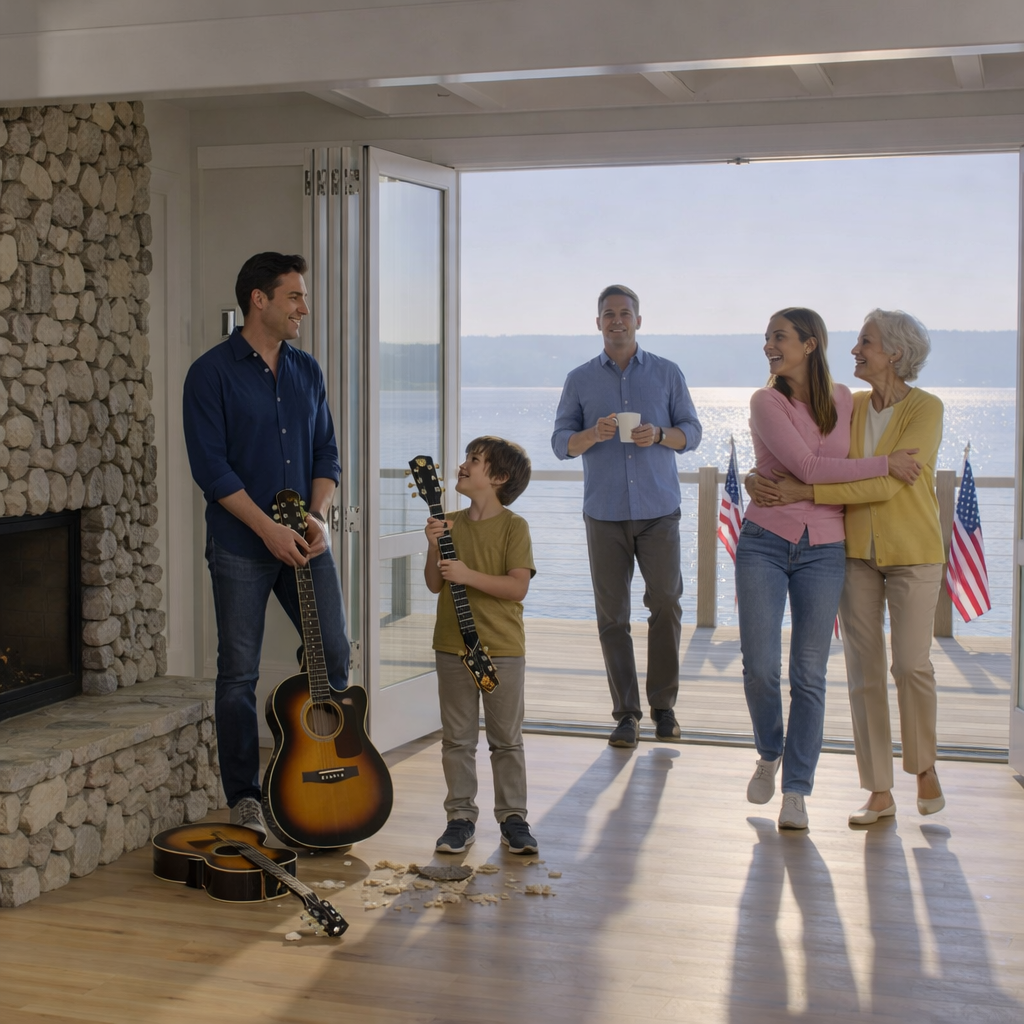
My nephew, nine years old, small for his age but wiry and restless, the kind of kid who always looked like he was holding in a laugh. He was in the middle of the living room, in front of the stone fireplace. He held my guitar by the neck with both hands, like it was a toy sword.
The body was smashed against the stone.
The bridge was ripped clean off.
The spruce top, that beautiful shimmering surface, was split down the middle like someone had taken an axe to it.
Strings hung in tangled loops, a spiderweb of metal catching light and trembling slightly, as if even the wreckage still remembered vibration.
For a second I couldn’t breathe.
My mind refused the image. It tried to turn it into something else. A dream. A prank. A hallucination caused by stress and lack of sleep.
Then Tyler looked at me and laughed.
It wasn’t a nervous giggle. It was bright, careless amusement.
“It broke,” he said, and lifted the neck slightly as if to show me proof. “Your guitar was fake.”
The room felt like it tilted.
My hands started shaking, not dramatically, just an uncontrollable tremor that made my fingers twitch as if they wanted to grab and fix and rewind time. Heat rushed into my face, then drained, leaving me cold and lightheaded.
“Tyler,” I managed, and my voice didn’t sound like mine. It sounded thin. Strained. “Why did you do this?”
He stood proud, chin up, shoulders squared. No fear. No apology. His eyes were bright, almost excited, like he’d completed a mission and expected applause.
Behind him, in the doorway, Derek stood frozen.
My brother-in-law.
Forty years old. Tall, broad-shouldered, always carrying himself with the easy confidence of a man who liked being the loudest voice in a room. He held a coffee cup halfway to his mouth. The steam rose in a thin curl. His face was white as paper.
He didn’t move. He didn’t speak.
The silence filled the living room, heavy and buzzing.
I knelt down and picked up the pieces of my guitar like I was gathering something fragile off a battlefield. The lacquered wood was splintered and sharp. A sliver bit into my thumb and I didn’t even feel it at first. The smell hit me, raw wood exposed, a clean, almost sweet scent that should have been beautiful and was suddenly obscene.
Eight thousand dollars in splinters.
Five years of saving.
Forty sessions.
Something irreplaceable.
I looked up at Tyler again, because I needed to make sense of it, and said, softer now, as if quietness could reach him, “Buddy… why?”
Tyler shrugged, still smiling. “Derek said real Gibsons are super tough. So I wanted to test if yours was real.”
My head snapped toward Derek.
He flinched like the words physically struck him.
“You told him what?” I said.
Derek’s face flushed red so fast it looked like a wave of heat moving under his skin. His mouth opened. Closed. Opened again.
“I didn’t tell him to… do that,” he stammered. “I just said, you know, craftsmanship. Durability. Like, real quality control. Those things are built to last.”
Tyler piped up immediately, eager. “You said Uncle Marcus probably has a cheap one. You said it at breakfast. You said he wastes money on fake stuff.”
Derek’s eyes widened, pleading, like he wanted Tyler to stop talking.
Tyler kept going, unstoppable. “You did. You said it this morning when I asked about guitars.”
I stared at Derek.
There are moments when your brain makes a clean decision: this is a person I do not recognize anymore. This is someone who just crossed a line so far it rearranged how you see them.
My guitar wasn’t just expensive. It was vintage. 1975. The kind of instrument you don’t simply replace with a trip to a store. It had history in its wood. It had a life. It had become part of the sound I built my work on.
And now it was broken in a way that couldn’t be undone. A split top is a death sentence. A ripped bridge isn’t a simple repair when the whole structure is compromised. You can patch, you can mend, but it will never be the same guitar again. The resonance changes. The integrity changes. The voice is gone.
The commotion drew footsteps.
Claire rushed in first.
My sister, thirty-eight, hair pulled into a messy knot, wearing one of my mom’s lakehouse sweatshirts like she belonged there in a way I never quite did. She took in the scene in a single scan: Tyler in the center of the room, my hands full of guitar fragments.
Tyler’s face shifted instantly.
Crocodile tears appeared like a magic trick. He threw his arms up and ran to her, and Claire scooped him into her arms like she was rescuing him from danger.
“What did you do to my son?” she demanded, eyes snapping to me.
I blinked, stunned by the speed of it. My mouth opened, then closed again. I held up the shattered body of the guitar. Bits of wood fell from it like dead leaves.
“He destroyed this,” I said. “Derek told him to test it.”
Claire looked at the guitar and for a moment something like shock flickered across her face. Then her expression hardened.
“He’s nine, Marcus,” she said, squeezing Tyler tighter as if I might attack him. “He didn’t know it was expensive.”
“Eight thousand dollars,” I said. The number came out flat, like a statement of fact, because if I let emotion into my voice, I wasn’t sure what would happen.
Claire gasped, and I saw the calculation happen behind her eyes. Eight thousand wasn’t just “a lot.” It was a category. It was a thing you could weaponize in a conversation. Her shock turned to anger.
“You spent $8,000 on a guitar?” she said, like the crime was mine.
“It’s vintage,” I said, trying to keep my voice steady. “1975. Worth more now. I use it professionally.”
Derek stepped forward, suddenly trying to play peacemaker, which made something inside me twist. “Look, I’ll pay for repairs,” he said quickly. “We can… take it somewhere. I’m sure it’s fixable.”
“It’s not,” I said. My voice cracked on the last word. I swallowed and tried again. “The top is split. The bridge is gone. This isn’t a scratch. It’s destroyed.”
More footsteps.
My mother, Barbara, appeared in the doorway like a general arriving at a crisis. Sixty-two, always put together, always convinced she could smooth any conflict with the right tone of voice.
She saw Tyler crying in Claire’s arms and made her choice instantly.
“Marcus,” she said sharply, “stop scaring the boy.”
My father, Richard, came next. Sixty-four, still broad in the chest, the kind of man who’d spent his life assuming problems could be solved by speaking firmly enough.
He looked at the guitar pieces on the floor. Looked at me. Looked at Tyler.
His face tightened, like he was annoyed at the inconvenience.
“It’s just a guitar, son,” he said. “You can get another one.”
That sentence hung in the room like smoke.
Just a guitar.
Get another one.
I felt something inside me go very still. Like a door closing.
Nobody asked if I was okay.
Nobody scolded Tyler.
Nobody told Derek to apologize.
All the concern flowed in one direction, toward the child who had just destroyed something I’d sacrificed years to own.
Claire shifted her stance so her body was between me and Tyler like she was physically shielding him. “Tyler’s a child,” she said, voice rising, defensive now. “He doesn’t understand the difference between a $200 guitar and an $8,000 one.”
“Then teach him not to destroy other people’s property,” I said.
Claire’s eyes flashed. “He made a mistake.”
“Derek made the mistake,” I said. “Tyler just followed instructions.”
Barbara stepped forward, her hands out in that familiar calming gesture, as if she could press the air into stillness. “Marcus,” she said, “you’re being unreasonable.”
Richard crossed his arms. The judge. The verdict already decided. “It’s replaceable,” he said. “Family isn’t.”
The words were meant to shut me down. To make me the villain if I pushed back. To force me into the role they’d assigned me: the one who compromises, the one who keeps the peace, the one who swallows anger so everyone else can stay comfortable.
I looked at each of them.
My sister, angry at my spending.
My mother, scolding me for “scaring” a child.
My father, dismissing my loss.
My brother-in-law, whose pride had planted this whole disaster.
My nephew, whose tears came and went like a faucet.
I felt completely alone.
Claire’s voice turned sharp again. “You’re supposed to forgive,” she said. “He’s just a child.”
Not one of them said, We’ll replace it.
Not one of them said, We’ll pay you back.
Not one of them said, Derek, what the hell were you thinking?
They wanted forgiveness as a shortcut. Forgiveness as an eraser. Forgiveness as a way to avoid the uncomfortable work of accountability.
My chest felt tight, like I couldn’t expand my ribs all the way. I knew if I spoke too much, the control I was holding onto would slip. I didn’t want to scream. I didn’t want to cry in front of them. I didn’t want to beg for empathy.
So I did something else.
I nodded slowly.
Not a dramatic nod. Not a sarcastic one. Just a small, quiet motion.
“Okay,” I said.
Then I turned around and walked away, carrying my guitar’s broken body like an injured animal.
Behind me, I heard Barbara exhale, relieved. I heard Claire coo something to Tyler, soothing him like he was the victim. I heard Richard mutter, “Good,” like he’d won.
They thought it was over.
They thought I’d accepted my assigned role.
They had no idea what I was doing inside my own head.
I moved through the house like I was underwater. The sounds of the lakehouse muffled, distant. The clink of dishes. The whirr of fans. Someone turning on a faucet. Life continuing as if nothing had happened.
At the entryway, there was a decorative wooden bowl on the table, full of keys. It was always there at the lakehouse, a communal drop zone for the people who felt entitled to treat the place like a resort.
My parents’ keys.
Claire’s keys.
Derek’s keys.
Derek’s key fob sat on top, glossy black with the three-pointed star logo.
Mercedes-Benz.
I picked it up.
It was heavier than I expected. Cold metal in my palm. The weight had a strange satisfaction to it, like holding a truth no one else wanted to acknowledge.
Through the front window I could see the car parked near the boat ramp.
Black Mercedes AMG GT. Sleek, low, the kind of vehicle designed to look expensive even when standing still. The plate read DR KFU NDS, a joke Derek had been proud of, a little wink at his supposed brilliance.
He bragged about that car constantly. Talked about horsepower and leather and prestige like it was proof of worth. It was his trophy, his shield, the thing he used to say, Look at me, I’m still winning.
I walked outside, not rushing, just observing.
The boat ramp sloped down toward the water, gravel packed into a smooth incline. No barriers. No posts. Nothing to stop a vehicle from rolling straight into the lake if it had momentum.
The water by the ramp was deep. I’d swum there as a kid, dove down until my ears hurt, and still never touched the bottom. Depth markers along the dock showed twenty feet.
Deep enough.
The Mercedes sat about thirty feet from the ramp edge.
A natural roll path.
I scanned the house for cameras. My parents weren’t the surveillance type. There were none pointed at the ramp.
I turned back toward the windows. Inside, Tyler was already laughing again, running around with a toy, bouncing off furniture, as if he hadn’t just shattered something precious.
No consequences.
No lesson.
Derek had started this, and yet the entire household had rallied to protect him from discomfort by putting the burden on me.
In that moment, something in me settled.
Not rage, exactly. Rage felt too hot, too chaotic.
This was colder.
Clearer.
A decision hardening like concrete.
The Labor Day barbecue went on as planned that evening. That was the surreal part, the way families can stage normalcy like a performance even when something inside them has ruptured.
Richard grilled steaks on the back patio like he always did, tongs clicking, smoke rising in a steady stream. Barbara set the table with her “good” dishes, the ones she saved for holidays. The lake glowed gold in the late light, the surface rippling when a breeze passed.
Tyler ran around with a water gun, shrieking with delight, spraying whoever wandered into range. Claire laughed and called him “my energetic boy, so full of life,” as if destruction was just enthusiasm with bad timing.
I stood alone by the railing, watching the water, feeling the absence of the guitar like a missing limb.
Derek came up beside me, trying to sound casual, trying to slide past what he’d done with the kind of charm men like him relied on.
“Hey,” he said, clearing his throat. “Look… about earlier. I can write you a check. Ten grand. More than the guitar cost. Let’s just… put it behind us.”
I didn’t look at him. My fingers gripped the railing until the wood pressed into my skin.
“You can’t make this right,” I said quietly.
He scoffed, offended. “Money makes it right.”
“Not this,” I said. “Some things don’t get fixed that way.”
He stood there for a moment, waiting for me to soften. When I didn’t, he walked away, frustrated.
Dinner began. Everyone gathered around the table with forced cheerfulness, laughing too loudly at jokes that weren’t funny, passing plates as if nothing was wrong.
Richard looked across at me. “You’re being childish about this,” he said.
I met his eyes. “Am I?”
Barbara set down her fork, her voice gentle but firm in the way she used when she wanted to control a situation without seeming controlling. “We’re family,” she said. “Let it go.”
The word let landed like a command.
I kept my voice level. “You’re right,” I said. “Family should forgive each other.”
Claire’s shoulders visibly relaxed. She smiled at me like she’d won. “Thank you,” she said. “That’s mature of you.”
I didn’t smile back. I ate in silence, mechanically, tasting almost nothing. I watched them all. The way Derek leaned back in his chair like the world owed him comfort. The way Claire stroked Tyler’s hair and told him he was “fine.” The way my parents pretended they were doing the right thing by smoothing over the problem.
My calmness should have frightened them.
It didn’t.
At 6:15 the next morning, the house was still asleep. The air outside had that cool, damp edge that comes before sunrise. Dew clung to the grass. The lake sat perfectly still, mist rising like breath.
I went to the entry table.
Derek’s keys were where he’d left them.
Of course they were.
I slipped them into my pocket and stepped outside. The screen door creaked softly. Somewhere in the trees, a bird made a single sharp call, then went quiet.
The Mercedes waited near the ramp.
I walked up to it and unlocked the door. The car beeped softly, an expensive little chirp that felt absurd in the stillness.
I slid into the driver’s seat.
Cream leather, immaculate. It smelled like money, like designer cologne and polished surfaces. The dashboard glowed faintly as the car recognized the key. The interior felt insulated from the world, like a sealed capsule.
I didn’t start the engine.
I shifted the transmission into neutral.
My heart beat steadily. Not wildly. Not frantically. A controlled rhythm. My hands didn’t shake now.
I opened the door, stepped out, left it ajar, and leaned back in to release the parking brake.
There was a soft click.
That was all it took.
At first, the Mercedes didn’t move. Then gravity began doing what gravity always does.
The car rolled slowly, tires crunching on gravel.
Then it picked up speed.
The incline guided it perfectly, like a path designed for exactly this.
Gravel sprayed in small arcs behind the tires. The open driver’s door wobbled slightly, then swung wider as the car accelerated. The mist over the water shifted as if it sensed what was coming.
I stepped back, arms folding across my chest.
And I watched.
The Mercedes hit the edge of the ramp and nosed down.
For one split second, it seemed to hover, the front dipping toward the lake like a bow.
Then it plunged.
The splash was enormous, a violent burst of water that shattered the morning silence and echoed across the lake. Ripples exploded outward, slapping the dock, the shoreline, the rocks.
The car sank front-first.
The tail rose briefly, like a hand reaching up.
Through the open windows, I could see the pale interior. The leather. The seats that Derek loved to brag about. Then the water swallowed them.
Bubbles streamed up in frantic bursts.
In less than thirty seconds, it was gone.
The lake closed over it, smoothing itself as if it had never been disturbed.
A moment later I heard the sliding door on the deck open.
Footsteps.
Derek appeared in pajamas, holding his coffee mug.
He saw me standing near the ramp.
He saw the water still churning. The last bubbles. The widening rings of ripples.
He stared, not understanding, his face blank like his brain hadn’t caught up.
Then his coffee mug slipped from his hand and shattered on the deck behind him.
The brown liquid spread slowly across the wood.
A sound came out of him, half breath, half wail.
Then he screamed.
It was an animal sound. Pure shock and horror.
The house woke up instantly. Lights flicked on. Doors opened. Voices called.
Derek ran down toward the ramp, slipping a little on the gravel. He reached the edge and leaned forward like he might somehow grab the car through the water.
Too late.
Nothing to save.
He stood there panting, staring at the bubbles fading.
Then he turned toward me, his face twisted into disbelief and fury.
“What did you do?” he shouted.
I didn’t raise my voice.
“I released the brake,” I said. “Physics did the rest.”
His mouth opened like he couldn’t believe the words.
“My car,” he choked out. “My… car.”
I met his eyes and used the same dismissive tone my father had used on me, the same casual cruelty.
“It’s just a car, Derek,” I said. “You can buy another one.”
For a second, the only sound was the lake water lapping at the ramp and Derek’s ragged breathing.
Then he lunged at me, hands reaching like he wanted to grab me by the shirt and shake answers out of me.
I stepped to the side easily.
He stumbled forward into the gravel, caught himself, then sprang back up, fists clenched, face red.
Claire came running out next, robe pulled tight around her. Her hair was wild from sleep. She looked at the lake, then at Derek, then at me, and her face crumpled in horror.
“Where’s the Mercedes?” she cried.
I pointed down at the water. “Right there.”
Her eyes widened like she couldn’t comprehend it. “You pushed his car into the lake.”
“I didn’t push it,” I said. “Gravity did. I just released the brake.”
Barbara and Richard arrived moments later, both in robes, hair disheveled.
Richard’s voice thundered across the ramp. “Marcus, have you lost your mind? What the hell is wrong with you?”
Barbara’s hands flew to her mouth. “Oh my God.”
I turned to them slowly.
Yesterday, they had spoken as if my loss didn’t matter. As if my feelings were an inconvenience. As if forgiveness was something they could demand from me to protect the people they favored.
Now they wanted outrage.
Now they wanted consequences.
I kept my voice calm. “Yesterday, Tyler destroyed something I saved years to buy,” I said. “Something I use professionally. You told me it was just a guitar. Get another one. You told me family forgives. You told me I was being childish for being upset.”
I gestured toward the lake, toward the last bubbles dissolving into still water.
“So I let his car go,” I said. “I applied your lesson. We’re even now.”
Silence fell.
Not peaceful silence. Stunned silence.
Derek fumbled for his phone, hands shaking so hard he nearly dropped it. “I’m calling the police,” he snapped.
I didn’t blink.
“Go ahead,” I said.
He froze mid-motion.
I continued, measured, almost conversational. “When they come, I’ll file a report about Tyler destroying my $8,000 guitar. I’ll explain how you told a nine-year-old to test whether it was fake. How you incited a minor to commit property destruction.”
Claire’s face drained of color so quickly it looked like someone had wiped it clean.
Derek swallowed, his Adam’s apple bobbing.
I let the next part land carefully. “That’s not a cute parenting moment,” I said. “That’s an adult manipulating a child into committing a crime. You want law enforcement involved? Fine. But you may not like where that goes.”
Derek’s phone hovered in his hand like a weapon he wasn’t sure he could use.
Claire grabbed it from him, suddenly frantic. “Don’t call,” she hissed. “Please don’t call.”
Derek stared at her, disbelieving. “He sank my car.”
Claire’s voice cracked with panic. “And you told Tyler to break his guitar!”
Richard stepped forward, palms out, trying to regain control. “Enough,” he barked. “Enough! Everyone calm down.”
I looked at him. “I am calm,” I said.
And I was.
That’s what shocked them most.
They’d expected anger. They’d expected drama. They’d expected me to explode and prove their narrative about me being unreasonable.
Instead I stood there steady, mirroring their own logic back at them.
I walked toward my truck, which I’d parked near the side of the driveway. I opened the back door and reached inside for my guitar case. The case felt heavier than it should have with the broken instrument inside, like grief had weight.
Barbara followed me, her slippers crunching on gravel. “Marcus,” she said, voice trembling. “Where are you going?”
“Home,” I said.
“Please,” she whispered, as if the word itself could undo what had happened. “Please don’t do this.”
I closed the truck door gently, careful with the case.
“Thanks for the lesson,” I said.
She blinked, confused, eyes wet. “What lesson?”
“The one you taught me,” I said. “About how family handles expensive property destruction.”
Richard’s voice cut in, hard. “If you leave now, you’re choosing to end this family.”
I turned and met his eyes, really met them. “No,” I said quietly. “You chose yesterday when you sided with Tyler over me. When you dismissed my feelings. When you told me it was just a guitar.”
I climbed into the driver’s seat. The engine started with a low rumble. The sound felt grounding, real.
Behind me, Claire sobbed, and her words came out in a broken rush. “We still owe eighty-seven thousand on that car loan!”
I backed out slowly.
“It’s just money,” I said out the window, keeping my tone even. “You can earn more. That’s what you told me, right?”
Then I drove down the long driveway, leaving them standing at the edge of the lake, staring at the water that now held Derek’s pride on the bottom.
Two hours later I was back in Nashville. The city felt loud after the lake, full of sirens and traffic hum and the constant murmur of people living their lives. I made coffee, sat on my porch, and let the quiet of my own space settle around me like a blanket.
My phone wouldn’t stop ringing.
Claire.
Barbara.
Richard.
Derek.
Claire again.
I stared at the screen until the numbers blurred, then I blocked them one by one. Each block felt like placing a stone in a wall.
An unknown number called.
I answered out of curiosity.
Derek’s voice came through, shaking, trying to hold onto authority he no longer had. “We’re getting it out,” he said.
“Getting what out?” I asked, though I knew.
“The car,” he said. “I called a tow company. They have a crane.”
“How much is that costing you?” I asked.
A pause. “Four thousand five hundred for the crane. Eight hundred for the tow.”
A laugh escaped me, short and involuntary. Not joy. Not cruelty. Just disbelief at the predictability of it all.
“What’s funny?” Derek snapped.
“You left the windows open,” I said. “Remember? I saw them before it rolled.”
Silence.
I continued, calm, like explaining something obvious. “Water damage. Flooded engine. Every circuit board. That interior. Even if you pull it out, it’s totaled. You’re spending five grand to recover a dead car.”
His voice cracked. “You knew that?”
“Yes,” I said.
Then I hung up.
By afternoon, texts started coming through from blocked numbers anyway, slipping around in different forms, like water seeping under a door.
Claire: Insurance denied the claim.
Claire: They said intentional submersion isn’t covered.
Claire: Derek still owes $87,000.
Claire: The bank wants payments on a car that’s ruined.
Claire: We’re ruined.
Claire: Marcus, you have to help fix this.
I read them, felt the echo of yesterday in each one. The way they’d wanted my forgiveness to erase consequences. The way they now wanted my help to absorb consequences they’d brought on themselves.
I deleted the thread and went to work.
I had a recording session at three. A singer-songwriter who needed acoustic textures laid down clean. The studio lights were dim and warm. The air smelled like cables and coffee and wood. When I sat down with another guitar, not my Hummingbird, my hands hesitated for half a beat, grief flaring.
Then I played anyway.
Because music doesn’t wait for your personal disasters to resolve. It asks you to show up.
That evening, I checked my phone and saw the family group chat exploding. Message after message, extended relatives pouring in like a jury that had only heard one side.
Aunt Linda: Marcus destroyed Derek’s car over a guitar. Unforgivable.
Uncle Tom: A $100,000 car over a guitar. He’s lost his mind.
Then cousin Sarah, unexpectedly steady: Tyler destroyed Marcus’ $8,000 guitar first. Derek told him to do it.
Cousin Mike: Derek’s always been an asshole. About time someone checked him.
Barbara: Everyone stop. We need to heal as a family.
Claire: Heal? Marcus destroyed our lives.
Cousin Sarah: You mean like Tyler destroyed Marcus’ guitar?
Uncle Tom: A guitar is not the same as a $100,000 car.
Cousin Mike: Then maybe teach your kid not to smash expensive stuff.
Aunt Linda tagged me directly: You’re tearing this family apart.
I watched the messages scroll, my thumb moving slowly. It was strange, seeing my life turned into a debate for entertainment.
I typed one response.
“I didn’t tear anything. You chose sides yesterday.”
Then I muted the chat.
The next morning an email arrived at 7:42 a.m.
Subject: Intent to Sue — Property Damage.
Derek’s attorney. Louisville.
The demand letter read like an insult dressed up in legal language. Replacement value. Emotional distress. Lost work time. A number at the bottom: $123,000.
I forwarded it to my attorney, Joel Ramos in Nashville.
Joel called ten minutes later, his voice amused. “This is incredible,” he said. “They have no case. Also, it’s going to be very fun to respond.”
He explained it in blunt terms. “You didn’t drive the car. You released a parking brake. The car rolled. Plus, your nephew destroyed your guitar first, and Derek’s involvement is a problem for them. If they sue, we counterclaim. We’ll ask for the guitar value, plus damages. It’ll get ugly for them.”
“Do it,” I said.
Day two after that, a knock came on my studio door while I was mixing tracks. The studio hallway smelled like stale coffee and dust. When I opened the door, Claire stood there with Tyler beside her.
Tyler held a folded piece of paper. He wouldn’t look up.
Claire’s eyes were red and puffy. Her voice had that tight edge of someone forcing politeness through rage. “Tyler has something to say,” she said.
Tyler unfolded the paper and read in a monotone, clearly rehearsed.
“Dear Uncle Marcus, I’m sorry I broke your guitar. I didn’t know it was expensive. I promise to be more careful. Please forgive me. Love, Tyler.”
He folded it back up and looked at Claire. “Can we go now?”
My chest tightened.
I looked at him carefully, trying to see past the performance. “Tyler,” I said, gentle, “do you know why what you did was wrong?”
He shrugged. “Because it was expensive.”
“No,” I said. “Because it wasn’t yours. Price doesn’t matter. You don’t destroy other people’s property.”
Tyler’s brow furrowed like he was hearing this idea for the first time. “I guess.”
“Do you feel bad about breaking it?” I asked.
He glanced at Claire, then blurted the truth without meaning to. “Derek said, ‘You just buy a new one.’”
Claire’s face snapped tight. “We’re not doing this,” she cut in. “He apologized. Drop the countersuit.”
“That wasn’t an apology,” I said quietly. “That was a script.”
Claire’s nostrils flared. “He’s nine.”
“Then teach him,” I said. “That’s your job.”
Claire grabbed Tyler’s hand and turned, yanking him away. The studio door slammed so hard the glass rattled. Tyler looked back once over his shoulder, confused, his face small in the hallway light.
I stood there for a moment after they left, my heart heavy in a different way. Tyler wasn’t a monster. He was a kid being shaped by adults who didn’t want to face themselves.
Three days later, Joel emailed me discovery documents. Court-ordered financial disclosures were coming, and Joel had done a quick summary of Derek’s financial situation based on early filings.
It was worse than I expected.
Mercedes loan: $87,000 remaining.
Home equity loan.
Credit card debt.
Personal loans.
Derek wasn’t standing on solid ground. He’d been balancing on appearances. The Mercedes wasn’t proof of success, it was a mask.
Joel’s note was simple: “He was drowning long before you sank the car.”
A certified letter arrived from my parents soon after, on formal letterhead like they were a corporation instead of the people who’d raised me.
They told me they were ashamed.
They told me Derek made a mistake. Tyler was a child.
They demanded I drop the lawsuit.
They demanded I pay half the car loan. $43,500.
They demanded I apologize to Tyler for scaring him.
They told me I wasn’t welcome at Thanksgiving or Christmas if I refused.
No love at the bottom.
Just their names, cold and official.
I read it twice, folded it neatly, and put it in a drawer without replying.
That same week, the story spilled into the outside world in a way I hadn’t expected.
A musician friend posted a photo of my smashed Gibson on social media, a shot he must’ve taken at the lakehouse. The caption was blunt and sympathetic. The comments poured in from people who understood what instruments mean to musicians. Not as toys. As tools. As partners. As a voice.
Studios I’d worked with emailed support. More session offers. More work.
My reputation didn’t collapse.
It held.
One week after the lakehouse, Derek called again, his voice different. Not angry. Not triumphant. Broken.
“Marcus,” he said quietly, and I could hear he’d been crying. “I messed up. I shouldn’t have said what I said about your guitar. Tyler shouldn’t have broken it. I’m sorry.”
I listened, letting the words land.
Then he rushed on, panic spilling out. “Can you drop the lawsuit? Please. We’re going to lose the house. Foreclosure in sixty days. Claire’s parents won’t help. Mine won’t give more. We’re drowning.”
I looked out at my porch, at the afternoon light on the street, at ordinary life continuing.
“You should have thought about that before you told a child to destroy my property,” I said.
He sobbed softly. “I’ll pay for it. I’ll get you a new one. Just drop the suit.”
“You can’t replace it,” I said. “It was vintage. Irreplaceable. Remember? You and everyone else told me to just get another one.”
Then I hung up.
That night, at 11 p.m., my doorbell rang.
Claire.
Mascara streaked down her cheeks. Her face was swollen from crying. She looked smaller than I remembered, stripped of the armor she’d worn at the lakehouse.
I let her in because I didn’t want her crying in the hallway.
She sat on my couch and shook like she was cold, though the apartment was warm.
“Marcus,” she said, voice breaking, “please. I’m begging you.”
I stayed standing.
“We’re losing the house,” she said. “Derek’s job is at risk. He can’t commute without a car. Tyler keeps asking why Uncle Marcus hates him.”
“I don’t hate Tyler,” I said. “I hate what you all did. I hate that nobody taught him consequences.”
Claire wiped her face with the back of her hand, smearing tears. “What do you want?” she whispered. “What will make it right?”
I took a breath, feeling the ache behind my ribs.
“I wanted you to care,” I said simply. “Before this. I wanted you to say you were wrong to dismiss me. Wrong to protect Derek. Wrong to treat my work like a hobby. I wanted an apology when it mattered, not when you’re afraid of losing everything.”
Her mouth opened, then closed. She looked like she’d been slapped with a truth she’d tried hard not to see.
“I’m apologizing now,” she whispered.
“Now it’s panic,” I said. “Not remorse.”
Claire stood suddenly, rage flashing through grief. “You’re going to destroy us.”
I met her eyes. “No. Derek did. I just held up a mirror.”
She left, slamming the door behind her.
Two weeks after the lakehouse, attorneys negotiated a settlement.
Derek dropped his suit.
I dropped my countersuit.
Derek agreed to pay me $8,000 in twelve monthly installments.
He and Claire signed an affidavit admitting Derek instigated Tyler.
Tyler wrote me a letter, unscripted.
A mutual no-contact order for two years.
No criminal charges. No admission of guilt on the car.
Clean break.
Ten days later, Tyler’s letter arrived in the mail. His handwriting was uneven, the words pressed hard into the page.
He told me he broke the guitar because Derek said it was fake.
He said Mom said they might move because Derek’s car sank.
He said Derek said it was my fault, and Mom said it was his fault, and he didn’t know who was right.
He said he was sorry.
He asked if we could still have Christmas together.
I read it three times.
I didn’t write back. The agreement said no contact.
But I kept the letter.
Somewhere in that messy honesty was the first real accountability anyone in that family had touched.
Weeks later, in the cold Nashville air of early winter, I walked into Carter Vintage Guitars. The shop smelled like polished wood and old strings and money. Walls lined with instruments that carried decades in their grain.
A salesman recognized me. “We have a ’74 Hummingbird,” he said, almost reverent. “Close to what you had.”
I shook my head.
“No,” I said. “I’m looking for something different.”
I picked up a Martin D-28. The tone was brighter, more cutting, built to slice through a mix differently than the Gibson ever had. It didn’t feel like my old guitar. It wasn’t supposed to.
It felt like a new chapter.
“I’ll take it,” I said.
That night I played until my fingers ached. The sound was different, the technique slightly altered. My muscle memory kept reaching for the warmth of the Hummingbird and finding clarity instead.
Some things don’t come back.
You learn a new language.
Months passed.
Cousin Sarah kept me updated in small, careful messages. Derek lost his job. Claire got a job for the first time in twelve years. Their house went on the market. Tyler got suspended twice for fighting. A counselor said he was processing family trauma and blaming himself.
I sat with that for a long time.
I started seeing a therapist in Nashville, a quiet office where the air smelled faintly of tea and clean paper. On the third session, she asked me, “Do you regret what you did?”
“No,” I said.
“Are you happy about the outcome?”
“No,” I said again, surprised by how quickly it came.
She nodded. “Both can be true.”
That was the beginning of peace.
Later, when Sarah forwarded me an email Claire had sent to extended family, I read the line that mattered most: “Did I fail my son by siding with my husband over my brother?”
For the first time, Claire sounded like someone looking in the mirror.
I didn’t break the no-contact order.
But I did buy a child-size acoustic guitar, simple and sturdy. I shipped it anonymously to Tyler with a note that said only: “Music heals. Keep playing. Someone who cares.”
No name.
No invitation back.
Just a small lifeline.
More months passed.
Claire filed for divorce. Derek fought it. Tyler got caught in the middle again. Derek posted bitter little messages about betrayal and materialism, still unable to admit fault.
I moved on with my life in ways that felt both triumphant and strangely quiet. My music career grew. More session work. More recognition. I released an instrumental project. Streams climbed. People reached out. I built a chosen family of friends in Nashville who showed up for me in a way my blood relatives hadn’t.
My mother came to my new house one day, standing on the porch with tears in her eyes. She said she’d been wrong. She asked for forgiveness. I told her I forgave her, but forgiveness wasn’t trust.
My father had a heart attack, minor, and I visited him in the hospital. He apologized. He asked if we could fix things. I told him we could try, slowly. He seemed to understand what slowly meant.
Eventually, Claire asked if Tyler could see me.
The two-year no-contact order still mattered, but the settlement also had limits and loopholes in its reality. Claire arranged it carefully, just a drop-off, just a short visit, no legal entanglements, no drama.
Tyler came to my porch holding the child-size guitar.
He looked older, his face more serious. His eyes held something heavier.
“Thank you for the guitar,” he said quietly.
I studied him. “How do you know it was me?”
He shrugged. “You always say music heals.”
We sat on the porch and played. His fingers struggled on new chords, then found them. He listened when I corrected him. He concentrated with the fierce intensity of a kid trying to do something right.
After a while he said, “I’m sorry I broke your guitar.”
I nodded. “I know.”
He swallowed. “I know why it was wrong now. Because it wasn’t mine. And because Derek told me to do it and I should have said no.”
Something loosened in my chest.
“That’s right,” I said.
We played for an hour. When Claire came to pick him up, she didn’t step out of the car. She just waved, cautious, respectful.
Tyler waved back, smiling.
I watched them drive away and felt something close to hope.
A year after the lakehouse, my parents invited me to Thanksgiving. Claire would be there. Derek would not. That line was firm. A boundary, finally, where one had never existed.
When I hung up the phone after accepting, I stood in my kitchen for a long time, listening to the city outside my window.
The lakehouse had been sold. Too many bad memories, Sarah said.
A dive team later found the Mercedes corroded beyond recognition. The insurance company didn’t want it. Derek didn’t want it. The tow costs outweighed the scrap value. The car stayed underwater.
Some things should stay buried.
On the next Labor Day weekend, I wasn’t at my parents’ lakehouse. I was at a rented place with friends and Emma, the woman I’d started building a life with. We sat on a different deck under different stars, laughter spilling from the kitchen, the sound of someone flipping burgers, the clink of bottles.
I held my Martin and played a piece I’d written after everything happened, a song I called “Underwater.” The notes drifted out over the dark lake, soft and clear.
When I finished, my friends clapped. Emma kissed my cheek.
My phone buzzed with a message from my mother: Thinking of you today. Miss you.
I stared at it, then typed back: Miss you too, Mom.
It wasn’t a reunion.
It wasn’t a perfect ending.
It was something quieter.
Accountability had cost all of us. It had cracked the family open. It had exposed rot that had been there for years, hidden under polite holiday routines and forced smiles.
Derek lost his mask. Claire lost her marriage but found a way to become a better mother. Tyler learned the difference between forgiveness and permission. My parents learned that “keeping the peace” can be another way of choosing a side.
And me?
I lost a guitar I will always miss. I lost a version of my family I’d clung to in my head.
But I gained something I didn’t know I needed until I had it.
A boundary.
A life where my work mattered.
A space where my voice didn’t get dismissed as “just a guitar.”
When people ask me now if I regret what happened, I tell them the truth.
I regret that it was necessary.
But I don’t regret refusing to be the one who always forgives while everyone else avoids accountability.
Sometimes the only way to teach people the weight of what they’ve done is to let them feel it.
And sometimes, to save yourself, you have to let something sink.