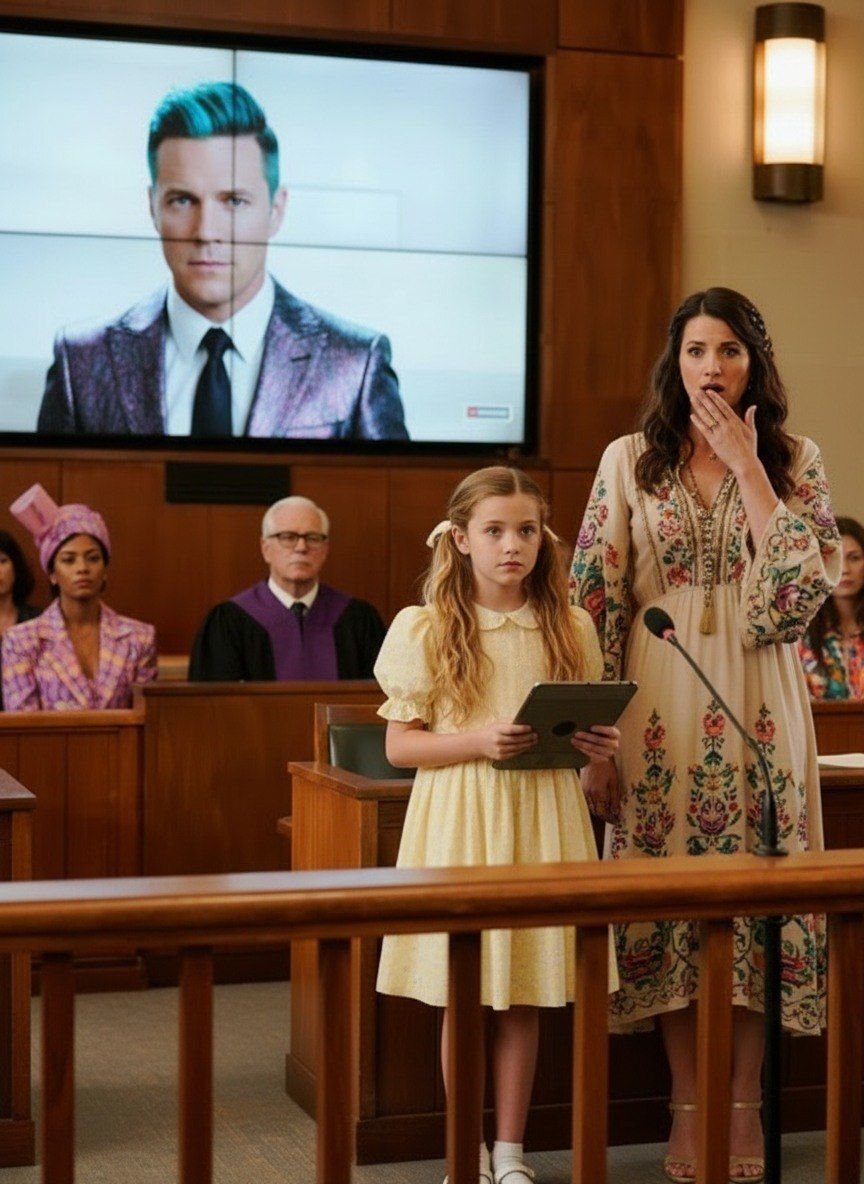
Mother Wins Custody Battle After Daughter’s Brave Courtroom Testimony Reveals Hidden Truth
The dissolution of a marriage rarely follows a predictable path, but for one mother, the end of her relationship arrived in the most impersonal way imaginable—tucked inside a standard manila envelope, delivered without ceremony to her workplace desk while she sat in an afternoon meeting.
No advance warning had prepared her for what waited inside. No difficult conversation had preceded this moment. No suggestion of marriage counseling or even an honest discussion about their struggles. Just crisp legal documents, professionally prepared and neatly organized, with a small adhesive note attached to the top page bearing a message written in handwriting she knew as well as her own: “Please don’t make this difficult.”
That brief, carefully worded request came from Caleb, the man she had married years earlier with hope and optimism. Throughout their relationship, he had always chosen his words with precision, speaking politely even when his intentions carried a sharper edge beneath the surface courtesy.
As she worked through the legal paperwork spread across her desk, her hands began trembling uncontrollably. The divorce petition itself, while devastating, represented only part of the shock. Buried within the formal legal language was something far more alarming—Caleb was seeking complete custody of their ten-year-old daughter, Harper, with no shared parenting arrangement proposed.
In that moment, sitting alone in her office with those papers in front of her, the world seemed to grow unnaturally quiet. Not the peaceful silence that brings comfort, but rather the oppressive kind that makes your pulse pound in your ears and your chest tighten with rising panic.
A Carefully Constructed Narrative
When the custody hearing finally began weeks later, the man who appeared in court bore little resemblance to the husband she thought she knew. Caleb presented himself with meticulous attention to every detail—immaculately dressed in tailored suits, speaking in measured tones that never wavered or rose in anger, maintaining an air of complete calm and reasonableness that seemed designed to contrast with any emotional response from her.
His testimony painted a disturbing picture. According to Caleb’s carefully rehearsed statements, his wife was fundamentally unstable, incapable of managing household finances responsibly, and prone to unpredictable emotional outbursts that created an unsafe environment for their daughter. He positioned himself as the steady, reliable parent—the one who maintained structure, provided consistency, and could be trusted to make sound decisions for Harper’s welfare.
The presentation was convincing. Disturbingly convincing.
Throughout his testimony, Caleb barely acknowledged his wife’s presence in the courtroom. On the rare occasions when their eyes met across the formal space, he would hold her gaze for only a second or two before deliberately looking away, as though she had already been relegated to his past, an uncomfortable reminder of something he preferred to leave behind.
Young Harper sat beside her mother during that first day of proceedings, accompanied by their attorney. The child’s feet dangled above the floor, not quite reaching the ground from the adult-sized chair. Her small hands remained folded neatly in her lap throughout the testimony, as if she were trying desperately to occupy as little space as possible, to somehow make herself invisible in that overwhelming adult environment.
That careful, protective posture shattered her mother’s heart into pieces.
She had fought against Harper’s attendance at the hearing, believing strongly that children should be shielded from the ugliness of parental conflict and legal battles. But Caleb had insisted with surprising firmness. According to him, the judge needed to “understand the complete reality of the situation,” and Harper’s presence would somehow illuminate that reality.
Apparently, Caleb’s version of reality required a ten-year-old child to sit silently and watch her parents systematically tear each other apart in a formal courtroom setting.
Words That Seemed to Vanish Into Air
Caleb’s attorney spoke with the practiced gentleness of someone who had delivered similar presentations many times before. Her tone conveyed sympathy and concern as she outlined her client’s position.
“Mr. Dawson has consistently served as the primary caregiver in this family,” she explained to the judge. “He provides the structure and stability that every child needs. Unfortunately, Ms. Dawson has exhibited unpredictable emotional behavior on numerous occasions and has exposed the child to unnecessary conflict and stress.”
That phrase—”unnecessary conflict”—hung in the air like an accusation that couldn’t be answered.
Harper’s mother had come prepared. She had gathered evidence carefully over preceding weeks—text message exchanges that revealed inconsistencies in Caleb’s stories, financial records showing unexplained transactions and money transferred into accounts she had never known existed, documentation of absences when he claimed to be working but couldn’t account for his time. Her attorney had organized everything methodically, ready to present a counter-narrative supported by concrete proof.
Her lawyer reached over and squeezed her hand gently, whispering reassurance that they would present everything in proper order, that the evidence would speak for itself, that truth would prevail.
Still, the judge’s expression remained professionally neutral throughout the morning session. Carefully neutral. The kind of studied impartiality that can make a person feel completely invisible, as though their pain and their truth matter less than procedural formality.
Harper’s mother reminded herself to keep breathing, to maintain composure, to trust the process even when every instinct screamed that nothing about this situation felt fair or right.
A Small Hand Changes Everything
Then something occurred that no one in that courtroom had anticipated or planned for.
Harper moved.
She raised her hand—small, trembling slightly, but remarkably steady given the circumstances.
“Harper,” her mother whispered instinctively, reaching toward her daughter, hoping to prevent her from speaking, to protect her from whatever she was about to do.
But Harper stood anyway, rising from her chair with visible determination.
She turned to face the judge directly, her narrow shoulders squared, her voice shaking but surprisingly clear as she spoke words that would transform everything that followed.
“Your Honor,” Harper said, “may I show you something? Something my mom doesn’t know about.”
The courtroom atmosphere shifted instantly. Every conversation ceased. Every movement stopped. The air itself seemed to hold its breath.
Caleb turned sharply toward his daughter, and for the first time since proceedings began, his carefully maintained composure cracked visibly across his features.
“Harper, sit down,” he commanded, his voice tight with something that sounded like warning or perhaps fear.
Harper did not sit down.
The judge leaned forward in her seat, her full attention now focused on the young girl standing in her courtroom.
“What would you like to show me?” the judge asked, her tone gentle but serious.
Harper swallowed hard, gathering courage. “I have a video on my tablet. I saved it because I didn’t know who else to tell. I didn’t know what else to do.”
Harper’s mother felt her stomach drop sickeningly. A video? What video? When had Harper recorded something, and why had she never mentioned it?
Caleb’s attorney rose quickly from her seat, beginning to object on procedural grounds. The judge raised one hand, silencing the objection before it could fully form.
“I will review whatever the child wishes to show me,” the judge stated calmly but firmly. Then she returned her attention to Harper. “But I need you to tell me first—why doesn’t your mother know about this video?”
Harper’s chin trembled. Her eyes filled with tears that she fought to control.
“Because Dad told me not to tell anyone,” she whispered, her voice barely audible in the suddenly silent courtroom. “He said I couldn’t tell Mom especially.”
The color visibly drained from Caleb’s face, leaving him pale and rigid in his seat.
When Hidden Truth Emerges Into Light
A court officer approached Harper gently, carefully taking the tablet from her small hands. She walked toward the front of the courtroom—so small in that large, formal space—holding herself together through sheer willpower and quiet determination that seemed far beyond her years.
When the video appeared on the screen visible to everyone present, Harper’s mother felt her heart begin pounding so forcefully she could barely hear anything else over the rush of blood in her ears.
The footage showed their home kitchen. The timestamp indicated late evening, well past Harper’s normal bedtime. And there was Caleb, looking directly into the camera with an expression his wife had never seen before—a smile that carried no warmth, only cold calculation.
Then his voice filled the courtroom, every word captured clearly by whatever device Harper had used to record.
“If you tell your mother about this,” Caleb said with terrifying calm, “I will make absolutely certain you never see her again. Do you understand me?”
No shouting. No visible anger. Just absolute certainty delivered in a matter-of-fact tone that made the threat even more chilling.
The silence that followed those words was profound and heavy, pressing down on everyone present from all directions.
The judge paused the video playback. She looked at Caleb with an expression that had transformed from professional neutrality to something much harder. Then she looked at Harper’s mother. Finally, her gaze dropped to Harper, still standing near the front of the courtroom.
“This hearing is adjourned,” the judge announced firmly. “This court will take immediate action regarding custody arrangements and will be requesting a full investigation into these allegations.”
The Moment That Transformed Everything
Harper’s mother did not have to mount an elaborate defense that day.
She did not have to raise her voice or prove her worth as a parent through extensive testimony.
She did not have to systematically dismantle Caleb’s accusations or present all the carefully gathered evidence her attorney had prepared.
Her daughter had done it for her, with courage that defied her small size and young age.
In that formal courtroom, surrounded by legal professionals and official proceedings, a profound lesson revealed itself. Truth does not always announce itself with dramatic flourishes or overwhelming force. Sometimes it arrives in the quietest possible way—through a small voice belonging to someone brave enough to speak when silence would have been easier and safer.
Understanding the Broader Picture
This mother’s experience, while deeply personal, reflects patterns that family law attorneys and child advocates encounter regularly in custody disputes. When one parent seeks to manipulate proceedings through carefully constructed narratives, children often find themselves trapped between loyalty to both parents and the need to reveal uncomfortable truths.
Research on parental alienation and custodial manipulation shows that controlling behaviors often include threats designed to silence children, isolation tactics that limit a child’s relationship with one parent, and systematic efforts to undermine a child’s trust in the targeted parent. Harper’s decision to record and preserve evidence suggests she recognized, even at her young age, that something fundamentally wrong was occurring in her family.
Child development experts emphasize that children possess remarkable insight into family dynamics, often understanding far more than adults give them credit for. Harper’s actions demonstrated not only awareness of the situation’s seriousness but also problem-solving skills and moral courage that many adults would struggle to summon.
The Legal Process That Followed
Following Harper’s revelation in court, the legal proceedings shifted dramatically. The judge ordered an immediate temporary custody arrangement that protected Harper’s relationship with her mother while a comprehensive investigation proceeded. Child protective services became involved, conducting interviews with Harper in age-appropriate settings designed to ensure she could speak freely without pressure from either parent.
Family court judges receive extensive training in recognizing manipulation tactics, parental alienation attempts, and situations where children face emotional abuse or coercion. The video evidence Harper provided gave the court concrete proof of behavior that raised serious concerns about Caleb’s fitness as a custodial parent and his willingness to prioritize his daughter’s wellbeing over his own objectives.
Additional investigation revealed other troubling patterns. Financial records showed that Caleb had been systematically hiding assets and income, preparing for divorce proceedings long before serving papers on his wife. Communications recovered from his devices indicated he had consulted with his attorney for months, carefully strategizing how to position himself favorably for custody while his wife remained completely unaware of his intentions.
The threatening statement captured in Harper’s video constituted a form of emotional abuse that family courts take extremely seriously. Judges understand that parents who threaten to sever a child’s relationship with the other parent are demonstrating a fundamental unwillingness to support the child’s emotional needs and healthy development.
The Impact on Family Relationships
For Harper’s mother, the revelation brought a complicated mixture of relief and heartbreak. Relief that the truth had emerged before the court made permanent custody decisions based on false information. Heartbreak that her daughter had carried such a heavy burden alone, feeling unable to confide in her mother about the threatening behavior she had experienced.
The mother later learned that Harper had recorded the video several weeks before the custody hearing, during one of many instances when Caleb had coached her on what to say and what to conceal. Harper had hidden the tablet under her bed, checking periodically to make sure the file remained saved, representing her insurance policy against a future she feared—permanent separation from her mother.
That a child felt compelled to take such action reveals the tremendous stress and fear she must have experienced daily. Child psychologists note that children placed in such positions often suffer anxiety, sleep disturbances, academic difficulties, and confusion about their role in adult conflicts. Harper’s eventual decision to reveal the video in court represented a breakthrough moment, but it also marked the beginning of healing work she would need to process her experiences.
Rebuilding Trust and Security
Following the custody hearing’s dramatic turn, Harper and her mother entered family counseling to address the trauma both had experienced. Therapists specializing in family reunification after parental alienation helped them rebuild trust and communication that Caleb’s behavior had damaged.
Harper needed reassurance that she had done the right thing by speaking up, that she wasn’t responsible for her parents’ divorce or the conflict that followed, and that both her feelings and her safety mattered more than adult disputes. Her mother needed help understanding how to support her daughter through this difficult transition while managing her own emotional response to betrayal and manipulation.
The therapeutic process revealed that Harper had been struggling with divided loyalties for months before the custody hearing. She loved both parents but recognized that her father’s behavior toward her mother was wrong. The threats he made created impossible situations where Harper felt she had to choose between protecting herself and protecting her mother—a burden no child should carry.
Lessons About Courage and Truth
Harper’s story illustrates profound truths about courage that extend far beyond family law proceedings. True bravery often emerges not from those with power and resources, but from those who have every reason to remain silent yet choose to speak anyway.
Harper had everything to lose by revealing that video. She risked her father’s anger, potential punishment, and the emotional turmoil of openly opposing a parent she still loved despite his troubling behavior. Yet she made the difficult choice to prioritize truth and justice over her own comfort and safety.
For older adults who may be navigating complex family situations—whether involving adult children going through difficult divorces, grandchildren caught in custody disputes, or their own relationship challenges—Harper’s courage offers important reminders. Truth matters, even when revealing it feels impossibly difficult. Children’s voices deserve to be heard and respected. And sometimes the smallest, quietest person in the room possesses the most important perspective on what’s really happening.
The Resolution and Moving Forward
The final custody determination, reached after several months of investigation and additional hearings, granted Harper’s mother primary physical custody with a carefully structured visitation arrangement for Caleb that included mandatory counseling and supervision until he demonstrated changed behavior patterns.
The judge’s written decision cited Harper’s testimony and the video evidence as crucial factors in determining that Caleb had engaged in manipulative and emotionally abusive behavior that undermined his daughter’s wellbeing and his credibility as a witness. The decision noted that his actions revealed a willingness to prioritize his own objectives over his daughter’s emotional health and her need for a healthy relationship with both parents.
For Harper and her mother, the legal victory brought relief but also acknowledgment that real healing would take time. Rebuilding their sense of security and normalcy required patience, professional support, and commitment to open communication about fears, needs, and boundaries.
Harper’s mother made clear to her daughter that she never had to keep secrets to protect her again, that adults should handle adult problems, and that Harper’s only responsibility was to be a child—to learn, grow, play, and feel safe in her home environment.
Reflections on Justice and Family
This family’s experience highlights how justice in family courts depends heavily on truth emerging despite efforts to suppress or manipulate it. Caleb had resources, planning time, and a carefully prepared strategy designed to control the narrative and achieve his desired outcome. He underestimated only one factor—his daughter’s moral courage and her unwillingness to stand by silently while injustice unfolded.
Family law attorneys emphasize the importance of thorough documentation, evidence preservation, and willingness to challenge false narratives even when doing so feels overwhelming. Harper’s mother had gathered financial records and communications that supported her position, but without Harper’s video, the case might have devolved into competing claims with no clear resolution.
The story also reminds us that children are not simply passive observers in family conflicts. They form opinions, make judgments about fairness and honesty, and sometimes take action when they perceive that adults are failing to address serious problems. Supporting children’s agency while protecting them from inappropriate burdens represents one of parenting’s most difficult balancing acts.
Hope for Others in Similar Situations
For readers who may be facing their own difficult custody situations or supporting loved ones through such challenges, this story offers several important insights. First, truth has power even when it seems overwhelmed by more polished presentations. Second, children’s perspectives matter and deserve respectful attention. Third, manipulation and coercion eventually reveal themselves, often in unexpected ways.
Family court judges, despite heavy caseloads and limited time with each family, generally possess significant experience recognizing manipulation tactics and false allegations. They understand that the most persuasive presentation doesn’t always align with truth, and they remain alert to evidence that contradicts carefully constructed narratives.
Parents facing custody disputes should document concerning behaviors, maintain detailed records of time spent with children, preserve communications that reveal manipulation or threats, and seek qualified legal representation as early as possible. Most importantly, they should remember that protecting children’s emotional wellbeing takes precedence over winning legal battles or punishing former partners.
The Strength Found in Vulnerability
Perhaps the most powerful aspect of this mother’s experience involves the strength she discovered through vulnerability and the validation that came from her daughter’s brave intervention. She had entered that courtroom feeling attacked, defensive, and fearful of an unjust outcome. She emerged with renewed confidence in truth’s power and deeper appreciation for her daughter’s character and courage.
The experience taught her that she didn’t have to face challenges alone, that asking for help demonstrated wisdom rather than weakness, and that sometimes the support we need arrives from unexpected sources—even from our children, who may be smaller in stature but enormous in heart and bravery.
For older readers who may have spent lifetimes believing they must handle everything independently, this story offers permission to accept support, to acknowledge when situations feel overwhelming, and to trust that truth has its own power independent of our ability to argue or defend it perfectly.
Final Thoughts on Truth and Time
Harper’s mother learned something in that courtroom that she will carry forward through all of life’s challenges ahead. Truth may not always arrive loudly or announce itself with obvious fanfare. Sometimes it comes quietly, tentatively, in a voice that shakes with nervousness but speaks anyway because remaining silent has become impossible.
Truth may take longer to emerge than we wish. It may test our patience, our faith, and our strength. We may feel desperate for resolution during the waiting, uncertain whether justice will ultimately prevail.
But when truth finally shows itself—when it steps into the light despite all efforts to suppress it—it possesses remarkable power to change circumstances, shift perceptions, and set things right in ways that seemed impossible just moments before.
And sometimes, in the most unexpected and beautiful turn of events, the strongest voice in the room belongs to the smallest person standing tall, speaking truth that needs to be heard.