Mother Saves Daughter From Wealthy Groom’s Control: The Wedding Day Note That Changed Everything
The champagne flutes caught the light from crystal chandeliers as guests lifted their glasses in toast after toast. Everyone called them the perfect couple. The fairy tale wedding. The American dream wrapped in designer lace and old money.
They had no idea what was really happening.
I stood near the edge of the dance floor in the Sturgis estate ballroom, thirty miles outside Dallas, unable to look away from my daughter. Simone glowed in her wedding gown, white silk embroidered with thousands of pearls and crystals that caught every flicker of candlelight. Her dark hair was swept into an elaborate updo that must have taken hours. Her train pooled behind her like spilled cream.
Next to her stood Preston Sturgis, tall and polished in a tuxedo that probably cost more than my monthly salary. He smiled at the crowd with the easy confidence of a man who’d never been told no in his entire life. Even from where I stood, I could see he looked exactly like what he was: the successful son of Texas oil money, born into privilege, raised to expect the world to arrange itself around his desires.
The wedding was being held at the Sturgis Ancestral Estate, the kind of property people in my part of Dallas only saw in magazines or on reality TV shows about the wealthy. White columns. Marble staircases. A circular driveway where luxury cars lined up like dominoes under the watchful eyes of valet attendants in white gloves.
Inside the mansion, oil paintings of stern-faced Sturgis ancestors hung in gilded frames. Outside in the garden, hundreds of roses perfumed the warm May evening. A clear tent stretched over the outdoor dance floor, strung with thousands of fairy lights and decorated with garlands of flowers that had been flown in from California. Waiters in crisp uniforms glided between tables refilling glasses with French champagne that probably cost more per bottle than I made in a day.
Near the far end of the tent sat a four-tier wedding cake, each layer a masterpiece of sugar work and buttercream, decorated with hand-crafted sugar flowers that looked almost real enough to smell.
I smoothed down my own dress, a modest beige number I’d bought on clearance at a department store in Dallas. Standing among guests in designer gowns and custom suits, I felt completely out of place. The women around me sparkled with diamonds and professional manicures. The men discussed business deals and investment portfolios, throwing around words like “acquisition” and “capital” as casually as discussing the weather.
I was Doris Jones, a certified public accountant for the Dallas County Health Department. I nodded and smiled when people glanced my way, but mostly I was invisible.
“Doris, you must be so proud,” chirped a distant relative of the groom, a woman wearing enough gold jewelry to stock a small store and wrapped in a fur stole despite the warm Texas evening.
“Your daughter made quite a match,” the woman continued, her voice sticky with false sweetness. “Preston is heir to everything, you know. Real estate, construction, investments across three states. She’ll never want for anything.”
“Yes,” I replied, forcing politeness into my voice. “I’m very happy for Simone.”
The woman kept talking about European investors and the Sturgis family’s latest development project in Austin, but I stopped listening. My eyes were pulled back to my daughter like iron to a magnet.
Simone stood beside Preston, accepting congratulations from an endless stream of guests. But something about her posture made my stomach clench. Her spine was too straight, her shoulders too rigid, her smile too fixed. It looked painted on, like a mask she couldn’t remove even if she wanted to.
I knew every expression my daughter had ever worn. I’d watched her grow up in a small rented house in a working-class Dallas neighborhood, from skinned knees and scraped elbows to college graduation. And right now, standing in her fairy tale wedding dress at her fairy tale wedding, she didn’t look happy.
She looked like she was barely holding herself together.
I remembered six months ago when Simone had come home to my little duplex off Interstate 35, practically glowing, to tell me about meeting Preston.
“It happened at Bean & Barrel, you know, that trendy cafe downtown with the exposed brick,” Simone had said, dropping her purse on my kitchen table and bouncing on her toes like she was eighteen instead of twenty-eight. “I was there with Kendra and Sierra after work. He walked right up to our table, apologized for interrupting, and said he couldn’t leave without meeting the woman with the most unforgettable smile in Dallas.”
She’d laughed when she told me, her cheeks flushed pink.
“Mom, you should have seen Kendra and Sierra’s faces,” she’d continued, eyes bright. “He’s so handsome, so confident. His eyes are this intense gray, like storm clouds. And the way he talked wasn’t cheesy at all. It was sophisticated.”
I’d been happy for her then. It had been ten years since my divorce from Simone’s father. My daughter had put herself through state university, earned a degree in interior design, and was working at a small studio in downtown Dallas. She’d dated casually over the years, engineers and grad students and once a bartender from Deep Ellum, but nothing serious.
And suddenly she’d met a man who courted her like something out of a romance novel.
Flowers arrived at her design studio every other day. Preston took her to restaurants I’d only seen on Food Network, places in Uptown where appetizers cost more than my weekly grocery budget. The gifts weren’t small gestures but expensive jewelry and designer handbags, all delivered in crisp branded boxes with ribbon and tissue paper.
Preston invited Simone to meet his parents within the first month. They welcomed her at the estate with practiced warmth and careful smiles.
Everything moved fast. Bright. Thrilling.
After only three months, Preston proposed.
He did it at the same Dallas cafe where they’d met, dropping to one knee in front of the entire room while people pulled out their phones to record. The diamond ring sparkled so brightly under the cafe lights that Simone had to squint when she looked at it.
“Of course I said yes,” Simone had told me afterward, breathless and flushed. “Who would turn down someone like him?”
The excitement in her voice had been real. But something underneath it bothered me even then. There was an anxious edge to her happiness, as if she were trying to convince herself this was right.
“Mom, do you understand what this means?” Simone had asked, pacing my small living room. “He’s brilliant, successful, wealthy. I won’t have to struggle like you did after the divorce. I can pursue my passion, open my own studio, travel. Finally see New York, maybe even Paris.”
I’d told myself it was normal. My daughter was excited and thinking practically about her future. Love was important, but so was financial security. We lived in America, where one medical emergency or lost job could destroy everything you’d built.
I’d married Simone’s father not from overwhelming passion but from a desire to build something stable. That stability had turned out to be an illusion. He’d cheated throughout our fifteen-year marriage before finally leaving for a younger woman. He moved to another state, leaving me in Dallas to raise a teenage daughter alone.
Maybe that was why I wanted so desperately to believe Preston was different. That this time, money and status came packaged with decency and respect.
The wedding preparations moved at lightning speed.
Preston’s parents insisted everything be top tier. They hired a celebrity event planner who mentioned she’d worked on weddings in Los Angeles and Palm Beach. Simone’s gown was couture, shipped from Milan through a New York boutique. The mansion was decorated an entire week before the ceremony with florists and lighting technicians and rental trucks rolling up and down the long driveway.
The guest list topped two hundred people. I personally knew maybe twenty of them, some relatives, a few of Simone’s friends, and a couple of my coworkers. Everyone else belonged to the Sturgis family’s network of business partners, political connections, country club friends, and society acquaintances.
I felt like a stranger at my own daughter’s wedding.
They didn’t even seat me near her.
Place cards put me at a side table with distant relatives of the groom, people I’d never met before that day.
When I’d gently mentioned to Simone a few days earlier that I’d hoped to sit closer to her at the reception, she’d given me an odd, apologetic smile.
“Mom, Preston and his parents handled the seating,” she’d said. “They have protocols about business partners and status. Please don’t take it personally.”
“Okay,” I’d said, even though it felt personal.
Now, standing apart from the celebration, that hurt felt sharper.
The music changed to a slow song. Preston took Simone’s hand and led her to the center of the dance floor. Guests stepped back, forming a circle, and phones lifted in unison to capture the newlyweds’ first dance.
I fumbled for my own phone, its cracked screen patched with tape at the corner. I opened the camera and aimed it at my daughter.
Preston placed his hand on Simone’s back. I noticed immediately how tightly he gripped her. He wasn’t gently guiding her through the steps. He was clutching her, fingers digging into the fabric of her gown, knuckles pale with pressure.
Simone flinched, just for a moment, as if in pain. Then she quickly smoothed her expression and tilted her head up at the perfect angle.
A beautiful picture for all the cameras.
But I saw the emptiness in her eyes. She wasn’t present in the moment at all. She’d checked out completely, going through rehearsed motions like an actress performing a scene she’d practiced too many times.
Step left. Step right. Smile. Turn.
“What a gorgeous couple,” exclaimed a nearby aunt in a purple dress with a feathered hat. “True love. You can just see it.”
I wanted to say something, to shout that this was wrong, that my mother’s intuition was screaming warnings. But I stayed silent. Who would believe me? Everyone else saw the perfect picture: the handsome millionaire groom, the beautiful bride, the lavish Texas wedding.
How could anyone be unhappy in a fairy tale?
The dance ended. Guests applauded. Preston dipped Simone dramatically and pulled her into a long kiss while cameras flashed and phones recorded from every angle.
When he finally released her, I saw Simone subtly wipe her mouth with the back of her hand. It was quick, almost invisible, but I caught it.
Everything inside me went cold.
I thought about the past few months before the wedding.
Simone had been visiting less and less. We used to call almost daily, chatting about everything and nothing, work gossip and funny things that happened at Starbucks. Then the conversations became shorter, more strained.
When I asked how she was, Simone answered in one-word responses.
“Fine, Mom. Just tired. Wedding planning, you know.”
One day I’d called just to chat, wanting to invite her over for the weekend to bake a pie together like we used to when she was in high school.
Simone had spoken in barely a whisper.
“Mom, I can’t talk right now. Preston’s home. We’re busy. I’ll call you back.”
She never called back.
When I tried again two days later, Simone’s voice had been sharp, almost panicked.
“Mom, why do you keep calling? I’m an adult. I have my own life. I’ll call when I have time.”
The words had stung. We didn’t speak for a week.
Then Simone called first, apologized, and said she was just stressed from wedding preparations.
I’d understood. I’d forgiven. But the unease never left.
Now, watching from the edge of the tent, I noticed Preston never left Simone’s side for even a second.
When her friends Kendra and Sierra came to congratulate her, he stood right there, listening to every word, interjecting his own comments. When Simone moved toward the drink table, he followed. When she suggested touching up her makeup, he took her hand and said something that made her nod and stay put.
A devoted groom, the guests would say. A caring husband who doesn’t want to let his wife out of his sight.
But I saw something else. Control. Surveillance. An invisible leash.
I tried to push the thoughts away. Maybe I was imagining things, seeing problems where none existed.
After all, they’d just gotten married. Of course the groom didn’t want to let his bride wander off. That was normal, even romantic.
But when I looked at Simone’s face again, my heart stuttered.
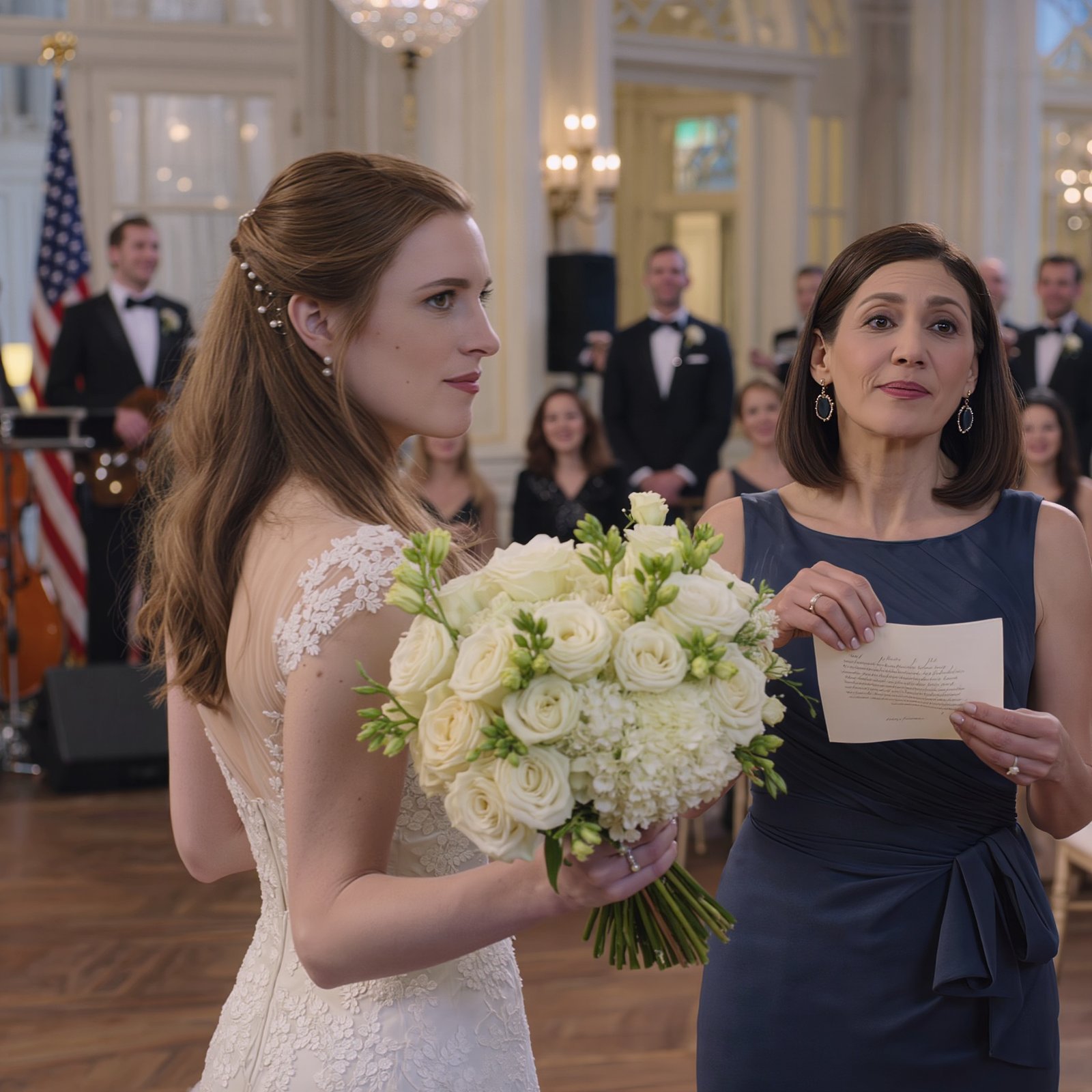
She stood clutching her bouquet of white roses, looking past the people, past the luxury, past everything.
In her eyes I saw something I’d only seen once before.
When Simone was twelve, she’d come home bruised after being bullied by classmates. She hadn’t cried then, just sat at the kitchen table with a hollow, absent stare.
It had taken me two hours to get the truth out of her.
That same look was in her eyes now. The look of someone enduring, holding on by her fingernails, one breath away from breaking.
The emcee’s voice cut through the music.
“And now our beautiful bride will toss the bouquet! All single ladies, please come to the dance floor!”
Simone’s friends rushed forward, laughing and jostling for position like they’d seen in movies. About fifteen young women clustered in the center, reaching up, giggling and nudging each other.
I stayed on the sidelines.
At forty-six, I had no business shoving into a crowd of twenty-somethings to catch flowers.
Simone stepped onto a small platform at the edge of the dance floor and turned her back to the crowd. Preston wrapped his arms around her waist from behind and leaned in to whisper in her ear.
Simone nodded and lifted the bouquet over her head.
Guests began counting down.
“One… two… three!”
The bouquet sailed through the air, arced over the dance floor, and flew nowhere near where the girls were standing.
It sailed over their heads, past several rows of tables, and dropped directly toward me.
I reached out instinctively and caught the bundle of roses, feeling the stems thump against my palms.
The guests laughed. Someone clapped.
“Oh look, the mother of the bride caught it!”
“That’s good luck. Means Doris will get married soon too!”
I forced a confused smile, pressing the bouquet to my chest. The roses were heavy, bound tightly with satin ribbon. Their scent was thick, almost overwhelming.
I looked up toward the platform and met my daughter’s eyes.
Simone stared at me as if desperately trying to communicate something important, something urgent. Her lips moved without sound, and I almost read the word “Mom.”
Then Preston turned her toward him, kissed her again, and the moment vanished.
I stood holding the bouquet, unsure what to do with it. The roses’ perfume was giving me a headache.
I tried to adjust them, shifting my grip to make them more comfortable. That’s when I noticed something white tucked between the tightly packed flowers.
An edge of paper was sticking out.
It must be a note from the florist, I thought. Or maybe a sweet message from the bridesmaids.
I carefully pinched the edge and pulled.
A twice-folded piece of plain printer paper slid into my hand, slightly crumpled.
I unfolded it.
And froze.
The letters were shaky and uneven, as if written in haste or terror. Only four words. But they hit me with the force of a physical blow.
Mom, save me.
The handwriting was Simone’s.
I would have recognized it anywhere. The same rounded letters, the same slant I remembered from school assignments and birthday cards. But now the letters were crooked, the pen strokes uneven. At the end of the phrase, the ink had bled slightly, as if a drop of water or a tear had fallen there.
I looked up, scanning the room frantically.
The guests continued celebrating. The band played a light jazz tune. Waiters circled with trays of appetizers. No one was looking at me.
Just an ordinary mother of the bride holding a bouquet.
Nothing unusual.
I squeezed the note in my fist and pressed it against my chest, hiding the paper in the folds of my dress. My heart hammered so loudly I was certain someone would hear it. My ears rang. My mouth went dry.
I looked back toward the platform where Simone and Preston were posing for photos. Simone wore that same painted smile.
But now, behind the smile, I saw a silent scream.
Save me.
What did it mean? Save her from what? From whom?
From the handsome, wealthy groom in the expensive tuxedo who was currently holding her close for the cameras? From this entire fairy tale that everyone around us was admiring and photographing?
I tried to think clearly. Panic wouldn’t help. I needed a plan, but how could I execute it?
Should I march up there in front of two hundred guests and drag my daughter away? I imagined the scene: storming the platform, shouting that the wedding was over, declaring my daughter was leaving with me immediately. A scandal. Phones recording. Preston’s parents calling security. And Preston himself?
I remembered how tightly he’d gripped Simone’s waist during the dance. How he monitored her every movement.
He wouldn’t let her go without a fight.
I needed help.
I scanned the tables and spotted Simone’s friends, Kendra and Sierra, sitting with another college friend, a petite woman named Aubrey. The four of them had been inseparable since freshman year at the University of North Texas. If anyone could help, it was them.
I moved quickly toward their table, clutching the bouquet so tightly the stems bit into my palm.
A wild plan was forming. It was risky. Maybe insane. But I saw no other option.
I slipped into the empty chair next to Kendra and leaned close.
“I need your help. Right now,” I said quietly, forcing my voice steady.
Kendra, a cheerful young woman with red curls and round cheeks, turned toward me. She’d been Simone’s closest friend the longest.
“Ms. Jones, is something wrong?” Kendra asked, concern creeping into her voice.
“Simone is in danger,” I said firmly, looking her straight in the eyes. “I can’t explain everything here, but I need to get her away from this place. And I need your help.”
Sierra, tall and blonde with sharp eyes, leaned closer. Aubrey looked alarmed.
“Are you serious?” Sierra whispered. “Right now? In the middle of the wedding?”
“Especially in the middle of the wedding,” I said.
I reached into my purse, pulled out a pen, grabbed a paper napkin from the table, and quickly wrote instructions.
In 5 minutes, go to Simone. Tell her you need her urgently. Do not leave her alone.
I slid the napkin to Kendra. She read it and went pale.
“Oh my God,” Kendra whispered. “Is this because of Preston?”
“I’ll explain later. Will you do it?”
Kendra hesitated for only a heartbeat, then nodded.
“Of course. Simone’s my best friend.”
I wrote quick instructions for Sierra and Aubrey on more napkins.
Sierra would approach from another angle, mention some made-up tradition about the bride needing a moment with her bridesmaids. Aubrey would run interference if Preston or his parents tried to stop them.
The girls read their napkins and exchanged glances. I watched understanding dawn on their faces, followed by determination.
“Have you noticed anything wrong with her?” I asked quietly.
Sierra nodded slowly.
“She’s been different the last couple months,” Sierra said. “Distant. We used to hang out every week, brunch and shopping and movie nights. Then she started canceling plans, saying she was busy. And when we did see her, she was constantly checking her phone, jumping whenever it buzzed.”
She paused.
“I thought she was just in love,” Sierra admitted. “You know, the way people get weird at the beginning of a relationship.”
“I saw a bruise,” Aubrey said suddenly, touching her own shoulder. “Three weeks ago when we went shoe shopping at NorthPark Mall. She tried on a dress and the strap slipped. I saw a mark on her shoulder. She said she bumped into a door, but the bruise looked like… like fingers. Like someone had grabbed her hard.”
My stomach twisted. Fingers.
So it had started even then. Maybe earlier.
And I, her mother, hadn’t seen it.
“I tried to talk to her once,” Kendra added, twisting the napkin nervously. “I asked flat out, ‘Simone, are you really happy? Maybe this is moving too fast.’ She looked scared and said, ‘Kendra, everything’s fine. I’m just nervous about the wedding.’ But I knew she was lying. I still didn’t push. I was afraid to interfere.”
“Stop blaming yourselves,” I said sharply. “There’s no time for that. We’re going to fix this now.” I looked each of them in the eye. “Are you ready?”
All three nodded.
“Then listen carefully.”
I took a breath and explained the plan. In five minutes, Kendra would approach Simone and insist they needed to perform some urgent tradition, that the bride needed a private moment with her friends.
If Preston refused, Sierra would back her up immediately, insisting it was mandatory, some Southern wedding custom. Aubrey would distract his parents.
“I need you to get her away for at least two minutes,” I finished. “After that, I’ll handle the rest.”
I wasn’t sure my plan would work. All I had was desperate determination to get my daughter away from these people.
I glanced back at the platform.
Preston was holding Simone’s hand, talking to an older man in an expensive suit. Simone stood beside him silently, eyes downcast, like a doll on display.
The five minutes crawled by.
I stood near a tent pole, counting seconds, squeezing the bouquet until my knuckles ached. The note stayed clenched in my other fist.
Finally, Kendra pushed back her chair, smoothed her dress, took a deep breath, and walked toward the platform.
I watched every step.
Kendra reached Simone, hugged her, and said something bright and cheerful. Preston turned, his expression carefully neutral but his eyes cold.
Kendra kept talking, gesturing. Simone nodded, then said something to Preston. His mouth tightened. I saw his lips form the word no.
Then Sierra appeared and linked arms with Simone from the other side, smiling warmly.
Two friends against one groom.
Preston was clearly annoyed. His fingers tightened on Simone’s hand until I could see the tension in his wrist. But guests were starting to look their way.
He couldn’t make a scene.
Not in front of two hundred witnesses.
Slowly, visibly, he released her hand.
Simone pulled free. With her friends on either side, she stepped down from the platform. Together they moved toward the edge of the tent.
Preston started to follow.
But Aubrey rushed up, talking quickly and pointing toward his parents’ table.
Preston turned with visible irritation.
In that moment, Simone and her friends disappeared behind a tent column.
I exhaled for what felt like the first time in minutes.
Phase one worked.
I moved quickly, skirting tables, nodding absently at anyone who tried to speak.
I slipped out of the tent into the cooler evening air.
I found them quickly. At the far end of the garden, near a small fountain lit by landscape lights, Simone sat on the low stone rim. Her white dress pooled around her. Kendra, Sierra, and Aubrey stood close by.
“Simone, what’s going on?” Kendra was asking, voice tight. “Your mom said you were in danger. Is that true?”
Simone didn’t answer. She sat hugging herself, shoulders rigid. In the soft light, I saw she was trembling.
“Simone,” I said softly, stepping closer.
I crouched in front of her and gently took her cold hands.
“I got your note,” I said.
Simone lifted her head.
Her eyes flooded with tears she’d been holding back all evening. Her lip trembled.
“Mom, I couldn’t… I didn’t know what else to do,” she whispered hoarsely. “He watches me constantly. I can’t even talk to you alone.”
The words came in broken fragments.
Simone pressed my hands to her face and finally cried, quiet sobs muffled as if she feared someone might hear.
“It’s okay,” I murmured, stroking her hair, feeling rage ignite in my chest. “Everything’s going to be okay. We’re leaving now.”
“No.” Simone shook her head frantically. “We can’t. He won’t let me. His parents said if I call off the wedding, they’ll destroy you. They said they’d get you fired, that you’d never work in Dallas again. They said they have connections.”
“Let them try,” I said, and the steel in my voice surprised even me.
“I’m not that easy to destroy. And I won’t let anyone hurt you. You’re my daughter. If I have to fight their whole family, their money, and all their connections, I will.”
I stood up.
“But you,” I said, “are going to stand up right now, and we are walking out of here together.”
“She’s right,” Kendra said firmly, crouching beside Simone. “We’re not letting anyone hurt you. Not Preston, not his parents. We’re here.”
“But you don’t understand,” Simone whispered, wiping her cheeks and smearing mascara. “He’s not who he seems. When we’re alone, he changes. He says I’m his property now. That I have to obey. That if I try to leave…”
She trailed off.
“What will he do?” Sierra asked, sitting beside her. “Simone, tell us. Did he hit you?”
“No,” Simone said quickly. “He never hits. He’s too smart for that. He grabs me. Squeezes so hard it hurts. But the marks barely show. He says it’s my fault, that I provoke him. That if I behaved properly, he wouldn’t have to discipline me.”
“Oh my God,” Aubrey whispered, covering her mouth.
“How long has this been going on?” Kendra asked.
“About three months,” Simone said. “At first he was perfect. Flowers, gifts, compliments. Then after we announced the engagement, he started changing. It began small. He’d say my lipstick didn’t suit me. That my dress was too short. Then he started checking my phone, demanding passwords to my accounts. He said we were family now, so there shouldn’t be secrets.”
She spoke quickly, words tumbling out.
“He forbade me to see you guys without him,” Simone continued. “He said you were bad influences. When I tried to argue, he gave me this look…”
She shuddered.
“Then he grabbed my shoulders and pinned me against the wall. Not hard enough to leave obvious marks, but enough to make me understand. I couldn’t argue. I couldn’t breathe.”
“Why didn’t you tell me?” I asked, hurt and anger mixing together. “Why didn’t you come to me?”
“I tried,” Simone said, voice breaking. “Remember when I called and then didn’t call back? I wanted to come over and tell you everything. But he found out. He always finds out. He said if I tried to ruin the wedding, if I told anyone, his parents would take care of you.”
Her voice dropped to a whisper.
“Preston’s father knows people. Powerful people. He said they could get you fired, make sure you never work in the county again. And he promised that if I ran, he’d find me no matter where I went.”
“Simone.” I took her face in my hands. “Listen to me. No one is going to hold you against your will. Not their money, not their connections. You have the right to leave. Right now. And we are all with you.”
“But how?” Simone sobbed. “We just signed the papers. I’m his wife now. He’ll say I’m hysterical. Everyone will believe him. Look at him. He’s perfect on paper. Everyone thinks I’m so lucky.”
“Then everyone is wrong,” Sierra said, standing up. “Simone, we’re not letting him keep you. We’ll get you out.”
I helped Simone to her feet.
“We’re going back into that tent,” I said. “You’re going to tell the truth in front of everyone. You’re going to say you’re leaving. That way, he can’t twist the story later.”
“He won’t let me talk,” Simone whispered.
“He will,” Kendra said, taking her hand. “Because we’ll be right there with you.”
“Let them try to stop us,” Sierra added.
We started back toward the tent, a strange procession moving through the Texas twilight: a bride in a stained designer gown, her mother, and three friends in bridesmaid dresses.
I walked in front, still clutching the bouquet with the note hidden inside. My heart pounded, but the terror had burned away. What remained was cold determination.
When we stepped back into the tent, the band was still playing and guests were still celebrating, but conversations dipped as people noticed the returning bride.
A murmur ran through the tables.
“Look, the bride is back.”
“What happened?”
“Her makeup is smudged. Was she crying?”
Preston stood near the head table talking to his father, Sterling Sturgis, a tall man with silver-streaked hair and an expensive suit. They turned as Simone approached.
Preston strode toward her quickly, face dark.
“Where have you been?” he asked sharply, voice low but hard. “I told you not to leave my side.”
“Step away from her,” I said, stepping between them.
Preston looked at me with surprise and contempt.
“Ms. Jones, don’t interfere,” he said softly. “Simone is my wife now.”
“She is no one’s property,” I replied loudly enough for nearby tables to hear. “She is my daughter. And she is leaving with me.”
The music faltered and stopped. The emcee lowered his microphone. Conversations died. Heads turned. Phones lifted.
“What nonsense is this?” Preston demanded, trying to sidestep me to reach Simone.
Sierra and Kendra moved instantly, stepping in front of Simone, forming a barrier.
“Get out of the way,” Preston snapped. “You’re making fools of yourselves.”
“These fools are protecting their friend,” Kendra said, folding her arms.
“From someone like me?” Preston scoffed, but rage flickered in his eyes. “What are you accusing me of? This is my wedding. I spent millions on it.”
“You can’t buy a person,” I said, stepping closer.
“But you thought you could, didn’t you?” I added, voice steady. “You thought because you have money, you’re entitled to control people. To intimidate them. To keep them in fear.”
Whispers rippled through the tent. Preston’s parents rose from their table and approached.
“What is happening here?” Sterling Sturgis asked, his tone expecting immediate answers and obedience. “Preston, explain this.”
“The mother-in-law and the bridesmaids are causing a scene,” Preston said with a tight shrug, trying to sound amused. “Some ridiculous stunt.”
“They are not ridiculous,” Simone said.
She stepped out from behind her friends.
Her voice trembled, but she didn’t back down.
“It’s all true,” she said, looking straight at Preston. “You intimidated me. You controlled me. You threatened my mom. I married you not out of love but out of fear.”
“Oh, darling,” Celeste Sturgis, Preston’s mother, said as she moved closer, diamonds glittering at her throat. “You’re exhausted. Overwhelmed. It’s normal on a day like this. Come, I’ll get you something to help you calm down.”
She reached for Simone’s arm.
“Don’t touch me,” Simone said sharply, pulling back.
“You knew,” Simone added, voice shaking but growing stronger. “You knew what he was like. You knew he was controlling and cruel. And you still pushed this wedding because you needed a wife who would stay quiet and obey.”
“You don’t know what you’re saying,” Sterling said, stepping forward, looming over her. “Think carefully, girl. You’re about to destroy your future. Our family can give you everything: wealth, status, connections. And you would throw that away to go back to… what? A cramped apartment and a paycheck-to-paycheck life?”
“Better a small apartment and freedom than a mansion and fear,” Simone replied, straightening her spine.
Several guests gasped.
Phones were definitely recording now.
“Enough of this circus,” Preston snarled.
He lunged toward Simone. Kendra and Sierra grabbed his arms, holding him back.
“Let go!” he barked. “Simone, stop this. You are my wife, and you are staying here.”
“I am not your anything,” Simone said quietly, but the words carried.
“I was never yours. I am not a thing. I am a person. And I am leaving.”
Preston wrenched free from Kendra and Sierra and reached for Simone, his face twisted with rage.
Before his hand could close around her arm, another hand seized his wrist.
A man had stepped out from the crowd.
“Don’t you dare touch my daughter,” the man said.
His voice was calm, but there was threat beneath it.
My heart stumbled.
“Michael,” I whispered.
My ex-husband. Simone’s father.
Michael Washington, who’d moved to Colorado years ago and rarely came back to Texas, stood there in a simple dark suit, his fingers digging into Preston’s wrist until the younger man winced.
“I heard your conversation by the fountain,” Michael said, still holding on. “I was outside having a smoke. I’m sorry, Simone. I thought you were happy. I was wrong. But I’m here now. And this boy is never laying a hand on you again.”
“You’ve all lost your minds,” Sterling roared. “Security! Where is security?”
Two large men in suits began pushing through the crowd.
I felt the situation spiraling toward violence. Fights. Lawsuits. Headlines.
“Stop!” I shouted.
The tent seemed to hold its breath.
“Everyone, just stop,” I said more quietly.
I stepped into the center of the circle, still holding the bouquet with Simone’s note pressed against my palm.
“Mr. Sturgis,” I said, turning to Sterling. “You’ve built an empire. You sit on boards. You donate to campaigns. Your reputation matters, doesn’t it?”
Sterling frowned.
“What are you getting at?” he asked.
“I’m getting at the fact that there are about two hundred people here,” I said evenly. “Half of them are already filming on their phones. Tomorrow morning, this scene could be all over the internet. TikTok, Instagram, Facebook, local Dallas news. The viral story of how your son intimidated a young woman into a wedding she didn’t want.”
I let that sink in.
“Can you imagine what that would do to your business reputation?” I asked softly.
Celeste paled. Sterling’s jaw clenched.
“Or,” I continued, “we walk out quietly. Simone, her father, her friends, and I. No fights. No shouting. No dragging anyone anywhere. You announce that the bride suddenly felt unwell. The wedding is postponed. Clean. Controlled. Then, in a week, Simone files for divorce quietly. And you do not interfere. No threats. No harassment. You leave her alone.”
I held his gaze.
“And then this story stays in this tent,” I finished. “It never leaves your property.”
“Are you blackmailing us?” Sterling asked through his teeth.
“I am protecting my daughter,” I replied calmly. “By any means necessary. Decide quickly. Every second you hesitate is another video. Another headline.”
Sterling looked around at the sea of faces, at the raised phones, at guests who also had reputations they wouldn’t want dragged into a viral scandal.
He made the calculation powerful men made, balancing cost against risk.
Finally, he turned to his son.
“Preston,” he said. “Let her go.”
“Father,” Preston started.
“I said, let her go,” Sterling repeated, leaving no room for argument. “I will not sacrifice our name over one marriage. Not when we’re in the middle of negotiations with European investors.”
Preston stared at his father as if he’d been slapped.
Then he looked at Simone, and the hatred in his eyes made my skin crawl.
“You’ll regret this,” he whispered. “All of you.”
“Threats,” Michael said dryly, finally releasing his wrist. “In front of two hundred witnesses. Smart.”
I took Simone’s hand. My daughter was trembling, but she didn’t pull away.
Kendra, Sierra, and Aubrey moved close, forming a protective ring. Michael stepped slightly ahead, positioning himself between us and Preston.
“Let’s go,” I said.
We began walking toward the exit.
The crowd parted for us.
Some faces held sympathy. Others, judgment. I heard whispers.
“Poor girl…”
“What a scandal.”
“Can you believe the Sturgises let this happen?”
“She’s brave. I could never do that.”
By the time we stepped into the warm Texas night, Simone’s legs were shaking. She stumbled. I caught her, and she sagged against me, finally letting go.
Tears streamed down her face.
“Mom, I was so scared,” Simone sobbed. “I didn’t think I could do it.”
“You did,” I murmured, stroking her back. “You did it, my brave girl.”
Kendra, Sierra, and Aubrey hugged her in turn, their own eyes shining. Michael stood apart, lighting a cigarette with slightly shaking hands.
“Thank you,” I said quietly as I approached him. “For helping her.”
“She’s my daughter,” Michael replied, flicking ash into the gravel. “I was a lousy husband, Doris. But I’m not such a bad father that I’d stand by and let her be hurt.”
Guests began trickling out of the tent behind us. The wedding was over before it had truly begun.
“We should go before anyone changes their mind,” Sierra said.
“Come to my place,” Kendra suggested. “I’ve got a big apartment in Uptown. We can all stay there tonight.”
“No,” I said, shaking my head. “We’re going to my place. Simone needs home. A real home, where she’s safe and loved.”
We piled into three cars.
Michael drove Simone and me in his rental. The friends followed in their own vehicles.
As the Sturgis estate disappeared behind us, swallowed by the Texas night, Simone exhaled shakily.
“I’m free,” she whispered.
“Free,” I repeated, kissing her hair. “And you will never be anyone’s property again.”
The first few days after that disastrous wedding passed in a blur.
I took a week off from my job at the county health department. Simone barely left the couch in my small two-bedroom apartment. She wrapped herself in an old throw blanket from her childhood, a faded quilt we used to curl up under for movie nights.
I cooked her favorite comfort foods: meatloaf and mashed potatoes, chicken soup, blueberry pancakes like we’d shared on slow Saturday mornings. Simone ate very little at first, but I didn’t push.
I just sat nearby, holding her hand, stroking her hair, letting the silence be what it needed to be.
Sometimes Simone cried quietly. Sometimes she stared out the window for hours, watching cars pass. Sometimes, late at night, she started talking in fragments, memories spilling out.
“He said I was stupid,” Simone murmured one rainy afternoon, knees drawn to her chest. “That my design work was childish. That real professionals would laugh at me. I showed him a project I’d worked on for a month. He looked at it for five seconds and said, ‘Well, it’s not bad for an amateur.’ Then he said I shouldn’t work at all. That a millionaire’s wife shouldn’t be stuck in some pathetic studio.”
“You are not pathetic,” I said firmly, sliding closer and putting an arm around her. “You’re talented. You’re strong. And you did something incredibly brave. You wrote that note. You asked for help. That takes courage.”
“I wrote it in the restroom,” Simone said, voice hoarse. “My hands were shaking so badly I almost dropped the pen. He even tried to follow me there. I barely made an excuse. I wrote the note on paper from my purse and stuffed it into the bouquet while it was on the table. I just kept praying it would end up in your hands.”
“And it did,” I said softly. “You found a way.”
Her friends came by every day.
Kendra brought pastries from a local bakery. Sierra arrived with DVDs and streaming passwords scribbled on sticky notes. Aubrey brought photo albums from their college years: tailgate parties, study sessions, cheap road trips across Texas.
“Remember when we slept in the library before that geometry exam?” Kendra said, pointing at a picture. “Security kicked us out three times, and we kept sneaking back in.”
Simone gave a small, genuine smile for the first time in days.
“Mom, remember?” she said. “You sewed Kendra’s jeans after she tore them that night.”
“I remember,” I said, chest tight with affection.
A week later, Simone said she was ready to step outside.
We walked to a small cafe on the corner, a cozy place with mismatched chairs and the best carrot cake in Dallas.
“I need to see a lawyer,” Simone said, stirring sugar into her coffee. “I need to file for divorce. Officially close this chapter.”
I pulled a business card from my purse.
“I already found someone,” I said. “Vanessa Thompson. She handles family law. A coworker recommended her. She’s tough.”
“Thank you, Mom,” Simone said, taking the card. “You’re doing so much for me.”
“Just live,” I said, covering her hand. “Be happy. That’s all I want.”
The meeting with Vanessa Thompson, whose office sat near the Dallas County Courthouse, went smoother than expected.
“This is classic coercive control and emotional abuse,” Vanessa said after listening carefully, pen moving across a legal pad. “It’s good you left immediately. We’ll file for divorce on grounds of emotional harm.”
She slid forms across the desk.
“The main thing,” Vanessa added, “is that you don’t talk to him or his family directly. Any communication goes through me.”
“What if they try to use their influence?” Simone asked, hands clenched.
“Let them try,” Vanessa said with a thin smile. “I’ve gone up against men like this before. You’re not alone.”
Leaving the office, Simone felt lighter. It was only the first step, but it was a step.
Next came the question of what to do with her life.
She didn’t want to return to her old studio job. The story had spread through gossip and social media. Pictures had leaked. Anonymous comments appeared.
“Don’t read that,” Sierra said firmly one evening when she caught Simone scrolling, eyes wet. “It’s not worth it.”
“They say it’s my fault,” Simone whispered. “That I trapped him and then dumped him. That I wanted his money.”
“Who cares what they say?” Kendra said, sitting beside her. “They don’t know you. They weren’t there.”
Simone deleted her social media apps. She lived in a small cocoon: my apartment, visits from friends, weekly therapy sessions with Dr. Elizabeth Harris.
“You made an incredibly brave choice,” Dr. Harris told her during one session. “You broke the cycle at the beginning. You are free now, Simone. You get to decide what your life will look like.”
Two months after the wedding, the court ruling came through.
Divorce granted. No property division. No alimony. No further claims.
The Sturgises hadn’t contested it. Perhaps Sterling had decided a quiet exit was smarter than a public fight.
Simone received the decree in the mail. That evening, she and I and the three friends opened cheap champagne at the apartment.
“To what’s next,” Kendra said, raising her glass.
“What is next?” Simone asked, half laughing, half nervous.
“I’ve been thinking about that,” Simone said after a pause. “I don’t want to work for someone else right now. I want to start my own interior design studio. Small at first. Just me, a laptop, and a portfolio. I want to choose my own projects.”
“That’s expensive,” Sierra said, concerned. “Websites, software…”
“I’ll start small,” Simone said. “Work from Mom’s place. Build a portfolio, then see.”
“I’ll help,” I said immediately.
“Mom, no,” Simone protested. “Those are your savings.”
“They’re for my happiness,” I replied. “And what could make me happier than helping my daughter build a life she loves?”
Simone hugged me, tears in her eyes.
“Thank you,” she whispered. “For saving me. For believing in me. For loving me just as I am.”
“Always,” I said, kissing the top of her head. “You’re my girl.”
The next few months flew by.
Simone built a simple website, launched social media for her business, and started sharing photos of small projects: living room makeovers, home office redesigns, Dallas apartments transformed into cozy sanctuaries.
I handled bookkeeping and taxes, my years at the health department finally feeling useful outside government work.
We grew closer than ever.
Six months after the divorce, Simone received an inquiry through her website.
A young woman named Lena wanted help redesigning an apartment near downtown.
They agreed to meet at a cafe.
“Sorry we’re late,” a man in his early thirties said as he walked in with Lena. “Traffic on I-30 was a nightmare.”
“No problem,” Simone said, standing to shake his hand. “I’m Simone, the designer.”
“Julian Harper,” he replied. “Lena’s brother and an architect. We’re redoing the apartment together.”
Julian turned out to be easy to work with: professional, respectful, quietly funny. He treated Simone like an equal, listening to her ideas without talking over her.
A couple months into the project, he asked if she wanted coffee after a site visit.
Coffee turned into walks along the Katy Trail, into shared meals, into movie nights.
Julian never pushed. Never demanded explanations.
One evening, sitting on a park bench watching the Texas sunset, he cleared his throat.
“Simone, can I ask something personal?” he said.
Simone tensed but nodded.
“Were you ever married?” he asked gently.
Simone exhaled.
“For a few hours,” she said with a wry smile. “The wedding didn’t quite go as expected.”
“Got it,” Julian said simply. “Do you want to talk about it?”
“Not yet,” Simone admitted. “Maybe later.”
“That’s fine,” he said, smiling softly. “Whatever happened before doesn’t change who you are now. You’re talented, strong, and I like spending time with you.”
Simone rested her head on his shoulder.
A year after the divorce, Simone opened a small office: two sunny rooms downtown with big windows overlooking a busy Dallas street.
Her mom, friends, and even her dad came to the opening. Julian arrived with a huge bouquet and champagne.
“To new beginnings,” he said, raising his glass.
“To freedom,” Simone added.
I stood off to the side, watching my daughter.
Simone was laughing, eyes bright, cheeks flushed, movements relaxed. She looked alive.
“You did good,” Kendra said, slipping an arm around my shoulders. “You saved her that day.”
“I’m her mother,” I replied. “What mother wouldn’t save her daughter?”
Later that evening, after guests had gone and lights were dimmed, Simone and I sat on the windowsill looking out at the city.
“Mom,” Simone said, taking my hand. “If it hadn’t been for that note, if you hadn’t understood, if you hadn’t pulled everyone together and walked me out of there, I’d be living a nightmare right now. You didn’t just help me. You saved my life. You are the best mom in the world.”
I hugged her, throat tight.
“Then do one thing for me,” Simone added gently. “Live your life too. Be happy. You deserve more than just worrying about me.”
“I am happy,” I said. “Seeing you like this is my happiness.”
“But you deserve your own happiness,” Simone insisted. “Maybe it’s time to start dating. You’re still young, Mom.”
“We’ll see,” I said, waving a hand but feeling something warm stir in my chest.
A few months later, when Simone and Julian officially became a couple, I knew somehow everything had unfolded the way it needed to.
The terrifying wedding. The note in the bouquet. The escape.
It hadn’t been an ending.
It had been a beginning.
One evening, Simone came over to my apartment. We sat at the kitchen table drinking tea.
“Mom, remember that note?” Simone asked. “The one I hid in the bouquet.”
“Of course,” I said. “I keep it in my jewelry box. With your old birthday cards and school photos. That note is a symbol of your strength.”
Simone was quiet for a moment, then smiled.
“You’re right,” she said. “I was trapped then. But I found a way out. And you heard me. We really are incredible women.”
I laughed softly and lifted my mug.
We clinked our cups together.
Another year later, Julian proposed.
It was simple. No grand estates, no hundreds of guests. Just the park bench where they’d first really talked.
“I’m not a millionaire,” he said, taking her hands. “I can’t promise mansions. But I can promise to respect you, to listen to you, and to support you. I promise you’ll always be free, even when you’re my wife. Simone, will you marry me?”
“Yes,” she whispered, voice catching. “Yes. A thousand times yes.”
Their wedding was small: about thirty close friends and family. It was held in a modest restaurant with good food and warm atmosphere. Simone wore a simple white dress. Julian wore a suit without a tie.
When it was time for the bouquet toss, Simone turned, looked at the small crowd, then walked directly toward me.
“This is for you, Mom,” she said, placing the bouquet in my hands. “Because you deserve your own happiness. And it’s coming. I know it is.”
I took the bouquet and pressed it to my chest. I looked at my daughter: happy, free, loved, understood.
“This,” I thought, “is real happiness. Not money. Not luxury. But seeing the people you love safe and smiling.”
“Thank you, darling,” I said, hugging Simone tightly. “For being you. For being strong. For teaching me to be strong too.”
“You taught me first,” Simone replied, leaning into me. “You showed me that love isn’t a cage, it’s wings. That real care doesn’t lock you in, it lets you fly.”
I thought about how strange life was, how the most beautiful things could be born from the most terrifying moments. How one little note crumpled between flower stems could change everything.
And I was grateful.
Grateful for the wedding that didn’t really happen.
Because thanks to that day, our real life, free and honest and happy, finally began.