Luxury Wedding Drama Turns Into a Divorce Reveal With a Private Investigator and Prenuptial Protection
The band eased out of our first dance like they were lowering something fragile back into its case. The last note held for a heartbeat, then dissolved into applause that shimmered across the ballroom.
James’s hand was still warm at the small of my back. My fingers rested lightly on his shoulder, the fabric of his suit smooth beneath my touch, as familiar as it was suddenly foreign. The lights above us glowed in soft amber, flattering everyone, forgiving everything. Crystal chandeliers scattered that light into a thousand gentle sparks, as if the room itself wanted to pretend we were inside a dream.
Outside the floor-to-ceiling windows, the city looked expensive and distant. Headlights on the expressway formed bright threads that stitched through the dark. The river caught neon and let it ripple, loose and restless. The skyline stood sharp against a winter night, all edges and certainty.
It should have felt like a beginning.
Instead it felt like the last page of a book I’d finished months ago, the kind you close quietly because you already know the ending and you’re tired of grieving it.
The applause tapered into chatter. Servers drifted between tables with trays that clinked softly, glass against glass. Somewhere near the bar, someone laughed too loudly, the way people do when they’re happy and slightly tipsy and convinced life is simple.
And then I saw Melissa move.
Not dancing. Not laughing. Not even pretending to browse the dessert table like she’d been doing earlier, hovering near the macarons like they were worth studying. She was cutting through the space with intention, the way a storm picks a direction and commits.
Her sequined gold dress caught every shard of chandelier light. It flashed as she wove between tables, unsteady enough to show she’d had too much champagne, steady enough to show she knew exactly where she was going.
The stage.
The microphone.
My sister wore confidence the way other women wore perfume: heavy, sweet, impossible to ignore. She didn’t ask for attention. She took it, the way she’d taken so many things in our lives and called it fate.
My chest tightened. It wasn’t surprise. Surprise had burned out of me months ago. This was something else: the small, familiar tension of watching someone reach for the match you already knew they’d strike.
I lifted my hand and touched James’s arm, just above the cuff of his tailored suit. The fabric was cool where his body wasn’t. His skin beneath it felt tight, like a wire pulled too hard.
“She’s going for the mic,” I said.
James’s posture stiffened instantly. His jaw clenched so hard I saw the muscle jump near his cheek. For a second, he didn’t look like a groom basking in celebration. He looked like a man bracing for impact.
“Should I stop her?” he asked.
His voice sounded like it was trying to be casual, like he was asking whether we should order another round. But I could hear the strain under it, the calculation.
I could also hear something else: a hope that I’d tell him to fix it. That I’d rush to smooth things over. That I’d do what I had always done.
Make everything easier for everyone else.
“No,” I said.
My voice came out steady. It didn’t match the tremor behind my ribs, the little shiver running through me like an underground current. But I’d been practicing steady for four months. I’d practiced it in mirrors and meetings, in bridal fittings, in quiet drives home, in the bathroom when I washed my face and stared at my own eyes to make sure I could keep them clear.
I adjusted my veil with hands that didn’t shake.
“Let her.”
James turned his head toward me as if he didn’t recognize the woman standing beside him. A few minutes earlier, he’d whispered into my hair, I can’t believe you’re mine, like it was a romantic line. Now his gaze searched my face for something familiar. Tears. Anger. Panic.
Something he could use.
He didn’t find it.
He didn’t move.
Melissa reached the stage and grabbed the microphone from the bandleader so quickly he barely had time to blink. His hands lifted in an instinctive protest, then fell. Confusion gave way to that weary expression service workers get when they realize they’re caught in someone else’s drama.
Melissa turned, holding the microphone like a trophy, and grinned as if the whole room belonged to her.
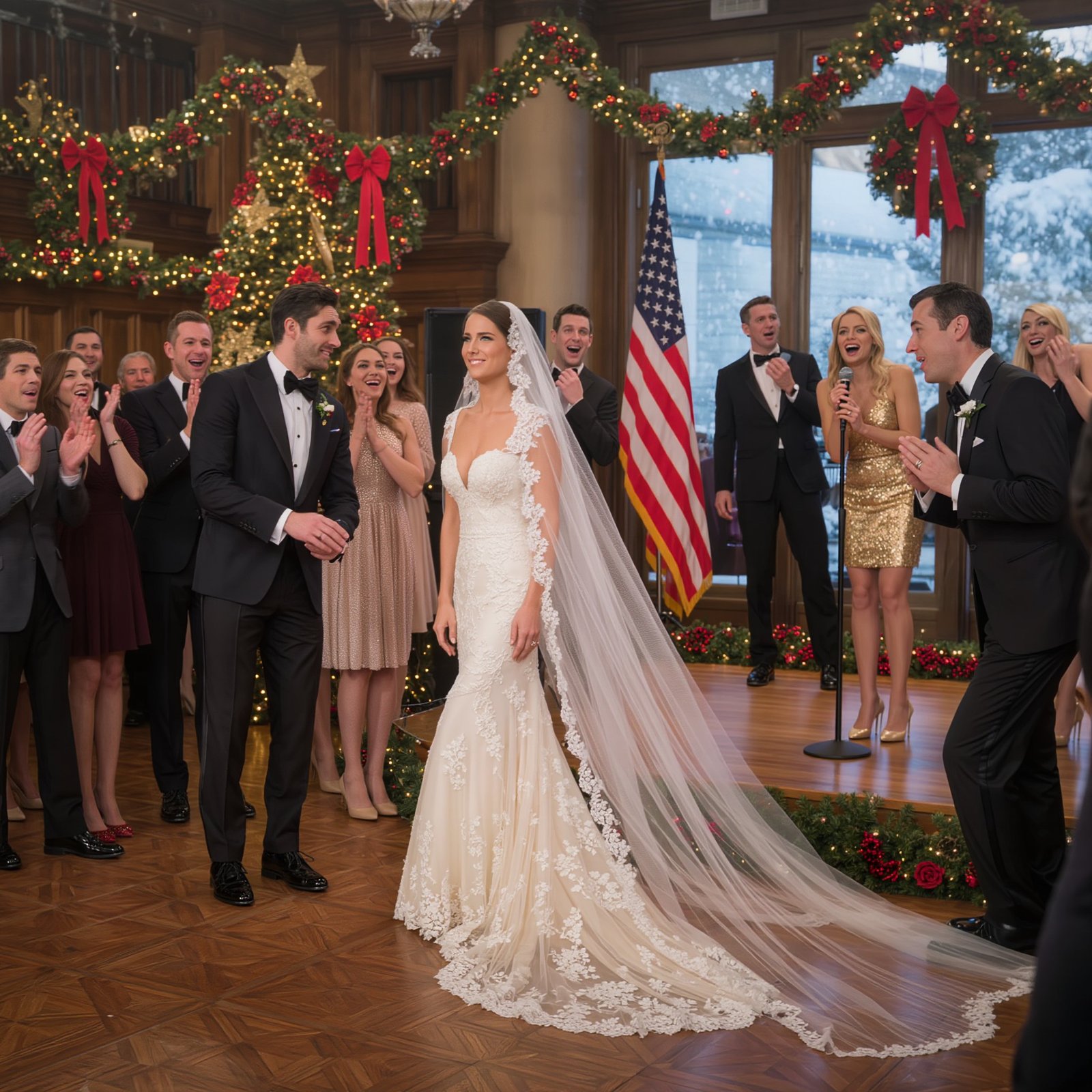
The quiet rolled through the ballroom in a slow wave. Two hundred guests turned in their chairs. Forks paused halfway to mouths. A woman near the dance floor lowered her glass, red wine trembling near the rim. Phones rose almost automatically, the soft glow of screens catching on faces.
A wedding reception is supposed to be about love.
But people love a spectacle more.
I spotted my mother halfway out of her seat, the way she always did when she sensed trouble, as if standing might give her some control over it. Anxiety was written across her face like someone had drawn it there in ink.
Melissa plus microphone plus alcohol never ended well.
My mother just didn’t know what kind of ending was coming.
From the side of the room, Kelsey, the wedding coordinator, stood frozen with her clipboard and earpiece. She looked at me like she was watching a fire start. Her mouth opened as if to say something.
I gave her a small shake of my head.
Let it happen.
Kelsey’s eyes widened a fraction, then she swallowed and said nothing. Even she, in her neatly organized world of timelines and seating charts, understood the unspoken truth.
No one ever stopped Melissa.
“Excuse me, everyone!” Melissa’s voice rang out. It was slightly slurred, but clear, the kind of clarity that comes from adrenaline. “I have an announcement.”
A nervous laugh fluttered somewhere near the back. It died quickly.
Melissa lifted her chin, soaking in the attention like sunlight. She gestured toward us dramatically, like she was introducing a couple on a game show.
“My beautiful sister Emma just married James!”
A few people clapped, uncertain, like they were following instructions they didn’t fully understand. Someone did an awkward whoop that collapsed into silence.
Melissa’s smile widened. She dragged the moment out, the way she always had since we were kids. She’d stand at the top of the stairs, holding some secret like a coin between her fingers, threatening to drop it just to watch me flinch.
I saw it in her eyes now.
That spark.
Not joy.
Not celebration.
Something sharp and hungry.
The look she got when she was about to hurt someone and wanted to make sure an audience was watching.
I’d seen it when she told my high school boyfriend I was “seeing someone else,” turning a harmless study session with a friend into a story that torched my relationship. I hadn’t been unfaithful. But Melissa didn’t care about facts. She cared about the effect.
I’d seen it when she announced my pregnancy loss at Thanksgiving, before I was ready to say the words out loud. She’d held her wine glass up and said, brightly, “Well, at least we can stop pretending Emma’s fine now.”
The room had gone silent then, too.
Melissa had smiled then, too.
I’d spent my whole life learning how to keep my face still when she did it.
“And I just want to say…” Melissa paused, voice thick with drama. She let her eyes sweep the room. She loved this. She loved the feeling of power, like she could tilt the whole evening with a single sentence.
Then she said it.
“I’m pregnant with the groom’s baby.”
For a heartbeat, the words didn’t land. They hung in the air, weightless, like something spoken in another language.
Then the room reacted.
Gasps snapped through the ballroom like a series of small explosions. Chairs scraped. Silverware clattered against plates. Someone dropped a wine glass. It hit the table first, tipping, spilling red across white linen, then fell and shattered on the floor like punctuation.
My mother’s scream cut through the noise.
“Melissa!”
And there I was, in my white dress, my grandmother’s pearls cool against my throat, standing next to the man I’d married three hours earlier.
I smiled.
Not a brittle smile.
Not a stunned smile.
A real one, slow and deliberate, the kind that starts inside and finds its way out.
“Perfect timing,” I said.
My voice carried. The microphone amplified Melissa, but shock gave my words their own volume. Heads turned toward me as if they’d forgotten I existed for a moment.
Melissa blinked from the stage. Her grin faltered. Confusion flashed across her face like a crack in glass.
She’d expected tears.
She’d expected shouting.
She’d expected me to fall apart, because Melissa lived for scenes, and she’d come dressed for one.
“Emma,” she said, leaning closer to the microphone as if she could press her words into my skin, “did you hear what I said? I’m pregnant with James’s baby. James and I have been… we’ve been together behind your back.”
I tilted my head slightly, as if she’d told me it might rain.
“Yes, Melissa,” I said. “I know.”
The room went so quiet I could hear the hum of the projector equipment Kelsey had arranged earlier. I could hear someone’s breath catch. I could hear the soft slide of a chair as a guest shifted, trying to see better.
Melissa’s eyes widened. The microphone trembled in her hand.
“You… you knew?” Her voice lost its triumphant edge. It sounded smaller, almost offended, like I’d broken the rules by not reacting correctly.
“Since last March,” I added, still smiling. “Right? That conference in Miami where you just happened to run into him.”
James went very still beside me, as if his body had decided movement was dangerous. If anyone had been watching from across the room, they might have mistaken him for a statue.
But I could feel the tension radiating off him in waves. I could feel his pulse under the skin of his wrist where my fingers brushed his sleeve, fast and frantic.
Melissa’s mouth opened, closed. Her gaze darted from me to James and back again, as if searching for the script she’d written in her head and finding the pages missing.
Of course I knew.
Four months ago, I’d been standing barefoot on cold tile in my bathroom, staring at a credit card statement I wasn’t supposed to see.
James handled the bills. Not because I couldn’t. I could, and he knew it. But he liked the feeling of being the provider. It fed something in him, that quiet pride men sometimes mistake for authority.
The statement had been left on the counter, folded too neatly to be an accident.
A hotel charge.
Miami.
Marlington Hotel.
Two nights.
Room service.
A bottle of champagne that cost more than my first car payment.
I remember how the air in the bathroom felt too cold, how my toes curled against the tile as if I could hold on to something. I remember the sound of water dripping from the faucet, slow and steady like a metronome.
I didn’t cry then.
I didn’t throw anything.
I stood there, clutching paper, and felt something go quiet inside me, like a door clicking shut.
People think betrayal is loud.
Sometimes it’s silent.
Sometimes it’s the moment you realize you’ve been living in a story someone else is writing.
I walked out of the bathroom with the statement in my hand, prepared for excuses, for a stammer, for some frantic attempt to cover tracks.
Instead I found James in our kitchen, humming as he sliced lemons for iced tea. He looked relaxed, domestic, like he didn’t have a single secret in his body. Sunlight came through the window and made his hair look softer than it was.
He turned and kissed my cheek.
“How’s my beautiful fiancée?”
His voice held that warmth he used when he wanted to reassure me. When he wanted me to trust him.
I held the statement up.
The change in him was immediate. A freeze. A tiny shift in his eyes, like shutters coming down.
For a second, I watched him calculate. Measure. Decide how much truth he could get away with.
Then he smiled.
Not a remorseful smile.
Not a nervous one.
The smile of a man caught doing something minor, like speeding, not the smile of someone caught dismantling a life.
“It was a business trip,” he said.
My voice stayed even. I didn’t accuse. I didn’t shout. I asked one question, because I’d learned that questions reveal more than accusations ever do.
“Why did you use the card you told me we closed last year?”
His eyes darted. Just once. Just enough.
That was all I needed.
Because unlike James and Melissa, I pay attention.
I notice patterns.
I notice when my fiancé starts working late in ways that don’t match his calendar.
I notice when my sister suddenly develops an interest in craft beer because James likes craft beer.
I notice when she asks too many questions about his gym, his favorite restaurants, his schedule, like she’s auditioning for the role of his partner.
I notice when hotel charges appear with familiar dates.
I notice when a man who used to laugh easily starts keeping his phone face-down.
I notice everything.
That’s what happens when you grow up in a house where love was conditional and silence was survival.
My father built a company from the ground up, and he ran our family the same way.
Structured.
Measured.
Rules that lived in the air even when no one said them out loud.
He loved us, but his love came with a constant assessment. Not cruel. Practical. Like he couldn’t help viewing everything through the lens of cost.
What will this cost me?
Melissa cost him a lot.
She always had.
When we were kids, I was the steady one.
Melissa was the storm.
She was beautiful even then. Big bright eyes. A smile that got her out of trouble. Hair that curled perfectly like it was trying to charm the world into giving her what she wanted.
Teachers adored her. Adults excused her. Boys followed her like she was a magnet.
And when things went wrong, Melissa became an expert at redirecting blame.
A vase shattered? She’d look at me with wide innocence and say, “Emma was playing too close.”
Money disappeared from Mom’s purse? Melissa would sigh dramatically and say, “Maybe Dad moved it because he’s worried about bills.”
A neighbor’s bike went missing? Melissa would shrug and say, “Maybe Emma forgot she borrowed it.”
I learned early that being good didn’t protect you.
It just made you useful.
By the time I met James, I had built my life around being useful.
I chose forensic accounting because numbers were honest. Numbers didn’t pretend. They didn’t smile and lie and swear they loved you while moving pieces behind the curtain. Numbers told the truth, even when it hurt.
James came into my life like an answer I hadn’t realized I’d been asking for.
He was charming without being loud, ambitious without seeming desperate. He laughed at my dry humor. He remembered little details I’d mentioned once and forgotten I’d even said, which made me feel seen.
After years of being the responsible daughter, the easy daughter, the one who didn’t make messes, being seen felt like oxygen.
He proposed on a rainy evening in Millennium Park, the city blurred behind us, streetlights smearing gold across wet pavement. His hands shook as he opened the box. I remember the smell of rain and his aftershave and the way my breath caught when I saw the ring glint.
My mother cried immediately. My father shook James’s hand. Melissa smiled too widely and hugged me too hard, pressing her cheek against mine like we were in a photograph.
Later that night, after the champagne was gone and the guests had left, Melissa cornered me in my parents’ kitchen. The overhead light made everything look harsher. There was still a faint scent of perfume and celebration, but her eyes were sharp.
“You’re really going through with this?” she asked.
“Of course I am,” I said.
She tilted her head, studying me like I was a dress she was deciding whether to buy. Her fingers traced the edge of the countertop, slow and absent.
“Just don’t get smug, okay?”
Smug.
As if love was a competition.
As if happiness was something you stole instead of something you built.
I should have heard the warning in her voice.
But I wanted to believe my sister could be happy for me. I wanted that so badly it made me careless.
I always wanted to believe the best.
That was the difference between me and Melissa.
She believed the worst in everyone.
And she learned how to make it true.
After I found the hotel charge, I didn’t run to my mother.
I didn’t confront Melissa.
I didn’t cancel the wedding.
I did what I do.
I gathered facts.
I built a case.
Because if I’d learned anything from watching Melissa for twenty-nine years, it was this.
If you accuse her without proof, she will tear you apart and call it your fault.
And James, I realized, had been learning from her too.
That’s when I called Daniel Morrison.
I didn’t find him through a search. I found him through my cousin Marcus, who had a talent for knowing people he shouldn’t and treating it like a party trick.
Marcus texted me at midnight.
If you need someone to dig, I’ve got a guy. Daniel. He caught Senator Walsh with another woman.
I stared at the message. My heart was pounding, not because I was scared of Daniel, but because the word dig made everything feel real. Like I was admitting, in writing, that the life I’d planned was rotten at the center.
A private investigator sounded like something from a movie.
My life wasn’t supposed to be a movie.
My life was tidy. Spreadsheets. Audit trails. Plans that made sense.
But then I pictured James’s smile when he lied. Melissa’s spark when she hurt me. And I typed back.
Send me his number.
Two days later, I met Daniel in a coffee shop on Wacker Drive, the kind of place with steel chairs and espresso machines that hissed like impatient animals. Outside, the sidewalk was busy with commuters. Inside, it was all low music and the smell of roasted beans.
Daniel was exactly the kind of man you’d expect to catch other people’s secrets.
Dark suit. Plain tie. Sharp eyes that missed nothing. He sat with his back to the wall, scanning the room like he’d done it a thousand times. He didn’t look threatening. He looked prepared.
He didn’t waste time.
“Emma Chen?” he asked.
I nodded.
He slid a file folder across the table, the cardboard scraping softly against the wood.
“Your cousin gave me the basics,” he said. “You want surveillance. You want proof.”
“I want the truth,” I said, and my voice sounded steadier than I felt.
Daniel’s mouth twitched, almost a smile, almost not.
“The truth is easy,” he said. “Proof costs money.”
I didn’t flinch.
“My father raised me,” I said. “I understand costs.”
Daniel studied me for a moment, like he was deciding whether I’d fall apart in his office later and make his job messy.
Then he nodded.
“Tell me what you suspect.”
So I told him.
I told him about the hotel charge.
About James’s late nights.
About Melissa suddenly ordering the same beer James liked, laughing too hard at his jokes.
About her asking questions that didn’t belong in sisterly conversation, the kind of questions you ask when you’re learning someone’s habits so you can fit your life around them.
Daniel listened without interrupting, calm as stone.
When I finished, he asked one question.
“Do you want to catch them,” he said, “or do you want to win?”
My throat tightened, because I knew what that question meant. He wasn’t asking about pride. He was asking about strategy.
“Both,” I said.
He nodded once.
“Then we do it right.”
He laid out a plan like a battle map.
Track James.
Track Melissa.
Collect photos, dates, receipts, video where possible.
Build a timeline.
Document everything.
When I asked about legality, because I had to ask, because I wasn’t Melissa, because I didn’t break rules lightly, Daniel looked at me like he respected the question.
“Public places,” he said. “No expectation of privacy. Everything documented.”
I signed the contract.
I paid the retainer.
And then I went home, smiled at my fiancé, hugged my sister, and acted like my life wasn’t cracking.
You’d be surprised what a woman can hide when she’s been trained to be pleasant.
The evidence came quickly.
March 15th.
Marlington Hotel in Miami.
James and Melissa in the lobby.
In the elevator.
Entering their room together.
Even in grainy photos, I could recognize their body language. The way James leaned toward her. The way Melissa’s head tipped back as she laughed, like she’d won something.
March 22nd.
Riverside apartment complex.
James carrying groceries like a man who belonged there.
Melissa pulling up in her distinctive pink Mercedes.
The two of them on the balcony, arms around each other, city wind tugging at her hair.
April 3rd.
Another hotel.
Another night.
Another lie.
Every time Daniel sent a new file, my stomach turned. My hands went cold. Sometimes I’d stare at the images so long my eyes hurt, as if pain could make them less real.
But I didn’t collapse.
I couldn’t.
Because my father insisted on a prenuptial agreement.
He didn’t trust James.
He said it with a laugh, like it was a joke, but my father rarely joked. Not about finances. Not about protection. Not about people who might become liabilities.
“You have a trust fund,” he told me in his office, the one with floor-to-ceiling bookshelves and framed photos of company milestones. “You have assets. You have a future. Protect it.”
“James loves me,” I said, because I still believed love meant something.
My father leaned back in his chair, hands folded, eyes steady.
“Then he’ll sign it,” he said.
I brought the prenup to James.
He smiled, kissed my forehead, and signed like it didn’t matter.
That was before I learned he’d been planning to use my trust fund to cover business loans.
But the prenup mattered.
Because I made sure the infidelity clause was solid.
I sat with my attorney, Linda Greene, a woman with silver hair and a voice like a scalpel. Her office smelled like paper and espresso and quiet power.
“I don’t want a spectacle,” I told her.
Linda’s eyebrow lifted.
“Then don’t marry a man who creates one,” she said.
I laughed because the alternative was crying, and I refused to give my grief that much oxygen.
“Too late,” I said.
Linda tapped her pen against the contract.
“If he’s unfaithful,” she said, “he gets nothing. No access to your trust fund, no shared assets, no spousal support. But you need proof.”
“I’ll have proof,” I said.
Linda studied me the way Daniel had. Like she was trying to understand how I could be so calm.
“You don’t look surprised,” she said.
“I’m not,” I admitted.
“Then why are you still having a wedding?” she asked.
That question hovered for days.
Why not cancel?
Why not walk away quietly?
The answer wasn’t just about deposits, though deposits mattered. Venues don’t refund heartbreak. Caterers don’t care about betrayal. A ballroom doesn’t turn sympathetic because your life fell apart.
But it wasn’t only practicality.
It was anger.
Not the kind that explodes. The kind that settles, steady and hot, like a coal in your chest.
Melissa had spent my whole life making herself the center of every moment. She’d stolen attention, joy, even grief. She’d taken my hardest days and made them about her reactions.
And James… James had decided I was easy to deceive because I was polite. He thought my quiet meant I was weak. He thought my smile meant I didn’t see.
I wanted them to think they were winning.
Right up until the moment they lost everything.
So I kept planning the wedding.
I chose the downtown hotel ballroom with the balcony and the skyline view, because if I was going to end something, I wanted it to end under lights that made people look honest.
I chose the menu: salmon, short rib, an open bar because my father insisted guests should never feel shorted.
I chose the band.
And I arranged for a large projection screen to be installed.
“For the couple slideshow,” I told Kelsey.
“Of course,” she said, delighted. “That’ll be beautiful.”
I told James I wanted it to feel special.
He smiled.
He had no idea how special it would be.
Melissa played her part perfectly.
She attended fittings. She went to cake tastings. She clung to my arm for photos and told everyone how excited she was, how proud she felt to be my sister.
And when she thought no one was watching, she tested boundaries the way she always did.
A hand on James’s shoulder.
A laugh too close to his ear.
A whisper that made him smile.
Sometimes I watched them from across a room and felt something close to calm.
Because once you know the truth, the lies become almost boring.
The hardest part was my mother.
My mother loved harmony the way some people love religion. She believed in the idea of a happy family so fiercely she could ignore reality to protect it. If I’d told her about James and Melissa, she would have tried to fix it.
She would have suggested counseling.
She would have begged me to forgive.
She would have told me to think about appearances.
And she would have demanded I protect Melissa, because Melissa was fragile, because Melissa was misunderstood, because Melissa just needed more love.
Melissa always needed love.
Even while she was breaking other people’s.
So I kept quiet. I hugged my mother. I listened to her talk about flower arrangements and place settings. I let her imagine grandchildren without knowing what it cost me to let her dream.
My father was different.
My father didn’t believe easily. But he believed in his company, and James worked there.
Not directly under him, because my father was too smart for that, but close enough that James’s charm could do damage.
James was confident in meetings. Smooth on calls. Good at making people trust him.
Good at making my father trust him.
Until I showed my father the first set of evidence.
I did it late one evening in his office when the building was quiet and the city outside looked tired. The fluorescent lights made everything feel sharp, almost clinical, as if we were about to perform an autopsy.
My father sat across from me, reading the photos the way he’d read financial statements my whole life. His face didn’t change.
His eyes did.
They hardened.
When he looked up, his voice was low.
“Are you sure?” he asked.
I slid Daniel’s timeline across the desk.
“Dates,” I said. “Locations. Receipts. Video.”
My father’s jaw tightened.
“And you’re still having the wedding?” he asked.
“Yes,” I said.
He stared at me for a long moment. I could see something working behind his eyes. Not just anger.
Recognition.
The realization that his daughter had been handling something catastrophic without leaning on anyone.
Slowly, he nodded.
“Okay,” he said.
One word, but it held weight.
It meant he trusted me.
It meant he would follow my lead.
It meant I wasn’t alone.
He stood, walked around the desk, and put his hand on my shoulder. His palm was heavy, warm, grounding.
“You’re my daughter,” he said quietly. “You don’t deserve this.”
I swallowed. The lump in my throat tasted like iron.
“No,” I said. “But I’m going to end it.”
He nodded again.
“Then end it properly,” he said.
That was my father.
Always proper.
Even in war.
As the wedding approached, Melissa’s energy shifted. She became restless. She snapped at my mother over table linens. She complained about the bridesmaid dress, the shoes, the schedule.
At the rehearsal dinner, she let out a loud theatrical sigh and said, “Some people have no idea what it’s like to be under pressure.”
As if I wasn’t the one standing beside a man who smiled at me with secrets in his mouth.
As if I wasn’t the one holding proof like a live wire.
At my bachelorette party, Melissa insisted on bottle service.
“My treat,” she said, waving off my protests, performing generosity the way she always did.
The next morning, Daniel texted me.
Your sister used James’s card at Zenith Lounge. $1,478. Receipt attached.
I stared at my phone, then at my reflection in the bathroom mirror. My face looked the same. My eyes looked the same. But something in me had sharpened, like a blade honed quietly in the dark.
Melissa wasn’t unlucky.
She was deliberate.
The morning of the wedding, I woke before dawn.
Not because I was excited.
Because my body refused to pretend it could sleep through what was coming.
The hotel suite smelled like hairspray and fresh flowers by sunrise. Bridesmaids moved around in soft robes, laughing, clinking glasses, sipping mimosas. Someone turned on music low and upbeat, trying to make the air feel light.
My mother sat on the couch, eyes shining with joy she’d waited for. She kept touching my hand, as if she needed to reassure herself I was real.
Melissa sat on the edge of a chair, scrolling her phone, smirking at something. When she looked up and caught me watching, she smiled like we were sharing a secret.
We were.
She just didn’t know which one.
Kelsey rushed in and out, managing timelines, checking her clipboard like it was a life raft. At one point, she pulled me aside.
“Are you okay?” she whispered.
I blinked at her.
“Why?”
“You’re… very calm,” she said, cautious, as if calm at a wedding was suspicious.
I almost laughed.
“I planned every detail,” I told her. “Calm is part of the plan.”
Kelsey nodded, satisfied, and hurried away.
No one suspects calm.
They suspect tears.
They suspect shouting.
They suspect mess.
Calm slips under the radar like a shadow.
At noon, the photographer arrived, cheerful and energetic, the kind of man who made people smile without trying. He took candid shots of my mother pinning my veil. He captured Melissa “fixing” my bouquet, rearranging it until it looked slightly more like hers.
He took a photo of me alone by the window, staring out at the city.
“Beautiful,” he said.
I didn’t correct him.
Beautiful isn’t always happy.
When it was time for the ceremony, I stood at the top of the aisle with my father. Music swelled. Guests turned. James waited at the altar, handsome and polished, smiling like a man about to win something he believed he deserved.
Melissa sat in the front row, dabbing at her eyes, performing emotion with a tissue.
My father leaned closer.
“You ready?” he asked.
“Yes,” I said.
Not because I was ready for marriage.
Because I was ready for the end.
I walked down the aisle and James looked at me like I was the only thing in the world. If I hadn’t known what I knew, I might have believed him completely.
That’s what makes people like him dangerous.
They can sound like love.
The vows were simple.
The rings were expensive.
The kiss was practiced.
When the officiant pronounced us husband and wife, the room erupted in applause, like everyone was celebrating something pure.
I smiled.
I let James kiss my cheek.
I let him whisper, “I can’t believe you’re mine.”
And I thought, not for long.
By the time we reached the reception, the room buzzed with alcohol and anticipation. People were drinking. Laughing. Dancing. My mother glowed. My father stayed stiff.
Melissa had already started on champagne again.
Then the band finished our first dance.
And Melissa moved toward the stage.
Now, in the aftermath of her announcement, the ballroom seemed to hold its breath. People stared at me like I was the last stable thing in the room, the only one who might explain what was happening.
Melissa stood on stage, pale now, but still trying to hold her smile in place.
“How could you possibly know?” she asked, voice tight.
“Because unlike you and James, I pay attention,” I said.
I turned to face the guests. Many of them looked like they were watching the most uncomfortable show imaginable and couldn’t decide whether to leave or lean in closer.
“I’m sorry for the interruption,” I said, my tone polite, almost cheerful. “But since my sister chose this moment to share her news, I thought I should share mine as well.”
I reached into my purse and pulled out a thick envelope. The paper edge pressed into my palm like something alive.
“Daniel,” I said.
A man in a dark suit stood near the back of the room, calm as if he’d been waiting for a meeting, not a public unraveling.
My cousin Marcus, sitting near the rear, made a sound like he’d swallowed air. His eyes went wide with a mixture of awe and disbelief, like he couldn’t decide whether to be proud or terrified.
Whispers shot through the room.
“That’s Daniel Morrison.”
“The private investigator.”
“He caught that senator in that story last year.”
“Yes,” I said pleasantly, because there was no point pretending now. “That’s him.”
Daniel walked forward, tablet in hand, moving with controlled efficiency. He didn’t look smug. He looked professional. That was part of what I’d paid for.
“Of course,” he said when he reached the front. Then he glanced at the wedding program, at James, at the framed place cards. “Sorry. Mrs. Patterson.”
“Just Emma,” I said. “I’ll be going back to Chen soon enough.”
A collective inhale swept the room, sharp and loud.
James’s face went too light.
“No,” he said, voice strangled. “Emma, please.”
Daniel turned his tablet toward the crowd. The large projection screen, the one we’d installed for our couple slideshow, flickered to life.
The first photo appeared.
James.
Melissa.
Miami.
The Marlington Hotel.
Clear as day.
A low sound rippled through the ballroom, part gasp, part murmur, part disbelief.
“This is from March 15th,” Daniel said in a steady voice. “Mr. Patterson and Ms. Chen at the Marlington Hotel in Miami.”
He swiped.
More photos.
The lobby.
The elevator.
Their bodies angled toward each other, close enough that it wasn’t a misunderstanding.
Daniel swiped again.
“March 22nd.”
Riverside apartment complex.
James carrying groceries.
Melissa arriving in her bright pink Mercedes.
The balcony.
An embrace.
I watched the screen the way you watch your own life being narrated by someone else. It was surreal, but it was also clean. The truth, laid out without drama, was almost merciful.
Then Daniel changed the screen again.
“April 3rd.”
Another hotel.
Another night.
Another lie.
Melissa’s breath came faster. Her hand tightened around the microphone.
“This is not okay,” she snapped. “This is illegal. You can’t do this.”
Daniel didn’t even blink.
“Everything was obtained legally,” he said. “Public places. No expectation of privacy.”
I stepped closer, letting my dress brush the edge of the stage. The fabric felt heavy, expensive, absurd, like costume armor.
“But my favorite,” I said, “is from two weeks ago.”
Daniel nodded once.
The screen changed to video.
Security footage from a jewelry store.
James and Melissa leaned over a glass counter, their heads close together as they looked at rings. Melissa’s hand lifted, slipping a ring onto her finger. Her posture was proud, possessive.
The audio was muffled, but clear enough.
“When are you going to leave her?” Melissa’s voice, sharp with impatience.
“After the wedding,” James replied.
Even though I’d heard it before, even though I’d watched it alone in my kitchen with the lights off and the envelope of evidence on the counter, my breath still caught.
Then came the line that made the air in the ballroom feel like it had been sucked out.
“I need her trust fund to handle my business loans first. Six months, maybe a year, then we can be together.”
The video froze on Melissa admiring the ring like it was already hers.
The reception hall erupted.
A rush of voices. Shock spilling into anger. Someone cursed. Someone else let out an ugly laugh that sounded like disbelief cracking.
My mother, who had been standing rigid, went pale and suddenly slid down as if her body couldn’t hold her upright anymore. For one terrifying moment, it looked like she was going to collapse completely. My aunt caught her, hands trembling.
“My own son-in-law,” I heard my father say, voice raw, like the words scraped his throat.
He pushed forward, but two of my uncles reached for him, gripping his arms as if they were holding back a tide.
Melissa’s date, the man she’d brought as if tonight was normal, stumbled backward, face drained of color, and headed toward the exit. Someone near the back hissed, “She brought a date?” like even in disaster, people couldn’t resist the detail.
Melissa looked like she might be sick.
James stepped forward, eyes wild, and for the first time that night he looked less like a groom and more like a man whose plans were falling apart.
“Turn it off,” he said. “Emma, please. We can talk about this.”
“We are talking about it,” I said, calm as a banker. “Right now. In front of witnesses, which will be helpful.”
His eyes narrowed, as if he couldn’t believe I was doing this to him, as if he hadn’t been doing something far worse to me.
“You planned this,” he said, voice shaking with accusation. “You knew and you let us get married.”
I let out a small laugh, not because it was funny, but because it was astonishing.
“Oh, James,” I said softly. “You really should have read that agreement more carefully.”
His gaze flickered, confused.
“The infidelity clause is solid,” I continued. “You get nothing. No trust fund access, no shared assets, no spousal support. Nothing.”
His mouth opened. Closed.
Then I added the part that made my father’s face shift from grief into something colder.
“And since you’ve been misusing company funds to cover your little setup,” I said, “you’re going to have bigger problems than a wedding speech.”
“What?” my father demanded, finally pulling free. His voice was so sharp it made people flinch. “You’ve been taking money from my company?”
James looked around, like he wanted an exit that wasn’t there.
I turned toward him, conversational, almost gentle.
“Did you think I wouldn’t look at the books when I found out about the relationship?” I asked. “You know I’m a forensic accountant.”
For a second, James looked genuinely confused, like he’d forgotten who I was beyond the role he’d assigned me in his head.
Melissa dropped the microphone.
It hit the stage with a squeal of feedback that made people wince.
She scrambled down, trying to get away, but her heel caught in the hem of her dress and she went down hard, palms hitting the floor. A few guests gasped. A few laughed. Not kindly. Not entirely cruel. Just in shock, the way laughter sometimes leaks out when people don’t know what else to do.
I didn’t move.
“Oh, and Melissa,” I said, voice light, “congratulations on the pregnancy claim. You might want to confirm the details.”
Her head snapped up so fast her hair swung.
Daniel’s tablet glowed in his hands like a silent witness.
“Daniel has footage from your trip to Vegas last month,” I added.
Melissa froze, eyes widening until the whites showed.
“That’s right,” I said. “James isn’t the only one who’s been busy.”
I tilted my head as if searching memory.
“What was his name? Trevor. The bartender.”
A sound like a gasp tore from Melissa’s throat. Her face twisted, not with embarrassment, but with fear.
James, desperate, angry, reached for me.
His hand clamped around my arm, too tight, gripping my sleeve and skin beneath it.
“Emma,” he said, voice low, urgent, “you can’t do this.”
I looked down at his hand. Then I looked up at his face. The face I’d once believed in. The face that had looked so sincere when he asked me to marry him.
I felt nothing for it now.
“Security?” I called, calm as if I were asking for a waiter.
Two uniformed men appeared quickly. I’d arranged for them weeks ago. I planned every detail of this day.
“Mr. Patterson is no longer welcome,” I said.
“This is my wedding too,” James protested as they stepped in, hands firm but controlled.
“No,” I corrected. “This was your performance. Now it’s my exit.”
He struggled for a moment, not violently, but in disbelief, like he couldn’t accept the room had turned against him. The security guards guided him toward the door. Melissa scrambled after them, mascara streaking down her cheeks, dress dragging, hair coming loose.
The ballroom stayed frozen, caught between horror and fascination.
When the doors swung closed behind them, the sound was startlingly final.
I turned back to the guests.
“I know this isn’t the reception you expected,” I said, voice carrying easily. “But the good news is the catering is paid for.”
A few people blinked at me, as if they were checking whether I was real.
I gestured toward the bar.
“The bar is open,” I said. “And the band knows plenty of songs for complicated nights.”
A laugh, hesitant at first, rose from somewhere near the center. It didn’t spread immediately. People were still trying to understand what kind of social rules applied now.
Then Diana stood.
My college roommate. The friend who’d slept on my couch during finals week, who’d brought me soup when I was sick, who’d once confronted a guy at a party for dismissing me like I was background noise.
She raised her champagne glass high.
“To Emma!” she shouted. “For handling the truth with more backbone than anyone expects!”
“To Emma!” someone echoed.
Then another voice joined.
And another.
Applause rose, uncertain at first, then stronger, like a wave finding momentum. It grew until it shook the chandeliers.
My mother, pale and shaken, was being helped into a chair. When she saw me, tears spilled down her cheeks.
“Oh, sweetheart,” she whispered, voice breaking. “Why didn’t you tell me?”
I stepped to her and let her pull me into a hug. Her perfume smelled like roses and familiarity. Her hands trembled against the back of my dress.
“Because you would have tried to fix it,” I said softly.
She pulled back, eyes wide, wet lashes clinging together.
“You would have suggested counseling,” I continued, “or talking it out.”
My throat tightened, but my voice stayed steady.
“And I didn’t want it fixed, Mom. I wanted it finished.”
She made a small sound, like the air leaving her lungs.
“But the wedding,” she whispered. “All the money… all the planning…”
“It was worth it,” I said, and I meant it. “To stop being the only one swallowing the truth.”
I leaned in and lowered my voice, so only she could hear.
“I needed the pattern documented,” I said. “And I needed Melissa to think she’d won. Just long enough.”
My father appeared beside us, face tight, eyes burning with anger that looked like it had nowhere safe to go.
“The funds,” I said quietly to him. “Around fifty thousand. I have the documentation. If you want to take action, you can.”
My father stared at the ballroom, at the guests shifting and whispering, at the stage where the microphone lay abandoned.
“My own employee,” he said, voice low. Then his eyes flicked toward the door Melissa had run through. “And my own… family.”
“I’m sorry,” I said.
He shook his head sharply.
“No,” he said. “I’m sorry.”
The words sounded unfamiliar in his mouth.
“We let her get away with too much for too long,” he added, voice rough. “We taught her she could break things and someone else would clean it up.”
Hearing my father admit fault was strangely disorienting. It almost made the room tilt. My father didn’t admit fault.
But tonight was making new rules.
The bandleader approached the edge of the stage cautiously, like he was stepping onto thin ice.
“Ms. Chen,” he said, clearing his throat. “Do you want us to keep playing?”
I wiped a tear from my mother’s cheek with the pad of my thumb, then looked up at him.
“Yes,” I said. “Please.”
He hesitated. “Any preference?”
I thought for a moment, then smiled.
“Something with energy,” I said. “People look better moving.”
The band exchanged a glance, then began to play. The music rolled back into the room, uncertain at first, then stronger, filling the empty spaces. Relief rippled through the guests like warmth. People didn’t know what to do with public heartbreak.
Give them music, and they find their feet.
The reception restarted in a strange, surreal way. People returned to their seats. They drank. They ate. They approached me as if I’d won something, not lost a marriage.
One woman I barely knew gripped my hands and said, “You’re incredible,” with the kind of awe people reserve for a performer.
I smiled and thanked her because old habits are hard to break.
My father sat with my uncles, speaking in low, controlled voices, the way men do when they’re deciding what to do next.
My mother drifted through the room like she was half in a dream, hugging people, apologizing, wiping her face, forcing smiles.
The photographer, still doing his job, leaned in at one point and said, “These are going to be the most memorable wedding photos I’ve ever taken.”
I laughed, surprised by the way it sounded like me.
Around midnight, I stepped out onto the balcony.
Cold air struck my face immediately. It smelled like river water, exhaust, and winter. The railing was icy under my palms. Below, the streets glowed with headlights and late-night impatience. Above, the sky was dark and endless, the kind of darkness that makes you feel both small and strangely free.
Diana joined me, slightly tipsy and fiercely loyal. She leaned her elbows on the railing and exhaled hard.
“You know what the best part is?” she said.
“What?” I asked.
“You’re going to be a legend,” she said, and her voice was thick with champagne and affection. “The woman who turned her wedding into a truth reveal.”
I let out a breath that almost sounded like laughter.
“I suppose there are worse things,” I said.
Diana nudged my shoulder.
“So what now?” she asked. “What’s the plan?”
I looked out at the city lights and let myself picture what I’d been holding in my mind for weeks.
The apartment I’d already rented across town.
The lease signed under my maiden name.
The key tucked into my purse.
Linda Greene, already preparing paperwork.
A job offer in Seattle I hadn’t told James about, a fresh start waiting like a clean page.
I’d planned quietly while James and Melissa assumed I was the one being played.
“Now,” I said, voice steady, “I live without lies.”
Diana’s eyes softened, and her shoulder pressed against mine.
“Without betrayal,” I added.
“Without people who say they love me while doing damage.”
My throat tightened again, but it didn’t break me. It was just the body catching up.
“Just me,” I finished, “starting over.”
Diana lifted her glass.
“Starting over,” she echoed.
“And the trust fund will go where it was meant to go,” I said.
Diana raised an eyebrow. “Oh?”
I smiled, feeling the idea settle into place like the last piece of a puzzle.
“I’m opening a forensic accounting firm,” I said. “Specializing in divorce cases. Helping people find out what’s really happening before it costs them everything.”
Diana laughed, bright and loud in the cold air.
“You’re going to do very well,” she said.
I looked at the city, at the steady movement of traffic below, at the lights that never stopped.
“I already am,” I said quietly. “I just had to let go of what was weighing me down.”
My phone buzzed in my hand.
A text from an unknown number.
I hesitated, then opened it.
This isn’t over. You ruined everything. You’ll pay for this. Melissa.
For a moment, the old fear tried to rise, the childhood reflex of bracing for her next move.
But I exhaled.
Of course she would.
I took a screenshot.
Evidence.
Then I blocked the number.
By morning, Linda would have the message in her inbox.
By the end of the week, paperwork would be moving.
By the end of the month, Seattle would be more than a thought.
But tonight, I wasn’t going to let Melissa claim another moment of my life with a threat. I’d done enough shrinking to accommodate her.
Diana watched me slip the phone back into my purse.
“You okay?” she asked.
I nodded.
“Better than okay,” I said, and the words surprised me with their honesty.
We went back inside.
The music was louder now. People were dancing in clusters, some awkward, some determined, like movement might shake the discomfort loose. The bar was busy. Laughter sounded more natural, relief woven into it.
I kicked off my heels. My feet hit the floor and I felt it through my bones, a grounding sensation, like returning to myself. I gathered the skirt of my dress in my hands, lifted it just enough to move, and stepped back into the room.
I danced.
Not carefully.
Not politely.
I danced like the weight had shifted off my chest and into the floor, like every beat was proof that my life belonged to me again.
And if a few tears mixed in with the laughter, that was okay.
You can’t build a new life without grieving the one you thought you had.
Even when that life was built on lies.
As I spun, dress swaying, music vibrating through me, I caught sight of my father across the room. He had his phone raised, face hard, eyes focused. FaceTime was open, his voice low and precise.
He was instructing someone to remove James’s things from my house.
Even now.
Even tonight.
My father never wasted time.
And standing there, barefoot, wedding dress gathered in my hands, surrounded by music and noise and people trying to figure out what kind of celebration this had become, I knew one thing with absolute certainty.
This was the best wedding reception I’d ever attended.
Even if the marriage only lasts, the length of a single evening.
The thought came to me so cleanly that it almost made me laugh again, right there on the dance floor with my hair coming loose from its pins and the hem of my dress brushing my ankles like a whisper. The room had shifted into a new shape, one I’d designed without ever saying it out loud. It was no longer a wedding reception. It was a wake for a lie, and a celebration for the version of me that refused to be small.
The band rolled into another song. The bass thumped through the floor, steady as a heartbeat. Glasses clinked. People’s voices rose and fell in overlapping waves. Someone near the bar was telling the story to someone else, embellishing with their hands, their eyes bright with shock and the strange thrill of having witnessed something “unbelievable.”
I moved through it all like I was underwater and somehow breathing fine.
Diana danced beside me, arms up, laughing, her cheeks flushed. She leaned close and shouted over the music, “Tell me you feel at least a little bit powerful right now.”
I looked at her, sweaty hair sticking to my temple, and for the first time that night I let myself answer with the full truth.
“I feel… lighter,” I shouted back.
She grinned and bumped her shoulder into mine. “That counts.”
Across the room, my mother sat with a glass of water between her hands like she needed something to hold that wouldn’t break. My aunt hovered near her, stroking her arm. Every now and then my mother’s gaze found me, and the look in her eyes was a mix of pride and grief, like she couldn’t decide which emotion was allowed to take up more space.
My father remained at his table with my uncles, his posture stiff, his jaw set. He was speaking in short, clipped sentences, the way he did in board meetings when the stakes were high and patience was low. If anyone in that room thought he was merely embarrassed, they didn’t know him.
He was planning.
And my father’s plans always ended with someone else paying.
I stepped away from the dance floor and made my way toward the stage, not in a rush, not drawing attention, just moving with purpose. My dress swished and caught on chair legs. A woman I didn’t know leaned toward her friend and whispered, and they both glanced at me as if I were a celebrity in a scandal.
I was used to being the responsible one. The quiet one. The one people forgot was in the room until they needed something fixed.
Tonight, everyone noticed me.
Kelsey appeared at my side like a shadow, her clipboard clutched to her chest. Her eyes were wide, and her professional composure looked like it was being held together by sheer will.
“Emma,” she said softly, as if speaking too loudly might shatter the evening, “do you… need anything? Are you safe?”
I met her gaze. The concern in her face was genuine. It startled me. People were always more comfortable with my competence than with my vulnerability.
“I’m safe,” I said. “Thank you.”
She swallowed. “I didn’t… I didn’t know.”
“Of course you didn’t,” I replied. My voice was gentle. Kelsey didn’t deserve the weight of anyone else’s secrets.
She hesitated, then nodded. “Your car is still scheduled for one a.m. If you want it earlier…”
“I’ll let you know,” I said.
Her shoulders dropped a fraction, relieved to have a task again, and she vanished back into her world of logistics and disaster control.
I climbed the small steps to the stage. The microphone lay where Melissa had dropped it, abandoned like a shed skin. For a second, I stared at it, remembering the feedback squeal, the way Melissa’s fingers had slipped off it when her power evaporated.
I didn’t pick it up.
I didn’t need it.
I stepped to the edge of the stage and looked out over the room. Faces turned toward me instinctively. Conversations quieted, not completely, but enough that the sound of forks against plates became noticeable again.
A few people lifted their phones, ready to capture whatever came next.
I resisted the urge to roll my eyes. Spectacle addiction was real.
I lifted a hand, not dramatic, just a small gesture for attention.
“I’m not making another announcement,” I said, loud enough to carry without the mic.
There was an awkward ripple of laughter. People lowered their phones, some sheepish, some disappointed.
“I just want to say thank you for staying,” I continued. “For not making my mother feel like she has to apologize for something she didn’t do.”
My mother flinched, as if the words had found her. She looked up at me, her eyes glassy.
“And for letting this be… what it is,” I said. I paused, searching for the right word. Freedom tasted unfamiliar in my mouth, like a new language I hadn’t practiced enough. “A night that’s honest.”
A man near the back, one of James’s colleagues, cleared his throat. “Emma,” he called out cautiously, “are you going to… press charges? About the company money?”
The room sharpened.
People loved a second act.
I felt my father’s gaze hit me like a hand on my back. I didn’t look at him yet. I didn’t want to be pulled into his anger before I finished doing what I came here to do.
“That’s not something I’m discussing tonight,” I said, keeping my tone steady. “But thank you for your concern.”
The man nodded quickly, like he’d been slapped with boundaries. He turned away.
I glanced at Daniel standing near the side wall. He was still there, still composed, a quiet sentinel among people who didn’t know what to do with him. When our eyes met, he gave me a subtle nod.
His job was done.
But mine wasn’t.
I stepped down from the stage and walked toward my father’s table. My dress brushed against chair backs. People shifted to make room. Someone reached out as if to touch my sleeve, then thought better of it.
My father’s table was a small island of silence. My uncles’ faces were tight. One of them was still gripping his napkin like he’d forgotten it was cloth.
My father looked up as I approached. The anger in his eyes was still there, but under it, something steadier.
Pride, maybe.
Or sorrow.
It was hard to tell with him.
“I don’t want you to do anything impulsive,” I said, leaning close enough that only he could hear. The band’s music covered my words.
My father’s nostrils flared slightly. “Impulsive,” he repeated, like it was a foreign concept.
“I know you,” I said quietly. “You’re furious. But I want you to let me handle the parts that involve me.”
His gaze held mine. His eyes were dark, tired. For the first time that night, he looked his age.
“What do you want from me?” he asked.
The question was simple. The answer wasn’t.
I looked down at my hands. The ring on my finger glinted under the chandelier light. It felt heavy. Ridiculous.
“I want you to protect Mom,” I said.
His jaw worked.
“She’s going to blame herself,” I continued. “She always does. She’s going to spiral into the idea that she failed Melissa. She’s going to start trying to repair something that shouldn’t be repaired.”
My father’s eyes flicked toward my mother. She sat hunched slightly, her shoulders drawn in, as if trying to take up less space. She looked like someone who’d been blindsided in public and was still trying to find her footing.
My father’s expression softened in a way most people never saw.
“I will,” he said.
I exhaled. A small release I hadn’t realized I’d been holding.
“And James,” my father added, voice turning to stone again, “will not be walking into my company tomorrow like nothing happened.”
“I didn’t think he would,” I said.
My father’s gaze sharpened. “And Melissa,” he said. The word sounded like it hurt.
I didn’t answer right away.
Because Melissa was my sister.
Because the word sister still carried weight, even after everything she’d done.
Because there was a part of me, small and stubborn, that still remembered us as kids, in the backyard, running through sprinkler water, squealing, hair wet and tangled, laughing like we didn’t know how complicated love could become.
But that part of me was not in charge anymore.
“Melissa made choices,” I said finally. “So did James. Let them live with them.”
My father stared at me for a long moment, then nodded once, slow.
“You’re stronger than I realized,” he said.
The compliment landed oddly. Not because I didn’t appreciate it, but because I’d been strong for so long that hearing it spoken aloud felt like someone naming air.
I gave him a small smile. “I learned from you,” I said.
He didn’t respond to that. He just looked away, swallowing whatever emotions he didn’t want to show.
I stepped back from the table and moved toward where my mother sat. Her hands were still wrapped around her water glass. Her fingers were pale from gripping it too tightly.
I crouched beside her chair, careful of my dress. The fabric pooled around me like a white tide.
“Mom,” I said softly.
She blinked down at me as if she’d forgotten I was here. Then her mouth trembled.
“I should have seen it,” she whispered. “I should have…”
“No,” I said firmly. “You shouldn’t have to anticipate your daughter hurting someone. You shouldn’t have to anticipate your son-in-law deceiving you. That’s not your job.”
Her eyes filled again. Tears spilled over, trailing down her cheeks.
“She’s my child,” she said, voice breaking. “Melissa is my child.”
“I know,” I said.
I reached up and wiped her tears with my thumb the way she used to wipe mine when I was small.
“I’m your child too,” I reminded her.
Her breath hitched.
“I’m sorry,” she whispered. “I’m so sorry.”
I squeezed her hand.
“Don’t apologize to me for what they did,” I said. “Just… stay with me. Tonight. Be here.”
She nodded, small and helpless.
“I’m here,” she said. “I’m here.”
Behind us, someone laughed loudly, and for a moment the sound felt wrong, like laughter in a church. But then I realized the people laughing weren’t laughing at me. They were laughing because the room needed it, because the tension needed somewhere to go.
The human body doesn’t know how to hold too much shock. It leaks out in strange ways.
I stood and leaned down to kiss my mother’s forehead.
“Eat something,” I told her. “Drink water.”
She tried to smile. It came out crooked.
“I can’t believe you knew,” she whispered. “Four months…”
“I didn’t want you carrying it,” I said. “And I didn’t want you trying to fix it.”
Her eyes closed briefly, as if she understood more than she wanted to.
“I always try to fix,” she admitted. “It’s what I do.”
“I know,” I said.
I straightened, and as I did, I caught sight of the bouquet on a table near the dance floor. White flowers, satin ribbon, delicate and absurd. The symbol of a tradition that felt hollow now.
The band shifted into another song, upbeat, familiar. The rhythm pushed people back into motion.
Diana appeared beside me again like she’d been summoned by my thoughts.
“Do it,” she said, nodding toward the bouquet.
I raised an eyebrow.
“Throw it,” she insisted. “Make it yours.”
I hesitated.
The bouquet had always been a joke to me. A ritual wrapped in superstition. But tonight, everything was being rewritten.
I picked it up. The stems were wrapped in ribbon, smooth and cool. The flowers smelled faintly sweet, clean and expensive.
I walked to the center of the dance floor.
The guests noticed immediately. A ripple of attention moved through them. People gathered, intrigued.
“Oh, she’s doing the bouquet toss,” someone said, voice excited like they were watching an unexpected plot twist.
Diana climbed onto a chair and waved her arms like an announcer. “Single ladies!” she yelled. “And anyone who wants to catch a bouquet for fun! Get over here!”
Laughter rose. Chairs scraped. A small group formed, not just unmarried women, but friends, cousins, even one of my male coworkers who shrugged and said, “Why not?”
I turned my back to them, bouquet in my hand, and for a moment I let myself feel the absurdity.
A wedding dress.
A room full of guests.
A marriage already dead.
And me, still standing.
I lifted the bouquet over my shoulder.
“Ready?” I called.
A chorus of excited shouts answered.
I threw it.
The bouquet sailed through the air, white and bright under the chandeliers, spinning like a soft weapon.
It landed in the hands of a woman I barely knew, someone from my father’s company, a quiet analyst named Nora who looked stunned to be holding it.
The room cheered as if this moment mattered.
Nora laughed, startled, then lifted the bouquet like a trophy.
Diana yelled, “Nora! You’re next!”
Nora’s eyes widened in mock horror. “Absolutely not,” she shouted back, and the room erupted in laughter again.
For a moment, it almost felt normal.
Not the normal I’d expected for my wedding, but a new kind of normal, the kind that grows after something burns down.
I let myself smile.
Then I saw Daniel again, and the reminder hit me.
I wasn’t done.
The evidence.
The paperwork.
The practical steps of separating a life.
I found Daniel near the edge of the room, speaking quietly to Kelsey. When he saw me approach, he stepped aside.
“Everything okay?” he asked.
“As okay as it can be,” I said.
He nodded, as if this was an ordinary status update.
“I need the full file,” I told him. “Everything. Timeline, receipts, photos, video. And I want copies for my lawyer and my father’s counsel.”
“Already prepared,” Daniel said. “I can deliver it to your attorney’s office tomorrow.”
“Thank you,” I said.
His gaze remained steady. “You handled it well,” he said.
The words should have felt validating. Instead they felt distant, like compliments often do when you’re too busy surviving to absorb them.
“I handled it,” I said.
Daniel’s mouth twitched again. “Yes,” he agreed. “You did.”
I hesitated, then asked the question that had been sitting in the back of my mind like a splinter.
“Did you find anything else?” I asked quietly.
His eyes narrowed slightly, not in suspicion, but in thought.
“You mean beyond what you requested,” he said.
I nodded.
Daniel glanced around, making sure no one was close enough to hear. Then he leaned in.
“There are some financial records,” he said, voice low. “It looks like your sister has been using credit under someone else’s name. Multiple accounts. It’s… messy.”
My stomach turned, not with surprise, but with exhaustion. Melissa’s messes always spilled outward, like she couldn’t help pulling others into them.
“Send that to Linda too,” I said.
Daniel nodded.
“And Emma,” he added, “you should consider a restraining order if she escalates.”
“I already have her message,” I said, touching my purse where my phone sat.
Daniel’s eyes flicked to my face. “Good,” he said. “Documentation matters.”
I almost smiled. Numbers and evidence. The language I trusted.
The night kept moving.
Guests stayed longer than I expected. Some out of genuine support, some out of curiosity, some because the open bar had become a life raft in a sea of discomfort.
People hugged me. Some said the wrong things.
One older woman clasped my hands and whispered, “At least you found out early.”
Early.
As if betrayal had a schedule.
As if a wedding wasn’t already a kind of public vow that carried weight.
I nodded and thanked her anyway, because it wasn’t her fault she didn’t know what to say.
My uncle tried to make a joke about how at least the cake was still good. My cousin Marcus looked like he was both thrilled and horrified to have been right about Daniel being the “perfect guy” for this.
At some point, my father stood and moved through the room with calm authority, speaking to people in low tones. I knew what he was doing. Damage control. Protecting the company. Protecting me. Protecting our family name, in the way he understood protection.
I didn’t stop him.
My mother stayed close to me after that. Not hovering. Just present. As if she’d realized that in trying so hard to keep Melissa afloat, she’d been letting me drown quietly for years.
Near one in the morning, Kelsey approached again.
“Your car is here,” she said softly.
I nodded.
Diana appeared at my side instantly. “I’m coming with you,” she announced.
“I’m fine,” I started to protest.
“Emma,” Diana said, voice firm, “let someone take care of you for five minutes. Just five.”
I blinked, and my throat tightened. The urge to argue faded.
“Okay,” I said quietly.
We moved toward the exit. Guests parted to let us through. Someone called out, “You’re amazing!” and another person clapped, as if I were leaving a stage.
At the doors, I paused and looked back at the ballroom.
The candles on the tables flickered. The dance floor was scattered with people swaying, a little drunk, a little shaken, still trying to turn this night into something they could file away in their minds as a story with a clear lesson.
My father stood with my uncles, phone still in his hand, eyes focused.
My mother stood near the edge of the dance floor, her hands clasped, her expression soft and wounded.
This room had held my wedding.
Now it held my ending.
I turned away.
The hotel hallway outside the ballroom was quieter, carpet muffling footsteps. The air smelled faintly of flowers and cleaning products, that neutral hotel scent that tried to erase whatever human mess had happened inside.
The elevator doors slid open. Diana and I stepped in. The mirror on the back wall reflected us: me in my white dress, hair coming loose, eyes bright from tears and adrenaline; Diana in her dark dress, lipstick slightly smudged, expression fierce.
The elevator descended in silence for a moment.
Then Diana spoke.
“Are you okay?” she asked again, but this time her voice was softer. No jokes. No performance.
I let my head rest lightly against the cool metal wall.
“I don’t know what I feel,” I admitted.
Diana nodded like she understood completely.
“You don’t have to know right now,” she said.
The elevator dinged. The doors opened into the lobby, quiet and glossy, late-night staff moving like ghosts. A few strangers glanced at me, then away quickly, unsure what story they were seeing.
Outside, the cold hit like a slap.
The car waited at the curb. The driver opened the door, eyes polite, expression carefully neutral. He didn’t ask questions.
Diana helped gather my dress as I climbed in.
In the car, the leather seat was cool against my skin. The city lights blurred past the window. My hands rested in my lap, fingers twisting the satin of my dress without meaning to.
Diana leaned back and let out a long breath.
“You really did it,” she said softly.
I stared out at the streetlights.
“I had to,” I said.
She was quiet for a moment, then asked, “Do you miss him?”
The question landed in my chest like a pebble dropped into water.
I thought of James’s smile when he proposed. The rain in Millennium Park. The way he’d looked at me like I was the answer.
I thought of his hand gripping my arm tonight, demanding control even as his lies collapsed.
I thought of the video of him saying he needed my trust fund.
I shook my head slowly.
“I miss who I thought he was,” I said. “I miss the story.”
Diana nodded. “Yeah,” she murmured. “That’s always the part that hurts.”
The car turned onto our street.
Our street.
The word felt strange now.
When we pulled up in front of the house, the lights were on.
My father’s instructions had already reached someone.
I saw movement through the windows.
People inside.
Removing things.
The car door opened, and cold air rushed in. I stepped out, dress gathered in my hands, heels dangling from my fingers. My feet hit the sidewalk barefoot, the concrete cold and real.
Diana followed, closing the door behind her.
We walked up the front steps.
Inside, the house smelled like familiar wood and lemon cleaner. The lights were bright, too bright, as if the house was trying to show us nothing could hide here.
Two men stood in the living room with boxes. One of them held a framed photo of James and me, taken last summer at the lake.
My stomach tightened, but I kept my face calm.
“Hi,” one of them said awkwardly. “Mr. Chen said we should… start with his personal items.”
I nodded.
“Put everything in the boxes,” I said. “Anything that’s mine stays.”
The man nodded quickly, relieved to have clear instructions.
Diana wandered into the kitchen and returned with a glass of water.
“Drink,” she said, pushing it into my hand.
I took it. The water was cold, grounding.
From the hallway, I heard footsteps.
My father appeared, coat off, sleeves rolled up. He looked like a man who’d decided sleep was optional.
My mother was behind him, eyes red, expression exhausted.
“You’re home,” my father said.
“I’m home,” I echoed.
He looked at my dress, the pearls, the bare feet.
“You should change,” he said, practical as always.
I nodded.
As I moved toward the stairs, my mother reached for my hand.
“Emma,” she whispered.
I stopped.
“I’m so sorry,” she said again, like the words were the only thing she could offer.
I squeezed her fingers gently.
“I know,” I said. “But I’m okay.”
I went upstairs to the bedroom.
The room looked the same, but it didn’t feel the same. The bedspread was smooth. The nightstand held a book James had been reading. A glass he’d left half full of water sat beside it.
I stared at it for a long moment.
Then I walked to the closet.
James’s side was still full.
Suits lined neatly. Shoes arranged in pairs.
Evidence of a man who’d planned to stay.
I opened a drawer and pulled out a large suitcase. The zipper rasped loudly in the quiet room.
I began to pack.
Not in a frantic way. Not in tears.
Methodically.
My clothes, folded.
My documents, organized.
My laptop.
The envelope with Daniel’s evidence.
The key to the new apartment.
Each item placed in the suitcase felt like a sentence in a story I was writing myself.
Downstairs, voices murmured as boxes were taped shut. The sound of packing tape tearing was oddly satisfying, sharp and final.
Diana leaned in the doorway at one point, watching me.
“You’re really doing this tonight,” she said.
I glanced up. “If I sleep here,” I said, “I’ll wake up and second-guess myself. I don’t want to give doubt that kind of power.”
Diana nodded slowly. “Okay,” she said. “Then we do it tonight.”
By the time the suitcase was packed, the house felt hollow. James’s things were stacked near the front door in neat boxes like a shipment being returned.
My father stood in the living room, arms crossed, staring at them as if he could burn them with his eyes.
“Tomorrow,” he said, voice low, “my counsel will contact him. He will not step into the office again.”
I nodded.
“And Melissa,” my mother said softly, like the name hurt her mouth.
My father’s jaw clenched.
“I’ll handle Melissa,” I said.
Both of them looked at me.
“You don’t have to,” my mother whispered, fear and hope tangled in her voice.
“I do,” I said quietly. “Not because I owe her anything. Because I’m not letting her control the narrative anymore.”
My father nodded once. “Good,” he said, as if he’d been waiting for me to claim that.
My mother’s eyes filled again.
Diana cleared her throat and clapped her hands once, brisk. “Okay,” she said. “Where are we going?”
I reached into my purse and pulled out the key.
“To my apartment,” I said.
Diana’s eyebrows shot up. “You already have an apartment.”
“I planned,” I said simply.
Diana stared at me for a beat, then a grin spread across her face. “Of course you did,” she said, admiration thick in her voice. “Of course you did.”
We loaded my suitcase into Diana’s car.
As we drove across town, the city was quieter, the streets slick with winter. Streetlights reflected on the pavement like pale gold. The radio played softly, some late-night DJ talking in a calm voice about weather and traffic like nothing in the world had shifted.
But everything had.
When we pulled up to the new building, it was modest compared to the house, but clean and safe. The lobby smelled like fresh paint and someone’s laundry detergent.
The elevator carried us up.
My apartment door clicked open.
Inside, the space was simple. A couch I’d ordered weeks ago. A small table. A lamp casting warm light against pale walls. Boxes in the corner with labels in my handwriting.
It didn’t smell like James.
It smelled like new beginnings and cardboard.
Diana set my suitcase down and looked around.
“This is… actually really nice,” she said.
“It’s mine,” I replied, and the words felt like a prayer.
Diana turned to me.
“So what happens tomorrow?” she asked.
I sank onto the couch, the fabric firm under me. My dress pooled around my legs like snow.
“Tomorrow,” I said, “I file.”
Diana nodded.
“And I call Linda,” I added. “And I forward Melissa’s message. And Daniel’s full file goes to the attorney. And I start separating accounts.”
Diana let out a low whistle. “You’re terrifying,” she said, and there was affection in it.
I smiled faintly.
“I’m tired,” I admitted.
Diana’s expression softened.
“You don’t have to do anything else tonight,” she said. “Just… breathe.”
I nodded.
She stood, walked into the small kitchen, and returned with two mugs of tea she found in one of my boxes. She handed one to me.
The mug was warm. The steam smelled like chamomile.
I wrapped my hands around it and let the warmth seep into my fingers.
For the first time all night, the adrenaline began to drain.
Without it, exhaustion hit like a wave.
Tears stung my eyes, sudden and hot.
Diana sat beside me without speaking, close enough that her shoulder touched mine.
I stared at the blank wall across the room, and the tears slid down my cheeks quietly.
Not dramatic.
Not loud.
Just real.
“I’m sorry,” I whispered, and I didn’t even know who the apology was for.
Diana’s hand covered mine.
“Don’t apologize,” she said softly. “You didn’t do anything wrong.”
I swallowed, trying to breathe through the tightness in my chest.
“I wanted it to be real,” I admitted. “I wanted it so badly.”
Diana squeezed my hand.
“I know,” she said. “That doesn’t make you foolish. It makes you human.”
I let my eyes close.
The night replayed behind my eyelids: Melissa’s voice through the microphone, James’s frozen face, the video on the screen, my mother collapsing, my father’s rage, the way the room had held its breath.
And then the dance floor. Bare feet. Laughter. The strange relief.
I opened my eyes and looked down at my ring.
The diamond caught the light, cold and bright.
A symbol of a promise that had never been real.
I slid it off my finger slowly.
My skin beneath it was pale, a faint indentation circling my finger like a ghost.
I set the ring on the coffee table.
The small sound it made when it hit the wood was soft, but it felt enormous.
Diana watched me.
“Good,” she murmured.
I leaned back against the couch and stared at the ceiling.
In the quiet of my new apartment, without the music and the guests and the chandeliers, the truth settled differently.
It wasn’t a spectacle anymore.
It was my life.
And it was mine to rebuild.
My phone buzzed again.
Another unknown number.
I didn’t even open it.
I turned the phone off completely and set it face-down on the table beside the ring.
Not tonight.
Tonight, Melissa didn’t get my attention. James didn’t get my fear. The world didn’t get my performance.
Tonight, I got silence.
Diana yawned, stretching.
“I’m going to crash here, if that’s okay,” she said. “I’m not leaving you alone tonight.”
I looked at her, gratitude tightening my throat again.
“Please,” I said.
She stood, pulled a throw blanket from one of my boxes, and draped it over herself on the far end of the couch like she’d done it a hundred times.
I rose slowly, dress rustling, and walked to the bedroom.
The room was empty except for a bed with clean sheets and a single lamp. I closed the door behind me, then stood in the center of the room, alone.
I unfastened the pearls and set them carefully on the nightstand.
I stepped out of the dress.
The fabric slid down like a shed skin. I folded it gently, not because it deserved gentleness, but because I did.
In the mirror, I looked different.
Not prettier.
Not worse.
Just… awake.
I washed my face. The water was cool. My cheeks were red from crying, my eyes tired.
I brushed my hair slowly, each stroke calming.
Then I crawled into bed.
The sheets were crisp and smelled faintly of detergent.
In the quiet, I finally let myself think of Seattle. The job offer. The possibility of rain and anonymity and a skyline that didn’t know my family.
I didn’t know exactly when I would go.
But I knew I could.
Because I’d already done the hardest part.
I’d stopped pretending.
In the living room, I heard Diana shift and sigh, the sound of a friend who had decided she would be your anchor without being asked.
My eyes closed.
And in the darkness, I let the last thought of the night settle in my chest.
This was not the end.
This was the first honest beginning I’d had in a long time.