I Overheard My Stepson Say, “The Job’s Done. The Car’s Been Tampered With” – So I Gave His Father a Gift
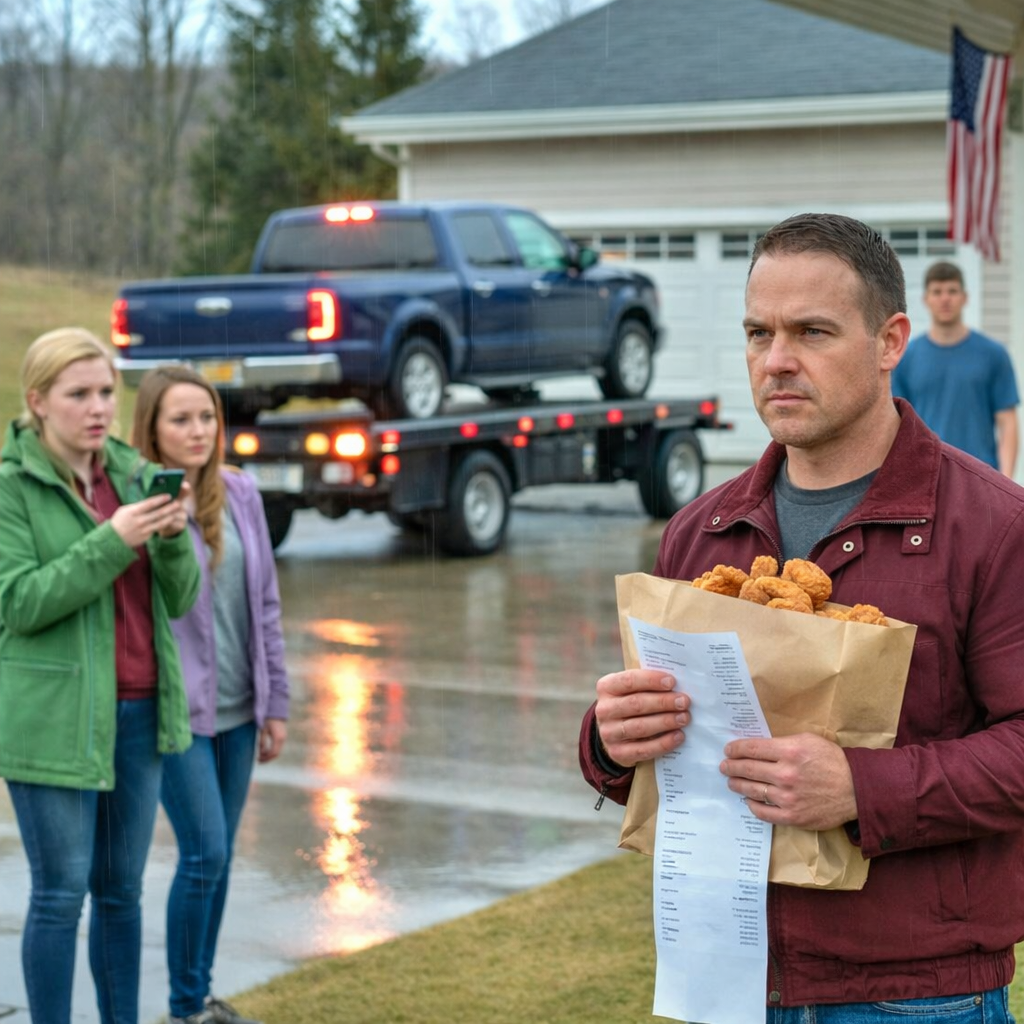
The bag of fried chicken from Ingles was still warm in my hand when I heard my stepson’s voice in the garage.
Not raised. Not angry. Casual.
“Yeah. I already cut the brake line.”
I stopped moving so abruptly my shoulder twinged. The paper bag crinkled softly, an obscene sound in the sudden stillness, and I tightened my grip until the grease soaked through and burned my palm.
For a second, my brain refused to process the words. They floated there, detached from meaning, like a sentence overheard in a dream. Cut the brake line. Those words belonged in crime shows, in news stories you shook your head at, not in my garage on Kuga Road with my truck parked ten feet away.
I leaned closer to the side door without touching it. Through the narrow crack where the frame didn’t quite seal, I saw the blue glow of a phone screen light up Trevor’s face. He stood near my workbench, shoulders loose, one foot hooked casually around the leg of an old stool. He looked comfortable. Relaxed. Like a man finishing a chore.
“Tomorrow,” he continued, voice steady. “He won’t make it to Monday.”
Then he laughed.
It wasn’t loud. It wasn’t manic. It was a small, amused exhale, the sound someone makes when a plan comes together. That sound slid straight down my spine and settled cold in my gut.
I waited for my body to react the way it should have. To shout. To run. To burst into the garage demanding an explanation. Instead, I stood there frozen, heart hammering so hard it felt like it might knock me forward through the door.
The garage smelled exactly the way it always had. Motor oil. Concrete dust. Cold December air seeping in through the cracks. Familiar smells that suddenly felt hostile, like witnesses that wouldn’t help me.
“You sure about this?” another voice crackled through the phone.
Deborah.
My wife.
Her voice was faint, distorted by the speaker, but unmistakable. She didn’t sound shocked. She didn’t sound horrified. She sounded… cautious. Like someone double-checking a reservation.
“Yeah,” Trevor said. “It’s done.”
I leaned my forehead against the siding and closed my eyes for half a second, willing myself not to make a sound.
“He won’t make it to Monday,” Trevor repeated, and there was satisfaction in his voice now.
I waited for Deborah to say my name. To say stop. To say what are you talking about? Anything that sounded like a conscience clawing its way to the surface.
Instead, she exhaled.
It wasn’t relief exactly. But it was close.
“Tomorrow,” she said. “Just be careful.”
Something inside my chest cracked.
My boot scuffed the concrete, barely a whisper of sound, but Trevor’s head snapped toward the door immediately. His body went rigid, every muscle alert.
I didn’t breathe.
For a long second, I thought he’d open the door and find me standing there with a bag of fried chicken and a face full of terror. I imagined trying to explain it away. Dropped my keys. Thought I heard something. Imagined the lie unraveling before I even had time to think.
But after a beat, Trevor relaxed. He turned back to the phone.
“Yeah. I’ll text you when it’s done.”
I backed away slowly, carefully, like I was stepping off a landmine. I eased the door shut until it rested without clicking, then moved fast around the side of the house, my heart pounding so loudly I was sure someone could hear it.
The neighborhood looked normal. Too normal.
Porch lights glowed softly up and down the street. Christmas wreaths already hung on doors, red bows bright against white siding. Mrs. Wallace’s dog barked once, then went quiet. Hendersonville doing what it always did, pretending danger only happened somewhere else.
My hands were shaking so badly I almost dropped my keys.
I walked down the sidewalk instead of straight to my car, forcing myself to slow my pace, to look like a man out for air instead of someone who’d just overheard his own murder being scheduled.
“Patience is my tool,” I whispered under my breath.
I’d said that line a thousand times over the years. Said it to apprentices when they rushed a job and stripped a screw. Said it when a system wouldn’t cooperate and frustration crept in. Slow down. Think. Don’t force it.
Now I needed it more than ever.
I got into my sedan and shut the door quietly. The engine stayed off. My breath fogged the windshield, each exhale shaky and uneven. My phone felt slick in my hand, my thumb hovering uselessly over the screen.
Call the police.
The thought came hard and fast, followed immediately by the next one.
What do I say?
Hello, officer, my stepson said he cut my brake line. No, I don’t have a recording. No, nothing has happened yet. No, I’m not injured. In a small town like this, that doesn’t end with sirens and handcuffs. It ends with sideways looks. With whispers. With people deciding you’re unstable.
Trevor would smile and say I’d been stressed lately. Forgetful. Paranoid.
Deborah would dab her eyes and say she was worried about me.
I couldn’t let that happen.
So instead, I opened my roadside assistance app and requested a tow.
The dispatcher sounded half asleep. “Pickup location?”
“My driveway,” I said, forcing my voice steady. “Silver Ford F-150. I need it towed tonight.”
“Is it drivable?”
“No,” I said. “Safety issue.”
“How soon do you need it?”
“As soon as possible.”
There was a pause. “Okay.”
“Please,” I added before hanging up, because even now, manners were muscle memory.
I sat there listening to the quiet tick of my cooling engine, my hands still trembling, my mind already shifting into something colder and sharper. Evidence. Timelines. Moves that keep you alive.
Trevor had asked me to co-sign a loan a few months back. Twenty-eight thousand five hundred dollars for “debt consolidation.” I’d looked at the paperwork and said no, explaining calmly what I’d learned about debt over a lifetime of fixing other people’s messes.
He’d smiled then. A slow, empty smile.
“You always think you’re better than me,” he’d said.
That was when the house changed. Subtle at first. Deborah stopped talking when I walked into rooms. Meals went quiet. Peace became my responsibility alone.
Now I understood what letting it go meant to them.
Headlights swept down the street. The tow truck rumbled to a stop in front of my house, chains clinking softly in the cold. The driver was a thick-set man in a beanie, breath puffing white as he climbed down.
“You the one who called?” he asked, knocking on my window.
“Yes.”
He glanced at the truck. “What’s wrong with it?”
I swallowed. “Brake problem. Taking it to a friend’s place to get checked.”
“At this hour?” he asked, eyebrow lifting.
“I’m up,” I said. “He’s up. It’s important.”
He shrugged, the universal gesture of a man who’s seen everything and wants to see nothing more, and got to work. The winch whined. The cable rattled like chains. My truck rolled onto the flatbed, obedient and helpless.
That truck had been mine long before Deborah and I ever shared a bank account. I’d driven it through snowstorms and bad years and good ones. Watching it disappear down the street felt like losing the last piece of the life I thought I had.
The driver handed me a clipboard. “Sign here.”
My pen shook, but I forced my hand steady. He studied my face.
“You alright, man?”
“I’m fine,” I said. “Just tired.”
As the truck pulled away, my phone buzzed.
Deborah: Where are you?
Trevor: Did you move the truck?
I didn’t answer.
Not yet.
Instead, I drove.
Thirty minutes through dark mountain roads to Asheville, my headlights cutting through curves I’d driven a hundred times before. Eugene Carter’s house sat quiet at the end of a gravel drive, porch light flicking on as I pulled in.
Eugene came out in flannel and sweatpants, gray hair flattened from sleep.
“Thomas?” he said.
I killed the engine. “Eugene, I need your help.”
He looked at my face, then nodded once. “Bring it here.”
Inside, the house smelled like black coffee and old leather. I told him what I’d heard. He didn’t interrupt. Didn’t argue. Just listened, jaw tightening.
“You accusing Trevor?” he asked carefully.
“I’m saying I’m not driving that truck,” I replied. “And I want it checked by someone I trust.”
Eugene stood. “I’ll look. But if this is what you think it is, I’m putting it on stands.”
When the tow truck arrived, Eugene slid under the truck with a flashlight. I stood in the doorway, heart pounding, watching his boots stick out from beneath the chassis.
“Thomas,” he called. “Come look.”
I crouched beside him. The brake line was cleanly severed. Straight cut. No corrosion. No fraying.
“That’s deliberate,” Eugene said quietly. “That’s someone trying to kill you.”
The words landed heavy and final.
I didn’t cry. I didn’t shout. I just sat down hard on a stool and stared at the floor.
“You okay?” Eugene asked.
“I don’t feel like I won,” I said.
He shook his head. “You didn’t. You survived.”
And that, I realized, was going to have to be enough.
I didn’t sleep that night.
I lay on Eugene’s couch staring at the ceiling fan as it chopped the dark into slow, rhythmic pieces. Every creak of the house sounded like a footstep. Every passing car outside made my pulse jump. When I closed my eyes, I saw the brake line again. Clean. Straight. Deliberate.
At around four in the morning, Eugene came out with two mugs of coffee. He set one on the side table without asking.
“You did the right thing,” he said quietly, lowering himself into the armchair across from me.
“I keep replaying it,” I admitted. “Every little thing I missed. Every moment I explained away.”
Eugene nodded. “That’s what people do when the ground falls out from under them. Doesn’t mean you’re stupid. Means you trusted your family.”
That word felt strange now. Family.
By sunrise, Eugene had the truck up on stands, the cut line tagged and photographed from three angles. He didn’t touch anything more than he had to. He called the sheriff’s office himself and reported suspected sabotage. When the deputies arrived, he spoke calmly, like a man who knew how to keep his emotions from muddying facts.
I watched from the doorway as they took notes, snapped pictures, asked Eugene questions about when he’d last seen Trevor.
“Two nights ago,” Eugene said. “He stopped by to borrow a socket set. Seemed fine.”
Seemed fine. That was the problem. Trevor always seemed fine.
When the deputies left, Eugene locked the garage and handed me a spare key.
“You’re staying here,” he said. Not a suggestion.
I didn’t argue.
By midmorning, my phone started buzzing in earnest. Calls from Deborah. Messages from Trevor. Missed calls stacking like bricks. I let them pile up untouched.
Then Deborah switched tactics.
Her first voicemail was soft, almost sweet.
“Thomas, honey, where did you go? You scared me last night. We need to talk.”
The second was sharper.
“You can’t just disappear. This is your home too.”
The third dropped the mask completely.
“If you’re trying to frame my son for something, you’re making a huge mistake.”
I forwarded every message to Elizabeth Garrett without responding. Elizabeth replied with one line.
Do not engage. Let them talk.
That afternoon, Detective Warren called to confirm what Eugene already knew. The cut was consistent with a tubing cutter. Not road debris. Not corrosion. Not an accident.
“Do you feel safe returning home?” he asked.
“No,” I said simply.
“Good. Then don’t.”
By evening, Hendersonville had decided who the villain was.
Deborah’s Facebook post went up just after dinner. Long. Emotional. Carefully worded. She didn’t accuse me directly of anything concrete. She didn’t need to. She let implication do the work.
Please pray for my family. Thomas left last night in a fit of anger. My son is being accused of something unthinkable. Lies can destroy a family faster than any accident.
Within minutes, the comments poured in.
Praying for you.
So sorry you’re dealing with this.
Some men can’t handle losing control.
Eugene showed me the post without comment. I stared at the screen until my hands went numb.
In a town this size, truth didn’t spread fastest. Stories did.
The next day, I went back to the house with a deputy to collect clothes and personal documents. Deborah agreed to stay elsewhere during the visit. Walking through the front door felt like stepping into a stranger’s life.
The air still smelled like her lavender candles. My boots were still by the door where I’d left them. The house looked exactly the same, which somehow made it worse.
I packed methodically. Clothes. Paperwork. Old photos I couldn’t bring myself to leave behind. That was when I noticed the nightstand drawer didn’t sit right.
It was subtle. Something you’d only notice if you’d opened it a thousand times.
I pulled it all the way out and reached into the cavity beneath.
My fingers brushed plastic.
A phone.
Cheap. Lightweight. Prepaid.
I pressed the power button. The screen lit up immediately. No password. Two apps. Messages and Calls.
The message thread with “G” went back months.
I sat on the edge of the bed and read until my chest felt hollow.
I can’t wait to start our life together.
It won’t be a divorce. Just be patient.
The house will be mine. Plus the retirement account.
It’ll be handled soon.
Handled.
The timestamp on the last message made my skin crawl. Two days before the night in the garage.
I called the deputy back into the room and handed him the phone. He didn’t ask questions. He bagged it.
That night, Detective Warren called again. His voice had changed. Less cautious. More certain.
“We’re expanding the investigation,” he said. “Stay where you are.”
The final piece fell into place the next day.
I was sorting through the garage with Elizabeth present, documenting tools and inventory, when I noticed a small red light blinking near the ceiling. One of the security cameras I’d installed after a neighbor’s shed was broken into months earlier.
I’d forgotten about it.
The app was still on my phone.
My hands shook as I opened it and scrolled back to the night in question.
11:47 p.m.
The video loaded.
Trevor entered the garage first, looking over his shoulder. Then Deborah followed, arms crossed.
“You sure about this, Mom?” Trevor asked.
Deborah stepped closer. Calm. Focused.
“Make it clean,” she said. “No fraying. It has to look like normal wear.”
I heard the snip of the cutter. Clear as day.
“When’s he driving it next?” she asked.
“Tomorrow,” Trevor replied.
“The sooner this is over, the better,” Deborah said.
Three minutes and forty-seven seconds.
Elizabeth watched the video once, then again.
“This is attempted murder,” she said flatly.
When the arrest came, it was fast.
Trevor first. Then Deborah.
I didn’t feel relief. I felt empty.
In the weeks that followed, I stayed in a cheap motel off I-26, then moved into a small apartment overlooking the French Broad River. Quiet. Locked. Mine.
I went to therapy because my blood pressure demanded it and because I needed somewhere safe to put the thoughts that kept looping in my head.
I learned that survival doesn’t feel heroic. It feels shaky. It feels like grief mixed with gratitude.
One year later, I stood on my balcony drinking coffee and watching the river move steadily past. My phone buzzed once.
Unknown number.
You destroyed everything.
I deleted the message without replying.
Some conversations end when you choose silence.
And for the first time since that night in the garage, I breathed without fear.
The trial wasn’t as dramatic as the night in the garage.
It didn’t have that electric, cinematic shock of hearing your own death described like a chore. It didn’t have the sudden clarity of a flashlight beam on a severed brake line. It didn’t even have the wild, church-lady energy of Hendersonville gossip.
The trial was slow.
Methodical.
It was the law doing what it does best when it’s done correctly, which is to take something chaotic and brutal and strip it down to facts that can’t be argued with. Dates. Photographs. Chain of custody. Audio. Intent.
Elizabeth warned me in the beginning that it would feel unreal.
“You’re going to walk into a courtroom and hear people talk about your life like it’s a file,” she said. “You’ll want to stand up and shout, but that’s not how this works. The truth will speak if you let it.”
I sat in the back row for most of it. Not because I was afraid, but because sitting close felt like standing too near an open flame. I had to watch without burning.
Deborah entered each morning in the same navy blazer, hair smooth, face composed. She wore her silver cross necklace like a statement. She wanted the jury to see a woman of faith, a grieving wife, a mother defending her son. She wanted that story to land before the evidence did.
Trevor came in shackled. Orange jail uniform. Eyes flat. He looked bored, almost, like the whole thing was an inconvenience. Every now and then his gaze would drift to me, and the hatred in it was clean and bright as a blade.
Eugene sat two rows ahead of me, shoulders hunched as if he was trying to make himself smaller than the weight of what his son had done. He didn’t speak much. He didn’t look at Trevor. He stared straight ahead and took it all like punishment.
On the first day, the forensic technician testified.
Richard Mason. Careful posture. Quiet voice. The kind of man who spent his life speaking with certainty only when certainty was earned.
He described the brake line. He described the angle of the cut. The lack of corrosion. The tool marks. He said words like perpendicular and clean sever and consistent with handheld cutter.
Then he said what mattered most.
“That is not an accident,” he told the jury. “That is deliberate sabotage.”
Deborah’s lawyer tried to float alternatives. Road debris. Maintenance error. “Maybe Mr. Bennett did this himself,” he suggested, eyebrows lifted as if he’d found something clever.
Mason didn’t flinch. “No.”
“No?”
“No. A person trying to fake this would not cut here. And would not leave these tool impressions. This is someone who knows enough to make it look like wear, but not enough to understand how we can tell.”
The jurors wrote notes. A woman in the second row crossed her arms and leaned back like she’d just stopped believing in fairytales.
The next day, the prosecutor introduced the AutoZone footage.
Trevor walking into the store with his hood up. Buying a tubing cutter. Paying with a card linked to an account Deborah had access to. Ten minutes later, Deborah entering the same store, buying supplies, paying cash.
The prosecutor didn’t dramatize it. He didn’t need to. The sequence did its own talking.
Then came the burner phone.
The cheap prepaid device found under the nightstand drawer, the messages back and forth with “G.” The prosecutor read them aloud, letting Deborah’s words exist in the room.
The house will be mine.
Plus the retirement.
It’ll be handled soon.
Just be patient.
Glenn Hartman took the stand after that.
He looked like a man who hadn’t slept in weeks. Wrinkled shirt. Hands shaking slightly when he took the oath. He didn’t look at Deborah until the prosecutor asked him to identify her.
“That’s her,” he said, voice cracking.
He explained how he’d met her. How she’d told him she was divorcing. How she’d said her husband was controlling, distant, cruel. How she’d made herself sound trapped and fragile. He had believed her.
He admitted, in front of strangers, that he’d planned a future with her.
And then he said the line that made the air shift.
“She told me it would be handled,” he said. “I thought she meant the paperwork. I didn’t… I didn’t think she meant murder.”
Deborah stared straight ahead. Her jaw tightened, a muscle jumping.
Then the prosecutor wheeled in the monitor.
The security camera footage.
Even the judge leaned forward slightly as the room darkened and the video began.
Trevor entered the garage. Looked around. Checked corners.
Deborah appeared a moment later, arms crossed, calm as a person supervising a home project.
“You sure about this, Mom?” Trevor asked.
Deborah stepped closer.
“Make it clean,” she said. “No fraying. It has to look like normal wear.”
The soft snip of the cutter sounded louder than it should have through courtroom speakers.
“When’s he driving it next?” Deborah asked.
“Tomorrow,” Trevor replied.
“The sooner this is over, the better,” Deborah said.
Three minutes and forty-seven seconds of truth.
When the lights came back up, the courtroom stayed silent for a long moment. Not because people were unsure. Because people were absorbing what they could not unhear.
Deborah’s tissue fell from her hand and fluttered to the floor. She didn’t pick it up.
The judge asked if the defense had questions.
Deborah’s lawyer stood, swallowed hard, and said, “No, Your Honor.”
It was the closest thing to surrender I’d ever seen in a courtroom.
Then Trevor’s lawyer tried to salvage something through Trevor’s own testimony. That was the mistake.
Trevor walked to the stand with a swagger that didn’t match the chains at his ankles. He looked at the jury like they were beneath him.
His lawyer asked gentle questions. Leading ones. The kind that let a witness appear reasonable. Trevor took the bait. He painted me as an abusive stepfather. Controlling. Critical. Always making him feel small.
Then the prosecutor stood for cross-examination.
He didn’t raise his voice. He didn’t need to.
“Mr. Bennett,” he asked, “did Thomas Bennett ever strike you?”
Trevor hesitated. “Not… hit me, no.”
“Did he threaten you physically?”
Trevor’s jaw tightened. “No.”
“So your motive wasn’t self defense,” the prosecutor said calmly. “It was profit.”
Trevor’s eyes narrowed. “That’s not true.”
The prosecutor held up the burner phone transcript. “Mrs. Bennett wrote, ‘The house will be mine, plus the retirement.’ Did you know about that?”
Trevor glanced at Deborah for a fraction of a second.
“I don’t know,” he said.
The prosecutor nodded slowly. “Okay. Let’s try a different question. On the night of October sixth, did you cut the brake line on Thomas Bennett’s vehicle?”
Trevor swallowed. “I didn’t cut anything.”
The prosecutor turned to the judge. “Your Honor, permission to play the audio again.”
Permission granted.
The room filled again with Trevor’s voice.
Yeah, I already cut the brake line.
Trevor went pale.
Then the prosecutor played the second video. The one where Trevor asked, “You sure about this, Mom?”
Trevor’s mouth opened. Closed. Opened again.
His lawyer’s hand clamped onto his shoulder like a warning.
Trevor ignored it.
“You told me to,” he blurted, and the words came out like bile. He twisted in his seat, looking toward Deborah. “You said to make it look like an accident. You said it had to be clean. You said—”
His lawyer stood abruptly. “Your Honor—”
But it was too late.
The jury had heard it. The court had heard it. The stenographer typed every syllable.
Deborah’s face cracked. Not into guilt. Into fury.
For a moment, she looked at Trevor like he was the problem.
Like he had ruined her plan by speaking too loudly.
The verdict didn’t take long after that.
Guilty.
Guilty.
Guilty.
Conspiracy. Attempted murder. Tampering with a vehicle. Evidence of premeditation.
Trevor took a plea deal later, eighteen to twenty-five years, no parole eligibility for fifteen. He accepted it with the same bored expression he’d carried into court, as if prison was just another inconvenience.
Deborah went to trial fully. Maybe she thought her performance could still carry her. Maybe she believed the cross necklace would do more than evidence. The jury deliberated less than four hours.
Fifteen to twenty years.
When the judge read the sentence, Deborah finally cried in a way that sounded real. Not because she regretted what she’d done, but because she couldn’t escape consequences anymore.
I didn’t feel victorious when the gavel fell.
I felt tired.
I felt older than my age.
I walked out of the courthouse into pale winter sunlight and stood on the steps breathing air that tasted clean and sharp. Eugene stood beside me, hands shoved deep into his pockets.
“I’m sorry,” he said quietly, and his voice held the kind of grief you can’t fix.
“I know,” I replied. “I’m sorry too.”
He shook his head. “You don’t have to be.”
We didn’t talk much after that. But he called once a month, a brief check-in, a man trying to keep one thread of decency alive after everything else had burned.
The divorce settlement gave me enough to start over. Eighty-five thousand from the house equity. I didn’t buy anything extravagant. I bought safety.
A small second-floor apartment in Asheville overlooking the French Broad River. Two bedrooms even though it was just me. Locks that only I had keys to. A balcony where I could stand with coffee and watch the water move steadily, indifferent to human cruelty.
The first morning there, I made coffee and stood outside in the cold air until my lungs hurt. The river flowed like it always had, and for the first time in months, my body unclenched slightly.
Not joy.
Relief.
I joined a support group for survivors of domestic violence because Dr. Patterson told me isolation would kill me slower than a brake line but just as surely.
The first time I walked into the meeting room, I felt out of place. Too male. Too ashamed. Like I didn’t belong among people who had suffered in ways society usually acknowledged. Then a seventy-three-year-old woman looked at me across the circle and said, “You trusted your gut. That’s what saved you.”
Something in my chest loosened.
Healing didn’t happen quickly. It happened in small increments.
Breathing without checking the door lock three times.
Driving without imagining the moment brakes might fail.
Sleeping through the night without jolting awake to phantom footsteps.
Six months after the trial, I met Margaret at the support group.
She was a school librarian with gentle eyes and a laugh that sounded like something she didn’t give away easily. We started with coffee. Then dinner. Then slow walks along the river when the dogwoods bloomed and the air smelled like wet earth and early flowers.
“You don’t have to rush,” she told me once when I apologized for being cautious.
“One day at a time,” she said.
My daughter Sarah visited twice. The second time she brought my grandkids. They ran around the apartment shouting about dinosaurs, sticky hands on my windowsill, their laughter filling spaces that had felt hollow for too long.
Normal sounded like a miracle.
Exactly one year after the night in the garage, I stood on my balcony with warm coffee, watching morning light catch on the river.
A year ago, I’d been holding fried chicken, listening to my stepson plan my death.
Today, I was planning dinner with Margaret. Looking forward to Sarah’s visit next weekend. Thinking about what kind of garden I could keep alive on a balcony.
My phone buzzed.
Unknown number.
You destroyed everything.
I stared at the message for a long moment, then deleted it without replying.
Some battles aren’t battles. They’re traps.
Silence, I’d learned, could be a boundary. Silence could be strength.
I finished my coffee and went inside.
The river kept flowing.
So did I.