At 18, I Promised to Keep My Seven Younger Siblings Together. Then One Old Family Photo Revealed the Truth
I was eighteen years old the morning my entire life took a turn I never could have imagined.
That morning began like any other. The kind of busy, ordinary household scene that older readers will instantly recognize from their own family memories.
Lila was laughing in the kitchen because Tommy had dumped cereal into a saucepan and proudly named it “breakfast soup.” Phoebe was loudly insisting it was the worst idea anyone had ever had.
Sybil was hopping around on one foot, hunting for a missing shoe. Ethan and Adam were arguing over a hoodie that neither of them actually owned.
Little Benji wandered through the hallway in his pajamas, dragging his blanket behind him like a sleepy ghost.
For about ten beautiful seconds, we were just a loud, chaotic, ordinary family of nine. The kind of household where mornings always sounded like a small storm.
Then I opened the front door.
The Knock That Changed Everything
Two officers stood on the porch. One of them looked at me with kind eyes and asked if I was Rowan.
I didn’t need to hear the rest. Something in his expression told me everything before he said another word.
He explained, gently, that there had been an accident on the highway. My parents had not made it home.
Behind me, the laughter in the kitchen was already starting to fade. Seven pairs of eyes were turning toward the doorway, sensing that something was very wrong.
I closed the door halfway so my younger siblings would not see the officers’ faces. My hands were shaking, but I tried to keep my voice steady.
“Everyone, come sit down,” I said softly.
Phoebe’s voice trembled. “Where are Mom and Dad?”
I opened my mouth. Nothing came out.
That moment is the kind that older parents and grandparents understand on a deep level. The moment when life expects you to find words you do not yet have.
The Conversation No Sibling Wants to Have
A few days later, the first wave of grief was already crashing into the second one. The hard, practical wave that no one ever prepares you for.
Ms. Hart from child services sat at our kitchen table with a thick folder in front of her. The folder felt heavier than the table itself.
“The children will need temporary placement,” she said in a careful, gentle tone.
“Together?” I asked.
She did not answer right away. She did not have to. Her silence said it for her.
From the hallway, I heard Lila let out a small, broken sound. The sound of a child realizing the world was about to change in ways she could not control.
I clenched my hands until my fingers ached. “They just lost their parents,” I said. “You cannot separate them now. Not now.”
Her voice softened. “You are only eighteen, Rowan. You do not have a steady income. The mortgage is behind. There are responsibilities that go far beyond love.”
“Then help me learn what to do,” I said. “Teach me. Walk me through it. But please do not split them up.”
She looked at me with the tired eyes of someone who had seen this scene play out too many times before. “Sometimes love is not enough on its own.”
“Then I will become whatever else they need,” I said.
A Courtroom and a Family Hanging in the Balance
The hearing was even harder than I imagined. The kind of day where everything feels too bright and too loud and too important all at once.
Aunt Denise arrived dressed like she had already decided how the day would end. Uncle Warren walked beside her holding a folder, the way someone carries paperwork they believe will win them something.
“I care deeply about my brother’s children,” she told the judge, dabbing at her eyes. “But Rowan is still a child himself. I would be willing to take the youngest two.”
Phoebe reached over and gripped Lila’s arm.
I could not hold back. I was not trying to be defiant. I was just a young man trying to keep a promise no one had officially asked me to make.
“The youngest two?” I asked. “Do you even know their names? Do you know which one needs an inhaler at night? Do you know which one hides food when he gets scared?”
Aunt Denise gave me a tight smile. “Don’t be selfish, dear. You cannot rescue everyone.”
I turned to face the judge directly.
“I am not trying to rescue everyone,” I said. “I am trying to keep my family from being scattered across different houses, different cities, different lives.”
The judge leaned forward and asked, with genuine care, if I truly understood what I was asking for.
“Not completely, your honor,” I admitted. “But I know my brothers and sisters. I know how they sleep. I know what they fear. I know what makes them laugh. That has to count for something.”
The Quiet Tears That Spoke Louder Than Any Argument
Behind me, Lila broke down first. Through her tears she said the words that, looking back, may have changed the entire outcome.
“I don’t want Aunt Denise. I want Rowan.”
Then Phoebe nodded silently. Tommy began sobbing. Even Adam, the tough one, covered his face with both hands.
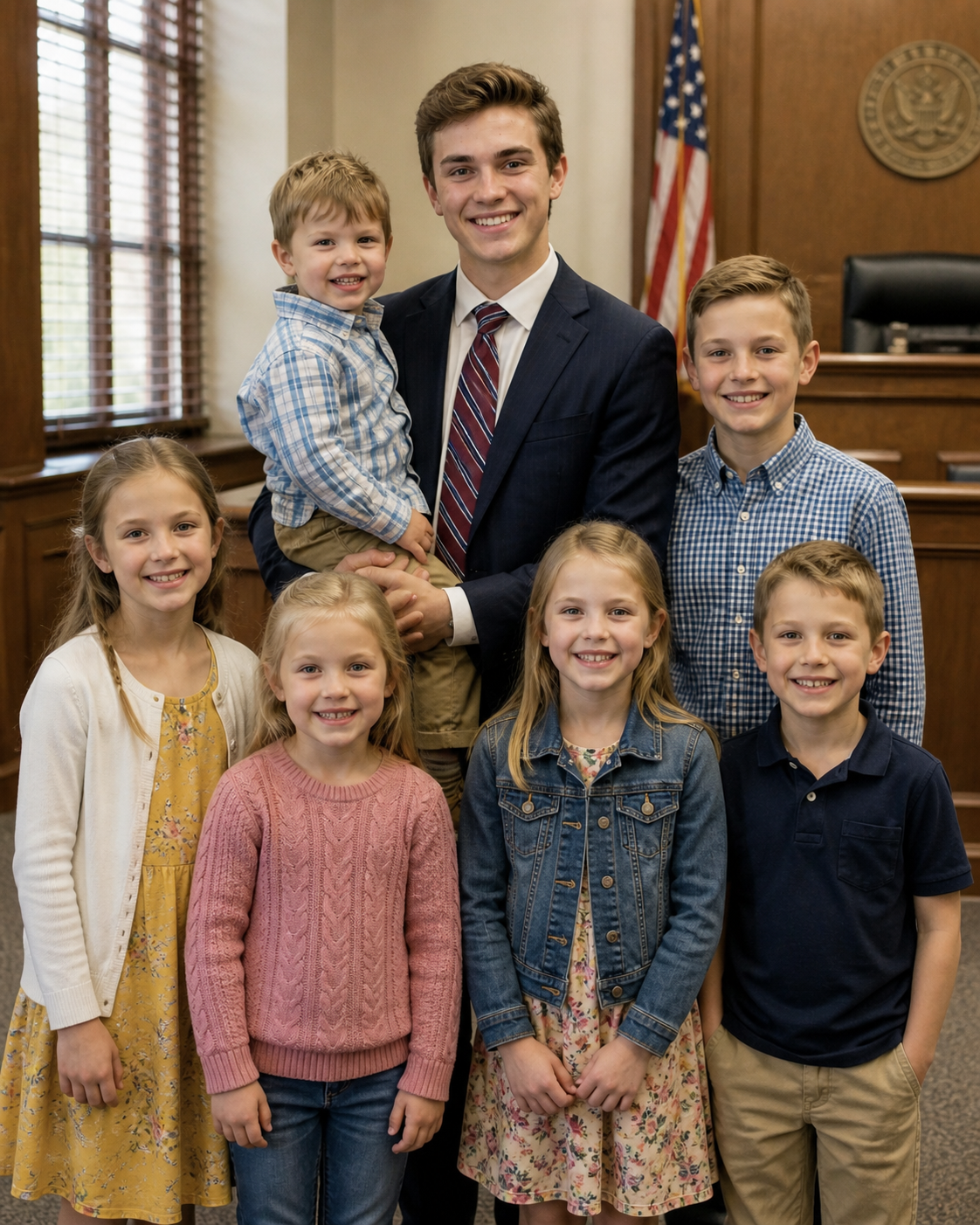
Two weeks later, the court granted me temporary guardianship of my seven younger siblings.
I celebrated the news by getting sick in the courthouse bathroom from sheer relief and exhaustion. Then I went home and started learning how to be the closest thing to a parent that an eighteen-year-old could possibly be.
Three Years of Quiet, Determined Love
The years that followed were not glamorous. They were not the kind of years anyone writes inspirational books about while they are happening.
I left college and took every shift I could find. Warehouse work. Grocery store nights. Delivery routes between dinner and bedtime.
I learned to function on very little sleep. I also learned that household budgeting becomes a different kind of math when there are eight mouths at the table.
Our neighbor, Mrs. Dalrymple, became our lifeline. She was a longtime widow with a heart that always seemed to have a little more room in it.
She watched the children. She brought casseroles. She refused every dollar I tried to give her in return.
“Pay me back by not burning down your kitchen,” she said once, sliding a warm dish onto the counter.
“I only burned the rice,” I muttered.
“Honey, rice is not supposed to smoke,” she said.
Lila laughed for the first time in days. That laugh was worth more than any paycheck I ever earned.
We were not thriving. We were not living the picture-perfect life that some families seem to have. But we were still together, under one roof, and that mattered more than anything.
The Quiet Strength of a Neighbor Who Cared
For older readers who have ever been the helpful neighbor, or who have ever been blessed by one, this part of the story may feel especially familiar.
Mrs. Dalrymple did not just bring food. She brought stability. She brought the kind of steady, dependable presence that anchors a young family through hard times.
She would sit with Benji while he did his homework. She would braid Sybil’s hair when school pictures came around. She would make sure the babies of our family had clean blankets when the laundry got behind.
She never asked for anything in return. She never made any of us feel like a burden.
Her quiet kindness reminded me of something my grandmother used to say. That the people who change your life the most are often the ones standing right next door.
A Late-Night Conversation That Stayed With Me
One evening, Sybil found me at the kitchen table, staring at an electric bill that I knew I could not fully pay that month.
“You are doing that face again,” she said.
“What face?”
“The one where you look like you are thinking about selling a kidney.”
I laughed weakly. “Go to bed, kiddo.”
She sat down across from me anyway. Her voice softened. “You don’t have to do everything by yourself, you know.”
That hurt more than anything. Because I wanted my brothers and sisters to be children, not young adults worrying about a tired older brother.
I wanted Sybil to be thinking about her friends and her drawings, not about household bills she should never have had to know about.
But I also realized something important that night. My family was not just leaning on me. They were learning to lean with me. There is a difference, and the difference is what holds families together for the long haul.
The Aunt Who Kept Showing Up at Our Door
Aunt Denise had not given up. She would stop by from time to time, mostly to comment on what was wrong with the house and how I was handling things.
“This place is falling apart,” she said one afternoon, glancing around the living room.
“We’re managing,” I said.
“Don’t you have access to the family funds yet?”
“Not yet.”
“What is taking so long?”
“I don’t know.”
She lowered her voice into something that sounded almost gentle. “Rowan, asking for help is not failure.”
“Wonderful,” I said. “Help.”
She blinked, caught off guard.
“Tommy needs new shoes. Benji needs glasses. Sybil needs money for her school field trip. Pick one and I will be grateful for the rest of my life.”
Her smile froze on her face.
“I meant adult help,” she said.
“You mean taking them,” I replied.
She did not deny it. She just gathered her purse and left.
I thought that conversation was the hardest part of those long years. I was wrong. The truth had not yet revealed itself.
The Photograph That Changed Everything
One late evening, little Benji wandered into my bedroom in his pajamas. He was holding an old photograph in his small hands.
“I was looking for the Christmas lights in the closet,” he said quietly. “I missed Mom.”
The photograph showed our parents standing outside a courthouse on a sunny day. Behind them, in the corner of the picture, stood Aunt Denise and Uncle Warren.
Aunt Denise was smiling, but it was a strange smile. The kind of smile that does not reach the eyes. The kind that older readers learn to recognize after a lifetime of watching people.
Curious, I turned the photo over. What I saw made my heart stop.
In my mother’s handwriting, written in soft pencil, were these words:
“If anything ever happens to us, do not let Denise take the children. Rowan will know what to do.”
I stared at the words for a long time. The hallway clock ticked steadily. Benji had wandered back to bed without realizing what he had given me.
A Neighbor Who Knew More Than I Realized
The next morning, I took the photo across the lawn to Mrs. Dalrymple. She stared at it for a long, quiet moment.
“I remember that day,” she said softly.
“What day?”
“The day your mother came over scared. She told me that if anything ever happened to her or your father, she wanted me to trust you. Not Denise.”
My chest tightened. “She actually said my name?”
“She said you were the only one who loved her children without wanting anything in return.”
Then Mrs. Dalrymple did something I never expected. She walked over to a small home safe in her hallway and pulled out a folder.
Inside were documents, copies of letters, and emails my parents had quietly saved. Together they painted a clear picture of family planning, family protection, and a careful effort to keep us safe long after my parents were gone.
It turned out my parents had not left us with nothing. They had been preparing for the worst in every quiet way they could.
And someone in our extended family had been hoping that preparation would never be found.
For the first time in three long years, I stopped just surviving and started fighting back.
The Hearing That Set Us Free
At the next family court hearing, Aunt Denise stood up confidently as if the matter was already settled in her favor.
“Rowan loves them,” she said to the judge. “But love does not fix a broken home.”
I stood up calmly and placed the photograph on the table.
“My mother knew that,” I said. “That is why she left this behind.”
The courtroom went very still.
I handed over the documents Mrs. Dalrymple had kept safe. I explained, as steadily as I could, what my parents had quietly arranged. Mrs. Dalrymple spoke too, confirming what she had witnessed.
Aunt Denise’s composure began to crack right there in front of everyone.
“You tried to separate my brothers and sisters,” I said.
“I was trying to protect them!”
“No,” I replied gently. “You were trying to take something that was not yours to take.”
The judge made a careful, thoughtful ruling. Aunt Denise’s request was denied. She would not be permitted to pursue guardianship again without specific court approval.
For the first time in three years, the woman who had treated our family like a transaction had nothing left to say.
The Neighbor Who Asked for One Thing in Return
After the hearing, Mrs. Dalrymple pulled me aside. She had a quiet, steady look on her face.
“There is something I would like, if you are willing,” she said.
“Anything,” I told her.
“I want to be listed as your emergency caregiver. So that someday, when the time is right, you can go back to school. You deserve a future too, Rowan.”
I looked at her, my eyes filling.
“You really want that?” I asked.
She smiled. “I’ve been taking care of you all for three years already. We may as well make it official.”
That evening, I sat down at the kitchen table and filled out the emergency contact form. Where it asked for relationship, I wrote one simple word.
Family.
She read it and laughed softly. “Honey, I’m just your neighbor.”
I shook my head.
“No,” I said. “Family lives next door.”
What Three Long Years Taught Me
For thirty-six months, I had quietly believed I was barely enough. Just barely keeping the dishes washed, the bills paid, and the children safe.
But my mother had known something I had not yet learned about myself. She knew I would fight for my brothers and sisters when the moment came. She knew I would not let our family be scattered.
She had trusted me long before I trusted myself.
For older readers who have raised children, helped raise grandchildren, or quietly stepped in for nieces and nephews, this part of the story may feel deeply familiar.
Family is not always something we choose. Sometimes it is something we step up for. Sometimes it is the brother who becomes a guardian. Sometimes it is the neighbor who becomes a grandmother. Sometimes it is the elder who teaches a younger generation what loyalty actually looks like.
These quiet acts of family devotion are the kind of legacy that lasts longer than any inheritance.
The Quiet Lesson That Stays With Me
Looking back now, I think about how much of our story was shaped by simple, unglamorous love. The kind of love that shows up at the kitchen table again and again.
A mother who left a note on the back of a photograph, hoping it would never be needed. A father who quietly prepared documents in a folder, just in case. A neighbor who opened her home and her heart without ever expecting credit.
A young man who said yes when life asked everything of him at once.
Strong families are not built only on perfect days. They are built on the choices we make when life becomes uncertain.
If you are an older reader who has watched your own family grow through hard seasons, you already know this. You have lived it. You have seen how a small act of devotion today can echo across generations.
In the end, my mother was right. I would know what to do. I would not let them be taken from each other.
And the quiet wisdom she left behind, written in soft pencil on the back of a photograph, would guide our family through the rest of our days.