After My Husband Left on a Business Trip, My Child Said We Shouldn’t Go Home. I Listened
The airport smelled like burnt coffee, overheated pretzels, and that faint chemical tang recycled air always carries. It was the kind of smell that clung to your clothes long after you left, a reminder of departures that were supposed to be temporary. I stood just past the security ropes with my son’s hand wrapped in mine, watching my husband move farther away with every step, and I told myself this was ordinary. Routine. Thursday.
Another business trip. Another three days of reheated leftovers, unfinished homework spread across the kitchen table, bedtime stories read in a voice that softened even as my own eyelids drooped. Another stretch of pretending I didn’t notice how quiet the house felt when he was gone.
Airport goodbyes were meant to be efficient. Predictable. A kiss that tasted faintly of mint gum. A reminder to take the trash out on collection day. A casual, “Text me when you land,” delivered with just enough concern to count as care. Then you turned around, herded your child back to the car, and merged into traffic that never moved the way you hoped it would, sliding back into a life that kept going whether one person was present or not.
That was the script, anyway.
Hartsfield-Jackson buzzed around us under fluorescent lights that drained color from faces and made everyone look a little sick, a little worn down. Wheels rattled over tile. Boarding announcements echoed overhead, clipped and impersonal. My husband stood in front of me looking like he belonged there, like airports were an extension of him. Crisp charcoal suit. Shoes polished to a mirror shine. A black carry-on positioned neatly at his side, as if it had been trained to stand at attention.
He always looked like this before a trip. Controlled. Composed. Already halfway into the version of himself that existed somewhere else.
“Chicago,” he said, leaning down to kiss my forehead. The kiss landed with careful precision, familiar enough to feel rehearsed. “Three days tops. Conference starts tomorrow morning. I’ll try to call after the keynote.”
“Drive safe,” I said automatically, then corrected myself with a tired half laugh. “Fly safe. Sorry. Long day.”
He smiled. It was the same smile I’d seen a thousand times, the one that should have felt warm but somehow stopped short of it. “You okay? You seem distracted.”
“I’m fine,” I said, because I had no language for the unease coiling in my stomach. “Just tired. You know how Thursdays are.”
He nodded, satisfied. Adjusted the watch on his wrist, the expensive one his father had given him for our anniversary. He wore it like armor. Then he stepped into the TSA line, phone already in his hand, attention already elsewhere, and was swallowed by a crowd of travelers removing shoes and belts and dignity with practiced resignation.
And that should have been the end of it.
That should have been the moment I turned around, squeezed my son’s hand, and headed for the parking garage to begin the familiar drive home through Atlanta traffic, the radio murmuring quietly while my mind drifted to grocery lists and homework folders.
Instead, my six-year-old stopped walking.
Not the casual pause of a child distracted by a screen of flashing souvenirs or a candy display near the gates. This was abrupt. His hand tightened around mine with a strength that startled me, fingers digging into my palm like he was trying to anchor himself.
I looked down.
Lucas stood rigid beside me, Spider-Man backpack slipping off one shoulder, shoelaces still untied despite my reminder that morning. His dark eyes were fixed not on the terminal, not on the crowd, but on me. And when he leaned closer, I could smell the strawberry toothpaste from our rushed morning routine.
“Mom,” he whispered, voice barely audible over the noise. “We can’t go back home.”
The words settled between us, heavy and out of place, while the airport continued on as if nothing had happened. A final boarding call crackled overhead. Someone laughed nearby. A child cried. Life moved forward in every direction except ours.
I forced a smile, the automatic one, the safe one. “What are you talking about, sweetheart? Of course we’re going home. Where else would we go?”
Lucas did not smile back.
His grip tightened, small fingers pressing into my skin with an intensity that made my chest ache. This was not imagination. This was not play.
“This morning,” he said slowly, carefully. “I heard Dad on the phone. He was in his office. The door was almost closed, but I heard him. He said something about us.”
About us.
“And it didn’t sound right,” he finished.
Every instinct I had as a mother rose up at once, ready to smooth, dismiss, protect. To laugh softly and tell him he’d misunderstood. To explain that grown-ups talked about complicated things that sounded scary when you only caught pieces. That kids misheard. That shadows in hallways became monsters if you stared at them too long.
But the words wouldn’t come.
His hands were trembling. His eyes flicked toward the security line where his father had vanished, like he was afraid of being overheard even now. And when he spoke again, his voice cracked just enough to slice through me.
“Please believe me this time, Mom. Please.”
This time.
The phrase lodged in my chest and refused to move.
Because it wasn’t the first time. Not really. It was just the first time I hadn’t immediately explained it away.
Three weeks earlier, Lucas had pointed at a dark sedan idling near the cluster of HOA mailboxes at the entrance of our subdivision. We were coming back from karate, the late afternoon sun slanting through the windshield, and he’d said, casually, “That car’s been there before. A lot.”
I’d glanced at it and shrugged. Told him it was probably someone’s friend. Or a delivery driver. Or a neighbor waiting for a kid. I’d said it confidently, because confidence made children feel safe.
Lucas hadn’t argued. He’d just gone quiet, staring out the window, and by dinner I’d forgotten about it entirely.
Two weeks ago, he’d mentioned hearing his father’s voice through the office door before sunrise. Low. Sharp. Not bedtime-story Dad. I’d poured more orange juice, reminded him to finish his eggs, and tucked the concern into a mental drawer labeled do not open unless necessary.
Last week, he’d asked why Dad had come home at two in the morning so many times. I’d explained deadlines. Important clients. Sacrifice. I’d made it sound noble.
Now, in the middle of the airport, I saw what I’d refused to see before.
Lucas wasn’t confused. He wasn’t dramatic. He was afraid. Deeply, specifically afraid.
And for the first time, I listened.
“We’re not going home,” I said quietly, the decision forming even as the words left my mouth.
His shoulders sagged with relief.
We walked to the parking garage instead of the exit. I buckled him into his booster seat, my hands steady despite the way my heart pounded. I started the car and took the ramp that led away from our neighborhood instead of toward it.
“Where are we going?” Lucas asked.
“I don’t know yet,” I admitted. “But we’ll figure it out together.”
I drove aimlessly at first, through streets I barely recognized, turning when my instincts told me to turn, checking my mirrors more than necessary. My thoughts snagged on ordinary things. Leftovers in the fridge. PTA emails. Laundry half-folded on the couch. Proof that this was ridiculous. That everything was normal.
Except my hands were shaking, and my son was silent.
Eventually, I circled back toward our neighborhood but stopped one street away, parking beneath the shadow of two oak trees where the streetlights didn’t quite reach. I cut the engine. Turned off the headlights.
Our house sat ahead of us, glowing warmly. Porch light on. Lawn neat. Lucas’s nightlight still visible through his bedroom window.
It looked perfect.
My phone buzzed.
Just landed. Hope you two are home safe. Love you both.
I stared at the message, unease crawling up my spine.
Then headlights appeared at the end of the street.
A dark van. Moving slowly. Too slowly.
It rolled to a stop in front of our house.
Lucas inhaled sharply. “That’s it,” he whispered. “That’s the car.”
Two men stepped out.
One walked to our front door and pulled out a key.
A key.
The lock turned.
The door opened.
And a stranger walked into my house like he belonged there.
I didn’t breathe until I was already starting the car again, easing away from the curb, my son clutching his backpack in the back seat.
Whatever my life had been until this moment, it was over.
And for the first time, I was grateful I had listened.
I drove like I was trying to outrun a thought.
The street behind us slipped away, then the turn, then the next, and I kept my headlights low as if light itself could betray us. My palms were slick on the steering wheel. I wiped one hand on my jeans, then put it back, gripping harder, as though the pressure could steady my mind.
In the rearview mirror, Lucas’s face hovered in the dim. His eyes were wide, fixed on the back window like he expected the van to peel off the curb and follow. He had both arms wrapped around his Spider-Man backpack, chin tucked into the top the way he did when he was trying to make himself small.
“Mom,” he whispered. “Are they coming?”
“I don’t know,” I said, hating how small my voice sounded. “But we’re not going back. Not tonight.”
My brain kept trying to assemble something normal out of the impossible. A locksmith. A neighbor with the wrong house. A realtor showing the property. A friend of my husband, stopping by to pick something up. Any explanation that let me put the world back into its old shape.
But the key.
The way it slid into the lock without hesitation.
The way the man didn’t pause, didn’t check, didn’t look around like someone uncertain. The calm efficiency of it, like he’d done it before. Like he had permission.
Like the house was not a boundary.
I made a right turn I didn’t need, then a left, then another left, circling a block like a dog trying to find a safe place to lie down. My heart kept beating in a hard, uneven rhythm against my ribs. The city lights blurred. Street signs flashed past. Somewhere, life was continuing. People were stopping for groceries. Pulling into driveways. Heating dinner. And inside our house a stranger had crossed the threshold.
Lucas sniffled once, quietly, then pressed his forehead to the window.
“I told you,” he said, not smug, not accusing. Just exhausted. Like he’d been carrying this alone for too long.
“I know,” I said. “You did. I’m sorry.”
A car passed us from behind, headlights sweeping across the inside of my vehicle, and I flinched so hard my shoulder cramped.
Lucas noticed. “It’s not them,” he said quickly, and his voice tried to be brave for me. That cracked something open in my chest.
My child should not have been comforting me.
I took a deep breath through my nose, slow and deliberate, the way a yoga instructor once told me to do in a class I never returned to. It didn’t calm me, but it gave me something to do besides spiral.
“We need a place to stay,” I said, more to myself than to him. “Somewhere we can lock the door.”
He nodded. “Like a hotel.”
“Yes,” I said. “Like a hotel.”
I avoided going anywhere near our usual exits. I stayed on roads that felt anonymous, roads lined with office parks and chain restaurants and gas stations bright as aquariums. I did not let myself look at my phone again. The screen might have been buzzing. It might not. Either way, I couldn’t afford the distraction.
The first hotel I passed looked too empty, too exposed. The second was near a bar that was spilling people into the parking lot. I wanted something bland. Something forgettable. The kind of place where no one asked questions because no one cared enough to be curious.
A mid-range chain near the Perimeter appeared, all neutral paint and polite landscaping. A sign that glowed steadily without personality. Cars parked in uneven rows. People moving in and out with suitcases, faces turned toward their own lives.
I pulled into a spot near the side entrance and shut off the engine. For a moment neither of us moved. The interior of the car held the heat of the day, the faint smell of Lucas’s snack crackers, the lingering scent of his shampoo from bath night. Ordinary things that felt like anchors.
Lucas looked at me. “Are we hiding from Dad?”
The question was so direct it made my throat ache.
“I don’t know,” I said honestly. “Not from him. Not exactly. I don’t know what he knows. I don’t know what any of this is.”
He swallowed. “But those men were in our house.”
“Yes.” The word came out sharp, as if speaking it could keep it real. “And they shouldn’t have been.”
He nodded slowly, eyes glossy. “So we’re hiding from them.”
“For now,” I said. “Yes.”
I made myself get out of the car. The air outside was cool and smelled like damp pavement. The hotel’s lobby windows reflected my face back at me, pale and tight around the mouth. I took Lucas’s hand again, feeling how warm his palm was, and we walked inside.
The lobby was brightly lit and smelled faintly of lemon cleaner. A TV mounted behind the seating area played some sports channel at low volume. A few people sat on couches scrolling their phones, waiting for rides or checking emails. None of them looked up.
The clerk was young, tired, and radiating the practiced neutrality of someone who had decided long ago that guests were not his problem beyond the basic exchange of key cards.
“Checking in?” he asked.
“Yes,” I said, and my voice nearly wobbled. I forced it steadier. “Two beds.”
He asked for my ID. I handed it over with a hand that trembled slightly, then tucked that hand behind my back like I could hide the shaking.
“And a card for incidentals.”
I hesitated.
It felt ridiculous to worry about a credit card trail when I had no proof anyone was tracking us. When the simplest explanation was still, in some corner of my brain, insisting this was all a misunderstanding that would be resolved by a phone call.
But the key didn’t let go of my thoughts.
I asked, “Do you accept cash?”
He blinked, surprised. “For the room, yes. We still need a card on file for incidentals unless you want to put down a deposit.”
“How much of a deposit?”
“Two hundred.”
My stomach tightened. Two hundred felt like a small price for control. I nodded. “That’s fine.”
I took Lucas back outside, told him to stay close, and walked two blocks to an ATM under the harsh light of a gas station canopy. I pulled out cash with fingers that did not want to cooperate, as though my hands had decided this wasn’t happening, this couldn’t be happening, and refused to take part.
Back at the desk, the clerk slid me the key cards without looking up. “Second floor. Elevator to your left.”
The hallway upstairs smelled like carpet and air freshener. The room itself was generic and clean. Two double beds with patterned comforters. A little desk. A lamp that threw a thin circle of yellow light. Curtains that didn’t quite meet in the middle.
It should have felt safe. It did not.
It felt like a waiting room.
Lucas climbed onto the bed nearest the window and pulled his knees to his chest. His socks were mismatched. One Spider-Man, one plain gray. I remembered dressing him this morning, half awake, rushing to get to the airport. A normal morning. A normal rush. A normal kiss goodbye.
Now everything normal felt like an illusion I’d been trained to accept.
I set my purse down and finally looked at my phone.
Three missed calls. Five. Then more as the screen refreshed. Texts stacked in a tight column, each one more urgent.
Just landed. Hope you two are home safe. Love you both.
Everything okay? You didn’t respond.
Babe?
Is Lucas okay? Did something happen?
Each message was written in his familiar tone. Concerned. Polite. Almost tender.
And that made it worse.
Because if the life I thought I had was real, these messages would have been reassuring. A husband checking in. A father asking about his child.
But I had just watched a man unlock our door with a key.
I stared at the screen until my eyes watered.
Lucas’s voice floated across the room. “You don’t believe him.”
It wasn’t a question. It was the same quiet certainty he’d used in the car.
I swallowed. “I don’t know what to believe.”
Lucas’s gaze stayed on me, serious. “But you believe me.”
“I do,” I said, and I meant it so deeply it felt like a vow. “I believe you. I believe what we saw.”
He seemed to relax, just a fraction. Then he asked the question that felt like a knife.
“What do we do now?”
I sat on the edge of the other bed. The mattress dipped beneath me like it was sighing. My mind ran in circles, looking for a person to call, an adultier adult, someone who could step in and say, Here’s what this is, here’s what you do.
My sister would tell me I was overreacting. My best friend would try to reassure me into calmness. The police would ask for proof, for details, for something I didn’t have beyond a memory and a child’s fear.
And then, out of nowhere, I remembered a name.
Detective Michael Chen.
A neighborhood watch meeting years ago, after a string of break-ins. I remembered sitting in a fold-out chair in the clubhouse, half listening while Lucas, still a toddler then, played at my feet. I remembered Chen’s calm voice, how he spoke about patterns and instincts and targeted surveillance versus random crime. I remembered the way he looked at the room and said something like, “If something doesn’t add up, don’t talk yourself out of it. Call.”
He’d handed out cards. I’d tucked mine into my wallet and forgotten it, like you forget flashlights and first-aid kits until the day you suddenly need them.
I dug through my purse and pulled my wallet open. My fingers fumbled through receipts and old membership cards until I found it. Creased. Slightly faded. Still readable.
Detective Michael Chen. Major Crimes Division.
My heartbeat stumbled again. Major crimes. Not stolen packages. Not neighborhood drama.
I hesitated, thumb hovering over the dial.
What if he didn’t remember me? What if this was foolish? What if he laughed, or worse, called my husband to calm me down?
The thought of my husband getting a phone call from the police because I was “acting irrational” made bile rise in my throat.
Still, I dialed.
The line rang once, then twice.
“Chen,” a voice answered, clipped and alert.
For a second, I couldn’t speak. The room seemed to tighten around me. Lucas watched from the other bed, silent and attentive.
“Detective Chen?” I managed. “This is Sarah Martinez. We met at a neighborhood watch meeting in Roswell a few years ago. You said to call if we noticed something that didn’t add up.”
There was a pause, so brief but so heavy I felt my blood turn cold.
“Mrs. Martinez,” he said, and it wasn’t a question. He knew exactly who I was. “Where are you right now?”
My mouth went dry. “How do you…”
“Are you at home?”
“No,” I whispered. “We’re at a hotel. Near the Perimeter. With my son.”
“Good.” One word, firm as a door locking. “Stay there. Do not go home. Do not contact your husband.”
My hand tightened around the phone. “What’s happening? Detective, I saw…”
“I’m sending Detective Rodriguez to you. She’ll show you her badge through the peephole. Don’t open the door for anyone else. What’s the room number?”
“Two thirty-seven.”
“Hotel name?”
I told him.
“Lock the door. Keep your son close. She’ll be there in forty-five minutes.”
“Detective Chen,” I said, voice cracking despite my effort. “Please. Tell me what’s going on.”
The silence on the other end lasted a heartbeat too long.
“Your husband has been under investigation for eight months,” Chen said quietly. “We’ve been trying to reach you without alerting him. Your disappearance tonight changes the timeline. Stay put. Rodriguez will explain.”
The line went dead.
I sat frozen on the edge of the bed, phone still pressed to my ear, listening to the dial tone as if it might turn into a different reality if I listened long enough.
Lucas slid off his bed and came toward me. He stood close, small hand hovering near my arm like he wasn’t sure if touching me would break me.
“Mom?” he whispered.
I forced myself to breathe. “Someone’s coming,” I said. “A detective. She’s going to help us.”
“Are we in trouble?”
“No.” The word came out quickly. “No, baby. We’re not in trouble.”
But the rest of it I couldn’t say without shaking. That my husband had been under investigation. That people in positions of authority already knew something about him that I didn’t. That the life I’d been living was not what I thought it was.
Lucas climbed back onto the bed and hugged his backpack. I sat beside him and pulled him close, letting his weight anchor me. His hair smelled like the shampoo I bought in bulk. His cheek was warm against my shoulder. I held him like I could protect him from everything if I held him tightly enough.
“I’m sorry,” I whispered into his hair. “I’m sorry I didn’t listen sooner.”
“It’s okay,” he murmured. And again, the generosity in his voice felt too big for his body. “You believe me now.”
We waited.
Minutes stretched into long, thin strands. The TV flickered on mute. The parking lot lights outside clicked on, bright and unforgiving through the curtains. My phone sat face-down on the nightstand like a sleeping animal.
At 8:31, exactly, three sharp raps hit the door.
Professional. Certain.
“Mrs. Martinez?” a woman’s voice called. “Detective Rodriguez. I’m holding my badge up to the peephole.”
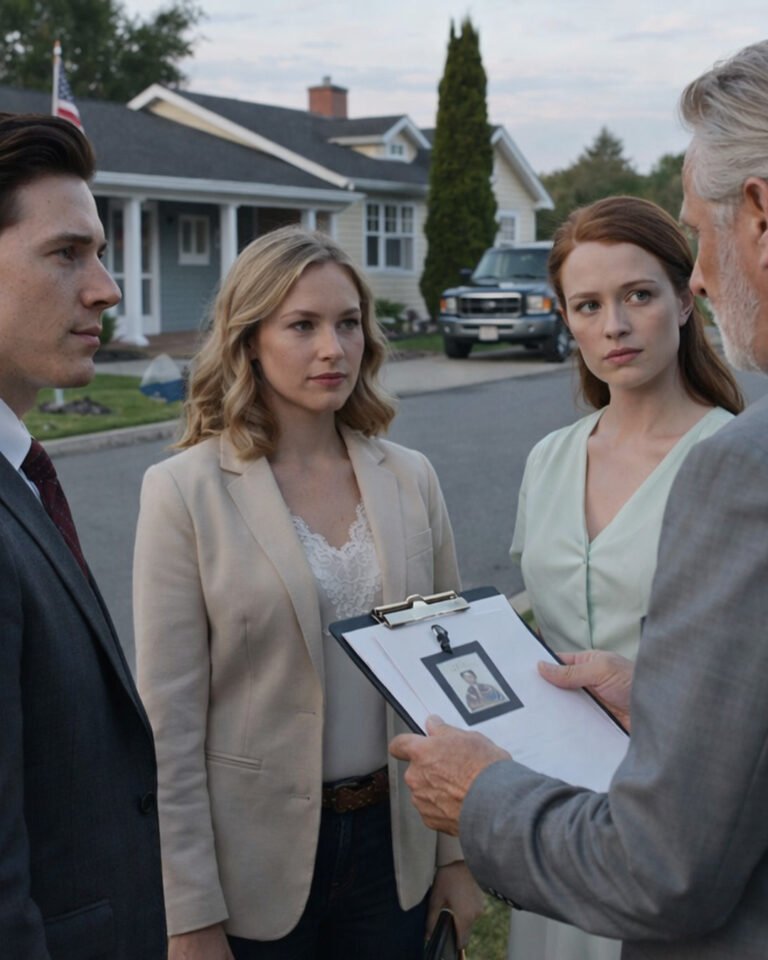
My heart slammed against my ribs. I moved to the door on quiet feet, looked through the peephole, and saw the badge filling the distorted circle. Atlanta Police Department. Major Crimes Division. Detective Isabella Rodriguez.
I opened the door.
She stepped in with the controlled urgency of someone who didn’t have time for comfort. Mid-forties, dark hair pulled back, blazer over a plain blouse, eyes scanning the room in a quick sweep that took in exits and windows and Lucas’s small frame on the bed.
Her gaze softened slightly when it landed on him.
“Hey,” she said to Lucas in a tone that treated him like a person, not an obstacle. “I’m Isabella. Your mom called Detective Chen, and he asked me to come talk to you. Is it okay if I sit?”
Lucas nodded once, solemn.
Rodriguez turned to me. “Mrs. Martinez, you and your son are safe right now. But we need to talk about your husband.”
My throat felt tight. “What did he do?”
She held my eyes for a long moment, like she was deciding how much truth my body could take without collapsing.
“Your husband is Daniel Martinez,” she said. “Correct?”
“Yes.”
“He works for a company called Meridian Global Solutions.”
“That’s what he says,” I answered, and my voice sounded strange even to me. Like something inside me had started separating from the narrative I’d been repeating for years.
Rodriguez nodded once, almost as if she’d expected that. “Meridian is a shell company. It looks legitimate on paper. But it’s used primarily as a front for money laundering tied to drug trafficking between Atlanta and Chicago.”
The words didn’t fit in my head. Money laundering. Drug trafficking. It was like she had spoken a language my brain couldn’t translate.
“That’s impossible,” I said automatically. “Daniel makes PowerPoints. He complains about meetings. He’s… he’s boring.”
Rodriguez didn’t smile. “He’s been under investigation by a joint task force for eight months. DEA, FBI, Atlanta PD. We have evidence of financial transactions that don’t match any legitimate consulting activity. We have recorded communications about shipments and distribution schedules. We have surveillance of your husband meeting with known associates.”
I shook my head, hard. “No. You have the wrong person.”
Then she asked, “Tell me what you saw tonight.”
My stomach dropped. “How do you know about that?”
“We’ve had intermittent surveillance on your residence,” she said. “Not constant, but check-ins. One of our units was rotating through your neighborhood when you returned from the airport. They saw you park one street over. They saw the van arrive. They saw entry into your home.”
The room felt smaller. Like the walls had crept closer while I wasn’t looking.
“The men who went inside,” Rodriguez continued, “work for the same organization your husband is tied to. They used a key that was provided. They were likely there to retrieve something he keeps at the house. Cash. Documents. Possibly both.”
“In our home,” I whispered. I looked at Lucas, at the child who slept in that house with his stuffed animals and his nightlight shaped like a football. “He kept that in our house.”
Rodriguez’s voice softened, just a fraction. “We believe so.”
Lucas made a small sound, halfway between a breath and a whimper, and I moved to him immediately, sitting on the edge of his bed and wrapping an arm around his shoulders.
“I don’t understand,” I said. “I didn’t know anything. I still don’t know anything.”
“It doesn’t matter what you know,” Rodriguez said gently. “It matters what they think you might know.”
The word she used next hit like a slap.
“Liability,” she said. “If they believe you’re aware of the operation, or might talk to police, you become a liability.”
I felt cold despite the hotel’s stale warmth. “So what happens now?”
“We move quickly,” Rodriguez said. “We were planning arrests next month. But your disappearance tonight accelerates the timeline. Your husband will realize something’s wrong if he hasn’t already. The organization will react. We need to get you and Lucas into protective custody while we execute warrants.”
“Protective custody?” The phrase sounded like something that happened to witnesses on television. Not mothers who worried about PTA emails.
“It means a safe house,” Rodriguez said. “Federal oversight. Security. It may mean new identities depending on how the case unfolds.”
Lucas’s voice trembled. “Mom?”
I turned to him. “We’re okay,” I said, because I had to say something. “We’re going to be okay.”
Rodriguez stood. “You need to pack what you have here. We leave in five minutes. There’s a team outside.”
My mind tried to latch onto practicalities. “My sister. My parents. They’ll worry when they can’t reach me.”
“They’ll be told you and Lucas are safe,” Rodriguez said. “They won’t be given details for their own protection.”
I swallowed hard. “And Daniel? My husband?”
Rodriguez didn’t offer comfort. She offered truth. “He will be arrested. He will face federal charges. He may ask to speak with you. You should not contact him.”
I glanced at the nightstand where my phone lay. I could feel his messages waiting. His voice, if I called. The familiar cadence that had soothed me after hard days. The man I’d kissed goodbye under fluorescent airport lights.
And under that familiar surface, something else. A life I had not been invited into. A secret safe I didn’t know existed. A key in someone else’s hand.
“Five minutes,” Rodriguez repeated.
I moved fast, hands shaking. Lucas grabbed his backpack like it was part of him. I swept toiletries into a bag. Threw in the spare shirt I’d packed for Lucas in case he spilled something on himself. My wallet. My keys.
My phone.
I picked it up and stared at the screen. More missed calls. More texts, shifting from concern to agitation.
Sarah, what the hell is going on? Where are you?
My thumb hovered over the keyboard. There were a thousand things I wanted to ask. Why. How long. Who are you. What did you bring into our house.
Instead, I powered it off.
Some conversations don’t deserve to happen.
When we stepped into the hallway, two men in plain clothes stood nearby, alert but not aggressive. Rodriguez guided us to a side exit, away from the lobby. The night air smelled like wet asphalt and car exhaust. A vehicle waited with dark windows. I buckled Lucas in and climbed in beside him, my arm automatically reaching across his chest as if I could physically shield him from whatever came next.
We drove, and I deliberately didn’t watch the route.
The safe house was an apartment in a quiet complex that looked like a dozen other quiet complexes. Beige walls. Trimmed bushes. A security car idling at the far end of the lot. Nothing about it announced danger or drama, and that almost made it worse, because it meant this world existed in plain sight.
Inside, everything was practical. Furniture that wasn’t meant to be loved. A couch. A table. Twin beds. Groceries already stocked, as if someone had tried to make displacement feel like hospitality.
“You’ll have officers outside at all times,” Rodriguez said, walking us through. “You don’t answer the door for anyone unless it’s law enforcement and you confirm identity. You don’t leave without escort. You don’t contact anyone from your previous life. Clear?”
“Clear,” I echoed, though my brain was still catching up to my body.
Lucas was asleep within an hour, exhaustion finally pulling him under. I watched him for a long time, his lashes resting on his cheeks, his small fingers still curled like he was holding onto something even in sleep.
I sat on the couch with Rodriguez. The apartment’s silence pressed in, different from hotel silence. This was a silence that felt official.
“Arrests will happen within forty-eight hours,” Rodriguez said. “Your husband, several associates, and other connected individuals.”
“And then what?” I asked, and my voice sounded thin. “We go home?”
Rodriguez’s eyes held mine with a steadiness that felt like a warning. “Mrs. Martinez, there is no going back. Your finances will be investigated. Your house may be seized. Your husband is likely facing decades in federal prison.”
The words landed one by one, each one opening a trapdoor beneath the life I thought I had.
I nodded because I couldn’t do anything else.
“The good news,” Rodriguez added, softer now, “is that we’re confident you didn’t know. You’re a victim in this. You won’t be charged. But the consequences will still be real.”
When she finally left, I sat alone in that borrowed apartment, listening to Lucas breathe in the next room, and I let the reality wash over me in waves that stole my breath.
I cried without sound, pressing my fist to my mouth so I wouldn’t wake him. I cried for the marriage I thought I had. For the man I thought I knew. For the ordinary life that had been a cover story I didn’t even realize I was acting in.
And underneath the grief, something else moved, smaller but unmistakable.
Relief.
Because some part of me had known there were cracks. Late nights. Closed doors. The way his warmth sometimes felt like performance. I had sensed it and looked away because looking directly meant admitting I might have married a stranger.
Lucas hadn’t looked away.
A six-year-old had been braver than me.
I wiped my face, drew a shaky breath, and stared into the dim living room until my tears dried. In the next room, my son shifted in his sleep, then settled again, safe for the moment.
I leaned back against the couch and listened to the faint sounds outside. A car door shutting. A quiet radio murmur from the security detail. The world holding its breath.
In less than two days, Rodriguez had said, arrests would happen.
In less than two days, the truth would have a shape so solid I could no longer deny it.
And until then, all I could do was stay awake, keep my child close, and wait for the next knock that would change everything again.
The arrests came before dawn.
I knew they were coming. Detective Rodriguez had warned me. She had explained the timeline, the coordination, the inevitability of it all. Still, when the phone vibrated on the side table at 6:47 AM, the sound felt like a gunshot in the quiet apartment.
I was already awake. I hadn’t really slept. I’d dozed in shallow increments, waking at every unfamiliar sound, every shift of air. The couch cushions still held the shape of my body, my spine stiff from staying alert through the night like vigilance itself could keep us safe.
Lucas was asleep in the next room, sprawled sideways across the narrow bed, one arm flung over his pillow, his mouth slightly open. He looked younger when he slept. Softer. Like the world hadn’t just cracked open beneath his feet.
I stepped into the hallway and closed the bedroom door gently before answering.
“Mrs. Martinez,” Detective Rodriguez said. Her voice was steady, professional. “We have him.”
My knees weakened, and I leaned against the wall, the cool paint grounding me. “Where?”
“Chicago O’Hare. He was detained while attempting to board a return flight to Atlanta. No bail. Federal custody.”
I closed my eyes.
Images collided in my mind. Daniel standing in another airport, maybe sipping burnt coffee, maybe checking his watch, maybe rehearsing the lie he’d tell me when he got home. Daniel looking surprised. Or angry. Or calm. I didn’t know which would hurt more.
“Did he…” I swallowed. “Did he ask about us?”
“He did,” Rodriguez said. “He requested to speak with you. We denied that request. His attorney will likely reach out within the next few days. You should not engage.”
“I won’t,” I said. The certainty in my voice surprised me. But it felt real.
“Additional arrests were executed simultaneously in Atlanta and surrounding areas. Twelve individuals so far. Assets are being frozen. Properties seized.”
Including our house, she didn’t have to say. Including the life I’d been living.
After we hung up, I stood there for a long moment, staring at the blank wall, trying to feel something definitive. Rage. Vindication. Collapse.
Instead, there was a strange quiet.
Like the moment after a storm breaks, when the air feels scrubbed raw and everything is too still.
Lucas woke an hour later, rubbing his eyes and padding into the living room in socked feet. He stopped short when he saw my face.
“What happened?” he asked.
I knelt in front of him, bringing us eye to eye. “Dad was arrested,” I said gently. “The police took him into custody.”
His lower lip trembled. “Is he… bad?”
The word landed hard.
“He did bad things,” I said carefully. “Things that hurt people. Things that put us in danger. That doesn’t mean he didn’t love you. But it does mean he has to face consequences.”
Lucas nodded slowly, absorbing it in the way children do, like stacking blocks one at a time until the shape makes sense. Then he leaned forward and wrapped his arms around my neck, squeezing hard.
“I’m glad we didn’t go home,” he whispered.
“So am I,” I said, and felt it settle into my bones as truth.
The days that followed blurred together.
There were meetings with agents and attorneys, explanations delivered in careful language designed to be accurate without being overwhelming. I learned that Meridian Global Solutions was one of several shell companies. That Daniel’s “consulting” trips were handoffs and meetings and negotiations. That the safe in our closet had held more money at one time than I made in a year.
That our house, our furniture, our accounts were all considered part of the investigation now.
I was allowed to return to the house once, escorted, to retrieve personal items.
Walking through the front door felt like trespassing in my own life.
The air inside smelled faintly stale, like it had been sealed too tightly. Drawers stood open where strangers had searched. Closet boxes had been shifted. The safe in the back corner of our bedroom gaped open, empty, its existence alone a betrayal.
I moved through the rooms slowly, touching nothing unnecessary. Lucas’s toys were scattered where he’d left them. My coffee mug still sat in the sink. The normalcy of it all felt obscene.
I packed clothes. Photos. Lucas’s favorite books and the stuffed dog he’d slept with since he was two. I did not take the china. I did not take the art on the walls. Those belonged to a life that wasn’t real anymore.
When we left, I didn’t look back.
The house was seized within the week.
News broke shortly after. Daniel’s face appeared on screens and websites, his professional headshot repurposed into something sinister. Articles dissected the operation in language that made it sound calculated and sprawling and efficient. Millions moved through accounts. Years of deception.
Friends called. Neighbors texted. Distant relatives suddenly remembered my name.
I did not answer.
We relocated again after that. Another apartment. Another city. Same names, but a quieter place. A nonprofit job for me. A school counselor and therapist for Lucas. A routine built from scratch.
He had nightmares sometimes. Asked questions I didn’t always have answers for. But he laughed again too. Made friends. Learned to ride his bike without training wheels in a park where no one knew our story.
I learned how to breathe again.
The trial was scheduled for the following spring. I was told I’d likely testify. I didn’t fear it the way I thought I would. There was something clarifying about the truth once it stopped being hidden.
A year after that Thursday at Hartsfield-Jackson, Lucas and I stood in another airport, waiting to board a plane to visit my sister. A real vacation. One we’d planned openly, without lies.
As we shuffled forward in the security line, Lucas tugged my hand.
I looked down. “What’s up?”
“I’m glad I told you,” he said. “And I’m glad you listened.”
I crouched so we were eye to eye, ignoring the impatient travelers around us. “I will always listen,” I said. “Always.”
He nodded, satisfied, and turned back toward the line.
On the plane, he fell asleep against my shoulder, warm and solid and real. I stared out the window as we lifted into the sky, watching the ground fall away.
I thought about keys that didn’t belong. About lives that were performances. About the moment when routine nearly led us back into danger.
And I thought about the quiet courage of a child who noticed what I couldn’t, and trusted his fear enough to speak it.
We didn’t go home that day.
Because home isn’t an address. It’s not a house with a porch light left on. It’s not a routine that looks good from the outside.
Home is where you are safe.
Home is where the truth lives.
Home is where someone listens when you say something feels wrong.
And because I listened, my son and I were still here to build one.