A Five-Dollar Choice That Changed Everything: A Twin Pregnancy, Quiet Strength, and the Moment a Woman Reclaims Herself
I did not used to notice how often I apologized.
Sorry for taking too long in the bathroom. Sorry for falling asleep on the couch. Sorry for needing help carrying groceries. Sorry for asking a question when someone looked busy. Sorry for sighing too loudly. Sorry for existing in a way that required care.
It was not something I did on purpose. It had become automatic, like blinking. A reflex built from years of trying to be easy, trying to be pleasant, trying to take up as little room as possible so no one could say I was too much.
Then I got pregnant.
And for a while, I truly believed pregnancy would change the way people treated me. Not in a spotlight kind of way, not with constant praise, just with a softer edge. I imagined small gentlenesses. A hand on my shoulder. A “sit down, let me do that.” A voice that carried concern instead of annoyance.
I imagined my boyfriend, Briggs, looking at me and seeing something precious, not inconvenient.
I was twenty six, and the pregnancy test turned positive on a Tuesday morning, when the sun was already sharp through the bathroom window. I remember the tile felt cold under my bare feet. I remember the hum of the vent fan. I remember the way my hands shook, not from fear exactly, but from the suddenness of it, like life had reached into my chest and pulled a thread.
Two lines.
I sat down hard on the edge of the tub and stared until my eyes watered. My throat tightened the way it does when you are trying not to cry in a public place. Only I was alone. Still, I felt watched by the moment itself, by the weight of what it meant.
When I told Briggs, he lifted me off the floor like it was a movie scene. He spun me once, laughing, his cheeks warm against mine.
“That’s my girl,” he said. “We’re going to be a family.”
In those first days, I held onto his excitement the way you hold onto a blanket when the room is cold. I wrapped it around myself and pretended it meant I would be safe.
At the first prenatal appointment, the nurse moved the wand over my belly, and the screen flickered with a small storm of gray and white shapes. The room smelled like sanitizer and printer paper. The gel on my skin was cold. I squeezed Briggs’s hand and tried to steady my breathing.
Then the nurse smiled.
“Well,” she said, voice bright, “we’ve got two in there.”
I blinked. “Two?”
“Twins,” she confirmed, and turned the screen slightly so we could see. Two little pulses. Two tiny flickers. Two heartbeats, fast and brave, like tapping fingernails against glass.
Briggs let out a low whistle, half impressed, half stunned. He squeezed my hand and laughed.
“Of course,” he said. “Of course my kids would come in a pair.”
I laughed too, because the sound was already rising in my chest, because I could not stop it. It poured out of me with tears close behind. I was so full of wonder it hurt.
On the drive home, I stared out the window at ordinary streets and ordinary people and could not believe I was carrying something extraordinary. Two babies. Two girls, I somehow felt, even before we knew. I started turning names over in my mind like smooth stones in my palm. Soft sounds, safe sounds.
Mia. Maya.
I did not say them out loud yet. They felt like secrets.
Briggs kept one hand on the steering wheel, the other on my thigh, and spoke in a confident, easy voice.
“You don’t need to stress about anything,” he said. “I’m going to take care of us.”
That sentence became his favorite. He repeated it like a motto. Like a promise. Like a slogan he could hang in the air whenever he wanted credit.
He liked calling himself a provider.
The first time he said it in front of someone else, I felt a small flutter of pride, because I thought it meant he was proud of us too.
We were at a barbecue with one of his friends. People were laughing, holding paper plates, standing under string lights that threw warm circles over the yard. Briggs had a drink in his hand and an arm around my shoulders. He leaned in toward the group and said, loud enough for everyone to hear, “I’m taking care of my girl now. She’s carrying twins. I told her she can rest. I’ve got it.”
Everyone smiled at him. Someone clapped his back. Someone said, “That’s how it should be.”
I smiled too, because that is what you do when your life is being presented like a success story. But even then, something in me tightened.
Because when we got home and I tried to put a load of laundry in, Briggs watched me for a second and said, “You don’t need to do that.”
Relief washed over me.
Then he added, “Just don’t start acting like you’re helpless.”
The relief drained away, leaving a thin ache behind my ribs.
I told myself he was joking. He had a sharp sense of humor. He always had. Maybe he was nervous. Maybe the news had surprised him. Maybe he did not know how to express worry, so he used jokes like a shield.
But the shield turned outward, and I was the one getting hit.
By the time I reached ten weeks, my body felt like it had been put into a different gravity. Twin pregnancy moved fast. My appetite came in strange waves. Sometimes I could not keep anything down. Other times my stomach felt hollow and urgent, like it was calling for fuel.
Fatigue settled over me like heavy fabric. I would wake up and feel as though I had not slept. My ankles started swelling earlier than I expected, and my lower back carried a deep, constant soreness that made me shift positions every few minutes.
Briggs did not soften. If anything, he sharpened.
He began speaking to me like I was a responsibility he was managing rather than a person he loved.
“You’ve been asleep all day, Rae. Seriously?” he would say, when I had only closed my eyes for half an hour because the room was spinning.
“You’re hungry again?” he would ask, staring into the pantry as if I was stealing from it.
“You wanted kids,” he reminded me more than once. “This is part of it.”
It was not only the words. It was the way he looked at me when he said them. There was a smirk, a little curl at the corner of his mouth, like he was amused by my needs.
He said these things when other people were within earshot. It always felt deliberate, like he wanted witnesses, like he wanted a record that he was the reasonable one and I was the dramatic one.
I began to feel careful around my own body. I would try to clear my throat quietly if I was nauseated. I would keep my hunger to myself until it was impossible. I would eat smaller portions even when my stomach begged, just to avoid the comments.
And then Briggs started dragging me to work.
He had meetings with clients. Warehouse drop-offs. Stops that required loading and paperwork and small talk. He said he needed me with him. He said it looked good. He said a family man was taken more seriously.
On a morning when my ankles were already puffed and my skin felt too tight, he called from the front door.
“You coming?”
I was sitting in the passenger seat of the car, trying to breathe through the nausea. The seatbelt pressed uncomfortably across my belly, still small but tender. I had worn my loosest leggings. My shoes felt like they were shrinking around my feet.
“I need a minute,” I said, trying to sound calm.
“I don’t have time for this, Rae,” he replied, and I could hear the impatience in his voice. “I can’t have people thinking I don’t have my life together.”
I gripped the door handle and pushed myself upright. My joints felt stiff. My back flared with pain as I stood.
“You think they care what I look like?” I asked, breathless.
“They care that I’m a man who handles his business and his home,” he said. “You’re part of the picture, Rae. They’re going to eat it up.”
The phrase part of the picture stayed with me, heavy and wrong. Like I was a prop. Like my role was to make him look stable.
Inside the warehouse, the air smelled like metal and dust. Fluorescent lights buzzed overhead, turning everyone’s skin a sickly shade. The floor was hard concrete that sent impact straight through my feet and up into my spine. People moved fast, pushing carts, lifting boxes, calling out numbers.
Briggs handed me a box without looking me in the face.
“Come on,” he said. “If you’re going to be here, you need to work.”
It was not even a heavy box, but my arms ached anyway, the way they do when you are running on too little energy. I carried it because arguing felt like climbing a mountain. I carried it because I did not know what else to do. I carried it because I wanted to go home.
The day blurred into stops. A meeting where Briggs talked loudly about supply chains and deadlines while I sat in a corner chair, trying to keep my face neutral. A drop-off where I climbed out of the car too quickly and had to stand still for a moment, pretending I was checking my phone while I waited for the dizziness to pass. Another warehouse where I carried paperwork and tried to ignore the way sweat gathered at the base of my neck.
By the fourth stop, my stomach felt like an empty, trembling bowl. I could taste acid in my throat. My hands were shaking so visibly that I pressed them between my thighs when we got back into the car.
“I need to eat,” I said quietly, and tried to keep my voice steady. “Please. I haven’t eaten all day.”
Briggs started the engine and pulled out like he had not heard me.
“You’re always eating,” he muttered. “Didn’t you clean out the pantry last night?”
“I’m carrying two babies,” I reminded him. “I haven’t had anything since dinner.”
“You ate a banana,” he said, and rolled his eyes as if I was being childish. “Stop acting like a drama queen. You’re pregnant. That doesn’t make you special.”
I stared out the window. My eyes burned. I blinked hard, once, twice, trying to keep the tears from spilling. Crying made him worse. Crying turned into another story he could tell about how sensitive I was.
“Can we stop somewhere?” I asked again, quieter now. “I feel dizzy.”
He sighed, long and theatrical, like I had requested a fancy restaurant.
Eventually, he pulled into a roadside diner.
It was the kind of place that looked like it had been there forever. Foggy windows that caught the light in smudged streaks. A red door with chipped paint. A neon sign that buzzed faintly, the kind of sound you barely notice until you stop and listen. Inside, the air smelled like coffee, fried potatoes, and something sweet baking in the back.
The booth seat was vinyl and cool against my skin. I slid in and let my shoulders drop. My legs felt heavy. My lower back pulsed.
For a moment, I closed my eyes and pictured Mia and Maya in matching onesies, asleep side by side. I imagined their tiny bellies rising and falling. I imagined the softness of their cheeks. I imagined the weight of their hands curling around my fingers.
The names drifted through my mind again, gentle and steady.
Mia. Maya.
A waitress approached our table. She looked like she had been carrying other people’s needs for a long time. Her hair was pulled into a bun that was coming loose. She wore a name tag that read Dottie. There was a tired kindness in her eyes, the kind that does not require explanation.
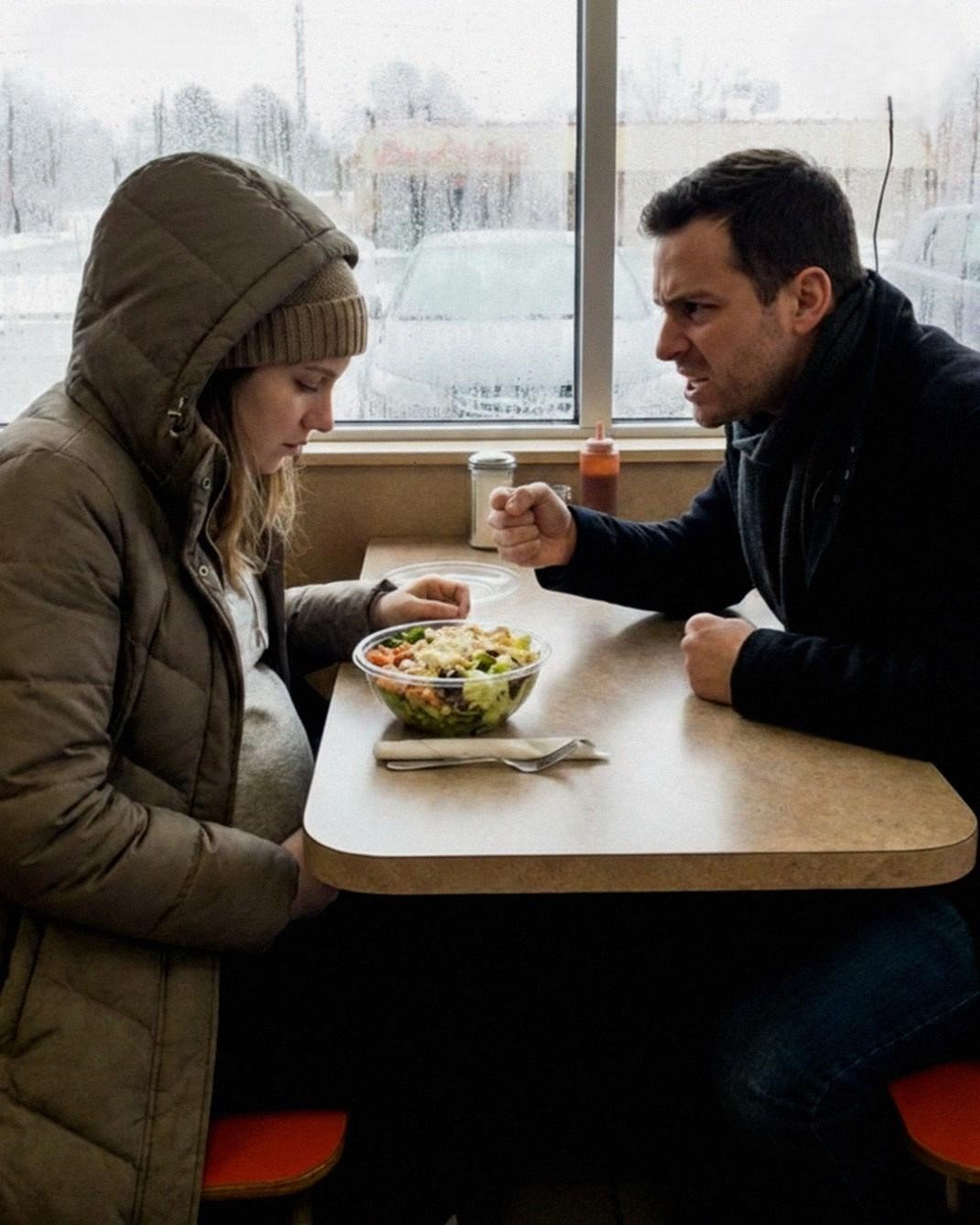
Before she could say a word, Briggs leaned back and grunted, “Something cheap, Rae.”
His voice had that public edge, like he was performing again.
I did not look at him. I opened the menu and scanned quickly, searching for something with protein that would not turn my stomach. My eyes landed on a Cobb salad.
Five dollars.
That was all.
It felt like such a small thing, almost laughable. A simple meal. A simple request.
“I’ll have the Cobb salad, please,” I said quietly to Dottie.
For one second, I imagined it would be fine.
Then Briggs laughed.
Not a quiet chuckle. A loud, barking laugh that turned heads.
“A salad?” he said. “Must be nice, huh, Rae? Spending money you didn’t earn.”
Heat rushed to my cheeks. My ears felt hot. I stared at the table, at the small scratches in the laminate, at a smear of syrup that had not been fully cleaned.
“It’s just five dollars,” I said, forcing my voice to stay calm. I pressed a hand lightly against my belly, a reflex, as if I could shield Mia and Maya from the sound of his mockery. “I need to eat. The babies need me to eat.”
“Five dollars adds up,” he muttered, like he was talking to a child. “Especially when you’re not the one working.”
The booth beside us went quiet.
I could feel the shift in the diner, like a breeze had changed direction. I did not have to look to know people were listening. But my eyes flicked up anyway, and I saw a gray-haired couple in the next booth. The woman’s mouth had tightened, her gaze fixed on Briggs with something sharp and disapproving.
Shame crawled up my throat. It tasted metallic.
Dottie’s expression did not change dramatically. She did not gasp or scold. But her eyes softened when they met mine.
“Would you like some crackers while you wait, sweetheart?” she asked gently, her voice low, as if offering me privacy inside the kindness.
“I’m okay,” I whispered, because I had learned to refuse help before someone could accuse me of taking it.
Dottie tilted her head slightly.
“No, honey,” she said. “You’re shaking.”
Before I could protest, she walked away.
Briggs scoffed under his breath. “Unbelievable.”
When Dottie returned, she placed a glass of iced tea in front of me, the ice clinking softly. She set down a small bowl of crackers on a napkin, and the gesture felt so tender I almost broke.
“Thank you,” I whispered, my voice thinner than I wanted.
Briggs leaned back and said, loud enough for others to hear, “Is everyone in this town trying to be a hero today?”
Dottie did not flinch. She did not raise her voice. She simply looked at him, eyebrows lifting slightly, calm as still water.
“I’m not trying to be anything,” she said. “I’m just being a woman reaching out to someone who needs it.”
I swallowed hard.
When the salad arrived, it looked better than I expected. Crisp greens, diced tomatoes, egg, bits of bacon, and on top, grilled chicken.
I had not ordered chicken.
Dottie leaned in slightly, her voice quiet.
“That part’s on me,” she said. “Don’t argue, missy. I’ve been you.”
Something in my chest cracked open. Not in a dramatic way, not like a scene from a movie. More like a tight knot loosening for the first time. My eyes stung. I blinked quickly and nodded.
I ate slowly. Carefully. Each bite steadied me. The salt, the crunch, the warmth of the chicken, the coolness of the iced tea. My hands stopped shaking. The dizziness eased into the background like a storm moving away.
Briggs barely touched his burger. He stared at his phone, jaw tight, as if the diner itself had offended him.
When I finished, he threw folded bills onto the table without counting and stood up so quickly the booth seat squeaked.
He walked out first.
In the car, the silence lasted until the doors shut.
Then he snapped, “Charity is embarrassing.”
I stared at my lap. My fingers were damp from condensation off the glass.
“I didn’t ask for anything,” I said.
“No,” he said, turning his head toward me, eyes narrowed. “You just sat there and let people pity you. Do you know how that makes me feel? Do you know how that makes me look?”
My stomach tightened again, not with hunger this time, but with something else.
“You embarrassed me,” he said, voice rising. “Yet again.”
I lifted my eyes to his, surprised by the steadiness in my own voice.
“I let someone be kind,” I said. “That’s more than I can say for you.”
His mouth opened as if he had a response ready, but nothing came out. His nostrils flared. He gripped the steering wheel and drove.
For once, neither of us spoke.
At home that evening, the rooms felt too quiet. The air smelled faintly of whatever cleaning product I had used earlier, mixed with the stale scent of the day. I moved slowly, my body heavy, my ankles aching. I made myself a small snack and braced for a comment.
Briggs did not come home at his usual time.
When he finally arrived, it was late. The front door opened and closed without the usual loud entrance. No booming greeting. No dramatic tossing of keys like he owned the world.
Just a softer sound.
Keys rattling on the kitchen table.
I stood in the hallway and watched him.
He sat down on the edge of the couch and did not remove his shoes. His shoulders slumped forward. His elbows rested on his knees. His head hung low, as if he was listening to something heavy echoing in his own mind.
For a moment, I felt something like pity. Not because he deserved it, but because I recognized the posture of someone whose armor had cracked.
“Long day?” I asked gently. My voice surprised me with its softness. “Can I make you something for dinner?”
He did not look at me.
“Don’t start, Rae,” he said.
“I’m not starting anything,” I replied. I took a step into the living room, careful with my balance. “I’m asking if you’re hungry.”
He rubbed his jaw, as if the question irritated him.
“Nothing,” he muttered. “People are just annoying. And dramatic.”
I waited. The silence between us felt thick, like fog.
Then he spoke again, his voice different now, edged with frustration that sounded almost like disbelief.
“That diner lady knows somebody,” he said. “She must have said something. It can’t be a coincidence.”
My stomach tightened.
“My boss called me in,” he continued. “The client requested I don’t come to meetings anymore.”
He glanced away, eyes fixed on the wall.
“They took my company card,” he added, quieter.
I stood still. I waited for what I thought I should feel.
A rush of satisfaction. A triumphant surge. A moment of payback.
But it did not come.
What I felt instead was a small exhale. A quiet settling. Like a truth I had been carrying finally had weight outside my own body.
“Can you believe that?” Briggs said, and a half laugh escaped him, sharp and humorless. “Over nothing.”
I tilted my head.
“Nothing?” I asked, keeping my voice calm.
“She gave you free food,” he said, as if listing evidence. “I made one comment. People are too sensitive.”
I stepped a little closer, not threatening, just present.
“Or maybe people are finally watching,” I said.
His eyes snapped to mine. “What’s that supposed to mean?”
It meant everything, but I said it plainly.
“It means maybe someone finally saw the version of you that I live with,” I said.
His face hardened. Then, without responding, he stood up, stiff, and walked upstairs.
I did not follow.
I curled on the couch, pulled a throw blanket over my legs, and rested my hand on my belly. The babies moved in small, fluttering ways that felt like whispers under my skin.
“Mia and Maya,” I whispered, the names finally leaving my mouth. Saying them out loud felt like lighting a candle in a dark room. “You’ll never have to earn kindness from me.”
My throat tightened.
“I promise,” I added.
I lay there and pictured them again, softer and clearer this time. Tiny fingers. Warm cheeks. Matching socks. The image was not just a daydream now. It felt like direction.
The next few days, Briggs avoided me. He moved around the house like a storm trying not to be seen, snapping at emails, muttering under his breath about “ungrateful people.” He complained about his boss. About the client. About how unfair everything was.
He did not mention Dottie’s name. He did not mention the diner. He did not mention the salad.
But I remembered all of it.
I remembered the burn of shame in my cheeks when he laughed at me. I remembered the way the nearby booth had gone silent. I remembered the gray-haired woman’s tight mouth. I remembered Dottie’s steady gaze and the way she spoke to me like I was worth protecting.
Most of all, I remembered how my body had felt in that booth, shaking, dizzy, and desperate, and how quickly kindness had steadied me.
It made me wonder what else kindness could do.
So I started doing small things that felt like quiet rebellion.
I emailed old friends, the kind you lose touch with when life gets busy and complicated. I did not pour out my whole story. I just reached out. Asked how they were. Reconnected threads I had let go of.
I searched for prenatal clinics with excellent reviews, places where women described feeling respected. I read comments late at night, the glow of my phone lighting the blanket around my shoulders. I looked for words like compassionate and patient and thorough.
I took walks.
Slow ones, with my hands tucked into my coat pockets, my breath puffing in pale clouds in the cold air. Movement hurt, but not moving hurt more. I needed to feel my legs carry me. I needed to remind myself my body was still mine.
“This is for you,” I whispered to my belly as I walked. “For you, babies.”
Briggs did not notice.
Or maybe he noticed and did not care. Maybe he assumed I would always stay. Maybe he believed my exhaustion would keep me obedient.
One morning, after he slammed the door on his way out, I stood in the quiet house and listened to the fading sound of his car. The silence afterward felt wide, like a field.
I picked up my keys.
My heart pounded, not from fear of doing something wrong, but from the strange, unfamiliar feeling of doing something for myself.
I drove without thinking too hard, following the memory of the road until I saw the diner again. Foggy windows. Red door. Chipped paint.
I sat in the car for a moment and watched people go in and out. An older man holding the door for a woman. A teenager carrying a to-go bag. Small ordinary kindnesses.
Then I went inside.
The bell above the door chimed softly. Warm air wrapped around me. The smell of coffee hit first, rich and comforting. Somewhere in the kitchen, something sizzled on a griddle.
Dottie was behind the counter. She looked up, and her face lit with recognition.
“You came back,” she said, and the words were simple, but the warmth in them made my eyes sting.
I slid into a booth, the same kind of vinyl seat, and my body exhaled in relief as if it had been holding itself tight for days.
Dottie untied her apron.
“Sit down, sweetheart,” she said. “I’m taking my break.”
She brought me hot chocolate first. The mug was warm between my hands, and the steam rose into my face, smelling like sugar and comfort. Then she brought a plate of fries. Golden, crisp, salted. Then a thick slice of pecan pie, glossy and dense.
I stared at the food and laughed softly, a real laugh this time.
“These are all the things I’ve been craving,” I said.
Dottie smiled like she understood something about the human body that no one else ever bothered to respect.
“Honey, I know,” she said. “Cravings are universal. Trust me.”
For a moment, I did not speak. I let my hands wrap around the mug. I let the warmth sink into my palms. I listened to the diner sounds, forks clinking, someone laughing near the counter, a coffee pot being refilled.
Then the words came out of me, not in a dramatic rush, but in a quiet spill, like water finally finding a crack.
“I keep thinking maybe he’ll change,” I admitted, looking down at my hands. My nails were short. My fingers looked a little swollen. “Sometimes he says the right thing. Sometimes he acts like he cares.”
Dottie’s gaze stayed steady.
“You can’t build a life on maybe,” she said softly.
I swallowed.
“Babies,” I corrected, because it mattered. “Twins. Girls.”
Dottie’s expression softened further. She reached across the table and placed her hand over mine. Her skin was warm. The touch was simple. It made my eyes burn instantly.
“You want your girls to know what love looks like?” she asked.
I nodded once, because I could not trust my voice.
“Then show them,” she said, gentle but firm, “by how you let yourself be treated.”
The words landed in me like something heavy and true. Not crushing, just real. Like a door closing behind me on the path I had been trying to pretend was still open.
I stared at her hand on mine and let myself feel the sadness of it. The mourning of what I had hoped Briggs could be. The mourning of the version of my life I had pictured when I saw those two heartbeats on the screen.
Dottie squeezed my fingers lightly.
“You don’t need perfection,” she said. “You need peace. You need softness. You need a home that feels safe. Until you find that, it’s better to walk alone than to walk with someone who makes you smaller.”
I nodded again, slow.
When I stood to leave, my body felt heavy, but my mind felt strangely clear. Dottie walked me to the door and pressed a small paper bag into my hand.
“Refill on the fries,” she said with a wink, as if trying to lighten the moment without taking away its seriousness. “And a warm place if you ever need one. My number’s in there too. Call me anytime.”
My throat tightened.
“Thank you,” I whispered.
Dottie tilted her head. “For what?”
I looked at her, really looked at her, at the tired bun and the soft eyes and the steadiness.
“For seeing me,” I said.
Her smile was immediate, warm as sunlight through a window.
Outside, the cold air hit my cheeks. It was sharp, but it felt clean. I did not flinch. I walked to my car with the bag in my hand and sat behind the wheel, breathing slowly.
Then I opened my phone.
I searched for the prenatal clinic I had been reading about. I booked an appointment for Friday. Seeing the confirmation on the screen made my chest loosen, like I had been holding my breath for weeks.
I requested a rideshare for the day, because I did not want to rely on Briggs. The app confirmed it. A simple thing, but it felt like a step.
Then I opened my messages.
My fingers hovered for a second. My heart thumped hard.
I did not want to fight with him. I did not want another argument. I did not want to be talked into staying with promises that sounded pretty but never turned into change.
I wanted to state my truth plainly.
So I typed:
“You will not shame me for eating again. Ever. I’m going to move back home to my sister. I can’t focus on my health and my pregnancy if you’re around.”
I stared at the words. My hands trembled a little. Not with fear, exactly. With the magnitude of it.
Then I hit send.
For a moment, the world did not change. Cars still moved in the parking lot. The sky was still pale and cold. People still walked past carrying their own lives.
But something inside me shifted.
I placed both hands on my belly, fingers splayed gently, feeling the curve and the warmth.
“Mia,” I whispered.
“Maya.”
The names felt solid now, not just dreams. They felt like a promise I could hold.
“We’re done shrinking,” I told them softly. “We’re done apologizing for needing care.”
I sat there for a long moment, breathing, listening to my own heartbeat, imagining theirs.
And in that quiet, with the diner behind me and the road ahead, I understood something that had taken me too long to learn.
Kindness is not a luxury.
It is not something you have to earn.
It is not something you should beg for with a lowered voice and a flushed face over a five-dollar salad.
It is a basic human thing, like air.
And I was finally ready to live as if I deserved it.