$33 Million for My Brother, Nothing for Me, Then the Lawyer Opened One Last Envelope and My Father Lost Control
The law office felt like it had been built to intimidate.
Not in a dramatic way, not with anything obvious, but with quiet, expensive confidence. The air carried the scent of old leather and furniture polish, that warm, sharp smell that clung to glossy wood and thick carpet. Even the light seemed curated, filtered through tall windows and softened by heavy drapes, as if harsh brightness had no place in a room where legacies were decided.
I sat in a rigid chair that didn’t want anyone getting comfortable. My hands were folded in my lap because I didn’t know what else to do with them. My nails were still faintly stained from the classroom marker I’d used that morning. Blue. A stubborn streak that never came off completely no matter how much scrubbing I did.
Across from me, Mr. Brennan’s desk gleamed, every surface arranged with careful intention. Pens aligned. Paper stacked. A framed photograph turned at a slight angle so it faced the chair where clients sat.
The photo was of Grandpa James.
He looked younger in it, smiling like he’d just heard something funny and decided to keep the joy to himself. The sight of his face made my chest tighten, a familiar ache blooming behind my ribs. Six months. That was how long it had been since I’d last heard his voice. Since I’d sat at his modest kitchen table while he stirred honey into his tea and asked me about my students as if their small lives mattered as much as boardrooms and balance sheets.
Only Grandpa James had looked at me without measuring what I could do for him.
Now the chair beside me creaked as my father shifted again, restless. He was close enough that I could hear his jaw working. The grind of his teeth was faint but constant, like he was chewing on anger and trying not to show it.
My mother sat on his other side, back straight, ankles crossed, posture perfect. She wore a navy dress that looked respectful and expensive, the kind of outfit chosen for appearances rather than comfort. Her expression was carefully neutral, the mask she’d perfected over decades of family gatherings where the truth was treated like an inconvenience.
On my other side, my brother Michael slouched like the room belonged to him. He scrolled through his phone with lazy confidence, thumb flicking over the screen with the casual arrogance of someone who had never once doubted his place in the world.
I stared at the edge of my skirt and reminded myself to breathe.
My name is Emma Thompson.
I’m twenty-eight years old, and I teach kindergarten at Lincoln Elementary.
To my students, I’m the person who knows where the extra crayons are and can untangle shoelaces and can make any day better with a sticker and a calm voice. To my family, I’ve been the ongoing disappointment. The daughter who chose finger-painting over finance. The one who earned an MBA from Northwestern and then did something unforgivable with it.
I used it to teach five-year-olds.
When I’d told my father, he stopped speaking to me for six months. No yelling, no dramatic confrontation. Just silence, the cold kind that felt like being erased.
Michael had never missed an opportunity to remind me where I ranked. At parties he introduced me as “my sister, the babysitter,” always smiling as if he’d made a clever joke. People laughed. I forced my mouth into a polite shape. Then I went home and stared at the ceiling, wondering why it hurt so much when I didn’t even like him.
Only Grandpa James had understood.
Only he had asked me what I loved about teaching, what my classroom looked like, what the kids were like this year, how it felt to watch someone learn something for the first time. He listened the way other people listened to business forecasts, as if my answers mattered.
And now he was gone.
Mr. Brennan cleared his throat.
It wasn’t a casual sound. It was deliberate, the kind of small gesture that pulled a room into stillness. Conversations that had been murmuring near the door softened. My mother’s shoulders lifted slightly as if she was preparing to be observed. Even Michael’s thumb paused mid-scroll.
He looked up and set his phone face-down on his knee. I noticed, for the first time, that his hands were trembling slightly.
Mr. Brennan folded his fingers on top of the will packet, then looked at us one by one, his eyes lingering just a second longer on my father.
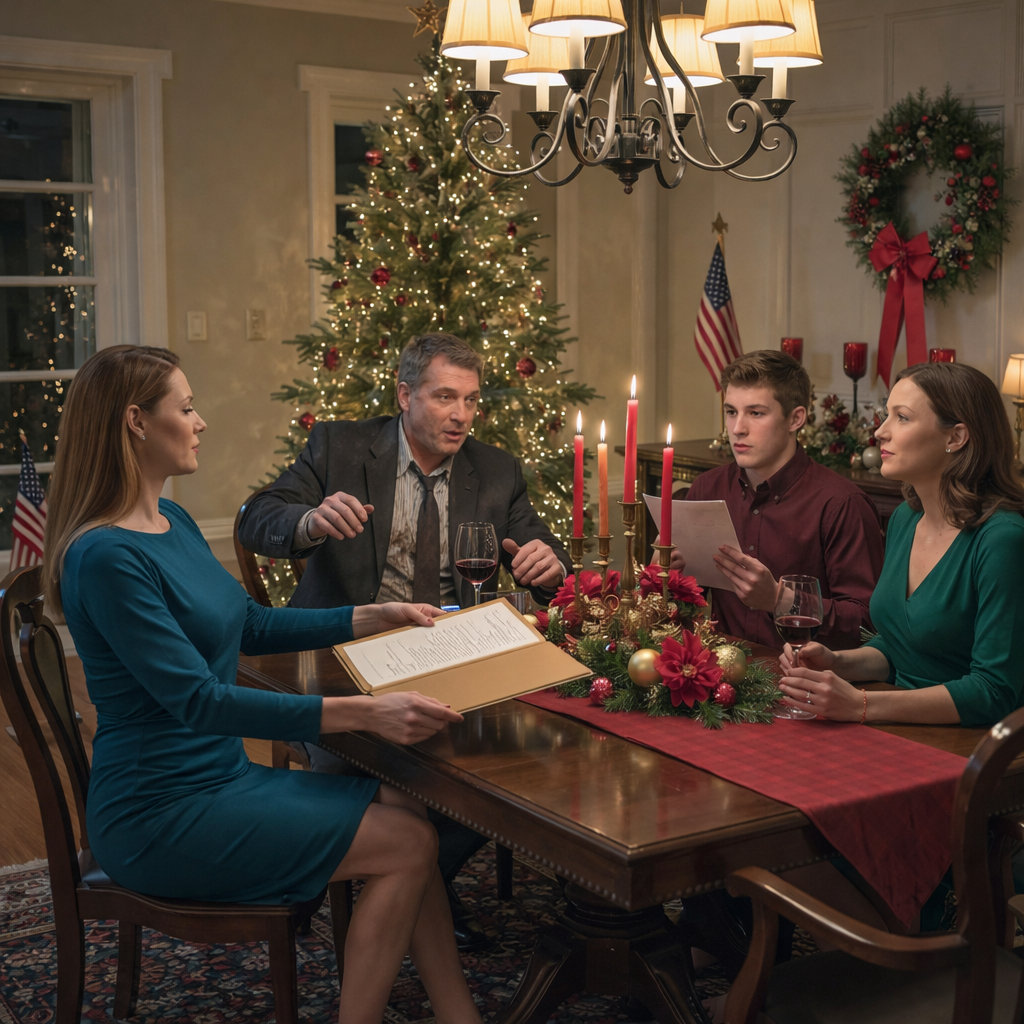
“Thank you all for coming,” he began, voice steady with the practiced formality of a man who had said these words too many times. “We’re here for the reading of James Thompson’s last will and testament. Before we begin, I want to acknowledge that James was not only a client, but a friend. His passing is a loss to everyone who knew him.”
My father shifted impatiently, the leather chair squeaking under the force of his movement. He had been circling since Grandpa died, calling financial advisors, muttering about what he deserved. He did it in the kitchen when he thought I couldn’t hear. In the hallway. In the living room after the memorial, as if grief were just a delay between him and an inheritance.
It had made me nauseous.
Mr. Brennan adjusted his glasses. The light caught on the lenses for a moment, hiding his eyes.
“James Thompson built an extensive estate,” he said. “Thompson Industries, real estate holdings across four states, mineral rights, investment portfolios, and multiple trusts.”
He paused, as if letting the words settle into the air.
“The total value is approximately one hundred and eighty-seven million dollars.”
Silence slammed into the room.
It wasn’t the comfortable kind of silence. It was stunned, as if every breath had been stolen.
My mother’s neutral expression cracked, her eyes widening. Michael’s phone slipped from his knee and clattered to the floor with a sharp plastic smack that sounded impossibly loud. Even my father looked momentarily disoriented, like he had misheard.
One hundred and eighty-seven million.
I’d known Grandpa was wealthy. I’d seen the way people treated him, the deference, the careful politeness. But he lived in a modest house. He made his own tea. He wore the same old cardigan with the frayed cuffs. He talked about the business like it was work, not like it was power.
I thought about all those afternoons with him, the sunlight slanting through his kitchen window, the way he’d laughed quietly at my stories about kids trying to negotiate snack privileges like they were courtroom deals.
He had been humbler than he had any right to be.
Mr. Brennan began reading.
“To my son, Richard, I leave the sum of five million dollars,” he said, voice precise, “with the hope that he will finally learn fiscal responsibility.”
My father’s face darkened immediately. A flush climbed from his collar to his cheeks.
Five million dollars was a fortune to most people.
To my father, in this context, it sounded like a reprimand.
His hands tightened on the armrests. His knuckles whitened.
I felt my mother glance at him quickly, a flick of her eyes, reading his reaction the way she’d learned to read weather.
Mr. Brennan continued.
“To my daughter-in-law, Patricia, I leave my late wife’s jewelry collection and the Cape Cod summer house, together valued at approximately eight million dollars.”
My mother’s mouth tightened. She nodded politely anyway, playing the part, her chin lifted as if she were graciously accepting an honor rather than privately tallying what she thought she should have received.
Then came the line everyone had been waiting for.
“To my grandson, Michael Thompson, I bequeath thirty-three million dollars,” Mr. Brennan read, “trusting he will use this wisely to build his future.”
Michael’s reaction was immediate and inappropriate.
He pumped his fist.
A small gesture, but loud in the room’s stillness, like a flare launched into the air. Mr. Brennan paused and looked at him over his glasses, disapproval tightening his mouth.
But what struck me wasn’t the celebratory motion.
It was the expression on Michael’s face.
Not joy.
Relief.
The kind of relief you see on someone who has been holding their breath for too long, someone who has been terrified and is suddenly allowed to inhale.
He looked like a drowning man who’d just been yanked back to the surface.
I didn’t understand it yet, but the detail lodged in my mind like a splinter.
Then all eyes turned to me.
The afterthought.
The family embarrassment.
The one who’d “wasted” an elite education on small chairs and glue sticks and circle time.
My father’s expression held disappointment and satisfaction at once, as if the will was about to confirm what he’d always insisted. That I was lesser. That my choices proved my lack of value.
Mr. Brennan’s voice flattened slightly as he read the next section, his tone shifting in a way that made my stomach tighten before the words even arrived.
“And to my granddaughter, Emma,” he read, “I leave specific instructions. Emma receives nothing from the primary estate. She can go earn her own money like the rest of the world.”
For a second, I didn’t feel anything.
Then heat rushed up my neck and face like someone had flipped a switch. Shame. Humiliation. The kind that makes your ears ring.
The room seemed to grow larger, as if everyone had moved back to make space for my embarrassment.
My mother smiled.
Not a wide smile. A thin one. The kind she wore when I was corrected in public, when I was reminded of my place.
Michael made a sound that was almost a laugh. “Guess Grandpa finally saw through all that teacher’s pet routine,” he said loudly.
My father leaned back, vindication settling into his features. “This is what happens when you waste your education,” he said. “Finger-painting with kids instead of joining the family business where you belong.”
I stared at the carpet because looking at them felt impossible.
My throat tightened. My hands clenched together in my lap so hard my fingers hurt.
After everything.
The afternoons I’d spent helping Grandpa sort his medications when no one else had time. The visits where I’d brought him soup and listened to him talk about the early days of the company, when he’d slept in his office and ate sandwiches over blueprints. The way he’d asked about my students, their home lives, their struggles, their triumphs, and listened like I was describing something important.
He had told me he was proud of me.
I had believed him.
Now I sat there with words like nothing and earn your own money echoing in my chest, and it felt like the floor had dropped away.
Mr. Brennan shuffled papers.
The sound was small, but it pulled my attention upward.
He cleared his throat again.
This time, the sound carried a different weight.
“However,” he said.
One word, sharp and clean, slicing through the room.
“There is one more item.”
My father’s triumphant expression faltered.
Mr. Brennan lifted a thick manila envelope. It was sealed with red wax, and pressed into the wax was the impression of Grandpa James’s signet ring. The sight of it sent a strange chill down my arms, as if some part of me recognized that this was the real moment, not the performance that had come before.
“James left specific instructions,” Mr. Brennan said. “This envelope is to be opened only after the primary reading, and only in Emma’s presence.”
He looked at me, and for the first time that day, I felt seen by someone in that room besides my grandfather’s photograph.
“Emma,” Mr. Brennan added quietly, “your grandfather wanted you to hear what your family’s reaction would be before learning what he actually intended.”
My heart began pounding so hard I could feel it in my throat. The room went silent again, but this time the silence was tense, expectant, like the air before a storm breaks.
Mr. Brennan broke the wax seal carefully, as if the envelope contained something fragile.
He unfolded several sheets of heavy paper.
Then he began to read.
“My dearest Emma,” the letter started.
Hearing his words spoken aloud did something to me. My eyes stung instantly. A familiar ache rose, sharp and bright, like grief resurfacing in a new form.
“If you’re hearing this, it means you’ve just witnessed your family’s true nature,” Mr. Brennan read. “I’m deeply sorry for that theatrical cruelty, but I needed them to reveal themselves completely before you learned the truth.”
My father leaned forward abruptly, his face draining of color. “What truth?” he demanded. “What is this?”
Mr. Brennan didn’t stop.
“Emma,” he read, “you are the only one in this family who has ever visited me without wanting something. You ask about my day, my health, my memories. You listen when I speak.”
My breath caught.
“And you inherited my sister Margaret’s kindness,” the letter continued, “along with her green eyes and gentle spirit.”
I felt my mother stiffen beside my father.
I had always wondered why I looked different. Softer features. Lighter coloring. Eyes that didn’t match my father’s dark intensity or my brother’s sharp, familiar resemblance.
Grandpa had spoken of Great-Aunt Margaret occasionally, always with a strange tenderness, though she had died long before I was born.
Then Mr. Brennan’s voice shifted, taking on the weight of something final.
“Therefore,” he read, “I am leaving Emma Thompson fifty-one percent controlling interest in Thompson Industries, effective immediately upon my death. Additionally, she inherits my full real estate portfolio, investment accounts, and mineral rights, totaling approximately one hundred and twenty-four million dollars.”
The room stopped breathing.
I heard the clock ticking on the wall. The small, relentless click that made time feel cruelly normal in the middle of something impossible.
My mother made a sharp sound, a quick inhale that cracked her composure. Michael stared at me as if he didn’t know who I was. My father’s mouth opened, but nothing came out.
Thompson Industries.
Fifty-one percent.
Controlling interest.
The words didn’t fit inside my mind.
I had spent the morning helping a five-year-old learn to tie her shoes and mediating a disagreement over who got to be line leader.
Now I apparently owned the power to decide the future of a company that generated more money in a year than my entire school district could imagine.
Michael’s face went paper-white. “That’s not possible,” he said. “Dad runs the company.”
Mr. Brennan’s voice was calm, almost gentle. “Richard has managed operations,” he said. “But James retained majority ownership. Those shares now belong to Emma, along with authority over major corporate decisions.”
My father surged out of his chair.
His face reddened so quickly it looked painful, like anger was flooding his body too fast to contain.
“This is outrageous!” he shouted. “Emma doesn’t know anything about running a business. She can barely manage a classroom budget!”
A strange calm settled over me, heavy and steady.
“Actually,” I heard myself say, voice even, “I have an MBA from Northwestern with a specialization in family business succession planning. I simply chose not to use it the way you wanted.”
The shock on their faces should have felt satisfying.
But it didn’t.
Because Mr. Brennan still hadn’t finished, and the look in his eyes warned me that the worst part wasn’t the money.
The worst part was what came with it.
He glanced down at the remaining pages, then back up at me.
“Emma,” he said, voice careful, “your grandfather wanted you to be prepared. What I’m about to read next will be difficult.”
And in that moment, with my father standing rigid and furious, with my brother staring as if the ground had moved beneath him, with my mother’s mask finally cracking at the edges, I understood something with startling clarity.
This inheritance wasn’t just wealth.
It was a reckoning.
Mr. Brennan didn’t rush the next pages. He held them the way a person holds something sharp, careful not to cut himself, careful not to cut the room before it was ready.
“Emma,” he said again, softer now, “your grandfather wanted you to be prepared. What I’m about to read will be difficult.”
My father remained standing, hands braced on the arms of his chair as if he needed leverage to keep himself upright. His face was still flushed, but the anger in his eyes had shifted into something tighter, more frantic. My mother’s fingers were clenched around his sleeve. Michael stared straight ahead, his pupils too wide, his breathing shallow.
Mr. Brennan lowered his gaze to the letter.
“Emma,” he read, “I need you to know something I never wanted to place on your shoulders. Your father has been taking funds from Thompson Industries in ways that violate the trust of the company and the law. I have documented proof of falsified expenses, kickback arrangements, and the steady transfer of company resources into private accounts.”
The room seemed to constrict.
My father’s face drained of color so quickly it looked like someone had pulled all the heat out of him at once. His mouth opened, but no sound came out. He sank back into his chair in a controlled collapse, shoulders slumping as if he’d suddenly remembered gravity.
My mother made a small noise, the kind you make when you realize you have misjudged the ground beneath you. Her hand tightened on his arm, then loosened, then tightened again, as if she couldn’t decide whether to hold him up or push him away.
Mr. Brennan continued, voice steady.
“The theft began in small increments,” he read, “a few thousand at a time disguised as legitimate business costs. But it escalated. In the past year alone, Richard has diverted approximately eight hundred thousand dollars from the company I spent my life building.”
I turned to look at my father.
For as long as I could remember, he’d spoken about Thompson Industries like it was his identity. Like the company existed because of him. Like the business was proof that he deserved respect, even if he never offered any.
Now he looked… reduced. Cornered. Not like a powerful executive, but like a man caught in a lie that had grown beyond his ability to manage.
Then Mr. Brennan’s tone shifted again.
“More troubling still,” he read, “Richard has been using company money to cover Michael’s gambling debt. Over the past three years, approximately forty-seven million dollars has been moved through fake consulting contracts and non-existent vendor agreements to pay off what has become a severe, high-stakes addiction.”
The number didn’t feel real.
Forty-seven million.
It sat in the air like an object too large to fit inside the room. My brain tried to translate it into something manageable, something I could picture, but it wouldn’t shrink.
I looked at Michael.
My brother, who had always carried himself like consequences were for other people. The golden boy who never had to clean up his own messes because someone else always did it for him.
His face was blank, but his hands were trembling. His thumb rubbed against his index finger over and over, like he was trying to grind away a feeling he couldn’t tolerate.
The relief I’d noticed earlier, when the thirty-three million was announced, suddenly made sense in a way that turned my stomach.
He hadn’t been celebrating.
He’d been calculating.
“Forty-seven million,” I whispered, the words barely leaving my throat.
Michael’s eyes flicked up to mine, then away. When he finally spoke, his voice was thin.
“The people I owe,” he said, staring at the floor as if it might open and swallow him, “they don’t negotiate. They don’t do long timelines. They want everything settled fast.”
He touched his side without thinking, a quick unconscious movement. Under his expensive watch, the skin around his wrist looked slightly discolored, the kind of mark you’d pretend was nothing if you didn’t want questions.
My teacher instincts kicked in, absurd in this room, in this moment, but present anyway. When a five-year-old panics, you don’t panic back. You ask the next question. You find the shape of the problem.
“How much is left?” I asked.
Michael swallowed. His throat moved visibly. “Fifty-two million.”
My chest tightened.
He took a breath that shook. “I can cover part of it with what Grandpa left me. But not all. And they gave me a timeline. Sixty days.”
My mother made a sound that was almost a sob. She pressed a hand to her mouth as if to hold it in.
My father found his voice, hoarse and desperate.
“Emma,” he said, leaning toward me, “you have to understand. I didn’t start this because I wanted to. I felt trapped. Michael got in too deep, and these lenders aren’t like normal institutions. They don’t take ‘no.’ They don’t accept delays. When they started putting pressure on him, what was I supposed to do?”
His eyes were glassy. For the first time in my life, he looked afraid.
“Let my son face the consequences alone?” he asked, as if that was unthinkable.
I stared at him.
At the man who’d watched my humiliation like it was entertainment. The man who’d treated my career like a joke. The man who’d turned his love into a transaction, spent freely on Michael and rationed carefully with me.
Something shifted inside me. Not pity. Not anger.
Clarity.
Mr. Brennan kept reading.
“Emma,” the letter said, “Thompson Industries is still financially strong, but only because I have been quietly covering the gaps from my personal accounts. I could not allow four generations of work to collapse under Richard’s desperation and Michael’s sickness.”
My throat tightened. Grandpa had been propping up the company while everyone else played their roles. He’d been watching the theft unfold, the pressure build, the lies pile up, and he’d been holding the structure upright with his own hands.
Mr. Brennan’s voice stayed even, but I heard the strain beneath it, as if he’d carried this knowledge too long.
“The company generates healthy profit,” he read. “Without the constant drain, it should be producing far more. Emma, I’m leaving you these assets because you are the only Thompson I trust to restore integrity to this family’s name and stability to this company.”
He paused and looked up at me. His eyes were steady, but kinder than I expected.
“There’s more,” he said gently. “Do you want me to continue?”
I nodded, because I couldn’t find words that matched what was happening inside me.
“Emma,” the letter continued, “you have been receiving financial assistance through the Thompson Education Fellowship for six years. Two hundred dollars a month. This came from a trust I established because I wanted you to teach without constant financial strain. I’ve been watching you, preparing you, without telling you.”
I felt my breath catch.
The fellowship. The small monthly amount that had always arrived like clockwork. The extra cushion that had let me buy classroom supplies without worrying. The reason I could stay in my tiny apartment and still feel like I wasn’t drowning.
It had been Grandpa.
All along.
“You are inheriting more than money,” the letter said. “You are inheriting the responsibility to decide what kind of person you want to be and what kind of legacy you want to build. The documentation is in safety deposit box four-four-seven at First National Bank. The key is taped under the bottom drawer of my desk in the study.”
Mr. Brennan’s voice softened as he reached the end.
“But remember this,” he read. “Sometimes the right choice isn’t the easy choice. Sometimes family loyalty and justice exist in tension. I trust you to find a balance I could not.”
The letter ended with his signature. The familiar loops of his handwriting, steady even in goodbye.
For a moment, no one spoke.
My father looked decades older, shoulders folded inward. My mother’s mascara had slipped, leaving faint tracks down her cheeks. Michael had his face in his hands, fingers pressed hard against his eyes as if he could push away reality.
And me?
I felt my mind go strangely quiet. Not numb. Focused.
The kindergarten teacher they mocked was running through options the way I ran through emergency plans at school. What needs to be stabilized first? Who needs protection? What must be contained?
I stood up. My legs felt steady, even if my heart didn’t.
“Mr. Brennan,” I said, voice calm, “I’ll need copies of everything in that envelope. And I want a meeting tomorrow morning to go through the full holdings and Thompson Industries’ current status.”
He nodded once, a small motion that looked like approval. “Nine o’clock?”
“Perfect.”
Then I turned to my family.
My father’s mouth opened, already forming another plea, another explanation, another attempt to rewrite the narrative into something that made him the hero.
“Tomorrow,” I said before he could speak. My voice wasn’t loud, but it held. “Go home. All of you. I need time to think.”
“Emma,” he said, strained, “please, you have to understand…”
“I understand plenty,” I replied, and surprised myself with how true it sounded. “Tomorrow.”
I walked out of that office with my head high, past framed diplomas and muted carpet and the quiet hum of old money. My hands shook only once the elevator doors closed.
The next morning, I stood outside First National Bank thirty minutes before opening, watching sunrise color the buildings in soft gold and pale pink. I had barely slept. My mind had run all night, looping through numbers and responsibilities and the long shadow of Grandpa’s trust.
Mrs. Chen, my principal, had sounded concerned when I called to request emergency leave.
“Everything okay?” she asked.
“It’s a family matter,” I said.
It was the most accurate understatement of my life.
Inside the bank, the safety deposit area felt cold and impersonal. Steel boxes. Bright fluorescent light. Silence that didn’t soothe, only sharpened.
Box four-four-seven was larger than I expected.
When it opened, I understood why.
Inside were folders, meticulously organized, labeled in my grandfather’s precise handwriting. The sight of his penmanship made my chest ache again.
The first folder documented my father’s financial misconduct, line after line of transfers disguised as business costs. Small at first, then bolder. A steady drift that became a current.
The second folder was labeled with my brother’s name and contained correspondence that made my skin tighten. Names I didn’t recognize. Terms that sounded informal but carried weight. Deadlines. Pressure. The language of people who did not operate by normal rules.
I forced myself to keep breathing.
The third folder was the company’s true financial status, and it was both relief and heartbreak. Thompson Industries wasn’t barely surviving, it was strong. Growing. Expanding despite the drain. Which meant Grandpa’s efforts to quietly hold it upright had worked.
The fourth folder made my hands tremble.
Emma’s Preparation.
Inside were copies of my academic work. Letters from professors. Detailed notes. Business proposals I’d written in graduate school.
At the bottom was a short handwritten note.
Emma, you are inheriting more than money. You are inheriting the responsibility to decide who you want to be. Trust yourself. Grandpa James.
I pressed my fingers against the paper for a moment, as if touch could translate his confidence into my blood.
My phone buzzed.
A text from Michael.
Can we meet? It’s urgent. Things are worse than I explained.
I stared at the message until my eyes burned.
Then I typed back.
Starbucks on Maple Street. Noon.
I had three hours to prepare, and for the first time, preparation didn’t mean a lesson plan. It meant legal strategy.
I found Margaret Hensley’s office downtown, the kind of place built from glass and clean lines, confident minimalism that promised competence and discretion. When she greeted me, her handshake was firm and her eyes were sharp, like she could read risk the way some people read weather.
I explained everything. The inheritance. My father’s misuse of company money. The hidden documents. Michael’s debt.
Margaret listened without interrupting, taking notes with quick, precise movements. When I finished, she leaned back slightly and studied me.
“With evidence like this,” she said, “you have options. Serious ones. You can remove your father from operations. You can pursue recovery of funds. You can restructure immediately. You have authority.”
“I don’t want to destroy my family,” I said, and felt the weight of the words as I spoke them. “But I can’t allow this to continue.”
“Then we move carefully,” she replied. “Strategically. Next week, we call an emergency board meeting. We secure the records, lock down access, and prepare a full financial presentation.”
“And my brother?” I asked. “He has a deadline.”
Margaret’s expression tightened. “If these lenders operate the way this paperwork suggests, paying them once does not guarantee they vanish. They’ll see your family as an ongoing opportunity. You need a plan that addresses the system, not just the immediate demand.”
Her words landed with cold truth.
Even if I gave Michael the missing amount, what stopped the cycle? What stopped him from slipping again? What stopped the pressure from returning, larger and uglier?
“I need to hear Michael’s full story,” I said.
At noon, Michael was already in the Starbucks corner, hunched over a table like he wanted to disappear into the wall. The brother who used to walk into rooms like he owned them looked hollow. His hands shook as he lifted his cup. His eyes kept flicking toward the windows.
When I sat, he looked at me like he wasn’t sure I was real.
“Thanks for coming,” he said, voice rough. “After yesterday… I didn’t think you would.”
“What’s worse than what you told me?” I asked.
He swallowed hard. “It’s not just my debt,” he said. “It’s what they made Dad do to cover it. Those fake contracts and vendor deals. They didn’t just accept the money. They started using the same channels for their own funds.”
My blood chilled.
“You’re saying the company was used for illegal transfers beyond your situation,” I said slowly.
Michael nodded, eyes glossy. “Yes. And it got bigger. We couldn’t stop it without… without serious fallout.”
I held his gaze. “Do they know about me? About what Grandpa left me?”
Michael’s face went pale. “I mentioned it,” he whispered. “When I asked for more time. I thought it would help. I thought it would show we had resources.”
I felt the ground shift again.
“So now,” I said quietly, “they know there’s a new person to pressure.”
Michael’s shoulders folded inward. “I’m sorry,” he said. “I never wanted you dragged into this.”
I didn’t reach across the table. I didn’t comfort him. My compassion was there, but it had boundaries now.
“It doesn’t matter what you wanted,” I said, steady. “We deal with what is.”
As I walked back to my car, my phone rang.
Margaret Hensley’s name flashed on the screen.
“Emma,” she said without preamble, “I’ve been reviewing recent contracts tied to Thompson Industries. The irregularities match known patterns of financial wrongdoing. This can’t stay internal.”
My hand tightened around the phone.
“I know,” I said. “Michael confirmed it.”
There was a brief pause, then Margaret’s voice lowered, sharper now.
“Then we need to involve federal investigators. Immediately.”
I stared at my car door handle, suddenly aware of how normal the day looked around me. How ordinary the parking lot was. How strange it was that a person could step from kindergarten circle time into this kind of storm.
“Okay,” I said.
And as I slid into the driver’s seat, I realized I wasn’t just inheriting a company.
I was inheriting a crisis my grandfather had been holding back with sheer will.
Now it was mine to face.
By the time I met Margaret again that afternoon, the weight of what I was stepping into had fully settled.
Her office felt quieter than before, the glass walls reflecting a version of me I barely recognized. I was still wearing the same cardigan I’d worn to school that morning, still had a faint smudge of marker on my sleeve, but my posture had changed. Something in me had hardened into resolve.
“We need to move fast,” Margaret said, sliding a yellow legal pad toward herself. “But we also need to move cleanly. Panic is how people make mistakes.”
“I don’t plan to panic,” I replied. And to my surprise, I meant it.
She explained the next steps carefully. Records needed to be secured. Access permissions quietly adjusted. A temporary freeze on certain financial channels, framed as routine restructuring. Nothing dramatic. Nothing that would send alarms ringing too early.
“And your father?” I asked.
Margaret paused. “Legally, you can remove him from any operational role immediately. But timing matters. If you want cooperation rather than resistance, we do this in stages.”
“And Michael?”
Her expression softened, just a fraction. “Your brother needs professional help. Structured, monitored, and separate from the business. His situation cannot touch the company going forward.”
I nodded. That much was clear.
That evening, I went home to my small apartment, the one Grandpa had quietly helped me afford. I sat on the edge of my couch, surrounded by lesson plans and picture books, and let myself finally feel the exhaustion. Not despair. Just the bone-deep tiredness that comes after a long day of holding yourself together.
I thought about my students. About how I taught them to clean up messes they made, not by blaming, but by taking responsibility. By saying, “Okay, what do we do next?”
The next morning, I called an emergency board meeting.
The reactions ranged from shock to confusion to barely disguised skepticism. I didn’t blame them. To them, I was still the granddaughter who’d chosen a classroom over a corner office.
I didn’t raise my voice. I didn’t overexplain. I presented the numbers. The discrepancies. The plans.
By the end of the meeting, the room felt different. Quieter. Focused.
My father didn’t speak once.
When I asked him to stay behind afterward, he looked like a man who already knew the outcome.
“I never thought it would be you,” he said finally, his voice low. “I thought he’d leave it to Michael. Or to me.”
“That’s the problem,” I replied. “You never thought about what was best for the company. Or the family. Only what was easiest in the moment.”
He stared at the table. “I was trying to protect my son.”
“And who was protecting everything else?” I asked.
He didn’t answer.
I offered him a choice. A dignified exit from daily operations. Full cooperation. Time to get help for Michael without the business collapsing under secrecy and pressure.
It wasn’t mercy.
It was structure.
My mother cried when I told her. Not dramatic tears. Quiet ones. The kind that come when denial finally dissolves.
Michael didn’t argue. He looked relieved, in a way that hurt to see. Like someone who had been carrying a secret too heavy to hide anymore.
“I don’t trust myself right now,” he admitted. “I don’t want to ruin anything else.”
That was the first honest thing he’d said to me in years.
Over the following weeks, Thompson Industries changed in ways most people didn’t notice at first. New oversight. Transparent systems. Open conversations that had been avoided for too long.
Revenue stabilized. Then grew.
The company didn’t just survive. It breathed again.
One afternoon, Mrs. Chen texted me during recess.
The kids asked if you’re coming back next month. They miss you.
I stared at the message for a long time before replying.
Tell them I’ll visit. And that I’m proud of them.
I didn’t leave teaching behind entirely. I just stopped letting it define the limits of what I was allowed to be.
Six months later, I stood in Grandpa’s old study, the room he’d loved most. The desk drawer was still open, the spot where he’d taped the safety deposit key now empty.
On the wall hung a framed drawing I’d made when I was eight. A crooked house. A sun too big for the page.
On the back, in his handwriting:
“To my Emma. Never forget who you are.”
For years, I’d thought being underestimated was something to endure.
Now I understood it could also be an advantage.
I hadn’t inherited just money or power.
I’d inherited trust.
And for the first time in my life, I intended to use it exactly the way Grandpa had hoped I would.