“You Need to Leave”: My Mother Evicted Me for My Sister, So I Quietly Took My Power Back
My mother didn’t lower her voice.
She didn’t soften it with a sigh or a guilty pause, didn’t glance toward the hallway as if worried someone might overhear. She set her spoon down with a neat little clink, looked straight at me across the kitchen table, and said, “Your sister is coming with her two kids to live here. So you need to leave.”
For a second, I thought I’d misheard. The kitchen light above us flickered, the old bulb doing that stuttering thing it did when it was on its last legs, and the sound made the moment feel unreal, like the house itself was glitching.
I blinked once. Then again.
“You’re joking, right?” I asked.
She laughed.
Not loud. Not amused in any joyful way. The laugh was quick and dismissive, like I’d made a cute mistake by believing my place here was real.
“No,” she said, still smiling faintly. “I’m serious.”
My hand was wrapped around a glass of water. The condensation had slicked the outside, and the cold seeped into my palm. I realized my grip was too tight. My knuckles looked pale. I loosened my fingers slowly, the way you do when you’re trying not to show anyone you’re shaking.
Across the table, Henry didn’t look up.
Henry was my mother’s husband. Not my father. My father’s chair stayed empty, pushed in tight against the table like nobody wanted to acknowledge it had ever been used. The emptiness had been a third person in the room for years now, always present, never addressed.
Henry’s fork scraped against his plate. He chewed. He stared at something on his phone, shoulders hunched. If he heard what my mother said, he didn’t act like it mattered.
Which, in a way, told me everything.
I didn’t argue. I didn’t cry. I didn’t ask why.
I just sat there for another long beat, watching my mother’s face as if it belonged to a stranger. Watching the calm certainty with which she rearranged my life as if it were furniture she’d gotten tired of.
Then I heard myself say, quietly, “I see.”
And something inside me that had spent a lifetime accommodating finally stopped moving.
The first time I understood what “place” meant in my family, I was nine.
It was summer. The living room smelled like warm dust and grape juice. Ivy was standing near the coffee table, swinging her legs like she had all the time in the world, when the pitcher tipped from her hand. Purple juice poured across the beige carpet, spreading fast, bright as a wound.
Before the liquid even finished blooming, my mother’s voice cut through the room like a knife.
“Elena, get towels.”
Ivy stood behind her, dry and spotless, hands folded neatly behind her back like she’d been trained in innocence. My mother didn’t look at her. Not once. She didn’t ask what happened. She didn’t scold. She didn’t even sigh.
I ran for towels.
I scrubbed until my shoulders burned. The stain never fully came out. My mother clicked her tongue at the carpet like it had done something wrong by absorbing what was spilled on it.
No one said thank you.
That was the pattern. My labor, Ivy’s forgiveness. My usefulness, her endless second chances.
When you’re a kid, you don’t name your role. You just live inside it. You become the one who knows where the towels are without thinking. You become the one who anticipates what needs fixing because the consequences always land on you, never on the person who caused the mess.
Ivy grew into the girl who wandered. Collected crises like souvenirs. Returned only when she needed comfort or applause. She could vanish for weeks, then appear at the table with a story about how unfair the world was, and my mother would lean toward her like a sunflower toward light.
I became the one who stayed.
Quiet. Steady. Useful.
The daughter who filled the gaps so other people never had to notice them.
When my father got sick, the pattern hardened into something like law.
I learned how to heat soup without waking him. How to fold laundry in the dim hallway so the machine wouldn’t disturb his rest. How to time my showers around his worst hours so I could hear if he called out. I learned the smell of hospitals and the way grief could settle into the walls before anyone said the word out loud.
Ivy called sometimes, voice bright and breathy, making promises that dissolved as soon as she hung up.
“I’ll come visit next week,” she’d say.
Next week became next month. Next month became never.
When my father died, Ivy arrived long enough to cry into our mother’s shoulder and leave again before the casserole dishes cooled. Her grief was dramatic and visible and therefore, in my mother’s eyes, important.
Mine was quiet and therefore, apparently, optional.
I stayed. Not because I was a saint. Not because I wanted to be praised. I stayed because silence had already shaped itself around my days, and because someone had to keep the house from falling apart in the way grief demanded it should.
My mother drifted through the rooms like a loose thread, fragile in ways she refused to name. Henry appeared like an accessory more than a partner, present but never fully involved. The house needed scaffolding, and I became it.
I drove my mother to appointments. I handled bills. I cooked meals. I refilled prescriptions. I learned which light bulbs flickered and which cabinet hinges needed tightening. I repaired the mundane things without being asked, the kind of maintenance no one noticed until it stopped happening.
I told myself it was temporary.
Grief needed time, I thought. Families bent under it. They reshaped unevenly. My job was to steady the weight until it settled.
Months became years.
Three, to be exact.
In those three years, the house grew smaller around me. The kitchen light hummed faintly most evenings. The cabinet door under the sink never closed right after the hinge loosened. The back door drafted cold air in winter. I patched and fixed and paid for things out of habit, leaving receipts on the counter that no one ever acknowledged.
My mother noticed only when Ivy called.
Those rare evenings, the old phone rang and my mother’s voice brightened in a way it never did for me. She would close her bedroom door, and I’d hear her laughter float down the hallway, soft and secretive. Afterward she moved restlessly through the house, shifting things as if preparing for a visit, as if making room for someone who still felt like the true center of her life.
Once, I found my childhood photo albums stacked in the garage. Slightly warped from cold. Dust along the edges. I carried them back inside and set them on the hall table.
My mother walked past and said, “Oh. I wondered where those went.”
No apology. No explanation.
I told myself it didn’t matter. Families misplace things. People grieve in strange ways.
But later, I’d think of those albums and realize the truth had been sitting in the garage with them.
My place in that house was never really mine.
It was a Wednesday night when she said it, the night she decided I was done.
I came home from work with cold air clinging to my sleeves and my tote heavy on my shoulder. The house smelled faintly of dish soap and whatever Henry had microwaved. My mother stood at the counter with two mugs, steam curling between us.
For a second, I thought she’d made tea for me. That she’d waited.
Then she said, almost casually, “Ivy called. She’s moving back. She and the kids need a stable place.”
My keys clicked against the tile when I set them down.
“Okay,” I said slowly, waiting for the reasonable part. The part where we talked about rearranging, about figuring out how to make it work.
My mother didn’t look at me as she continued. “She’ll take your room.”
The words landed like a small administrative note.
“I’m still living here,” I said, not loud, just factual.
My mother finally turned, expression unbothered. “You’re thirty-three, Elena. It’s time you started your own life. Ivy can’t manage two kids alone. They need this house more than you do.”
The ease with which she said it made my stomach twist. No hesitation. No guilt. Just certainty, as if she was stating a rule she assumed I’d always known.
“You’re joking, right?” I asked, and my voice came out softer than I meant it to.
She laughed.
“No,” she said. “I’m serious.”
Henry appeared in the doorway then, glancing between us. He didn’t question her. He didn’t ask what I thought. He nodded once, like my mother’s decision was a plan he’d already signed off on.
No one looked at my face.
No one waited for my reaction.
In that instant, years folded together. The closed bedroom door phone calls. The shifting of my belongings. The moments my mother had made space by quietly taking it away from me.
The tea mugs between us suddenly looked ridiculous.
I felt my hand settle flat against the cool counter. I breathed once, slow and steady, more for my own body than for them.
“I see,” I said.
And the part of me that always reached first, that always fixed, went still.
I didn’t pack that night.
I didn’t slam doors. I didn’t cry loudly in a way that would make my mother call Ivy to talk about how sensitive I was. I didn’t give them the satisfaction of framing me as dramatic.
Instead, I moved quietly.
I watched. I listened to the sounds between sounds. The heater clicking. The faint flicker of that kitchen light. My mother rinsing her mug like the conversation had left no stain.
I sat at the kitchen table long after she went upstairs. The chair across from me, my father’s chair, felt impossibly empty.
But the emptiness steadied me.
It reminded me what silence could do when it was chosen, not imposed.
By morning, I had a plan.
I woke before sunrise. The sky over the neighborhood was still bruised blue, the streetlights casting thin pools of light on the damp pavement. The house felt cold in that early hour, the kind of cold that seeped into walls and bones.
I brewed coffee. Not for comfort. For clarity.
Then I pulled out the folder I’d been building for years without fully realizing it mattered.
Bills I’d paid. Repairs I’d covered. Insurance statements. Utility payments in my name. Receipts from the plumber, the electrician, the grocery store. Proof that I hadn’t been a parasite. Proof that I’d been the scaffolding holding the place upright.
I slid each paper into a tidy stack, the action almost ceremonial.
At 6:12 a.m., I opened my laptop and logged into the shared account my mother and I used for household expenses. The numbers loaded slowly, line by line.
There it was again.
An irregular withdrawal I hadn’t made.
Not the amount that made my stomach twist, but what it implied: the assumption that whatever I earned was hers to rearrange.
I exhaled, long and level.
Then I opened a new bank account at a different institution. My fingers didn’t tremble. The transfer of my savings was quiet, almost gentle, a shift of digital decimals that felt like a door clicking shut.
By seven, Henry’s footsteps thudded down the hallway. He cleared his throat too loudly before entering the kitchen, like he always did, as if announcing himself made him feel important.
He paused when he saw the papers on the table.
“What’s all that?” he asked.
“Records,” I said.
He stared a moment longer, then walked past without another word.
His indifference helped more than he knew. It confirmed how invisible I’d become, how easy it had been for them to decide I no longer belonged.
Before leaving for work, I walked through the house slowly.
Not nostalgically. Not with grief.
I walked like someone taking inventory.
The loose cabinet hinge. The draft near the back door. The stack of mail addressed mostly to me. The laundry basket I’d emptied every week without anyone noticing. The thermostat Henry adjusted without asking.
All the small things I’d kept running.
I left them exactly as they were.
At the office, I didn’t tell anyone what had happened. I answered emails. I sat in meetings. I nodded at coworkers who wished me happy holidays too early because everyone was already in that festive haze.
During lunch, I stepped outside into the crisp air and called Adele, the attorney Meera had recommended months earlier as a joke.
“Just in case,” Meera had said at the time, smirking. “Legal armor.”
Back then I’d laughed. Now I felt the seriousness of dialing the number like pressing a button on a lifeboat.
Adele answered with a voice that was calm and precise.
I told her the essentials. She asked questions that sharpened my thoughts. Dates. Payments. Names on accounts. Who was on the deed. How long I’d been living there. Whether I’d been paying rent. Whether my mother had made threats.
I answered each one, hearing myself become more factual with every sentence.
“You’ve contributed significantly,” Adele said. “Document everything. Keep records accessible. And Elena, do not leave in a way that lets them frame it as you running. If you leave, it’s by your choice and on your terms.”
“My choice,” I repeated, letting the phrase settle somewhere deep.
When I returned to my desk, the plan had shape.
That evening, I began packing.
Not with boxes stacked in the hallway. Not with loud announcements.
I packed in exits.
I started with essentials. Clothes, toiletries, personal documents, the folder of records. I moved quietly, slipping things into bags and totes in a way that wouldn’t catch anyone’s attention. Every item I chose felt deliberate, like unhooking myself from a net.
My mother and Henry watched television in the living room, the volume low. I walked past them with my keys in hand.
“Working late?” my mother asked, eyes still on the screen.
“Yes,” I said.
It wasn’t a lie. I was working on the part of my life she no longer got to edit.
I drove to Meera’s apartment that night. She opened the door and took one look at my face.
“Oh,” she said softly, the humor disappearing. “So it’s really happening.”
“It’s been happening,” I replied.
Meera handed me two storage bins and made a face. “You’re not running,” she said firmly. “You’re reclaiming.”
The words didn’t comfort me.
They clarified me.
Over the next three days, I built a private architecture of departure.
During lunch breaks, I toured small apartments across Seattle’s quieter neighborhoods. One smelled like stale cigarettes. One had windows that faced a brick wall. One had a tiny kitchen with just enough space for a table that would belong only to me.
On Friday, I signed a lease for a one-bedroom with wide windows and a view of trees rather than traffic. The simplicity felt like oxygen. I scheduled a locksmith for Saturday morning. I arranged for Jonah, a friend with a pickup, to help move the bigger things.
I told no one.
At home, the house continued on as if nothing had shifted. My mother talked about Ivy’s arrival, about paint colors, about where the kids would sleep, about how exciting it would be to have “life” in the house again.
Henry made comments about how these transitions were healthy.
I listened without responding, sipping water at the table, letting their plans drift around me like distant weather.
They didn’t notice my bags growing fuller. They didn’t notice my drawers growing emptier.
They didn’t notice me becoming someone else.
Friday night, the house was unusually still. My mother went to bed early. Henry watched TV, eyes half-lidded, remote in hand.
I stood at the foot of the stairs for a long minute, one hand resting on the railing. This had been my home. It had held my exhaustion, my caretaking, my quiet hope that effort earned belonging.
But belonging had never been part of the deal.
Only usefulness.
I went upstairs, zipped the last bag, and placed it by the door.
At dawn Saturday, my mother left to pick up Ivy and the kids. I watched her car pull out of the driveway from my bedroom window. Brake lights blinked once, then disappeared.
When the street fell silent, I exhaled.
The house was finally empty enough for me to leave properly.
The locksmith arrived exactly on time. His tools glinted in the cold morning light. He didn’t ask why. He just confirmed which locks to change and got to work.
Metal scraped. Screws loosened. Old locks came off with a dull sound that felt like peeling wallpaper from a room you no longer lived in.
When he handed me the new keys, they felt clean in my palm. Decisive.
“All secure,” he said.
“Good,” I replied.
Jonah arrived minutes later with his pickup. We loaded the last pieces of my life: my father’s bookshelf, two suitcases, the tote with my documents. No rush. No drama. Just movement, steady and final.
When the truck was packed, I stood in the doorway for a moment and looked at the house the way you study a stranger across a room. Familiar outline, no warmth.
Then I got in the truck.
My new apartment was quiet and blank and mine. The air still smelled faintly of fresh paint and emptiness. We set the bookshelf near the window. We carried in the boxes. Meera arrived with groceries and a lamp like she’d been waiting for this moment too.
For the first time in years, my space felt like it had room for me.
That peace lasted nine minutes.
My phone lit up on the counter.
Mom calling.
Again.
And again.
Texts started stacking beneath the calls.
Why aren’t you opening the door?
The key isn’t working.
Elena, what did you do?
I stared at the screen and felt a strange calm settle through me. Not satisfaction. Not revenge.
Just finality.
I didn’t answer.
Outside the window, trees moved softly in the wind. My apartment absorbed the ringing like it was protecting me.
When I finally drove back to the house, I didn’t pull into the driveway. I parked across the street.
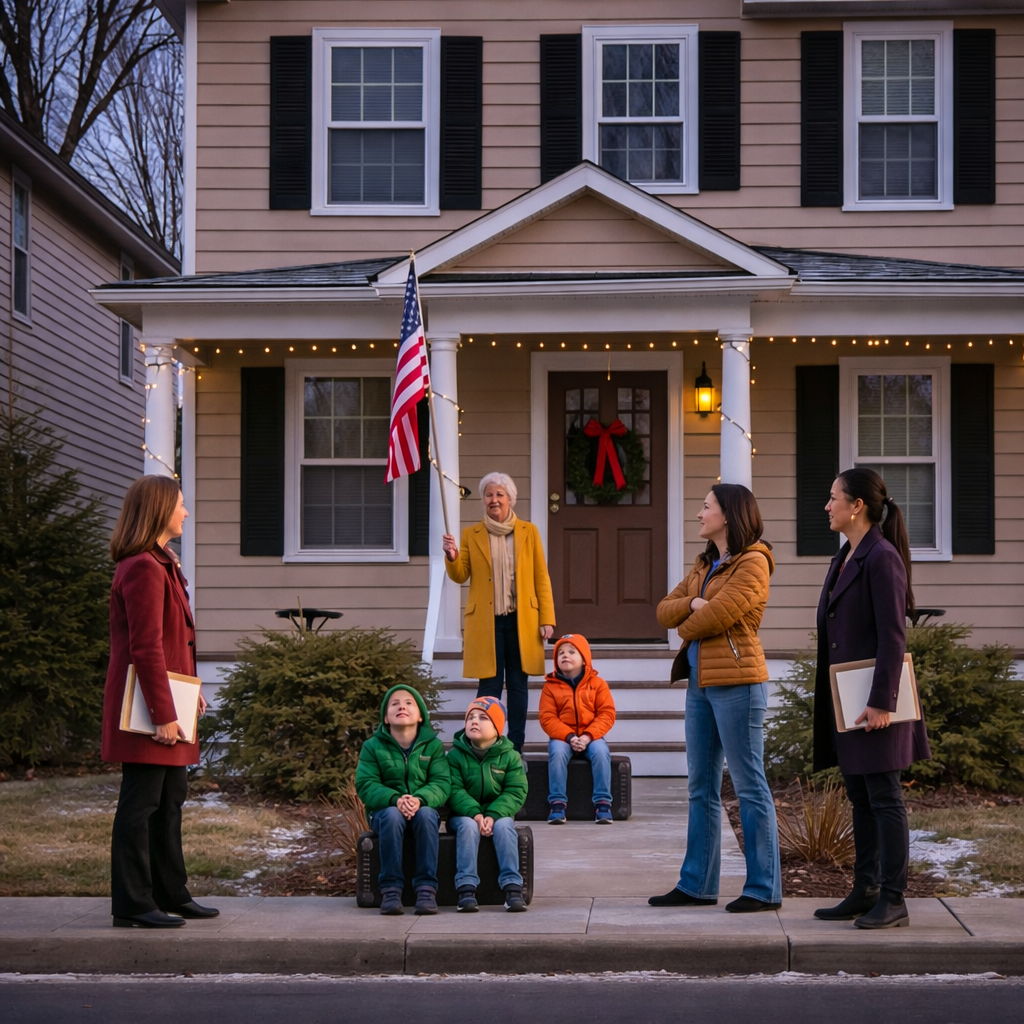
Suitcases were piled on the porch. Ivy was pacing, arms crossed, face tight with irritation. Her kids sat on the steps, bundled in coats, looking tired and confused.
Henry kept jiggling the doorknob, trying the key harder each time like force could unlock what wasn’t his anymore.
My mother’s voice rose in frantic bursts, each sentence sharper than the last.
Then she saw me.
Relief flashed across her face for half a second before anger swallowed it whole.
“Elena,” she snapped, stepping forward. “Open this door. Now.”
I walked up slowly, stopping at the bottom step.
“It’s no longer my responsibility,” I said.
My mother’s mouth fell open. “What does that mean?”
Ivy scoffed. “Are you serious right now?”
I lifted the folder in my hand, thick with paper. Proof. Ledger. Years flattened into documents.
“This outlines what I’ve covered, what I managed, and what I’m no longer doing,” I said. “There’s written notice inside. I’m not living here, and I’m not maintaining anything.”
Henry’s face reddened. “You can’t just change the locks.”
“I can,” I said. “And I did.”
My mother stared at me like she was searching for the version of me who used to apologize before she even knew what she’d done wrong.
“She always does what I tell her,” she whispered, more to herself than to anyone.”
“Not anymore,” I said.
I placed the folder on the porch railing, stepped back, and turned away.
Their voices rose behind me, overlapping, demanding, accusing, panicked.
But the locks were already changed.
The decision was already made.
And the silence that followed me back to my car was the first silence in years that belonged entirely to me.
The first night in my new apartment, I slept like I’d been drugged.
Not peacefully, not gently. I crashed. My body shut down the way it did after you’d been holding a weight for too long and suddenly the weight was gone, leaving only the ache of muscles that didn’t know how to relax.
I woke around three in the morning with my heart pounding, disoriented for a few seconds by the unfamiliar ceiling. No yellow kitchen light humming. No hallway creak. No footsteps shifting above my room, reminding me I was still in someone else’s orbit.
Just silence.
I lay there listening to it, waiting for it to turn threatening the way silence always had in my mother’s house. Waiting for the door to fling open, for my name to be called, for a demand to come down the hall like a gust of cold air.
Nothing came.
Eventually my breathing slowed. I rolled onto my side and stared at the pale outline of my father’s bookshelf by the window. The wood looked darker in the moonlight, steady and familiar, like the only piece of my past that didn’t feel like it belonged to someone else.
I fell back asleep.
In the morning, sunlight poured in through the wide windows and landed on my floor in long clean stripes. The apartment smelled like fresh paint and cardboard. I made coffee slowly, not because I had time, but because no one could interrupt me.
When my phone buzzed, I didn’t flinch.
The screen lit up with my mother’s name. Then again. And again. A cluster of missed calls stacked like a tower.
Texts followed.
OPEN THE DOOR NOW.
WHAT DID YOU DO TO THE LOCKS?
ELENA, THIS IS INSANE.
CALL ME BACK IMMEDIATELY.
I set the phone down on the counter and watched it vibrate itself into silence. The calm in me didn’t crack. It stayed put, quiet and solid, like a door finally latched.
I sipped my coffee and stared out at the trees outside my window, branches moving gently in the wind. The world didn’t feel like it was collapsing. It felt like it was continuing, indifferent to the drama my mother tried to summon.
By late morning, the calls shifted. Ivy’s name replaced my mother’s.
Her first voicemail was all fury, the kind of fury that always came from being inconvenienced.
“What the hell is wrong with you? The kids are freezing on the porch. Mom is freaking out. You think this is some kind of power trip?”
I deleted it without responding.
The next message was from Henry.
“Unlock the door. You are trespassing on private property.”
That one almost made me laugh, but the sound stuck in my throat. Trespassing. In the house where I had managed bills and repairs and appointments for three years, where I had held the entire structure up like a beam no one thanked.
My mother texted again.
Your father would be ashamed.
The words hit differently than she intended. Not because they hurt. Because they revealed how little she understood what shame actually was.
I stared at the message for a moment, then opened my notes app and typed a single sentence.
You don’t get to use him against me.
I didn’t send it. I didn’t need to. It wasn’t for her.
It was for me.
That afternoon I met Meera at a small Thai place near her apartment. She slid into the booth with her coat still on, cheeks pink from the cold, and looked at me like she was trying to confirm I was real.
“Well,” she said, scanning my face. “You look… weirdly calm.”
“I feel weirdly calm,” I admitted.
Meera tapped her chopsticks against the table. “That’s adrenaline. Or freedom. Or both.”
I stared at the steam rising from my tea. “They’re acting like I committed a crime.”
Meera snorted. “To them you did. You committed the crime of not being available.”
The waitress brought us food. I barely tasted it. My mind kept flicking back to the porch scene, the kids bundled on the steps, Ivy’s jaw tight, my mother’s panic turning to rage. It wasn’t guilt exactly. It was… awareness. Like I could see the pattern from a distance now, and distance made it clearer.
Meera reached across the table and squeezed my hand once.
“Did you do anything illegal?” she asked.
“No.”
“Did you steal anything?”
“No.”
“Did you abandon children you’re responsible for?”
“No.”
Meera lifted an eyebrow. “Then the only thing you did was stop volunteering.”
I swallowed.
Meera leaned back. “Now you need to let them feel the consequences of their decision. Because if you rush back, you’ll teach them the same lesson you always have: they can do whatever they want and you’ll clean up the mess.”
“I know,” I said softly.
“Do you?” she asked, not unkindly.
I met her eyes. “I do.”
That night, I finally called Adele.
She answered on the second ring.
“Tell me everything,” she said.
I did. The kitchen conversation. The demand. The way my mother laughed. The porch scene. The texts. The voicemail about my father.
Adele listened without interrupting. When I finished, she exhaled.
“Okay,” she said. “Here’s what we’re doing. We’re sending a formal notice today. You will not communicate directly about the property. All communication goes through my office. That removes their ability to bait you emotionally.”
“I already gave them a folder,” I said.
“Good,” Adele replied. “Now we back it with a letter that outlines: one, you are no longer residing there; two, you are not responsible for maintenance or bills; three, any dispute about your contributions will be addressed legally if necessary.”
The word legally sent a chill through me, not because I was scared of the law, but because my mother would treat it like betrayal.
“Let her,” Adele said, as if she’d read my mind. “She already betrayed you. You’re just naming reality.”
After we hung up, I sat on my couch in my quiet apartment and stared at my bare walls. My phone buzzed again.
Mia.
I hadn’t expected that. Not so soon.
The message was short.
Hi Aunt Elena. Mom gave me your number. Grandma’s yelling a lot. Are you okay?
My throat tightened.
I typed slowly.
Hi sweet girl. I’m okay. I’m sorry it’s loud there. None of this is your fault.
The response came almost immediately.
I liked when you lived here. You were nice. Grandma says you’re selfish.
The words were so simple they hurt more than any of my mother’s accusations. Because Mia wasn’t manipulating. She was reporting.
I stared at the screen until my vision blurred.
I typed back.
I love you. Even if adults are upset, you are still loved. If you ever want to meet for hot chocolate sometime, I’d like that.
Three dots appeared. Then:
Okay. I don’t know if Mom will let me. But I want to.
I swallowed hard.
Me too, I wrote. And meant it.
That night I cried for the first time since the kitchen conversation. Quietly, sitting on my floor with my back against my father’s bookshelf. The tears weren’t dramatic. They were steady, like something finally draining out of me.
Grief for what I hadn’t had. Relief for what I’d escaped. A strange tenderness for the girl I used to be, the nine-year-old who scrubbed juice out of carpet and never asked why Ivy didn’t have to.
The next day Adele sent the letter.
It was crisp and professional. No emotion. No apologies. It stated facts and boundaries. It gave a single point of contact.
My mother responded exactly the way Adele predicted.
She called me anyway. Eight times.
She left voicemails that swung from rage to sobbing within the same minute.
“Elena, how could you do this? How could you bring lawyers into our family? After everything I’ve done for you? You think you’re better than us now? You’re making me look crazy. Your sister has nowhere to go. The kids are crying. Henry is furious. I can’t believe you’re doing this to me.”
Each message ended the same way.
Call me back.
I didn’t.
By the end of the week, the story began to spread through extended family. Cousins I hadn’t spoken to in years suddenly texted with concern that felt rehearsed.
Your mom says you locked them out.
What happened?
That seems extreme.
I answered only once, to a cousin named Patrice who had always been kind to me at holidays.
Mom asked me to move out. I did. I’m not discussing details. Please respect that.
Patrice replied with a single line.
Proud of you.
I stared at it for a long time.
In the chaos, practical things happened too, the kind of things my mother had always expected me to handle. The water heater in the house started making noise. The mailbox key went missing. A pipe under the sink dripped.
My mother texted about each one, each message phrased like a command wrapped in panic.
The sink is leaking. Come fix it.
Do you remember the plumber’s number?
The thermostat isn’t working right.
I didn’t respond directly. I forwarded each message to Adele. Adele replied to my mother with the same calm professionalism every time.
Ms. Cain, please contact a licensed professional. Elena is not responsible for household maintenance.
The first time I saw Adele’s reply, a laugh burst out of me before I could stop it. Not because it was funny. Because it was the first time I’d ever seen someone speak to my mother the way I wasn’t allowed to.
Two weeks after I moved, my mother showed up at my apartment.
I wasn’t expecting it. I’d just come home from work, arms full of groceries, when I saw her car parked crookedly near the curb.
My stomach dropped.
For a moment, old instinct surged. The reflex to shrink. To brace. To apologize before she even spoke.
Then I remembered my keys on their hook. My space. My door.
I carried my groceries inside, set them on the counter, and took a slow breath. When I opened the door, my mother stood in the hallway like she owned it.
Her hair was pulled back too tight. Her eyes were red-rimmed. She looked exhausted, but her posture was still rigid with authority.
“Where have you been?” she demanded.
“I live here,” I said calmly. “I’ve been at work.”
She stepped forward, as if she could push past me.
I didn’t move.
Her gaze flicked over my shoulder, taking in the quiet apartment like she was appraising it. “So you really did it,” she said, voice trembling with anger. “You really left us.”
“You told me to leave,” I reminded her.
Her face twisted. “I didn’t mean like this.”
I almost smiled. Not out of cruelty. Out of recognition. She hadn’t meant for me to actually obey. She’d meant for me to scramble, to plead, to stay in my assigned place until she decided otherwise.
She swallowed hard. “Your sister needs help.”
“I’m sure she does.”
“And the kids”
“I’m not responsible for Ivy’s choices,” I said softly.
My mother’s eyes flashed. “So you’re just going to let them suffer?”
I felt the old guilt reach for me like a hand.
Then I pictured the kitchen table. The spoon. The laugh. The word parasite thrown like a stone.
“No,” I said. “I’m going to let you handle the situation you created.”
Her breath hitched. “You’re cold.”
“I’m clear,” I replied.
My mother’s hands shook. For a moment her voice softened, slipping into something almost vulnerable.
“Elena,” she whispered. “I can’t do this without you.”
There it was. The truth hidden under every insult.
Not love.
Need.
I held her gaze. “You’ve been doing it without me emotionally my whole life,” I said. “You can do it practically too.”
Her face crumpled, and for a second I thought she might apologize.
Instead she straightened, anger snapping back into place like armor. “Fine,” she hissed. “Don’t come crying to me when you regret it.”
I nodded once. “Okay.”
She stared at me like she expected me to flinch. When I didn’t, she turned sharply and walked away.
I closed the door and leaned my forehead against it for a long moment. My hands were shaking now, adrenaline finally catching up. But beneath the shaking was something solid.
I hadn’t caved.
I hadn’t fixed it.
I’d stayed in my life.
That night, I cooked pasta in my own kitchen while the city darkened outside my windows. I ate at my small table, alone but not lonely, letting the quiet settle around me.
My phone buzzed once.
A text from Mia.
Grandma came back mad. Mom is crying. I’m sorry.
I stared at the message, heart aching.
You don’t have to be sorry, I typed. You’re allowed to feel whatever you feel. I love you.
Then I added:
If you ever need a quiet place, I’m here.
I hit send, then sat back and let myself breathe.
The panic calls kept coming for weeks, fewer each day. My mother’s voice grew hoarser, less commanding, as reality settled in. Ivy’s messages turned from rage to silence when she realized guilt wasn’t working.
Life in my apartment grew steadier. I bought curtains. I hung a small framed photo of my father on the bookshelf. I learned my neighbor’s name. I started going to a pottery class on Thursdays, hands in clay, making lopsided mugs and laughing when they collapsed.
One evening, months later, I realized I hadn’t checked my phone in an hour.
The thought startled me.
Then I smiled, small and quiet, because that was the point.
I wasn’t rushing to fix it anymore.
I was finally living.