The Day My Mother Left My 7-Year-Old Daughter in the Snow for Four Hours: How One Word Changed Everything
The airplane touched down twenty minutes past schedule. I felt that particular kind of exhaustion that settles into your bones after five days of conference rooms that smell like burnt coffee and forced networking smiles. My phone was dying, the battery icon flashing red like a warning light I didn’t have energy to interpret. I’d been away from home, away from my daughter Ella, longer than either of us liked.
When I finally retrieved my suitcase from the baggage carousel, watching it circle endlessly with all the other identical black bags, I saw two text messages waiting on my lock screen. Both from my mother. I stared at them for a moment, my thumb hovering but not opening them.
“Call me when you land.”
“We handled a few things while you were gone. Don’t overreact.”
Something in my stomach twisted, but I was too tired to analyze it. I told myself I would deal with whatever family drama was brewing after I got home, after I showered, after I held Ella and felt like myself again. I silenced the notifications and headed toward the rental car return.
Outside the airport terminal, December air hit my face with that sharp bite that makes your nose sting immediately. The rental car smelled like artificial pine and someone else’s peppermint gum. I plugged my phone into the charger and watched the battery percentage crawl from two percent to three percent like it was doing me a personal favor.
The drive home took forty-five minutes through quiet American highways. Semi-trucks rumbled past. Christmas lights blinked on overpasses. Occasional billboards advertised insurance and fast food and happiness you could apparently purchase. At one exit, I passed a row of restaurants glowing like tiny islands in the darkness. At another, a gas station had mounted a plastic Santa on the roof, its mechanical arm waving stiffly in the wind.
By the time I reached our neighborhood, snowbanks lined both sides of the street where plows had pushed them into gray-white walls. Porch lights glowed warm and inviting in windows. Someone two houses down had hung a wreath so enormous it looked like it might swallow their front door. An American flag hung stiff and still in the cold.
I slowed my car as I approached our house, more from habit than intention.
That’s when I saw Ella standing by the gate.
Not playing. Not waiting excitedly. Just standing there, motionless, like someone had placed her in that spot and forgotten about her completely.
For half a second, my brain tried to rationalize it. Maybe she heard my car and ran outside. Maybe she was just getting fresh air for a moment. Maybe this was normal and I was overthinking because I was tired.
Then my headlights swept across her face, and I saw the truth written in her posture. The way her shoulders hunched forward. The way her arms were locked rigid against her sides. The way she didn’t move when my car stopped, like she wasn’t sure she had permission to approach.
I jerked the steering wheel and pulled over so hard my tires crunched into the accumulated snow at the curb.
I got out fast, leaving the engine running, door hanging open.
“Ella.”
She turned her head slowly, like the movement required tremendous effort. Her face looked pale in the harsh glow of my headlights. Snow clung to the knees of her pants. Her eyelashes were wet from either melting snowflakes or tears, I couldn’t tell which. Her lips had that faint bluish tint that doesn’t belong on any child’s face.
“Mom,” she said quietly.
It wasn’t relief in her voice. It was a question, as if she needed confirmation that I was real, that I was actually there.
I crossed the distance between us in three long strides and dropped to a crouch in front of her, my hands automatically going to her arms, checking without conscious thought. Cold? Too cold? Not just winter cold but outside-for-too-long cold. The kind of cold that seeps through layers and settles into bones.
“Hey,” I said, keeping my voice deliberately even because she needed steady right now. “Hey, sweetheart. I’m here. I’m right here now.”
She nodded once, a single mechanical bob of her head like she was confirming factual information, then leaned into me. Stiff at first, her body resistant, then all at once collapsing forward. Her whole frame shook, not with sobs but with deep shivers that came from her core.
That’s when I noticed a small detail that made my stomach twist into a knot so tight it hurt.
Her coat was buttoned wrong. Not kid-careless wrong, where buttons and holes don’t quite match up because small fingers get impatient. This was rushed wrong. Misaligned wrong. Like someone had bundled her up the way you package something you need to get rid of quickly.
“How long have you been out here?” I asked, fighting to keep my voice from sharpening into panic.
She shrugged against my shoulder, a tiny movement. “A while.”
When a seven-year-old says “a while,” it’s never actually a while. It’s always much, much longer than it should be.
I wrapped my coat around her shoulders immediately and pulled her closer, positioning my body to block the wind. My eyes lifted past her small form to scan the front yard, and that’s when I saw it for the first time.
The sign.
Massive white post driven into our lawn. Bright red letters visible from the street. Impossible to miss even in the darkness.
SOLD.
It looked cheerful somehow. Festive, even, like someone was proud of an accomplishment. Like this was good news worth announcing to every passing car. Like the entire neighborhood should celebrate this victory.
The sign was very clearly planted in our yard. Not the neighbor’s property. Not placed there by accident. Our yard. Our house.
I stared at it for several seconds too long because my brain kept trying to reframe what I was seeing. Maybe it was a mistake. Maybe someone from a real estate company got the address wrong. Maybe this was some kind of elaborate prank.
But the sign stood there, solid and real and deliberate.
“Ella,” I said, swallowing down the rising panic that wanted to show on my face, “can you tell me what happened today?”
She sniffed, her nose running in the cold, and swallowed hard. “Dad brought me home.”
That made sense. Brendan had custody this week. We’d planned the schedule carefully around my business trip. He always dropped Ella off at the end of his time. He never stayed long afterward. Conflict made him physically uncomfortable. If tension had a smell, Brendan would be the kind of person who held his breath until it dissipated.
“He dropped you off like normal?” I prompted gently.
“Yeah,” she said. “He waved at me and drove away.”
I nodded, processing. “And then what happened?”
“Then I knocked on the door,” she said, voice getting smaller. “I knocked a lot of times.”
My jaw tightened involuntarily. “Who opened it?”
“Grandma,” she whispered, her eyes dropping to stare at her snow-covered boots. “But she only opened it a little bit.”
A memory flashed through my mind. The way my mother used to open doors when I was growing up and she was angry. Never fully. Just enough to establish presence and power. Just enough to remind you she controlled access.
“What did Grandma say to you?” I asked carefully.
Ella’s voice became even smaller, barely audible over the wind. “She said the house was sold.”
I waited, keeping my hand firm and steady on her shoulder, giving her time and space to continue.
“She said I’m homeless now,” Ella whispered, and the word homeless coming from her seven-year-old mouth felt like a punch to my chest. “And that I should wait by the gate.”
Something hot and sharp went through my entire body, then settled into a place inside me that felt very calm and very, very dangerous.
“Did she let you inside at all?” I asked. “Even for a minute?”
Ella shook her head, snow falling from her hair with the movement. “She said I don’t live here anymore.”
“And you waited out here the whole time?”
She nodded, as if she genuinely didn’t understand there had been any other option available to her. “She said it would be better if I waited outside. She said it was an important lesson I needed to learn.”
A lesson.
An important lesson.
For a seven-year-old child.
Standing in the snow.
In December.
For hours.
I stood up slowly, deliberately, and took Ella’s small hand in mine. I turned us both toward the house, my mind crystallizing into sharp focus.
Inside the House That Was Suddenly “Sold”
The front door wasn’t locked when I tested the handle.
That single detail mattered somehow. I didn’t know why yet, but I felt it in my bones. The house itself was telling me something important.
We walked inside together, Ella staying close enough that her coat sleeve kept brushing against my leg, as if she needed constant physical confirmation that I was real and present and not going to disappear.
The house smelled wrong the moment we stepped through the threshold. Cardboard. Packing tape. Industrial cleaning solution. That peculiar hollow scent that rooms develop when they’re being systematically emptied of the life that filled them.
Cardboard boxes lined the hallway in neat stacks. Some were sealed with brown tape. Others sat half-packed, contents visible. My name was written on one box in thick black marker. Ella’s name appeared on another. My stomach went cold in a way the December weather couldn’t compete with.
Her purple backpack sat abandoned on the floor near the coat rack, half-unzipped, like someone had dumped it carelessly and moved on to more important tasks. A damp mitten lay beside it, flattened and forgotten. I picked it up without thinking, and the fact that it was still cold to the touch made something inside me snap tighter.
The house felt violated somehow. Rearranged. Claimed by people who had no right.
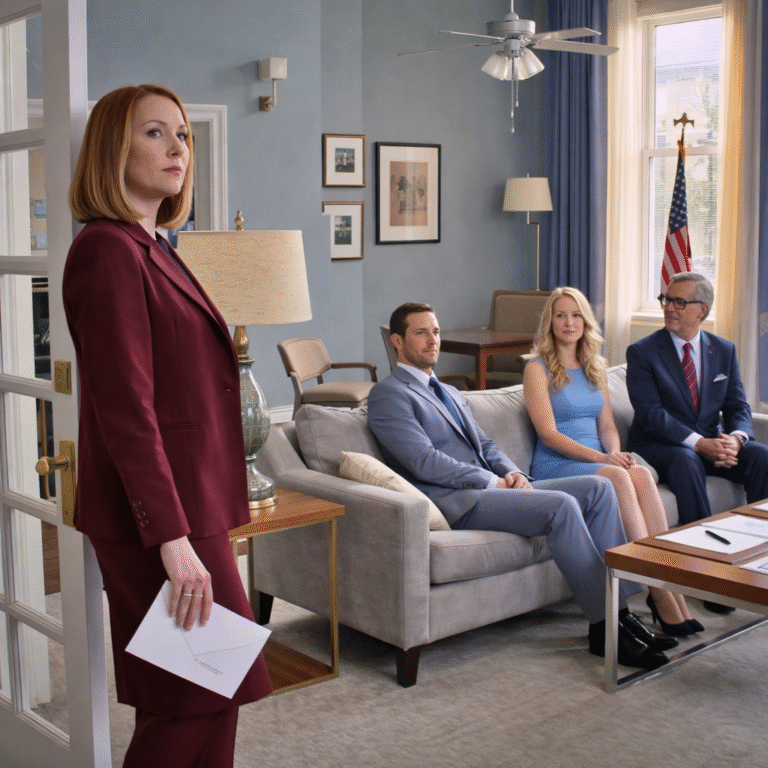
My mother emerged from the kitchen first, looking composed and slightly annoyed, like I had arrived home early and disrupted her carefully planned schedule. My father hovered behind her holding a roll of packing tape in one hand like it was a symbol of authority he could wield.
My sister Samantha sat at the dining table scrolling through her phone, legs crossed casually, humming a tune under her breath like this was a minor domestic inconvenience. A coffee mug sat in front of her decorated with little snowflakes. My coffee mug. The one I used on mornings when I needed comfort but didn’t have time to acknowledge that need.
“You’re back,” my mother said flatly, as if commenting on weather.
“Yes,” I replied, keeping my voice level. “I live here.”
Her eyes flicked briefly to Ella, then back to me. “She’s inside now. That’s good.”
“You left her outside,” I said. Not a question. A statement of fact.
My mother’s mouth tightened into that thin line I recognized from childhood. “I told her she had a coat on. She was fine.”
I looked around deliberately at the boxes stacked everywhere, at the walls where Ella’s drawings had hung and now showed only nail holes, at the empty spaces where our life used to be visible. The refrigerator door looked bare, magnets missing, the little plastic animals Ella loved to rearrange gone. The holiday card I had taped to the pantry door last week had vanished.
It looked like someone had started systematically erasing us.
“What is going on?” I asked, though part of me already knew. Part of me had known the moment I saw that sign.
My father cleared his throat importantly. “We sold the house, Sarah.”
The words didn’t land properly at first. They hovered in the air between us, waiting for permission to become real.
“You did what?”
“We sold it,” my mother repeated, slower this time, patient, like she was explaining something obvious to someone dim. “You refused to listen to reason. You wouldn’t help the family, so we took care of it ourselves.”
Samantha finally looked up from her phone, eyes flat and bored. “It’s for the family. Someone had to be practical.”
I let out a breath that sounded almost like a laugh because my body was trying desperately to keep me from doing something I would regret.
“You sold my house,” I said, each word placed carefully. “You don’t have the authority to do that.”
My father straightened his spine, pulling himself up to full height. “We had permission on file. Legal documentation.”
I stared at him, genuinely confused now. “For what? For Ella’s school forms and medical emergencies. Not for selling my house.”
My mother waved one hand dismissively, like he had mentioned the wrong brand of cereal. “Technical details. The point is, you don’t need a house this big anyway. You travel constantly for work. You’re divorced. This place is completely wasted on you.”
“Wasted,” I repeated so quietly the word barely made it into the air.
Samantha’s smile sharpened into something cruel. “You could always rent an apartment somewhere. Plenty of people rent.”
I looked down at Ella. Her face was pressed against my shoulder now, small fingers twisted desperately into the fabric of my sweater like she was afraid I might evaporate if she loosened her grip.
“You told my seven-year-old daughter that she was homeless,” I said.
My mother shrugged, an actual casual shrug. “It’s not untrue if you don’t live here anymore. Children need to understand reality.”
“You made her stand outside in the snow for hours,” I continued, my voice staying measured even as rage built pressure behind my ribs.
“She needed to understand the situation,” my mother replied, using that particular tone she reserved for explaining things she considered self-evident. “She needed to see what happens when people don’t cooperate with family decisions. When people refuse to share resources properly.”
My father nodded along like this was reasonable parenting. Like this made perfect sense.
And that’s when something fundamental clicked into place inside me.
I had been shocked. Confused. Tempted to argue and demand explanations. But this wasn’t an argument I could win with logic. This was a declaration. My parents announcing what they believed they were entitled to, what they thought they had the right to take.
And declarations only move in one direction.
“Okay,” I said.
My mother blinked, clearly thrown by my tone. “Excuse me?”
“Okay,” I repeated calmly.
I didn’t explain what I meant. I didn’t ask follow-up questions. I didn’t enumerate all the ways they had crossed lines. I didn’t raise my voice, because raising your voice is what you do when you want someone’s permission to be angry.
I just turned around and walked toward the door.
Behind me, my mother’s voice rose sharply. “Sarah, you can’t just walk away from this conversation. We need to discuss the timeline and your responsibilities and where you’re going to…”
I closed the door, cutting off her words mid-sentence.
Outside, the cold air hit my face like a slap of clarity. I kept one firm hand on Ella’s shoulder and walked her to my car, opening the passenger door and buckling her into the seat with hands that were perfectly steady now. Steady in the way you get when the decision has already crystallized.
Ella’s eyes tracked my face carefully, searching for the moment I would break down.
“Are we really homeless?” she whispered, fear making her voice smaller than it should ever be.
“No,” I said firmly. “We are not homeless. That house is ours, and no one gets to take it.”
I started the engine. In the rearview mirror, I could see my mother standing in the doorway with her arms crossed, absolutely certain she had won this confrontation.
I didn’t give her the satisfaction of seeing me hesitate or look back again. Looking back is how you get pulled into the gravity of people who think they own you.
I drove away into the December night, and everything changed.
The Hotel Room Where We Rebuilt Safety
We ended up at a hotel off the main commercial road, the kind of mid-range chain where the lobby smelled like cinnamon air freshener layered over industrial cleaning solution. The front desk clerk wore a Santa hat that looked like it had survived too many consecutive shifts. A small artificial Christmas tree blinked cheerfully in the corner, its lights timed to a pattern that felt aggressively optimistic.
The clerk gave me a room on the second floor. I didn’t choose this hotel because it was nice. I chose it because it was close, well-lit, open twenty-four hours, and I could get us inside without having to think too hard about anything.
In the room, Ella sat on the bed nearest the window with her shoes still on, staring at the television screen like it was a portal to some other, safer dimension. I turned the thermostat up, then turned it up again when the first blast of warm air didn’t feel sufficient. She didn’t complain about the temperature or ask for anything.
That scared me more than anything else that had happened. If she had complained, it would have meant she still believed adults were listening and responsive to her needs.
I knelt in front of her and carefully peeled off her wet socks, rubbing her small feet between my hands until color returned and warmth spread through the cold skin. She watched me like she was afraid I might stop if she moved wrong.
“You can take your coat off now, sweetheart,” I said gently. “You’re inside where it’s warm.”
She hesitated, then shook her head firmly. “I want to keep it on.”
“Okay,” I said, because I had learned in the last two hours what the word okay really meant. Okay meant I’m not going to argue with your fear. Okay meant I’m not going to make you feel foolish for protecting yourself however you can.
I ran a warm bath and let her sit in it longer than usual, the hot water gradually pinking her cheeks back toward normal. I washed her hair slowly, carefully, like I was untangling something that had gotten knotted deep inside her rather than just cleaning strands.
When I finally tucked her into bed afterward, she made an unexpected request.
“Can you move the chair?” she asked, pointing to the desk chair near the window.
“Move it where, baby?”
“By the door,” she said with complete seriousness.
I paused, looking at her face, then complied without questioning the logic. I dragged the chair across the carpet, its legs making soft scraping sounds, and positioned it in front of the door.
“There,” I said. “Chair’s by the door now.”
She nodded like that accomplished something important, like that was how you made absolutely certain no one could open a door and tell you to go back outside again.
She fell asleep still wearing her coat, her small hands curled into fists even in sleep, like she was holding onto something invisible. I sat on the other bed with my shoes still on because taking them off felt like surrendering momentum, and right now momentum was the only thing keeping me functional.
My phone buzzed repeatedly on the nightstand. I didn’t check it. Not because I’m mature or above pettiness, but because I’m strategic. If I saw my mother’s name lighting up that screen, I would do something that would create a different kind of problem I wasn’t ready to handle yet.
I stared at Ella for a long time. Her eyelashes resting against her cheeks. The faint pink pressure line from where her face pressed into the pillow. The way she kept her hands tucked close to her chest like she was conserving warmth or protecting something precious.
Then the question I had been deliberately avoiding all evening finally grabbed me by the throat and demanded attention.
How long was she actually outside?
I knew “a while.” I knew “too long.” But I didn’t know the actual number, and the number mattered desperately.
Numbers are evidence. Numbers are proof. Numbers are the difference between someone believing you and someone suggesting you’re exaggerating.
I slipped into the bathroom and closed the door softly behind me. The mirror showed a woman who looked surprisingly normal for someone whose parents had just told a seven-year-old she was homeless.
I called Brendan.
He answered on the second ring, his voice cautious but not defensive. “Hey. That was… unexpected.”
“Hi,” I said, keeping my voice level. “Quick question. What time did you drop Ella off today?”
A beat of silence while I heard him thinking, not stalling. “About two o’clock. Maybe two-fifteen. Why?”
I did the mental calculation automatically. I had arrived at the house a little after six. My throat tightened, but my voice stayed steady.
“Okay,” I said. “So she was outside for approximately four hours.”
“What?” His voice jumped an octave. “No. Sarah, no. Your mom answered the door. I saw her open it.”
“I’m not asking what you saw happen,” I said carefully. “I’m asking what time you dropped our daughter off.”
He exhaled sharply, frustration mixing with confusion. “Around two. I swear that’s accurate.”
“Okay,” I repeated, because I needed him to hear that I believed him. “Thank you.”
Silence stretched between us, then he spoke quieter. “Sarah, I didn’t leave her with some stranger on the street. I left her with your mother. She was standing right there at the door.”
“I know,” I said, and I meant it genuinely.
I wasn’t calling to make Brendan the villain in this situation. He’s many things, most of them frustrating. He’s conflict-avoidant to a pathological degree. He’s allergic to confrontation. He’s the human embodiment of the phrase “I don’t want to get involved.” But he’s not psychic. He couldn’t have known my mother would transform a routine custody handoff into some twisted life lesson.
“I’m not blaming you for this,” I said, because he needed to hear it explicitly and because it was true. “I just needed to confirm the timeline.”
Another exhale, this one relieved. “Okay. Okay, good.”
“You definitely saw my mom open the door when you dropped Ella off?” I asked, double-checking.
“Yeah,” he confirmed. “Ella waved goodbye to me. She looked fine. She was bundled up in her coat.”
I swallowed the rising nausea. “Did my mom say anything to you?”
“No,” he said. “She barely even looked at me, which honestly felt like a win at the time.”
A sound that wanted to be a laugh tried to climb up my throat and turned into just air.
“Same,” I said quietly.
He hesitated before asking, “Is Ella okay now? Is she safe?”
“She’s asleep,” I told him. “She ate something. She’s warm. She’s safe.”
“Thank God,” he said, and for once it didn’t sound like an empty phrase. It sounded like genuine feeling.
“Brendan,” I said, keeping my tone calm and clear, “if anyone contacts you about this situation in the coming days or weeks, my parents, Samantha, anyone from that side, do not engage with them. Just tell me immediately.”
“I won’t talk to them,” he said quickly, almost eagerly. “I’m not stepping into whatever this is.”
The smartest thing he had said in years.
“Okay,” I said. “Thank you for answering my questions.”
We disconnected.
I stood in that small hotel bathroom with my palms pressed flat against the cold sink and let the number settle into my chest like a stone dropping into deep water.
Four hours.
Four hours of my seven-year-old daughter standing outside in December weather, believing she had done something wrong enough to deserve exile.
Four hours of her thinking that waiting obediently was what good children did when adults told them they didn’t have a home anymore.
I went back into the main room, checked on Ella again, watching the rise and fall of her breathing under the blankets, and finally removed my shoes like a person attempting to pass for human. Then I sat on the edge of my bed and did the one thing I hadn’t let myself do yet.
I looked at the chair I had positioned by the door at her request.
And I understood with perfect, painful clarity that something fundamental inside Ella had changed shape tonight. Something about her understanding of safety and home and whether adults could be trusted.
Morning Brought Hunger, Which Meant Hope
In the morning, Ella woke up announcing she wanted waffles, which mattered more than most people would understand.
Hunger is hope. Hunger means you still believe the world will provide. Hunger means you’re planning for a future that extends past this moment.
“I want waffles,” she declared like she was issuing an executive order.
“Of course you do,” I said, relief flooding through me. “This place charges ridiculous prices for bottled water. They can definitely afford to give you waffles.”
She smiled then. Small but genuine. Real. And I held onto that smile like it was physical proof she was still herself underneath the trauma.
We ate in the hotel breakfast area surrounded by other people pretending they weren’t also living temporary versions of their lives. A man in a work jacket read news on his phone. A couple argued in whispers over paper coffee cups. Someone’s toddler threw cereal like confetti while exhausted parents tried to look like they had everything under control. The television played morning weather with a relentlessly cheerful anchor discussing snow like it was entertainment.
Ella pushed syrup across her plate in slow, deliberate lines, then looked up at me with an expression that said she had something important to ask but didn’t know how to start.
“Mom,” she said finally, carefully, “did I do something bad?”
My chest constricted so fast I almost choked on the coffee I’d been swallowing.
“No,” I said immediately, firmly. “No, sweetheart. You didn’t do anything bad. Not one single thing.”
“But Grandma said…” Her voice trailed off into uncertainty.
“I know what Grandma said,” I replied, keeping my tone absolutely steady. “Grandma was completely wrong.”
She stared at my face, searching for truth the way children do when they’re trying to decide whether to believe the adult in front of them.
“Am I in trouble?” she asked quietly.
“No,” I said again, leaning forward so she could see my eyes clearly. “You are not in trouble. You are safe. And I am never going to let anyone make you feel like you have to earn your place in your own home ever again.”
She didn’t smile that time, but her shoulders dropped slightly, releasing tension she’d been carrying since yesterday. Her body had been holding a weight it didn’t know how to put down.
Back in our room, I turned on cartoons and handed her the remote control like it was a sacred object conferring power.
“Stay here and watch whatever you want,” I said. “I need to make a couple of phone calls.”
“Are you calling Grandma?” she asked, voice suddenly cautious.
“No,” I said firmly. “I’m calling adults who don’t think a gate is appropriate childcare.”
She nodded like she liked the sound of that, even if she didn’t fully understand the implications.
The Calls That Started Everything
I stepped into the hotel hallway, letting the door close softly behind me, and made my first phone call. I kept my voice calm and my facts clean and organized. Names. Specific times. Exactly what Ella was told. Precisely how long she was left outside. Where I found her and in what condition.
The person on the other end of the line went quiet for several seconds, then started asking questions in that particular careful voice people use when they’re realizing something is significantly bigger and more serious than they initially thought.
When I hung up, my hands were still perfectly steady. It wasn’t catharsis or emotional release.
It was documentation. A trail of evidence.
Then I made the second call, the one that would change the trajectory of everything.
A colleague had once mentioned an attorney who “moves fast” and “doesn’t play nice when people get entitled about things they don’t own.” At the time, I had laughed at the description. That morning, I didn’t laugh at all.
We arranged a video consultation because speed mattered more than professional ambiance. He appeared on my phone screen looking like someone who owned multiple expensive suits and had never once smiled by accident or politeness.
“Sarah,” he said briskly, “tell me what happened. Give me the short version first.”
So I gave him the condensed facts. My parents claiming they sold my house. The SOLD sign in the yard. My daughter left outside for four hours. The emergency permission documents they were apparently stretching beyond recognition.
He didn’t gasp dramatically. He didn’t make sympathy face or offer condolences. He didn’t say “I’m so sorry this happened to you.” He just started mentally sorting facts like they were files that needed proper organization.
“Do you own the home yourself?” he asked immediately.
“Yes,” I confirmed. “Only my name on the deed.”
“Did you give anyone permission to list or sell it?” he asked.
“Absolutely not.”
“Are your parents listed as owners anywhere in any documentation?” he pressed.
“No. Not anywhere.”
He nodded once, decisively. “Then what they’re claiming is either not completed, not legitimate, or not legally permissible. Possibly all three simultaneously.”
I explained the emergency permission documentation I had established for Ella-related situations. The kind of thing responsible single parents arrange when they travel for work. The kind of thing designed to protect your child in genuine emergencies, not hand someone a weapon to use against you.
He asked if that permission included anything about the house itself, about property decisions or real estate transactions.
“No,” I said clearly. “It’s extremely narrow in scope. School situations and medical emergencies only. Nothing about property or financial decisions.”
“Excellent,” he said, and I heard approval in his tone. “Then if anyone attempted to stretch that documentation to cover real estate transactions, the professionals handling the sale will become very nervous the moment they realize there’s a discrepancy between claimed permission and actual permission.”
“What happens now?” I asked.
“I identify who’s involved in the sale process,” he explained. “If there’s a SOLD sign physically placed in your yard, that means there’s a listing agent somewhere and a title company or closing office processing paperwork. I contact them directly and inform them that the actual legal owner disputes the permission being claimed. That typically triggers an immediate hold on all proceedings.”
“Typically,” I repeated, catching the qualifier.
He gave a slight shrug. “People in real estate and title work get extremely careful when they suspect someone might be misrepresenting ownership or authority. It’s a liability issue.”
He leaned forward slightly toward his camera. “Here’s what’s critically important, Sarah. Do not contact your parents about any of this. Do not threaten them. Do not warn them what’s coming. Let them be genuinely surprised when reality arrives.”
“A strategy that matches my current emotional state perfectly,” I said.
He outlined what he needed from me. Proof of identity. Proof of sole ownership. A few specific details to enable him to move quickly. He said he would start immediately, that very morning.
When the video call ended, nothing had physically changed in the hotel hallway where I stood.
But something fundamental had shifted in the air, because now the situation had left the contained ecosystem of family drama and entered the adult world of legal reality, where people don’t care about your mother’s tone or your sister’s tears.
They only care about what you can prove with documentation.
The SOLD Sign Was a Message
While I waited for the next developments, I kept thinking about that SOLD sign. Not just the object itself, but the audacity of placing it. How public it was. How confident. How my mother had positioned it like planting a flag on conquered territory.
The more I thought about it, the more I understood something crucial. The sign wasn’t primarily for strangers driving past. The sign wasn’t for potential buyers or neighborhood gossip.
The sign was for me.
It was carefully calculated to be the very first thing I saw when I returned home. It was designed to make me feel small, late, powerless, like I had missed the critical moment where my entire life was decided without my input.
It was meant to communicate: We did this without you, and you cannot stop it.
By midday, my phone started vibrating so persistently it felt like it was trying to escape the nightstand.
Dad called. Mom called. Samantha called. Over and over, the names cycling through my screen.
I didn’t answer any of them.
A voicemail arrived from my father first. His voice sounded strained, pitched higher than normal, slightly panicked.
“Sarah, we just received a very concerning phone call. Someone is claiming there are questions about the sale. They’ve put everything on hold. This is absolutely ridiculous and unnecessary.”
On hold. Those two words meant everything was working.
A second voicemail followed quickly, this one from my mother, absolutely furious in that particular clipped way she uses when she’s trying to sound in control while actively losing it.
“They’re accusing us of impropriety,” she hissed into the phone. “You need to call them immediately and fix this misunderstanding. Do you hear me, Sarah?”
Then a text message from Samantha appeared on my screen:
“What did you do???”
I stared at the message without responding.
I didn’t know exactly who had contacted them yet, or what specific language had been used in those conversations. But I knew this much with certainty: someone official had just told my parents “no,” and it had hit them like an unexpected collision.
Ella looked over from the bed where she was watching cartoons. “Mom? Is that them calling?”
“Yeah, baby.”
“Are they yelling?” she asked.
I exhaled slowly. “They’re upset about something.”
“Why are they upset?”
Because they genuinely believed they could do whatever they wanted. Because they thought rules and laws applied to other people but not to them. Because they thought a seven-year-old child was an acceptable casualty in their plan.
But I didn’t say any of that to Ella.
“Because they don’t like being told to stop,” I said instead.
Ella nodded once like that explanation made perfect sense to her, then returned her attention to the cartoon like she was actively trying to live in a world where adults didn’t behave this way.
That night, she fell asleep without asking me to move the chair by the door.
Not because she suddenly felt completely safe again.
Because she was too exhausted to keep actively guarding herself.
I watched her breathe in the dim light filtering through the hotel curtains and tried very hard not to imagine those four hours from her perspective. Standing at the gate. Snow accumulating on her shoulders. The house visible behind her. The growing understanding that maybe, possibly, she wasn’t going to be let back inside.
I kept thinking about my mother’s face in the doorway that first night. That absolute certainty. That calm conviction that she was teaching an appropriate lesson.
Certainty like that doesn’t apologize. Certainty like that doesn’t back down. Certainty like that keeps pushing forward until it collides with something harder than itself.
The Lawyer’s Call That Changed Everything
The next morning, I received a call from the attorney.
His voice maintained that same calm, clipped, all-business quality.
“They moved quickly on the sale,” he explained. “That’s why the sign went up when it did. They were trying to create momentum and fait accompli.”
“So it wasn’t actually final yet,” I said, more statement than question.
“Correct,” he confirmed. “It was in active process, not completed. The moment I contacted the relevant offices and informed them that the actual legal owner disputes the claimed permission, everything paused immediately.”
“And that’s why my parents received those calls,” I said, pieces clicking into place.
“Exactly,” he said. “Because suddenly they had to explain something they couldn’t explain cleanly.”
I sat on the edge of the hotel bed, staring at Ella’s small sneakers lined up carefully by the wall like she had placed them there to remind herself she still belonged somewhere.
“They must have shown someone documentation,” I said slowly. “They had to present something official-looking.”
“They did,” he confirmed, voice going flat. “They presented a version of your emergency permission that included language you never agreed to.”
My mouth went dry. “So they altered it.”
“They expanded the scope significantly,” he said. “And that’s precisely what triggered the red flags for the professionals involved.”
The words landed like cold water splashing across my face.
I thought about how my mother had dismissed “details” like they were irrelevant trivialities. I thought about how my father had held that roll of packing tape like he was in charge of reality itself.
“What happens now?” I asked.
“We’re operating on two separate tracks,” he explained. “Track one addresses the house situation: stopping any sale process permanently and removing anyone who has no legal right to occupy your property. Track two addresses what happened to your daughter. That will be handled through appropriate child welfare channels.”
I pictured Ella standing at that gate again, and my stomach clenched.
“Do I need to involve Ella directly in any of this?” I asked, hating the question but needing the answer.
“No,” he said firmly. “Your job is protecting her. Adults handle the adult situations.”
That was the first thing anyone had said that made me feel like I could actually breathe properly.
He outlined next steps, what he would handle, what I needed to provide. He also gave me one instruction, repeated twice for emphasis, like he knew exactly who he was dealing with.
“Do not communicate directly with your parents,” he said. “Not now. Not until this is resolved. Let them experience the consequences without warning or preparation.”
Then he added, quieter but no less firm, “They were willing to leave a child standing in snow to prove a point about power. They don’t deserve advance notice of what’s coming.”
After we disconnected, I returned to the hotel room and watched Ella for a long moment. She was building something with hotel sugar packets, arranging them in careful geometric patterns on the small table.
“What are you making?” I asked gently.
“A wall,” she said without looking up from her work.
A wall.
I knelt beside her. “To keep bad people out?”
She shrugged, still focused on her construction. “To keep me in.”
My throat tightened so suddenly I had to swallow hard against it.
“Sweetheart,” I said softly, “you don’t have to keep yourself contained or small.”
She paused in her work, then looked at me with those serious eyes children get when they’re asking something profound they don’t have proper words for yet.
“Then who does it?” she asked simply.
I held her gaze steadily. “I do,” I said. “I keep you safe. That’s my job as your mother. You don’t have to make yourself smaller or guard yourself or earn your safety.”
She stared at me for a long moment, then returned to carefully stacking sugar packets like she was practicing how to believe me.
The Meeting That Made Everything Official
Three days later, I met the attorney in person at his office.
The space was deliberately unremarkable. No dramatic city skyline views. No intimidating leather furniture. Just a functional desk, a printer humming quietly in the background, and a man who looked like he had seen this exact type of family situation enough times to be genuinely tired of it.
He slid a folder across the desk toward me. Inside were emails, forms, screenshots, official documents. Clean and boring and absolutely devastating in their implications.
“They listed the home,” he said without preamble. “They accepted an offer quickly. That’s why the SOLD sign went up so fast. But the sale wasn’t completed yet. It was still in the processing stage.”
“So the sign was premature,” I said. “It was theater.”
“It was confidence,” he replied. “And confidence is often at its loudest right before it collapses completely.”
He pointed to one specific page in the folder, where the emergency permission language had been expanded far beyond what I had actually authorized. I didn’t need him to explain the technical details. I could see the difference clearly, the way you can immediately spot a forged signature.
“That’s not what I signed,” I said flatly.
“I know,” he replied. “That’s exactly why the hold happened so quickly. People who handle real estate transactions become extremely nervous when they spot inconsistencies involving large assets.”
I let the word “inconsistencies” settle in my chest. It sounded so polite and professional. But what it actually meant was that my parents had done something fundamentally dishonest.
“What happens next?” I asked.
“First priority,” he said, “we remove their access to your property immediately. They don’t get to continue living there. They don’t get to claim they belong there. They absolutely don’t get to use your home as leverage in any capacity.”
“And if they refuse to leave?” I asked.
His expression didn’t change at all. “Then we use formal enforcement procedures.”
The word “enforcement” wasn’t dramatic. It was simply factual. It felt oddly comforting, like gravity. Like something that existed independently of my mother’s opinions.
I signed the documents I needed to sign. Not because I wanted to escalate family conflict, but because I needed reality to be documented and official.
When I stood to leave, he said one more thing.
“Don’t take your daughter back to that house until this is completely resolved,” he said firmly. “Even if she begs to see her room. Even if she misses her stuffed animals. You are not putting her back into a space that recently became a threat to her safety.”
I nodded. “She won’t go back until it’s genuinely safe.”
He watched me for a moment, then added quietly, “What they did wasn’t just a power play or family disagreement. It was a message delivered through a child. And messages like that don’t soften on their own. They require consequences.”
They Refused to Leave Voluntarily
My parents did not leave the house willingly.
My mother called first, oscillating between fury and wounded indignation, as if I was the person who had done something outrageous and incomprehensible. My father followed with apologies that somehow never included actual responsibility or acknowledgment of wrongdoing. Samantha sent a barrage of text messages suggesting that if everyone would just calm down and be reasonable, this could all be resolved.
I didn’t respond to any of them.
Blocking phone numbers is not immature behavior. It’s operational efficiency.
The formal notice was delivered. It expired without compliance. Enforcement was scheduled.
I didn’t bring Ella with me that day. She stayed with a friend from school, safe and happily distracted, completely unaware that her grandparents were about to experience consequences for the first time in their lives.
I parked my car down the street from the house and watched from a distance.
The neighborhood looked exactly like it always had. Snow covering front lawns. Holiday decorations still hanging on porches. Cars passing slowly. A dog barked once somewhere, then went quiet. Someone’s garage door opened and closed with that familiar mechanical sound. Everything appeared completely normal.
But my heart wasn’t beating normally at all.
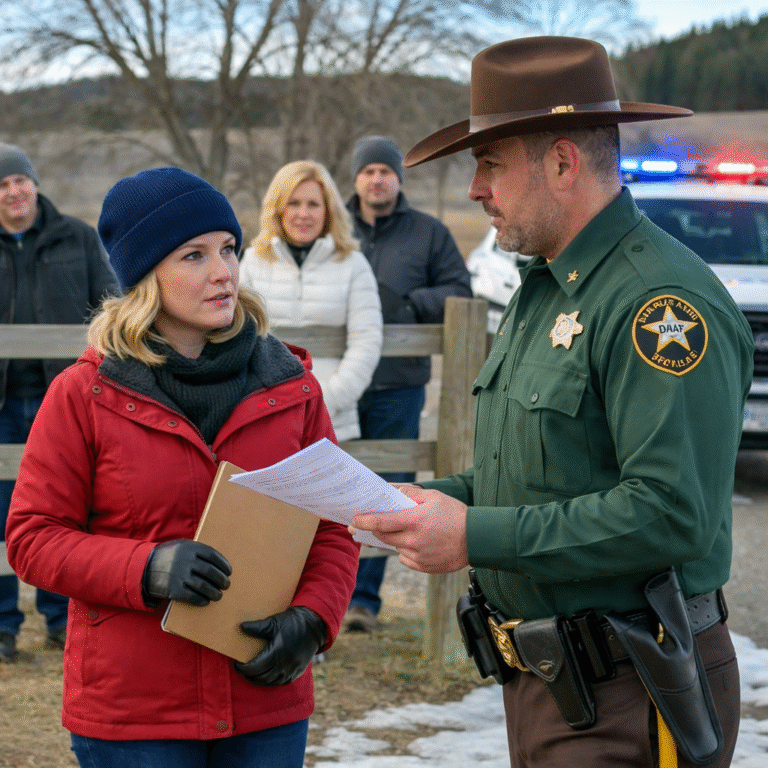
The deputy knocked on the front door, explained the situation professionally, and waited. My mother argued loudly enough that I could hear her voice carrying from where I sat. My father hovered behind her with his hands flapping uselessly, like he was trying to smooth out air itself. Samantha appeared in the doorway crying dramatically, performing grief loud enough to be heard from the sidewalk, as if tears could somehow rewrite legal documents.
At one point, my mother pointed directly at the deputy and shook her head with utter disbelief, like she genuinely couldn’t comprehend that anyone would speak to her this way. At another moment, Samantha dropped onto the porch steps like she was auditioning for a dramatic film, her fiancé standing awkwardly beside her looking like he had just realized he’d gotten engaged into something fundamentally rotten.
None of their performance mattered.
When they were finally escorted from the property, my mother spotted me sitting in my car and made a direct beeline toward me like proximity was still some form of power she could wield.
“I hope you’re proud of yourself,” she snapped, her breath visible in the December cold.
I considered the question honestly for a moment.
“I’m relieved,” I said calmly. “Pride might come later.”
Her face twisted into an expression I’d never seen before, like she couldn’t process existing in a world where her voice didn’t automatically end every conversation.
My father took a hesitant step toward me, eyes shining with unshed tears, hands extending like he wanted to touch my arm and somehow reset this entire situation like it was a scene he could control and redirect.
“Sarah, please,” he started, voice cracking.
I lifted my chin slightly. “Don’t,” I said quietly but firmly.
It wasn’t loud. It didn’t need volume. The single word carried everything it needed to carry.
The deputy closed and locked the front door, then walked over and handed me the keys to my own house.
“Property is secured,” he said professionally.
I nodded, fingers closing around the metal. “Thank you.”
Then I stood there for several long moments, looking at my own front door like it might still argue with me, like it might still belong to someone else’s version of reality.
Bringing Ella Home to a House That Was Finally Safe
That evening, I brought Ella home.
She stood in the doorway of our house looking around cautiously, like she expected everything to be different somehow. Like she expected to see the gate again, the snow again, that terrible SOLD sign again.
“Are they really gone?” she asked in a small voice.
“Yes,” I said clearly. “They’re gone. This is our home again.”
She didn’t run inside excitedly. She didn’t squeal with joy. She didn’t do any of the normal enthusiastic child things you might expect.
She stepped across the threshold slowly, carefully, her eyes scanning every corner like she was checking for hidden traps.
I turned on every lamp in the living room first, flooding the space with warm, soft light. I didn’t want shadows anywhere. I didn’t want anything that could remind her of standing outside in the cold darkness looking in at a home she couldn’t access.
We walked through the house together, room by room. I pointed out her drawings that I had rehung on the refrigerator, restored to their proper places. I let her choose where to put her backpack down. I opened the pantry door so she could see it was full again, like abundance was another form of safety and reassurance.
When we reached her bedroom, she froze in the doorway.
Her bed was made, but not the way I made it. Too neat. Too tight. Military-precise corners. Like someone had wanted to demonstrate ownership through hospital corners on a child’s sheets.
Ella swallowed visibly. “Did Grandma sleep in here?”
“She was in the house while we were gone,” I said honestly, because lying would make her feel crazy and unable to trust her own perceptions. “But she doesn’t get to come in here anymore. Ever.”
Ella walked slowly to her dresser and opened the top drawer. Her favorite unicorn pajamas were still folded inside. She touched them gently, like she was confirming they were real and hadn’t been taken away.
Then she sat down on the carpet and started lining up her stuffed animals in a careful row, organizing them by size.
“What are you doing, sweetheart?” I asked gently.
“Making sure they’re all here,” she whispered.
I sat down on the floor beside her, the carpet cold through my jeans.
“They’re all here,” I said softly. “Everything that belongs to you is still here.”
She nodded once, then reached for her stuffed rabbit, the threadbare one she’d slept with since she was three years old. She held it tightly against her chest, pressed her face into its worn fur, and for the first time since I had found her at that gate, she cried.
Not loud or dramatic. Just quiet, shaking sobs that came from somewhere deep inside where fear had been living.
I wrapped my arms around her and rocked her slowly, saying nothing at first because sometimes words are too small to hold what needs to be expressed.
When her breathing finally steadied and the tears slowed, she pulled back slightly and looked at me with wet eyelashes and that heartbreakingly serious expression.
“Mom?” she whispered.
“Yeah, baby.”
“If you have to go away again for work… will I have to wait outside?”
The question hit me so hard I had to breathe deeply before I could answer properly.
“No,” I said, and I made it an absolute promise, not just comfort. “Never again. If I travel, you will always be with people who treat you like you belong and matter. Always. You will never stand outside waiting for anyone’s approval or permission ever again.”
She watched my face intently for a long moment, then nodded slowly like she was filing this information away carefully, like she was trying to learn how promises actually work when adults make them.
That night, I sat in the hallway outside her room much longer than usual, just listening to the house settle around us. Pipes ticking quietly. Heating system humming. The soft creaking of wood adjusting to temperature changes. Normal sounds that finally felt normal again instead of threatening.
There were still processes in motion that moved at the bureaucratic speed of adult systems. There were still appointments scheduled and follow-ups required and consequences that would unfold over weeks and months. There were still questions that people in official capacities would need to ask and document.
But the house was quiet now.
And my child was safely inside it.
The Sign Came Down
The SOLD sign disappeared by morning.
Not because I was seeking revenge or trying to make some dramatic statement. Simply because I wanted the first thing Ella saw when she looked out her bedroom window to be completely ordinary and unremarkable.
Snow covering our lawn.
A neighbor’s holiday wreath hanging on their door.
The American flag down the street barely moving in the still air.
The kind of ordinary, boring normalcy you don’t consciously notice or appreciate until you almost lose it completely.
Months Later: The System Finished What I Started
Over the following months, the legal system processed what had happened with the methodical thoroughness of bureaucracy that doesn’t care about anyone’s feelings.
My parents faced serious consequences for altering that emergency permission document and for endangering a child. There were financial penalties. Mandatory parenting classes that felt absurdly inadequate for people in their sixties. Supervised visitation conditions they would need to meet before ever being allowed near Ella again.
Adult consequences for adult choices.
They still told anyone who would listen that they had been “trying to help the family” and “teaching important lessons about sharing and gratitude.”
They still insisted with absolute conviction that I had overreacted to a simple misunderstanding.
They still used phrases like “we were preparing her for reality” as if the world owed them applause for calculated cruelty.
I stopped trying to make them understand. You cannot reason someone out of a position they didn’t reason themselves into.
We don’t speak anymore. No phone calls. No text messages. No updates about Ella’s life. No birthday cards that arrive with strings attached. No holidays where my daughter has to guess whether she’s actually welcome or just tolerated.
Silence turned out to be remarkably efficient.
Ella Is Thriving Now
Ella is genuinely thriving now in ways that matter.
She sleeps through the night consistently. She laughs easily and often. She calls our house “home” without any hesitation or uncertainty in her voice. The chair has been moved back to her desk where it belongs, serving its original purpose. The gate outside is just a gate again, not a boundary line between belonging and exile.
Sometimes she still asks out of nowhere, usually when I’m putting her to bed or we’re driving somewhere ordinary, “You’re not leaving me, right?”
The question sneaks up on her when her guard is down.
And every single time, I give her exactly the same answer.
“No,” I tell her firmly. “I am not leaving you. And no one gets to put you outside ever again. That’s a promise I’m keeping forever.”
Because the truth is, my mother thought she was teaching my daughter an important lesson that cold December day.
She did teach a lesson.
Just not remotely the one she intended.
Ella learned that some adults use love like a leash, something to control and manipulate rather than something freely given.
Ella learned that safety isn’t automatic just because someone is family.
Ella learned to pay attention to people’s actions instead of their explanations.
And I learned that sometimes the word “Okay” can be the beginning of the hardest, most necessary boundary you’ve ever drawn in your entire life.
Six months after everything happened, Ella and I were sitting at the kitchen table working on a school project about families. She was drawing pictures and writing captions in her careful seven-year-old handwriting.
She looked up at me suddenly with that thoughtful expression she gets.
“Mom, are Grandma and Grandpa still my family?” she asked.
I considered how to answer honestly without burdening her with adult complexity.
“They’re related to you by blood,” I said carefully. “But family is really about how people treat you and whether they make you feel safe.”
She nodded slowly, processing. “So family is people who don’t make you wait in the snow?”
My throat tightened. “Exactly. Family is people who would never make you wait in the snow.”
She went back to her drawing, apparently satisfied with that definition.
That evening, I found the picture she’d drawn for her school project. It showed our house with careful details. The door was open wide. Yellow light spilled from the windows. Two stick figures stood in the doorway, one tall and one small, both smiling.
At the bottom, in her wobbly printing, she had written: “My family is me and my mom. We are always home.”
I put that drawing on the refrigerator where I could see it every single day.
What I Would Tell Other Parents
If I could tell other parents facing similar situations anything, it would be this:
Trust your instincts when something feels wrong. When your gut tells you that what’s happening to your child isn’t normal or acceptable, listen to that feeling.
Document everything with dates and times and specific details. Documentation is the difference between “she said” and “here’s proof.”
Your job is protecting your child, not preserving family peace. Those two things are sometimes mutually exclusive, and your child’s safety must win that conflict every single time.
Some people will use your love for your child as a weapon against you. They will exploit your desire to be reasonable and accommodating. Don’t let politeness become a trap that endangers your child.
The word “family” doesn’t grant unlimited access or immunity from consequences. Blood relation doesn’t automatically equal trustworthiness.
Sometimes the most loving thing you can do is establish an impenetrable boundary and refuse to negotiate it.
And finally: You are allowed to choose your child’s wellbeing over your parents’ feelings. You are allowed to be the parent your child needs, even if that means disappointing the parents who raised you.
That December evening when I found Ella standing at the gate, when I said “Okay” and drove away from my mother’s certainty, I didn’t know if I was making the right choice.
I just knew I was making the only choice I could live with.
Looking back now, watching Ella sleep peacefully in her own bed in our own home, knowing she feels genuinely safe, I know it was exactly right.
The house is quiet tonight. Snow is falling gently outside. The gate is just a gate. The door is unlocked from the inside because we live here and we belong here.
And my daughter knows, bone-deep, that she will never have to stand in the cold wondering if someone will let her in.
That’s not just healing.
That’s home.