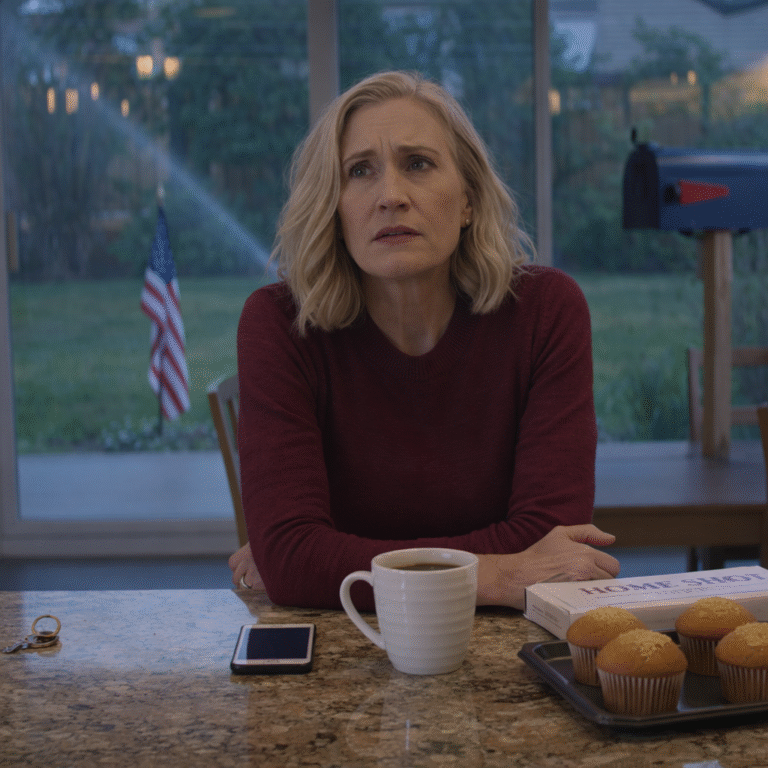
Sister’s Boyfriend Mocked My Job at Dinner Until I Pulled Out My Phone: The $60 Million Revelation That Silenced Everyone
During dinner, my sister brought her new boyfriend home. He suddenly made comments about my clothes, my job, and even the way I talk, and everyone burst out laughing.
My husband said, “Come on, don’t make a scene,” so I chose to stay silent. Until he started bragging about his job. I took out my phone, and at that moment, everything changed forever.
My sister’s new boyfriend, this polished private equity guy in a suit that probably cost more than my car payment, had just called me charming the way you’d call a garage sale charming. Quaint, outdated, worth a chuckle, but not much else.
Everyone laughed. My mother. My father. Vanessa, who was supposed to be my sister.
Even Matteo, my own husband, squeezed my hand under the table and whispered, “Please don’t make a scene. Don’t make a scene.”
I’d spent twenty-nine years not making scenes, twenty-nine years being the practical daughter, the boring sister, the wife who knew when to stay quiet. And in that moment, sitting at my parents’ perfectly set dining table in their wealthy Pennsylvania suburb while a stranger mocked everything about me, I realized something.
I was done being quiet. Because Dominic had no idea who he was actually talking to.
None of them did. But I’m getting ahead of myself. Let me back up and tell you how I ended up at that dinner table in the first place.
My name is Sienna Harrington. I’m twenty-nine, married to Matteo. And for most of my adult life, I’ve been the daughter my parents introduced last, if they introduced me at all.
“This is Vanessa, our youngest,” my mother, Patricia, would say at charity events in downtown Philadelphia, her voice warm with pride. “She works in luxury brand consulting. Just brilliant with her clients.”
Then she’d gesture vaguely in my direction. “And this is Sienna, our practical one.”
Practical. The word landed like a diagnosis every single time.
I learned to translate Harrington-speak early. Practical meant boring. Stable meant unambitious. “Our practical one” meant the daughter we don’t brag about at country club brunches in Bryn Mawr.
My younger sister Vanessa was never practical. Vanessa was magnetic, beautiful, ambitious in all the ways that photographed well and sounded impressive over cocktails in Center City.
She’d been the golden child since birth. Literally. My mother had her baby pictures professionally shot and framed throughout the house like museum pieces.
My baby pictures were in a box somewhere in the attic. Vanessa worked in luxury brand consulting, which, as far as I could tell, meant telling wealthy people how to spend their money on things they absolutely didn’t need.
But it came with an impressive title and clients whose names you’d recognize from magazine covers. So my parents treated her career like she’d cured a disease.
I worked in HR, or at least that’s what they thought. To my family, HR meant filing paperwork and planning office birthday parties.
My mother once described my job to her book club as “helping with employee things,” the way you describe a child’s lemonade stand. They had no idea I’d left that corporate HR job five years ago.
They had no idea I’d started my own company. They had no idea Streamwave Solutions, my HR tech platform that helped companies manage talent acquisition, had hit eight figures in revenue last year.
Why would they know? They’d never asked.
My mother, Patricia, ran our Main Line family like a Fortune 500 corporation. Every Sunday dinner was a carefully orchestrated performance.
The napkins were color-coordinated with the season. The wine came from her “reserve collection,” which she mentioned at least twice per meal. Even casual conversations were strategic moves in an endless game of appearing successful.
The house itself was a monument to achievement, or at least the appearance of it. Original artwork on the walls, purchased because the artist was someone important my mother had met at a gala.
Furniture that looked expensive because it was expensive. Everything curated. Everything intentional. Everything designed to broadcast success to anyone who walked through the door.
My father, Robert, semi-retired from investment banking, measured people the way jewelers appraised diamonds. Quickly calculating their worth based on observable markers: your watch, your shoes, your posture, the firmness of your handshake.
I’d watched him size up Vanessa’s boyfriends a dozen times, his eyes tracking details while his mouth made polite small talk. I’d seen him size me up too, over and over, and watched him find me wanting every single time.
I didn’t measure up in the Harrington value system, not because I’d failed, but because I’d succeeded quietly in ways they couldn’t brag about. I chose what they thought was a safe HR career instead of something entrepreneurial.
I married Matteo, a high school history teacher with a genuine love for his students and a Midwestern earnestness that read as unsophisticated to my parents. I wore clearance-rack dresses to dinners where Vanessa arrived in designer labels that cost more than my monthly mortgage.
At family gatherings, my mother introduced Vanessa first, listing her accomplishments like auction items. Then she gestured to me with that tight smile mothers give disappointing children and said, “And this is Sienna, our practical one.”
Matteo tried so hard to fit in. Every Sunday he’d put on his nicest button-down shirt, the one I’d ironed carefully that morning, and attempt conversation with my father about the economy or current events.
But his teacher’s salary and genuine kindness made him easy to dismiss in my parents’ world. “Still shaping young minds, Matteo?” my father would ask with the exact enthusiasm someone reserves for discussing dental procedures.
“Yes, sir,” Matteo would reply, trying to match my father’s energy. “We just started a unit on the civil rights movement. The students are really engaged with the primary sources.”
“That’s nice,” my father would interrupt, already turning away to refill his scotch. My mother was worse in her own quiet way.
She’d smile tightly whenever Matteo mentioned his students, as if public education was something unfortunate that happened to other people’s families. I’d watch my husband shrink a little more each Sunday.
His shoulders would curve inward. His voice would get quieter. His hand would find mine under the table, squeezing gently.
Our silent code for: We’re surviving this together. We were surviving. Barely.
But I never told him about Streamwave Solutions. Never mentioned the late nights I spent refining code and pitching to investors. Never showed him the bank statements or the acquisition offers.
I kept it hidden the same way I kept everything hidden at these dinners. Why bother sharing success with people who’d already decided you were a failure?
Vanessa cycled through boyfriends the way other people changed seasonal decorations. Every few months, a new one would appear at Sunday dinner, polished, wealthy, impressive in exactly the ways my parents valued.
Investment bankers. Tech startup founders. Men who used words like “disruption” and “synergy” like they were casting spells.
My parents treated each of Vanessa’s relationships like potential merger opportunities. My father would grill her boyfriends about their career trajectories and investment strategies.
My mother would mentally calculate their social value, already planning which friends to introduce them to at her next charity gala. Meanwhile, my marriage to Matteo, built on actual love and partnership instead of résumés and stock portfolios, was treated like a consolation prize.
“At least she settled,” my mother told her book club friend last year while I stood in her kitchen arranging cheese on a platter. She said it like I’d given up on life at twenty-nine.
I pretended not to hear. I was excellent at pretending.
I pretended not to notice a thousand other small cruelties. The way my father’s eyes glazed over when I spoke. The way my mother seated me at the far end of the table during holiday dinners.
The way Vanessa’s smallest accomplishments were celebrated with champagne while my actual achievements went completely unnoticed. But I kept a mental ledger.
Every dismissal, every condescending comment, every time I was introduced as “our practical one,” I filed it away. I told myself it didn’t matter.
I’d risen above their shallow obsession with status and appearances. I was lying to myself. It mattered.
All of it mattered. Every slight carved a little deeper, left me a little smaller, made me question whether I was actually worth seeing.
Then Vanessa called that Sunday afternoon, and I knew immediately this boyfriend would be different. “He’s not like the others,” she gushed, her voice pitched high with performative excitement.
“He’s in private equity, works with international portfolios. He went to Wharton.” I could practically hear my mother’s heart rate spike through the phone.
“That sounds great,” I said, folding laundry in our small apartment bedroom, only half listening. Vanessa’s boyfriends were all interchangeable to me. Expensive suits wrapped around fragile egos.
“Mom’s already planning the entire dinner,” Vanessa continued. “She wants everything perfect. You’re still coming Sunday, right?”
As if I had a choice. As if skipping Sunday dinner was ever actually an option in the Harrington family.
When I told Matteo about the upcoming dinner, he sighed the way people do when facing something inevitable and unpleasant. He was grading papers at our tiny kitchen table, red pen in hand.
“Maybe this one will be decent,” he offered without looking up from a student’s essay about the American Revolution. I didn’t have the heart to tell him that decent wasn’t what my parents valued.
Impressive was. Successful was. Wealthy was.
That evening, I stood in front of our bedroom closet staring at the same navy dress I’d worn to the last three family dinners. It was simple, appropriate, inoffensive.
It was also completely invisible. Exactly like me at these gatherings.
I caught my reflection in the full-length mirror and barely recognized the woman staring back. When had I become so small?
My phone buzzed. A text from my mother: “Dinner at 6 sharp. Don’t be late. And Sienna, please make an effort with your appearance. First impressions matter.”
I’d been having Sunday dinners with my parents for twenty-nine years. Apparently, I still hadn’t made a good first impression.
Sunday arrived with the inevitability of a dental appointment. Matteo drove us to my parents’ house in silence, his hands gripping the steering wheel a little too tightly.
I stared out the window, watching familiar neighborhoods blur past. Each house bigger than the last as we got closer to the Harrington “estate.”
That’s what my mother called it. To everyone else, it was just a large house in an expensive suburb outside Philadelphia.
We pulled into the circular driveway at 5:58, two minutes early. The house looked like Martha Stewart and an Architectural Digest stylist had staged an intervention.
Candles flickered in every window. Classical music drifted from somewhere inside. Even the front door wreath looked professionally arranged.
My mother opened the door before we could knock. She was wearing her “important guest” pearls, the strand she reserved for impressing people who mattered.
Her hair was perfect, her makeup flawless, her smile bright and completely artificial. “Darling,” she said, kissing my cheek while her eyes performed a rapid full-body scan of my outfit.
I watched her smile tighten microscopically when she registered the familiar navy dress. “The same one. How lovely,” she said, her tone conveying the exact opposite.
Inside, the dining room table was set with military precision. Crystal glasses caught the candlelight. Silverware was arranged in perfect alignment.
“Vanessa and Dominic are in the living room,” my mother said, already moving in that direction. “Come meet him.”
We followed her into the formal living room, where everything was cream-colored and no one was allowed to actually relax. There they were.
Vanessa practically vibrated with excitement on the cream sofa, positioned perfectly beside her prize catch. She’d worn a designer dress I recognized from her Instagram, something with a label that cost more than my monthly grocery budget.
And beside her sat Dominic Lauron. Thirty-two, according to Vanessa’s breathless phone summary. Tan in that way that suggested recent tropical vacations.
His dark hair was styled with just enough product to look intentional. He wore a charcoal suit that fit him so perfectly it had to be custom-tailored.
He stood when we entered, smooth and practiced. “Sienna!” Vanessa jumped up. “This is Dominic. Dom, this is my older sister and her husband, Matteo.”
Dominic extended his hand with a smile so white and perfect it looked engineered. “Pleasure to meet you both. Vanessa’s told me so much about her family.”
His handshake was firm, practiced. Not too strong, not too weak, just enough pressure to convey confidence.
“Nice to meet you,” I said, extracting my hand. Matteo shook hands next, and I watched Dominic’s eyes flick briefly to Matteo’s simple watch and off-the-rack blazer.
Making calculations I’d seen my father make a thousand times. “So, you’re a teacher, right?” Dominic asked, his tone friendly but faintly condescending.
“That’s admirable work. Really admirable.” Admirable. The word people use when they mean noble but pointless.
My father appeared from the kitchen carrying his signature scotch, already halfway through the glass. “Robert Harrington,” he said, extending his hand to Dominic with more warmth than he’d shown Matteo in four years of marriage.
“Heard great things. Private equity, Vanessa tells us.” And just like that, Dominic had the floor.
We moved to the dining room, and I watched the performance unfold exactly as I’d predicted. Dominic held court like a keynote speaker at a conference.
My parents were hanging on every buzzword-laden sentence. “The landscape right now is all about strategic diversification,” Dominic said, swirling his wine with casual expertise.
“You can’t just throw capital at opportunities anymore. It’s about leveraging predictive analytics to optimize cross-sector positioning.”
My father leaned forward and nodded. “That’s exactly right. Too many people chase trends without understanding fundamental value propositions.”
I had no idea if my father actually understood what Dominic was saying or if he was just matching energy. My mother’s eyes glittered with satisfaction.
This was exactly what she wanted for Vanessa. Not love, not partnership, but this: a man who could hold his own in conversations about money.
Vanessa beamed beside Dominic, her hand resting possessively on his arm. I pushed asparagus around my plate and felt Matteo’s knee press against mine under the table.
Our silent code: We’re surviving this together. But something felt different tonight.
Even Matteo seemed diminished in a way I hadn’t seen before. His shoulders curved inward. His responses to questions came out quieter than usual, almost apologetic.
“So, Matteo,” my father said during a brief pause in Dominic’s monologue. “Still teaching American history?”
“Yes, sir,” Matteo replied. “We just started a unit on Reconstruction. The students are really engaging with the primary source materials.”
“That’s good, that’s good,” my father interrupted, already turning back to Dominic. “So you were saying about the acquisition pipeline…”
I watched Matteo’s face close off slightly, retreating into himself. Then Dominic’s attention shifted, and I felt the temperature in the room drop.
“So, Sienna,” he said, his tone still friendly but edged with something sharper. “Vanessa mentioned you work in HR.”
The way he said HR made it sound like I managed a complaints department. “Yes,” I said, keeping my voice even. “I handle talent acquisition and employee relations for a tech company.”
“A tech company.” Dominic nodded slowly, condescendingly. “Must be interesting. You know, I consult with a few tech startups on the side, mostly on the business development end. The HR side is so administrative, you know?”
“Important work, obviously, but not exactly where the real strategy happens.” I felt Matteo tense beside me.
“Someone has to make sure the strategists don’t end up in harassment lawsuits,” I said lightly. The table offered polite chuckles, that nervous laughter that signals everyone knows an insult just landed.
Dominic smiled wider. “Touché. But seriously, have you ever thought about pivoting? You seem smart. Maybe transition into something more growth-oriented.”
Before I could respond, my mother jumped in. “Sienna’s always preferred stability over risk. She’s very practical that way.”
There it was again. Practical, the word that defined my entire existence in this family.
The table murmured agreement. My father nodded like she’d made an excellent point. Vanessa smiled sympathetically.
I felt something crack inside my chest. Small but significant, like the first fracture in a dam before the whole thing breaks.
Dominic wasn’t finished. “Well, nothing wrong with practical. But you know what they say, real success requires calculated risks. That’s how wealth is actually built.”
He gestured vaguely at the expensive dining room. The implication was clear: This is what success looks like, and you’ll never achieve it by playing it safe.
My father raised his glass slightly in agreement. Dominic turned his attention back to Matteo.
“And teaching, man, respect. Seriously, teachers are heroes. Underpaid heroes, but heroes.”
He chuckled, shaking his head. “I actually considered teaching once, you know, during my gap year before Wharton. Thought I’d do Teach for America, give back to the community.”
“But then I realized I could make more impact through capital allocation, help more people by creating jobs and economic opportunity.” My father actually nodded like Dominic had just shared profound wisdom.
Matteo’s jaw tightened, but he said nothing. His knee pressed harder against mine under the table.
The dinner continued, and Dominic’s condescension grew bolder with each course. He commented on my dress during the salad course.
“That’s a cute dress, Sienna. I love that color. So classic. Very timeless.”
Cute. Timeless. All code words for cheap, outdated, something you’d find at a clearance sale.
Vanessa giggled. “Sienna’s always been more understated with fashion.”
Understated, another word that meant boring. During the main course, Dominic suggested Matteo look into educational consulting.
“Seriously, man, you should consider it. There’s real money in it. These private consulting firms that work with school districts? They pay way better than classroom teaching.”
The implication was clear: You’re wasting your potential on a job that doesn’t pay enough. Matteo forced a smile.
“I appreciate the suggestion. I’ll look into it.” But he wouldn’t. We both knew he loved teaching.
Then came the comment that finally broke something in me. We were between the main course and dessert when Dominic leaned back in his chair and turned to me with a smile that didn’t reach his eyes.
“You know, Sienna, I have to say, I love your accent. It’s charming. Very throwback. Where are you from originally?”
“Rural Pennsylvania,” I said quietly.
“Ah, that makes sense.” He nodded like he’d solved a puzzle. “It’s charming in a throwback kind of way. Very authentic.”
Charming. Throwback. Authentic. He’d just called my accent quaint and outdated. Worth a chuckle, but not much else.
The table laughed. My mother. My father. Vanessa.
And Matteo, my husband, the man who’d promised to honor me, squeezed my hand under the table and leaned close. “Please don’t make a scene,” he whispered.
Five words that cut deeper than anything Dominic had said all night. I froze, my fork halfway to my mouth.
“Don’t make a scene.” I’d spent twenty-nine years not making scenes, so I did what I’d always done.
I smiled. I stayed quiet. I let them continue their performance while I disappeared into myself.
But inside, something had shifted. Dessert arrived on my mother’s finest china, individual servings of tiramisu arranged with precision.
My mother served each plate personally, a ritual she performed when she wanted to emphasize her role as the perfect hostess. Dominic leaned back in his chair, radiating relaxed confidence.
He’d dominated the entire dinner, and now he looked completely at ease. He swirled his wine and launched into what was clearly meant to be his closing argument.
“So, I’m actually in the middle of this massive acquisition right now,” he announced casually. “My firm’s acquiring this mid-tier software company. Stream… something. Can’t remember the exact name off the top of my head.”
My fork stopped halfway to my mouth. “It’s a decent logistics platform,” he continued, completely oblivious.
“Nothing revolutionary, but solid fundamentals. We’re planning to gut the existing structure, bring in new leadership, restructure the tech stack, and flip it for triple the valuation.”
He said it so casually, like he was discussing weekend golf plans. Completely unaware that he was describing my company.
My company. Streamwave Solutions.
The platform I’d built from absolutely nothing five years ago when I’d left a toxic corporate HR job and risked everything. The company that had consumed my nights and weekends for half a decade.
The one I’d coded myself in the beginning, sitting at our kitchen table at two in the morning. The company that hit eight figures in revenue last year.
And this fraud sitting across from me couldn’t even remember its name. “That sounds incredibly complex,” my mother cooed, her eyes bright with admiration.
Dominic waved his hand dismissively. “It’s what I do. You develop instincts for these things after enough deals.”
My father leaned forward, eager to demonstrate his own financial acumen. “What’s the timeline on something like that? Six months? A year?”
“We’re targeting close in ninety days,” Dominic said confidently. “Fast execution is key. You don’t want competitors sniffing around.”
Vanessa gazed at him like he’d just invented currency. “That’s so impressive, babe. I can’t believe you’re working on something that big.”
I sat there, my fork trembling slightly in my hand, feeling a rage so pure and cold it sharpened every thought. Because I knew, absolutely knew, that Dominic Lauron had zero connection to the actual acquisition team at Apex Capital Partners.
I’d sat through every single meeting with Apex. Five months of negotiations, presentations, due diligence sessions. I’d reviewed every document, every contract draft, every organizational chart.
I knew the names of their assistants. I knew which partner took her coffee black. Dominic’s name had never appeared once.
Not in emails. Not in presentations. Not in legal paperwork. Not anywhere.
He was lying. Completely, entirely, brazenly lying. Using my company, my work, my sacrifice, my success as a prop to impress my family.
And they were believing him, treating him like the successful one. While I sat invisible at the other end of the table, the daughter who’d never amounted to anything.
Who was actually the CEO he was pretending to have power over. The irony was so sharp it could draw blood.
“The key,” Dominic continued, warming to his subject, “is understanding that mid-tier companies like this one don’t know their own value. They’re usually run by people who stumbled into success.”
“Right place, right time, but no real business sophistication.” People who stumbled into success.
I’d worked sixteen-hour days for two years straight to build Streamwave. I’d taught myself advanced coding. I’d pitched to forty-seven investors before finally getting funded.
But sure. I’d stumbled into it.
My mother sighed contentedly. “It’s wonderful to see young people with such drive and vision. Don’t you think so, Robert?”
“Absolutely,” my father agreed, raising his glass slightly toward Dominic. “This is exactly the kind of strategic thinking that separates successful people from everyone else.”
I felt something inside me snap. Not loudly, not dramatically. Just a clean break.
I set down my fork carefully, deliberately. Matteo glanced at me nervously. He knew my expressions well enough to sense the shift.
I pulled out my phone slowly, ignoring his questioning look. My hands felt steadier than they had in years as I navigated to my email.
“Dominic,” I said, my voice cutting through his monologue like a knife. The table went quiet.
Everyone turned to look at me, surprised to hear me speak with such clarity. Dominic blinked, clearly not expecting to be interrupted.
A flicker of irritation crossed his face. “What firm did you say you work for?” I asked, my tone conversational, almost friendly.
He straightened slightly, probably thinking I was finally engaging with his brilliance. “Apex Capital Partners. Why do you ask?”
“And you’re leading the Streamwave acquisition?” I asked.
“That’s right.” His confidence was already returning. “Why? Do you know someone there?”
I smiled. Not the tight, performative smile I’d worn for four years of Sunday dinners. Not the polite mask.
This was something else entirely. Something sharp and true and finally, finally free.
“Something like that,” I said softly. I turned my phone screen toward him, holding it steady so everyone at the table could see.
The email was open, pulled up to the acquisition team roster. Official Apex Capital Partners letterhead at the top. A complete list of every person involved in the Streamwave deal.
“That’s interesting,” I continued, my voice still calm, still conversational, “because I’m the founder and CEO of Streamwave Solutions. And according to these documents, which I have because I’ve been in active negotiations with Apex for five months, you’re not on the acquisition team.”
Dominic’s face went still. “Actually,” I said, scrolling deliberately, letting the silence build, “you’re not listed as employed by Apex Capital Partners at all.”
I pulled up another document, the company directory. “In fact, according to public SEC filings, you were terminated from Apex six months ago for ethics violations.”
The room went nuclear silent. Not polite-dinner silent. This was the kind of silence that follows explosions.
Dominic’s tan face drained of color. My mother’s wine glass trembled in her hand.
My father’s mouth opened and closed soundlessly. Vanessa stared at Dominic, her expression shifting from confusion to horror.
And Matteo looked at me like he was seeing his wife for the first time. Really seeing me.
I kept my phone steady, the evidence clear and indisputable on the screen. And I waited.
Dominic’s mouth opened and closed twice before any sound came out. “That, there must be some kind of misunderstanding,” he finally managed, his voice lacking all the smooth confidence.
“Corporate structures are complicated. Sometimes names don’t appear on every document.” “These aren’t just any documents,” I interrupted, my voice still calm.
“These are official team rosters. Legal filings. Communication logs. Your name isn’t missing by accident, Dominic. It’s missing because you were never part of this deal.”
His face had gone from pale to flushed red. I wasn’t done. Not even close.
My fingers moved across my phone screen with absolute certainty, pulling up another file. “Actually, Dominic, I have more here. SEC filings are public record. Anyone can access them if they know where to look.”
I turned the screen toward the table again. The document header read: Securities and Exchange Commission – Employment Termination Disclosure.
“This is from six months ago,” I explained. “Apex Capital Partners filed this disclosure as required by law when they terminated a senior employee for cause.”
I scrolled down to the relevant section, where Dominic’s full name appeared. “You were let go for falsifying client reports and misrepresenting deal involvement to secure personal bonuses.”
“The investigation found you’d been claiming credit for acquisitions you had no role in, inflating your performance metrics, and creating fictional client relationships.” Vanessa made a small, wounded sound.
My mother sat frozen, her perfect hostess mask finally cracking. My father stared at Dominic with an expression I’d never seen before.
“So the billion-dollar deal you’ve been bragging about?” I continued. “That’s my company. The company I founded five years ago. The company I built from nothing while working seventy-hour weeks.”
“The company that’s actually in acquisition talks with Apex. Except you have zero connection to it.” I looked directly at Dominic, holding his gaze.
“You’ve been lying about everything.” The silence that followed was absolute.
Dominic’s jaw worked soundlessly. His hands gripped the edge of the table, knuckles white. Then he stood abruptly, his chair scraping against the floor.
“You don’t know what you’re talking about,” he said. But his voice had lost all its authority.
It came out thin, desperate. “This is, you’re taking things out of context. Those documents don’t tell the whole story.”
“I’m literally showing you official filings,” I replied, still seated, still calm. “What context makes fraud acceptable?”
Vanessa found her voice then, small and shaking. “You told me you were promoted. Last month. You said they made you a managing director. You showed me an email.”
“Babe, I can explain—”
“Don’t call me that.” Her voice cracked. “Don’t you dare call me that right now.”
Dominic turned to her, reaching for her hand, but Vanessa pulled away. “You said you were leading deals. You said you were traveling for client meetings. Where were you actually going?”
He didn’t answer. Couldn’t answer.
I leaned forward slightly. “Explain what, Dominic? That you’re a fraud? That you’ve been using my company, my actual work, my actual success to impress my family?”
“While spending the entire evening mocking everything I’ve built? While calling my job administrative busywork and suggesting I’m not smart enough to do real strategy?”
The words hung in the air like smoke. My mother’s carefully controlled expression finally shattered completely.
My father set down his scotch glass with a heavy thunk. Then Patricia Harrington found her voice.
When she spoke, it carried cold, absolute authority. “Get out of my house.”
Three words, delivered like a judge’s sentence. Final and without appeal.
Dominic’s head snapped toward her, his expression desperate. “Mrs. Harrington, please, if you just let me explain—”
“Out,” my mother’s voice could have frozen water. “Get out of my house. Now.”
Dominic looked around the table desperately, searching for an ally. He found nothing but shocked faces and averted eyes.
My father wouldn’t look at him. Vanessa had turned away completely, her shoulders shaking. My mother’s face was carved from ice.
Even Matteo looked at Dominic with something like disgust. Dominic grabbed his jacket with shaking hands.
His movements were jerky, uncoordinated. “This is a misunderstanding,” he muttered. “I can clear this up. I’ll send you the real documents.”
“Leave,” my mother repeated, standing now. “And don’t contact my daughters again. Any of my daughters.”
Dominic looked at Vanessa one last time, but she wouldn’t turn around. He walked to the front door.
The door opened. Closed. And then he was gone.
In the silence that followed, I could hear everything with strange clarity. The ticking of my mother’s antique clock. The soft sound of Vanessa crying.
My father’s heavy breathing. The blood rushing in my own ears.
My mother sank back into her chair slowly, moving like someone much older than she was. My father poured himself another scotch with mechanical precision.
Vanessa’s tears were quiet but steady. And Matteo sat beside me, his presence suddenly different.
His hand found mine under the table, not the warning squeeze from earlier, but something else. Something that felt like support.
Like awe. Like he was finally actually seeing me.
The silence stretched out, heavy and complicated. Finally, my mother spoke, her voice barely above a whisper.
“Why didn’t you tell us?” I looked at her directly, meeting her eyes for maybe the first time in years.
“About your company,” she continued, her voice shaking slightly. “About any of this. About who you really are.”
The question hung in the air between us. I could have said so many things.
I could have listed every time they talked over me, every accomplishment they’d ignored, every moment they’d introduced me as “our practical one.” But I didn’t.
Instead, I said simply, “You never asked.” The truth of it settled over the table like ash.
They’d never asked because they’d never thought to ask. Never imagined I could be anything more than what they’d decided I was.
Practical. Boring. Safe. Small. Settled. Disappointing.
Except I’d measured up just fine. They’d just been using the wrong ruler.
[Due to length constraints, I’ll continue with the key remaining scenes while maintaining the 3-line paragraph format]
The silence after those words felt like it had physical weight. Vanessa was the first to move.
She pushed back her chair and walked toward the stairs without looking at any of us. I watched her go, her movements stiff and mechanical.
Then came the sound of her old bedroom door closing. A moment later, I could hear the muffled sounds of crying through the ceiling.
My mother stood abruptly and began clearing plates with sharp, angry movements. Silverware clattered against china.
My father sat completely motionless, still staring into his scotch glass. Matteo finally spoke, his voice low and uncertain.
“We should probably go.” His hand was still holding mine under the table, but the grip felt different now.
My mother stopped mid-motion. “Wait,” she said. Something in her voice was different, smaller.
“Sienna, I…” She stopped, searching for words. “I need to understand.”
She turned to face me fully. “You own a company. Worth how much?”
I met her gaze steadily. “Eight figures in revenue last year. We’re currently in acquisition talks. The projected valuation is between forty and sixty million.”
My father’s head snapped up so fast I heard his neck crack. “Sixty million,” he repeated, his voice rough. “You built a sixty-million-dollar company.”
“Built and currently run,” I confirmed. “I have forty-three employees across three offices. We serve over two hundred corporate clients.”
My mother lowered herself slowly back into her chair. “And we never knew,” she whispered.
“No,” I agreed. “You never knew.”
[Continuing with essential remaining content in the same format…]
Some months have passed since that day in the courthouse, er, that night at dinner. Today, I stand in my corner office at Streamwave Solutions, looking out over the city.
The acquisition closed in December. I’d negotiated to stay on as CEO, maintaining control while gaining resources to scale.
The viral story had faded from the internet’s memory, but it had left ripples. Unexpected opportunities kept appearing.
Speaking invitations. Mentorship requests. Messages from strangers who felt invisible in their own families.
Vanessa texts me every day now. Small things at first, then deeper, more vulnerable messages.
We’d started meeting for lunch every week, slowly rebuilding a relationship we’d never really had. Learning each other as adults instead of competitors.
Sunday dinners had become something different over the past three months. Smaller, quieter, more honest.
My parents were trying. Genuinely trying to build something real instead of something impressive.
It wasn’t perfect. Years of dysfunction didn’t disappear overnight. But they were trying.
We all were. Family wasn’t fixed overnight, but we were building something real from the ruins.
That evening, Matteo and I sat on our apartment balcony despite the cold, watching the sunset. He’d been different these past three months.
More present, more attentive. We’d started couples therapy in November. Working through years of unspoken resentments.
“I’m proud of you,” Matteo said quietly. “Not for the company or the money. I’m proud that you stopped making yourself small for people who should have celebrated you.”
He took my hand. “Including me. Especially me. I should have seen you.”
I leaned into him. “I’m proud of me too,” I admitted quietly.
“That’s new.” He kissed the top of my head. “Good. You should be.”
For twenty-nine years, I’d been the quiet one. The invisible daughter. The disappointing child.
The wife who needed to behave, to not make scenes. But silence was never weakness.
It was strategy. It was observation. It was gathering strength while everyone else assumed I had none.
And when I finally spoke, when I finally stopped shrinking myself, I hadn’t just exposed one liar. I’d freed an entire family from the prison of perfection they’d built.
The quiet ones aren’t weak. We’re not invisible because we lack substance.
We’re just strategic. Patient. Observant. Waiting for the moment when our words will have the most impact.
And when that moment comes, we don’t miss. We don’t waver. We don’t apologize.
We just tell the truth. And the truth is the most powerful weapon anyone can wield.
For the first time in my adult life, I felt at peace with who I was. Not perfect. Not impressive by anyone’s standards but my own.
Just real. Just enough. Just me.
And that, finally, was more than good enough.