“Only $300?” My Father Laughed Until the Numbers Finally Spoke for Themselves
The first time it truly landed, the first time I felt it settle into my bones as something undeniable, it wasn’t during one of my dad’s loud lectures or my mom’s quiet, surgical silence.
It was on my birthday, under the warm glow of our dining room light, when my father tore into my gift like the wrapping paper had personally insulted him.
The apartment smelled like roast chicken and cinnamon candles, that sweet, artificial warmth my mother loved when she wanted to make a tense night feel like a celebration. The candle sat on the windowsill, flame steady, the label turned outward like it was part of the decor. The table was too small for the crowd Lena insisted on, plates pushed close together, elbows brushing, glass rims clinking every time someone gestured too broadly.
My chair was wedged between my brother Tim and my youngest cousin, and my knees kept bumping the underside of the table. I’d set out the good napkins, the ones with the faint embroidered border, even though no one noticed details like that in my family unless they could criticize them.
I’d cooked. Cleaned. Smiled. Taken the “happy birthday” hugs that felt like staged photos, arms around me for two seconds before they pulled away and began talking about themselves again.
And still, I’d brought the envelope.
Cash, tucked inside. Three hundred dollars, taken from my emergency fund, not my main account. The money felt hot in my palm when I slid it across the table to him. Not because it was a lot, but because it was the last thing I could offer without hating myself for offering it. A small peace offering. A token. A gesture that said, I’m trying.
My father held it between two fingers, as if it might be dirty. He peeled back the paper and lifted the envelope, eyes narrowing at the thickness, the way you might judge a piece of mail you already resent.
He opened it.
Then he laughed.
Not a private chuckle. Not an amused little sound you could pretend wasn’t cruel. He laughed big, loud, performative, the sound bouncing off our walls and landing in every corner of the room. Heads turned. Forks paused mid-air.
“Only three hundred?” he said, as if he’d found a parking ticket in there. “Lena covers your mother’s entire life. Forty-seven hundred a month minimum. What’s this supposed to be, a snack?”
The words hit me first in my throat. A tightening. A slight inability to swallow. Then they sank lower, into my chest, where my lungs suddenly felt too small.
Across the table, Lena didn’t blink. She watched me the way a shark watches a cut finger, calm and patient, sure the blood would come.
My mother’s spoon clinked softly against her teacup. She stirred and stared into the tea like there was something fascinating at the bottom of it. Her posture stayed perfect. Her face stayed neutral. She didn’t glance up. She didn’t say my name.
Tim kept chewing, jaw working steadily like this was normal conversation, like this was just another Tuesday dinner, not my birthday.
My father leaned back in his chair, satisfied with his own joke. His eyes shone with the kind of confidence he always had when he was humiliating someone who couldn’t safely fight back.
“Three hundred bucks,” he repeated, louder, turning his head slightly toward my cousin, toward Tim, toward the invisible audience he always seemed to imagine. “Is that how you say thank you for raising you?”
My fingers curled around the edge of the table. I could feel the seam of the wood, the slight rough patch where a coaster had once trapped moisture and lifted the finish. I focused on that texture because focusing on my father’s face would have made something in me snap.
I wanted to say, I didn’t bring it from my main account because I’m tired. I wanted to say, I’ve been paying your bills for years. I wanted to say, you’re holding my money like it’s a joke while I’ve been quietly bleeding myself dry to keep you comfortable.
Instead, I heard my own voice come out too small.
“It’s what I could do,” I said.
My father tilted his head, mocking. “That’s adorable.”
Lena took a sip of her drink, unhurried. Her nails were freshly done, pale pink and glossy. She looked put together in the way she always did, like a curated lifestyle. She also hadn’t held a real job in sixteen months, but if you scrolled her social media you’d think she lived inside a boutique ad.
My mother’s cinnamon candle threw warm light across Lena’s face, making her look softer than she was.
Lena set her glass down and slid her chair back with slow, deliberate grace. She stood the way someone stands when they’re about to make an announcement in a boardroom. Calm. Smooth. Smiling just enough.
Then she lifted a folder and tossed it across the table toward me.
It landed with a sharp slap, paper against wood, loud in the silence my father’s laughter had created.
“We voted,” Lena said, voice crisp. “You need to move out by Friday.”
For a second my brain didn’t understand the sentence. It heard the words but couldn’t assemble them into meaning. It was like trying to read a foreign language you half remember from childhood.
I blinked once.
“What?” I managed.
“By Friday,” Lena said, as if she were reminding me when trash day was. “We all agreed. You’ve been tense lately. It’s not healthy for anyone.”
I stared at her. Then at the folder. Three pages. Stapled. Official-looking. The kind of formatting people use when they want something to feel legitimate.
My throat tightened again, but this time it wasn’t emotion. It was a cold, sharp awareness.
I looked around the table.
My father’s expression didn’t show surprise. Not even a flicker. He looked pleased, like a man watching a plan go exactly how he wanted.
My mother stirred her tea again, slower this time. Still not looking at me.
Tim made a small sound in his throat that could have been a chuckle if I squinted hard enough at my memory later. He kept chewing.
No one flinched.
That was the moment something in me went quiet.
Not my anger.
My hope.
Because if they could vote me out of my own apartment, after years of breathing in my space, eating my food, using my utilities, draining my accounts like it was their right, then the truth was brutally simple.
To them, I was never a person.
I was a resource.
A bill they didn’t have to pay.
The folder blurred slightly as my eyes filled with heat, but I refused to let the tears fall. Tears were for a family that felt safe. Tears were for love.
This was something else.
I inhaled slowly. The cinnamon candle smelled suddenly nauseating.
“I… I live here,” I said, voice steadier than I felt.
Lena’s smile widened. “Not for long.”
My father leaned forward, forearms on the table, the posture of a man about to deliver the final word in an argument. “Don’t start,” he said. “You always make things dramatic.”
I felt my fingernails dig into the underside of the table edge. My birthday napkin sat folded on my plate like a little triangle of politeness, and the sight of it made me want to laugh.
I didn’t.
I stood.
My chair scraped back softly. The sound cut through the room more than any of their words had. I pushed it in carefully, because some part of me still clung to manners even as my family tore my life apart.
“I’m going to my room,” I said, as if I needed permission.
My father muttered, “She always does this. Dramatic.”
Lena’s voice floated after me, sweet as poison. “We’re giving you space. It’s a kindness.”
I walked down the hallway, each step measured. The walls felt closer than usual. The apartment felt smaller. My bedroom door was at the end, and when I shut it behind me, the click of the latch sounded like a lock sealing me away from them.
I leaned my back against the door and closed my eyes.
Breathe in.
Breathe out.
Count.
One.
Two.
Three.
Like I was disarming a bomb.
When my pulse stopped pounding in my ears, I crossed the room and sat on the edge of my bed. My hands didn’t shake. That surprised me. I’d expected shaking. I’d expected some kind of visible breakdown. But I’d spent years holding myself together for them. My body had learned to conserve emotion like fuel.
I opened my banking app.
The screen lit my face in cold blue-white. My account balances loaded. My stomach tightened as familiar names appeared beneath the transactions, like parasites with polite labels.
Mom’s health insurance.
Dad’s gym membership.
Lena’s cloud storage.
Tim’s Spotify family plan.
Utilities.
Rent split transfer.
Six recurring payments. Six silent drains. Six ways my money had been leaking out while I told myself it was temporary, while I told myself it was family, while I told myself I was being a good daughter.
I tapped the first one.
Cancel.
A pop-up asked if I was sure.
I didn’t hesitate.
Yes.
Cancel.
Cancel.
Cancel.
Each tap felt like pulling a thorn out of skin that had been inflamed for years. Painful, but clean.
My thumb hovered over the rent transfer, the one I’d set up when my family moved in “temporarily” after my father’s rough patch. I could still hear the way he’d said it, like his pride had been bruised by the very idea of needing help. Just until I’m back on my feet. Just a few months.
Temporary had turned into years.
I hit cancel.
Then I clicked into Connected Users.
Five names.
All of them attached to my accounts like they belonged there.
Remove.
Remove.
Remove.
Remove.
Remove.
A confirmation popped up. Are you sure you want to revoke access for these users?
The old version of me rose up like a reflex.
What if they can’t pay?
What if Mom cries?
What if they tell everyone you’re selfish?
The old version of me was trained. Guilt was her leash. Obligation was her collar.
Then another voice answered, calmer, colder, more honest.
They just voted you out of your own home.
Good.
I tapped yes.
The confirmation flashed. Access revoked.
I sat still for a moment, listening for my heartbeat. It was steady. Too steady, almost.
I wasn’t done.
I opened my email and drafted a message to my landlord, Mark. My fingers moved quickly, decisive. I attached screenshots of the lease documents and my payment history.
Hello Mark, I’m confirming that I am the sole leaseholder and no one else is authorized to request reassignment or negotiate changes without my signature.
I read it twice, then hit send.
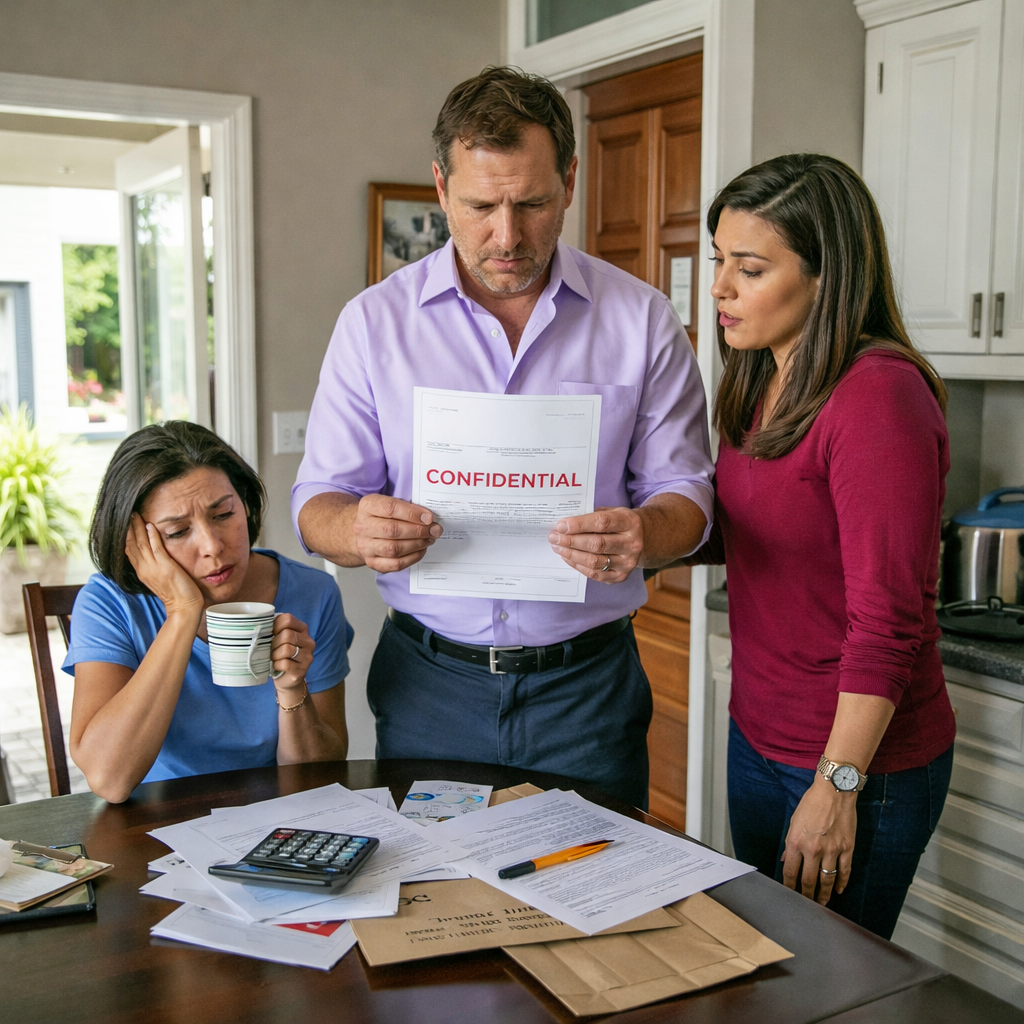
After that, I pulled a plain envelope from my drawer. The kind you’d use for a bill, nothing special. I wrote CONFIDENTIAL across the front in block letters, pressing hard enough that the pen slightly indented the paper.
Inside, I placed a single page. My handwriting looked unfamiliar to me, sharp and clean.
You built a lie on my silence. Now you can pay the bill.
I stared at the sentence for a moment, then folded it and sealed the envelope.
My hands didn’t tremble. My chest didn’t collapse.
Instead, I felt something strange.
Space.
Like I’d been holding my breath for years and had finally exhaled.
I left the room and walked back down the hallway. The sound of their voices drifted from the dining area, low and casual now, like the whole thing had already been resolved in their minds. Like voting to evict me was as ordinary as choosing a movie.
I didn’t go back to the table. I didn’t pick up my coat with a dramatic flourish. I simply walked to the kitchen, placed the envelope on the counter where they couldn’t miss it, and grabbed my keys.
No speech.
No slamming doors.
Just the soft click of the lock behind me as I stepped into the hallway outside the apartment.
The building smelled like old carpet and someone’s laundry detergent. The fluorescent lights buzzed faintly overhead. It was unglamorous, practical, real.
I walked down the stairs, my footsteps echoing, and by the time I reached the bottom, my phone was already vibrating.
The group chat.
Mom: Sweetheart, call me.
Tim: What’s going on? Wi-Fi is down.
Lena: LOL you seriously canceled utilities?
Dad: This is childish. Fix it.
I stared at the messages without responding. The familiar pull tried to grab me, the old instinct to explain, to soothe, to repair what they broke.
I slid my phone into my pocket and kept walking.
By eleven thirteen the next morning, my phone rang with a number I recognized.
Mark.
I answered on the second ring.
“Hey, Jennifer,” he said cautiously. His voice had that careful tone people use when they can smell conflict and don’t want to step into it. “Your sister called yesterday.”
My stomach tightened. Not surprise. Confirmation.
“She said you were moving to Seattle,” Mark continued, “and that she’d be taking over payments. She wanted me to draft a lease reassignment.”
A laugh escaped me before I could stop it. Sharp and humorless, like something snapped under pressure.
“I live here,” I said.
There was a pause on the line, then Mark exhaled. “Yeah. I figured something was off. I checked the lease. It’s all you. I’m not doing anything without your signature.”
Relief didn’t arrive like warmth.
It arrived like another wave of anger.
Because it wasn’t enough that they’d been living off my money. They were trying to take the structure too, trying to slide their hands under the foundation and claim they’d built it.
“Thank you,” I said, and meant it.
“No problem,” Mark replied. “Just… keep me in the loop, okay?”
“I will,” I promised.
When the call ended, I stood for a moment on the sidewalk outside my building, the winter air biting at my cheeks. Cars hissed past on wet pavement. Somewhere nearby, someone laughed, a normal laugh, about something that mattered in a normal way.
I looked up at my apartment windows.
My apartment.
And inside, my family was probably staring at blank screens and cold rooms, confused by the way consequences feel when they’re no longer cushioned by someone else’s generosity.
I took a slow breath.
Then I started walking, because I had work to do, and for the first time, it was work that belonged to me.
That afternoon, Lena posted a black-and-white photo of herself staring out a window like she was auditioning for a heartbreak commercial. Her caption was a clean, sharp knife wrapped in poetry.
“Sometimes the people you trust most are the ones who teach you what betrayal means.”
Within minutes, hearts and sympathetic comments poured in. Aunts. Cousins. Old family friends. People who’d held me as a baby, who’d watched me grow up, who’d never once asked where my paycheck went every month.
So many of them called her brave. So many called me ungrateful.
Money changes people, one cousin wrote.
I can’t believe Jennifer would do this to her parents, an aunt said, as if she had personally witnessed it.
I wasn’t raised like that, someone else added, which was funny, because I was. I was raised exactly like that. Raised to apologize for needing things. Raised to pay for peace. Raised to swallow.
Nobody asked what happened.
Nobody asked why the Wi-Fi was in my name. Why the rent came out of my account. Why my mother’s insurance and my father’s gym membership were linked to my card. Nobody asked why Lena’s “job search” had lasted over a year while she somehow still managed to buy clothes that cost more than my weekly groceries.
They didn’t ask because they didn’t want the answer.
They wanted a villain. Lena had handed them one.
I didn’t post a rebuttal. I didn’t comment. I didn’t DM Lena to scream at her. My anger was too focused for that. I could feel it in my hands, steady, like a weight I could lift if I chose.
Instead, I started digging.
It began as a vague memory, a small mental flash of Lena sitting at my desk a couple of years back, asking if she could plug in an external hard drive because her laptop was “acting weird.” She’d been in her “freelance phase” then, the one where she talked about creative work but never seemed to get paid. I remembered the drive because it had a neon sticker on it, a little lightning bolt, like a joke about power.
I remembered it because she’d left it behind.
That night, after I’d come back to the apartment only long enough to grab a few more clothes, I went into the drawer by my desk. The same drawer where random cords go to die. I pushed aside tangled chargers and an old set of earbuds and found it wedged behind cables.
The hard drive.
My pulse kicked up, but my hands stayed steady as I plugged it into my laptop. The little light on the drive blinked once, then glowed.
A folder popped up on-screen.
At first it looked boring. A mess of subfolders with dates and vague titles. I clicked through slowly, scanning names, letting my eyes adjust to what I was seeing.
Then I found a folder labeled: rent 2022.
My stomach tightened. I clicked.
Inside was a PDF ledger.
Not a budget.
A confession.
Jan – autopay transfer $450. Say it’s Spotify.
April – mortgage top-off. She won’t notice. Came from reserve.
May – medical bill. Just use backup debit. She never checks.
The words sat there, blunt and casual, written like notes to herself. Like reminders for a grocery list. Like stealing from me was as normal as picking up eggs.
My fingers went cold.
It wasn’t just that Lena had taken money.
It was that she’d documented it, like a strategy, like a game.
I scrolled further. More entries. More “she won’t notice.” More references to my emergency fund, the reserve I’d built because I’d been taught that safety wasn’t guaranteed.
I had built that reserve brick by brick. Denying myself things. Saying no to vacations. Saying no to new furniture. Keeping an emergency fund because the world can fall apart fast.
And Lena had treated it like a pantry she could snack from.
I backed out of the folder and clicked another.
Recordings.
My breath stalled.
Dozens of audio files sat there, each with a name that made my skin crawl. Some were innocuous at first glance, like meeting notes. Then I saw others, titles that felt too specific, too deliberate.
I clicked one at random.
My laptop speakers crackled, and Lena’s voice filled my room, clear as if she were sitting beside me.
“Dad,” she said, theatrical and bright, “she said she’s cutting you off. Said you’re a leech. I recorded it. Want me to send it?”
I froze.
It wasn’t just the content, though it was bad enough. It was the tone. The pleasure in her voice, the satisfaction of offering my words like ammunition.
I clicked another file, one with a title that made my stomach drop hard enough I had to grip the edge of my desk.
final cut mom dying.mp3
I stared at it for two full seconds before my finger moved.
The audio began with my own voice.
My real voice.
Then a glitch. A tiny skip, like a breath cut out. Then another.
And suddenly it wasn’t my sentence anymore.
“I don’t care if she dies,” my voice said.
My blood went cold.
I knew exactly what I had actually said. I could remember the moment, the argument, the way my mother had lied to my face again and again, the way I’d finally snapped, exhausted.
I had said, “I don’t care if she lies again. I’m done.”
But Lena had chopped it. Reordered it. Stitched it into something monstrous.
A DIY villain origin story, ready to be deployed whenever she needed the family to see me as heartless.
I sat in the dark, listening to my own voice turned into a weapon.
And something inside me shifted.
Guilt had been my default for so long it felt like part of my personality. Like a second heartbeat.
But guilt only exists when you believe you’re wrong.
This wasn’t wrong.
This was war.
I kept digging, deeper now, the anger in me sharpening into focus. I pulled up bank statements and old emails, cross-referencing dates in the ledger with actual transactions. Every time I found a match, it felt like another nail being hammered into place.
Then I found it.
A personal loan from 2022.
Fifteen thousand dollars.
Co-signer: me.
Social Security number: mine.
Signature: mine, but not mine.
The signature was sloppy, a clumsy imitation that made my throat burn. Whoever signed it had tried to mimic my looped J and the way I cross my t, but they’d gotten the pressure wrong, the rhythm wrong. It looked like someone tracing over a memory.
My hands tightened into fists.
I remembered confronting my dad about that loan. I remembered the way he’d acted offended, the way he’d made me feel stupid for even asking.
Paperwork mix-up, he’d said. You know how these banks are.
I’d been younger then. Tired. Still trained to swallow discomfort to keep the peace.
I’d told him I’d let it slide if he paid it off.
He never did.
The interest had been quietly eating at my credit like acid.
I stared at the loan documents until my eyes hurt, then I called the loan company.
The woman on the phone sounded bored at first, like she’d heard every complaint. But when I said the words identity theft and forged signature, her tone changed. Her voice tightened into professionalism.
She emailed me fraud forms.
I filled them out with shaking hands that didn’t shake from fear, but from the sheer force of fury being held under control. I attached evidence. Screenshots. Lease info. Bank history.
Within forty-eight hours, the loan froze.
And I felt something I hadn’t felt in a long time.
Power.
Not the kind that comes from intimidation.
The kind that comes from finally having proof.
I didn’t stop there.
I compiled everything. Every rent payment. Every utility bill. Every “therapy money” request from Lena that coincided with a new designer hoodie showing up on our doorstep. I built a spreadsheet with dates, amounts, descriptions.
Family expenses paid 2018–2025.
When I calculated the total, my mouth went dry.
$71,384.
It wasn’t just the number. It was what the number represented.
Years of my life. Months of my labor. Nights of me eating cheap ramen because I thought I needed to keep saving. Times I’d told myself I couldn’t afford to take a break.
Seventy-one thousand dollars, poured into people who had just voted to kick me out of my own home.
I named the folder on my desktop:
CONFIDENTIAL — THE LEDGER.
Then I printed copies.
The sound of the printer in my quiet apartment felt like a countdown. Paper slid out page by page, crisp, undeniable. It smelled faintly of ink, warm from the machine.
I stapled packets together. I slid them into envelopes without writing letters. No explanations. No emotional pleas.
Just receipts.
One copy I hand-delivered to my father’s office. I walked into the lobby with my shoulders squared, held the envelope out to the receptionist, and said, “Please make sure he gets this.”
Her eyes flicked over the word CONFIDENTIAL. She swallowed and nodded.
I left another in my mother’s mailbox.
Then I went home and waited.
Two weeks later, my brother Tyler called.
Tyler was the kind of brother who only showed up when he wanted to give a speech. He lived in a nicer place, drove a nicer car, and loved talking about responsibility as if it was something he understood in theory, not something he practiced.
“You can’t cut off Mom and Dad like this,” he said without greeting, voice sharp. “Dad’s talking about selling the house. They built their budget around that money.”
I actually laughed, but it wasn’t funny.
“Tyler,” I said, and my voice sounded calmer than I felt. “I sent them seventy-one thousand three hundred eighty-four dollars over six years.”
There was a pause.
Then he scoffed. “That’s… that’s your choice. Families help each other.”
“When I had a miscarriage,” I said, and the word landed heavy in my mouth, a fact I rarely spoke aloud, “I called bleeding and scared at two in the morning. They said no because they were at your golf tournament.”
Silence.
I could hear Tyler’s breathing.
“If they need money,” I continued, “maybe you should help them. You make six figures.”
Tyler’s voice hardened. “I have expenses.”
“So do I,” I said. “But somehow I managed to send them thirty-two hundred a month for years.”
He didn’t answer. He made a small sound, like he wanted to argue but couldn’t find a clean way to do it without sounding awful.
We hung up with no resolution.
A few days later, a letter arrived from my parents’ lawyer.
Threatening language. Polished sentences. Words like financial abandonment and breach of oral contract, as if they could sue me for no longer being exploitable.
My hands didn’t shake this time. I read it once, then forwarded it to Marisol.
Marisol was my friend, and she was also a lawyer sharp enough to make grown men regret opening their mouths. She had a way of looking at a document and immediately seeing where it was weak, where it lied, where it pretended.
She called me after reading it.
“They’re bluffing,” she said. “But I’m going to answer anyway.”
“What do you need from me?” I asked.
“Everything,” she said, and there was a smile in her voice. “Send me the ledger. Send me the recordings. Send me the loan documents. Send me every text where they asked for money.”
I did.
Marisol’s response letter went out the next day.
It was long, comprehensive, and brutal in the quiet way only truth can be when it’s formatted professionally. It cited laws. It referenced fraud. It outlined amounts and dates. It included a summary of evidence.
Within a week, their lawyer withdrew the suit.
Later, Marisol told me in a low voice over drinks, “He admitted they hadn’t told him the whole story. He sounded embarrassed.”
Embarrassment was a luxury my family rarely allowed themselves. They preferred rage.
My mother asked to meet me at a café.
It was one we used to go to after my school competitions, back when she still called me champ and kissed my forehead like I was precious instead of useful. The café smelled like espresso and sugar. The windows were fogged slightly from the cold outside. Soft music played overhead, trying to make everything feel cozy.
My mother sat at a table near the back, hands wrapped around a cup like she needed the warmth. Her hair looked thinner. Her face looked tired. For a moment, something in me softened, purely out of habit.
Then I remembered her stirring tea while my father laughed at me.
I sat down across from her.
She looked at my cheek, which had long since healed, and her eyes flickered with something like guilt, but it didn’t settle long enough to be real.
“I didn’t know about everything,” she began quickly. “The loan, the recordings. That was Lena’s idea.”
I stared at her. The café’s warm light made her look almost gentle. I knew better.
“You helped them steal from me,” I said calmly. “You wrote the emails. You called the landlord. You let them use my name.”
My mother flinched as if I’d raised my voice. Her fingers tightened around her cup.
“We didn’t think it was a big deal,” she whispered.
My throat tightened, not from sadness, but from the casualness of it. Like I was talking about a missing spoon.
I reached into my bag and slid a folder across the table.
CONFIDENTIAL — THE LEDGER.
The edges of the paper caught the light. My mother stared at it like it might bite.
Then I placed a tiny flash drive on a napkin.
“This has Lena’s audio edits,” I said. “You should hear what she made my voice say.”
My mother’s face drained. The color left her cheeks.
“You think this is revenge?” she asked, voice trembling.
“This isn’t revenge,” I said. “This is closure.”
I leaned forward slightly, keeping my tone even. “You sat at that table and voted to evict me from an apartment I paid for. You watched them post lies. You let them reroute payments from my emergency fund, then acted confused when I pulled away.”
My mother swallowed. Her eyes shone with tears.
“We were drowning,” she whispered.
“No,” I said. “You were comfortable. You were thriving on my credit and my silence.”
I pulled out a sealed envelope and placed it beside the folder.
“This is a formal withdrawal of all financial support,” I said. “Effective immediately.”
My mother stared at it, lips parting.
“You wouldn’t,” she breathed.
“I already did,” I said.
I stood, slid my chair in carefully, and left money on the table for the coffee. A small, final courtesy.
“This coffee is on me,” I said, not unkindly. “Everything else, never again.”
That night, in my new apartment, I set up my phone on a stack of books and pressed record.
No music. No dramatic lighting. No careful editing.
Just me, sitting on my couch with the folder beside me like a witness that didn’t blink.
I looked into the camera.
“Some of you may have heard things about me lately,” I said. “That I abandoned my family. That I snapped. That I’m selfish.”
My voice was steady. My hands were still.
“This isn’t a story about betrayal,” I continued. “This is a spreadsheet.”
I held up the pages, walked through them slowly. Rent. Utilities. Insurance. The loan. The ledger notes. I played short clips, not enough to violate privacy beyond what was necessary, just enough to show intent.
My father’s voice, smug and casual: “She doesn’t even read the statements. That’s the beauty.”
Lena’s voice, bright with malice: “Want me to send the recording so everyone knows she’s the bad guy?”
I ended with the simplest truth I had.
“If you’re watching this and wondering if I’m doing this to shame them, I’m not,” I said. “I’m doing it to free myself, and maybe someone else who’s been made to feel like a wallet in a family photo.”
I posted it at nine p.m.
Then I turned my phone face down and sat very still, listening to the quiet of my apartment.
By midnight, the views were climbing so fast the numbers blurred.
Forty-eight thousand.
Then more.
By morning, it was over six hundred thousand.
My inbox exploded.
Messages from strangers. Men and women with stories like mine, stories they’d never dared to say out loud because their families had trained them to swallow it. People saying, I thought I was crazy until now. People saying, this is my life. People saying, thank you.
My father tried to respond with his own video filmed in his car, face flushed, voice tight.
He said I was unstable.
He said the spreadsheet was doctored.
He said I’d always been dramatic.
It got four likes, all from accounts with no photos and weird usernames.
The top comment read: You taught her everything she knows, especially how to walk away.
I stared at that comment longer than I expected to.
Not because it was clever.
Because it was true in the most bitter way.
A week later, I launched a simple website.
Nothing fancy. Clean layout. Practical language. A digital shelter for people trying to escape family-based financial abuse.
Steps to freeze shared accounts.
Templates to notify landlords.
A PDF guide titled: How to Exit a Family With Receipts.
Within seventy-two hours, fourteen thousand dollars had been raised for a foundation supporting adults recovering from family-based financial abuse.
The money shocked me. Not because people were generous, but because it meant this was common. It meant there were thousands of people out there paying for their own mistreatment, trapped by guilt.
Then the fraud case moved forward.
Lena tried to fight back by forging documents. She created a fake “family cohabitation agreement,” claiming I’d signed something that allowed them to vote me out. She brought it to investigators as if it would settle everything.
But the detective compared it to my verified signatures from my bank and lease.
It didn’t match.
Then they checked the metadata.
Created on Lena’s laptop. Emailed to herself two hours before the interview.
That was the moment the whole thing stopped being a family fight and became what it always had been.
A crime.
My father took a plea deal.
Fraud. Identity theft. Restitution plan. Probation.
Lena avoided charges by cooperating. By admitting to forging audio. By signing a no-contact agreement.
My mother went quiet, not because she suddenly understood, but because silence was all she had left when manipulation stopped working.
In January, on my next birthday, I wasn’t alone.
Rachel came over with takeout and a grin, dragging in cold air when she opened my door. Marisol showed up with wine, eyes bright, still half-laughing about the lawyer who’d tried to threaten me.
Friends from my Zoom support sessions sent a group video, everyone holding up mugs that said CONFIDENTIAL like it was a badge of honor.
I looked around my apartment.
White sheets. Citrus rosemary scent in the air. Furniture arranged exactly how I liked it because no one else got to vote on it.
On my coffee table sat a pistachio cake, no frosting, exactly how I like it.
I took a bite and closed my eyes.
The taste was clean and sweet, not too much, not trying to be impressive.
Peace tasted like that.
I swallowed, opened my eyes, and whispered to myself, quietly enough that no one else heard.
“I’m not a villain. I’m not a victim. I’m just finally unavailable.”
And this time it didn’t feel like a defense.
It felt like a home.
Six months later, I ran into my mother in the fluorescent aisle of a Target.
I hadn’t planned to be there long. I needed paper towels, toothpaste, and the kind of cereal that only tastes good late at night. Rachel’s daughter sat in the child seat of the cart, swinging her sneakers against the metal and humming to herself, a sticker peeling off her sleeve.
I turned the corner near housewares and nearly walked straight into her.
She looked smaller than I remembered. Not physically, but structurally, like someone whose posture had collapsed inward. Her coat was unremarkable. Her hair was pulled back without the careful styling she used to insist on. In her cart were generic brands. No impulse candles. No luxury snacks. Just necessities.
Her eyes landed on the child first, then moved to me.
“Jennifer,” she said, voice catching like she hadn’t practiced saying my name out loud in a while. “Can we talk?”
I stopped the cart. Rachel’s daughter leaned forward, curious, then tugged gently at my sleeve.
“Who’s that?” she whispered.
“A person I know,” I said quietly.
My mother clasped her hands together, the same gesture she used when she wanted to appear reasonable. “Just for a minute,” she said. “About fixing this. About being a family again.”
The aisle smelled like detergent and plastic. Somewhere down the row, a scanner beeped. Life continued at full volume around us, indifferent.
“We were never a family,” I said calmly. “We were a one-way relationship where I gave everything and you took it.”
Her mouth trembled. “That’s not fair.”
“It’s completely fair,” I replied. “What do you want me to say?”
She swallowed. “I want you to say you were wrong.”
I looked at her, really looked at her, and for the first time I didn’t feel pulled toward softness out of habit. I felt steady.
“I want you to say it,” I corrected. “I want you to say, ‘I chose a golf tournament over my daughter’s medical emergency and it was unforgivable. I took your money for six years and never once thanked you. I treated you like an ATM instead of a daughter. I was a bad mother and I’m sorry.’”
Her eyes widened, shock overtaking her carefully assembled hurt.
“That’s cruel,” she said.
“That’s honest,” I replied. “And if you can’t be honest about what you did, we can’t move forward.”
Rachel’s daughter tugged my sleeve again, this time harder. “Can we go?” she asked. “This lady is making you sad.”
My mother’s face crumpled. “I’m not this lady,” she said, desperation creeping in. “I’m your—”
“No,” I said, firm and gentle all at once. “You’re just someone I don’t know.”
I pushed the cart forward.
Behind me, her voice cracked. “You ruined my life.”
I stopped, turned once, and met her eyes.
“No,” I said clearly. “You ruined your own life. I just stopped protecting your lies.”
I walked away.
Later that night, I replayed the moment in my head, not with satisfaction, but with clarity. It wasn’t victory. It was alignment. The moment when what I said finally matched what I believed.
A few weeks after that, my website crossed another milestone. More emails arrived every day. People describing accounts frozen in secret. Parents who demanded access. Siblings who kept score. Adult children who had been paying for love with silence.
I answered as many as I could.
You’re not crazy.
You’re allowed to stop.
Receipts matter.
I learned something in the quiet months that followed. Healing didn’t arrive with fireworks. It arrived with small, almost boring moments.
Paying my rent without anxiety.
Opening my banking app without bracing.
Buying groceries without calculating who else might need the money more than me.
Peace was subtle. It didn’t announce itself. It settled.
My name is Jennifer Walsh. I’m thirty-one now.
I’m building a life with people who show up. People who don’t need convincing. People who don’t confuse love with access.
I lost the parents I wished I had. I lost the fantasy of a family that would one day wake up kind.
But I gained something far more solid.
Self-respect.
Boundaries that hold.
The knowledge that I get to choose who has access to my time, my money, my energy, my life.
If you are the family ATM. If you are funding your own mistreatment. If you are being called dramatic for asking for basic respect.
You are allowed to stop.
You are allowed to walk away with receipts.
You are allowed to become unavailable.
Because love without respect is not love.
And the people who truly love you will never make you pay for it.