My Sister Raised Me. I Called Her a Nobody. Then I Learned the Truth That Changed Everything
I was twelve when our mother passed away, an age where childhood still clings to you, but just loosely enough that it can be ripped away in an instant. One day the world felt reliable, predictable, arranged in familiar patterns. The next, it was a place of long hallways, muffled footsteps, and adults who spoke as if every word might shatter something fragile.
I remember the hospital corridor more vividly than I remember my own childhood bedroom.
The floor shone with an artificial polish, reflecting the overhead lights in long, white streaks. The air burned with the sharp, clean scent of antiseptic, a smell I would later associate with fear long before I ever learned to associate it with healing.
Somewhere down the hall, a machine beeped steadily, its rhythm calm and indifferent, as if it did not know what had just been taken from us.
People kept telling me to sit down. To drink water. To be brave. I did not understand what bravery meant yet. All I knew was that my hands felt too big for my arms, that my chest hurt in a way I could not explain, and that every few seconds I expected my mother to walk toward us, annoyed that everyone was making such a fuss.
She never did.
What I remember most from that day is not the doctors, or the nurses, or even the moment when someone finally said the words out loud. What I remember is my sister.
She stood beside me during the funeral, her black dress pressed neatly against her knees, her back straight in a way I had never seen before. Her shoulders were squared, as if she had decided that nothing would push her forward or bend her down.
Her eyes were dry. That detail confused me at the time. I remember wondering if something was wrong with her, if grief had skipped over her somehow and landed heavier on everyone else.
She was nineteen. Barely more than a teenager. She should have been crying harder than anyone.
Instead, she was still.
Not frozen, not empty. Still in the way a wall is still. In the way something solid braces itself when it knows impact is coming.
People kept approaching her, whispering condolences, touching her arm, her shoulder. She nodded politely, thanked them softly, and then turned her attention back to me every single time. Her hand never left my back. When my knees felt weak, she shifted closer. When I started shaking, she pulled me into her side without a word.
That was the moment everything changed, even though none of us said it out loud.
In that single, quiet shift, she became my parent, my protector, my anchor. Not by choice, not by ceremony. Just by standing there and refusing to let me fall.
She never made an announcement. There was no dramatic promise about stepping up or sacrificing her life. She did not tell anyone she was taking on a responsibility far heavier than she should have had to carry. She simply did it.
Quietly.
In the weeks that followed, our home felt different. The silence stretched longer. The rooms felt bigger, emptier. The refrigerator was never quite as full, though I did not notice at first. I was wrapped in my own confusion, my own grief. I moved through the days like someone underwater, aware of motion but disconnected from its meaning.
My sister, on the other hand, moved with purpose.
She started waking up earlier. I would hear her alarm before the sun came up, the soft buzz cutting through the quiet. Sometimes she would turn it off quickly, as if trying not to wake me. Other times she would let it ring a little longer, gathering the strength to sit up before the day demanded something from her.
She stopped talking about college.
At first, I thought it was temporary. She had been accepted to a nearby school, had spent months discussing dorm rooms, schedules, possibilities. But the brochures disappeared. The acceptance letter vanished from the counter. When I asked her about it, she smiled and said she was taking a break. Just a year. Maybe two.
I believed her.
I wanted to.
She took two jobs. One during the day, one at night. She learned how to measure time in fragments, how to exist on sleep that never felt complete. She learned how to stretch a grocery list until it barely resembled what it once was. How to choose the cheaper brand without making it obvious. How to turn tiredness into a smile that was convincing enough to fool a twelve year old who desperately needed to believe everything was going to be fine.
And somehow, it was.
At least, that is what she told me.
She learned things our mother had always handled. How to talk to landlords without sounding scared. How to argue bills down a few dollars at a time. How to balance rent, utilities, food, and school supplies with money that never seemed to be enough. She learned which lights could be turned off, which rooms did not need heat, which expenses could be delayed just a little longer.
I did not see most of this. Or maybe I did, but chose not to understand it.
Growing up, I focused on school. She focused on survival.
I buried myself in textbooks and homework, convinced that doing well was the best way I could honor everything that had been lost. Teachers praised me. Counselors pulled me aside to tell me I was special, that I had potential.
Every gold star, every high grade felt like a small victory, like proof that the sacrifice unfolding quietly at home meant something.
She rarely talked about herself. When she did, it was in passing. A comment about a long shift. A joke about being tired. A shrug when I asked if she was okay.
“I’m fine,” she always said.
She said it with a smile that never quite reached her eyes, but I did not know how to read that yet. I saw what I wanted to see. Strength. Control. Stability.
Years passed faster than I expected them to. High school blurred into college applications. College acceptance letters arrived one by one, thick envelopes full of possibility. I remember opening them at the kitchen table, my heart pounding, her standing behind me pretending not to be nervous.
When I got into medical school, she cried for the first time since the funeral.
She tried to hide it, wiping her eyes quickly, laughing at herself. But I saw it. I saw the way her shoulders shook just slightly, the way she pressed her lips together as if afraid the sound might escape.
“I knew you could do it,” she said.
At every milestone, she was there. Not front and center, not drawing attention. Usually toward the back, clapping softly, smiling with a pride that felt steady and unshakeable. She never asked for credit. Never hinted at what she had given up. Never reminded me of what it had cost.
By the time I finished residency, my life felt like it was unfolding exactly as it was supposed to. I had a career people respected. A future that looked impressive on paper. A sense of momentum that made it easy to believe I had earned everything through effort and intelligence alone.
At my graduation, wrapped in a stiff gown that smelled faintly of dust and fabric cleaner, applause echoed through the auditorium. My name was called. I walked across the stage. Hands shook mine. Cameras flashed.
I scanned the crowd until I found her.
She was seated toward the back, just like always. Her hands came together softly, her smile warm and familiar. Her eyes shone in a way that made my chest tighten, though I did not understand why at the time.
When the ceremony ended and people gathered in clusters, laughing and taking photos, she hugged me. Her arms felt thinner than I remembered. Or maybe I was imagining it.
Something ugly surfaced inside me then. A feeling I did not recognize right away. It felt like confidence at first, like pride. But underneath it was something sharper, something unkind.
I laughed, high on accomplishment, and said words I would later wish I could pull back into my mouth.
“See?” I said. “I climbed the ladder. You took the easy road and became a nobody.”
The sentence hung between us, heavy and fragile at the same time. I watched her face carefully, waiting for a reaction I did not know how to name.
For a moment, I thought she might finally break.
She did not.
She smiled. Small. Tired. The kind of smile she had worn for years.
“I’m proud of you,” she said.
Then she stepped back. Turned away. And walked out of the room.
We did not speak for three months.
At first, I told myself she just needed time. That she was hurt, but she would come around. She always did. I had a new job, a new city, a new life that demanded my attention. Guilt surfaced occasionally, usually late at night, but I pushed it aside with the same ease I had learned to push aside discomfort.
She had always been strong.
I assumed she always would be.
I did not know yet how wrong I was.
The weeks without her stretched longer than I expected. At first, the silence felt temporary, almost polite, like a pause both of us understood without needing to name. I sent a message once, something casual, something light, asking how she was doing.
It went unanswered. I told myself she was busy. I told myself she needed space. I told myself a lot of things that allowed me to keep moving forward without looking back.
Work filled my days completely. The hospital where I had started my new position was large and efficient, its hallways always humming with motion. I learned new routines, new faces, new expectations. I told myself this was what progress looked like. This was adulthood.
This was success. I worked long hours, stayed late, volunteered for extra responsibilities. When people asked about my family, I spoke about my sister with practiced ease, careful not to mention the distance, careful not to linger.
Every now and then, usually late at night when the city outside my apartment window fell quiet, her face would surface in my thoughts. The way she had smiled after my words landed. The way she had walked away without a sound.
In those moments, discomfort crept in, a dull ache I did not quite know how to sit with. I reminded myself that she had always been capable. Always resilient. She would be fine.
Then work sent me back to my hometown for a conference.
The email arrived without ceremony, a simple notice about dates and accommodations. I stared at the screen longer than necessary, feeling something tighten in my chest. Going back felt inevitable and unsettling all at once.
The town I had left behind existed in my memory like a preserved image, untouched by time. I told myself this would be quick. Professional. In and out.
Still, the thought of being so close to her without seeing her felt wrong.
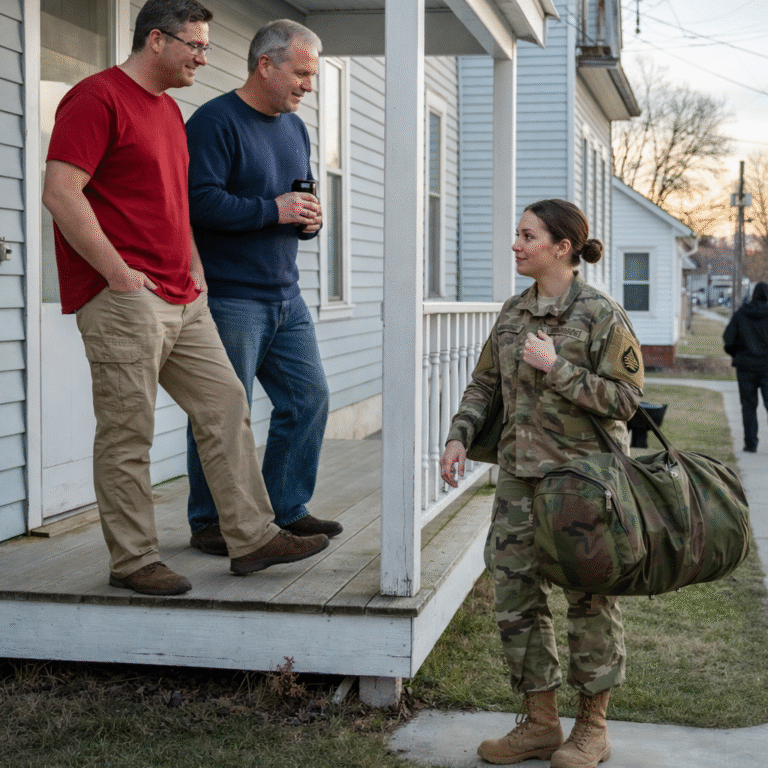
I decided to visit her on impulse. No call. No message. I imagined knocking on her door, standing awkwardly on the porch while we navigated the space between us. Maybe there would be tension. Maybe anger. Maybe tears. None of it felt unmanageable. I had rehearsed apologies in my head without committing to any of them.
The afternoon light was already starting to soften when I pulled into her street. The houses looked smaller than I remembered. Familiar, but changed. Or maybe I had changed. I parked in front of her place and sat in the car for a moment longer than necessary, my hands resting on the steering wheel, my heartbeat louder than it should have been.
The front door was unlocked.
That should have stopped me. It should have made me pause, question, call out. Instead, I pushed the door open and stepped inside, already forming her name in my mouth.
The house felt wrong immediately.
Not just quiet, but hollow. The kind of quiet that presses against your ears, that feels deliberate rather than peaceful. The air was cool and still. My footsteps sounded too loud against the floor. I noticed the absence before I noticed anything else. The couch that had always been by the window was gone. The lamp in the corner. The framed photos that once lined the walls, moments of our childhood frozen behind glass.
Bare patches marked where life had once been.
A faint sound reached me from deeper inside the house. Soft. Uneven. Not quite a voice. My chest tightened as I followed it down the hallway, each step heavier than the last. The light grew dimmer toward the living room, the late afternoon sun barely reaching the far wall.
She was on the floor.
For a moment, my mind refused to accept what my eyes were seeing. She looked smaller than she ever had, curled slightly on her side, one arm wrapped around her middle. Her skin was pale, almost gray in the low light. Her breathing was shallow, uneven, each breath a visible effort.
I dropped to my knees beside her, the world narrowing to the space between us. My hands shook as I touched her shoulder.
“Hey,” I said, my voice sounding too loud, too thin. “Hey, it’s me.”
Her eyes fluttered open slowly. When she saw me, she smiled.
Even then.
“I didn’t want to worry you,” she whispered, her voice barely there.
The words hit harder than anything else. I helped her sit up, supporting her weight as carefully as I could. She felt light in my arms, alarmingly so. My mind raced through possibilities, symptoms, explanations, but nothing prepared me for how fragile she felt.
The drive to the hospital blurred together. I remember the sound of the engine, the way my foot pressed harder on the gas than it ever had before. I remember glancing at her in the passenger seat, watching her chest rise and fall, counting breaths without realizing I was doing it. She kept insisting she was fine. That it was nothing. That she just needed rest.
I did not believe her anymore.
At the hospital, time stretched and folded in on itself. Tests. Questions. Waiting rooms that smelled faintly of cleaning solution and old coffee. I sat beside her bed, my hands clasped together so tightly my fingers ached. She looked exhausted, her eyes half closed, her face slack in a way that scared me.
The truth did not come all at once.
It arrived in pieces. A quiet conversation with a doctor. A chart reviewed too carefully. A series of terms explained gently, cautiously. A condition she had known about for years. Symptoms she had minimized. Treatments delayed. Appointments skipped.
Because there was always something else that needed the money more.
She told me later, her voice steady despite everything, that she had learned how to ignore discomfort. How to live around it. How to pretend it was not there. She told me she had done the math more times than she could count, choosing which expenses mattered most each month.
Then she said the thing that broke something open inside me.
“There was never any inheritance,” she said quietly, staring at the ceiling. “Mom didn’t leave us anything.”
I stared at her, my thoughts scrambling to catch up.
“All that money you thought came from savings,” she continued, her voice calm in a way that felt unreal, “it came from me. I didn’t want you to feel trapped. I wanted you to study freely.”
The empty house made sense then. The missing furniture. The jewelry I remembered our mother wearing. The boxes that had quietly disappeared over the years.
Sold.
Every memory shifted under the weight of that knowledge. The extra shifts. The exhaustion she brushed off. The way she never bought anything new for herself. The tired smiles I never questioned.
She had been shrinking her life, piece by piece, so I could expand mine.
I sat there, listening, nodding, unable to find words that felt worthy of what she had given. The room felt too small, the air too heavy. I thought of my graduation. Of my laughter. Of the word I had used so carelessly.
Nobody.
That night, after she was stabilized, the room finally quieted. Machines hummed softly. The lights were dimmed. She slept, her breathing more even now, her face relaxed in a way I had not seen in years.
I stayed beside her bed.
When the weight of everything finally settled, I cried. Not quietly. Not politely. The kind of crying that comes from somewhere deep and unguarded. My shoulders shook. My chest hurt. I pressed my face into my hands and let the sound come out because holding it in felt impossible.
I realized how wrong I had been.
I had measured success by titles, degrees, applause. She had measured it by love, responsibility, and endurance that asked for nothing in return.
Morning arrived slowly, almost cautiously, as if the day itself was unsure whether it was welcome. Pale light slipped through the narrow gap in the curtains, touching the edge of the bed, the metal rail, the quiet machines. The hospital room looked softer in daylight. Less threatening. Or maybe I was simply too exhausted to see it clearly.
I had not slept. Not really. I drifted in and out of shallow moments of rest, my head tilted back against the chair, my hand still wrapped around hers. Every time she shifted or breathed a little differently, I was awake again, alert, my heart racing before my mind could catch up.
When she finally stirred, it was subtle. A small movement of her fingers. A slow inhale. Her eyelids fluttered before opening, adjusting to the light.
She looked at me, confused for a second, then smiled.
That smile nearly broke me all over again.
“You stayed,” she said quietly.
“Of course I did,” I replied, my voice rough. I cleared my throat and tried again. “I’m not going anywhere.”
She studied my face, her expression gentle but searching, as if she were reading something new there. For years, I had been the one she watched over. The one she checked on without being asked. Sitting there now, I felt the weight of that reversal settle into place.
The nurse came in soon after, cheerful and efficient, checking vitals, adjusting settings, explaining the plan for the day. Follow ups. Treatment adjustments. Monitoring. Words that meant safety and structure, but also time. Time she had never allowed herself before.
When we were alone again, silence filled the space between us. Not the hollow silence of her empty house, but something quieter. Expectant.
“I owe you an apology,” I said finally.
She turned her head slightly, watching me with the same patience she had always had.
“No,” she said softly. “You don’t owe me anything.”
I shook my head, the motion sharp. “I do. I said things I had no right to say. I thought success looked one way. I was wrong. I was blind.”
Her fingers tightened faintly around mine.
“You were young,” she said. “You were excited. I knew you didn’t mean it the way it sounded.”
I swallowed hard. “I meant it enough to say it. And that’s on me.”
She was quiet for a moment, her gaze drifting toward the window. Outside, a tree moved slightly in the breeze, its branches casting slow shadows across the glass.
“I never wanted you to feel like you owed me your life,” she said. “I just wanted you to have one.”
The simplicity of that statement stunned me. All those years. All that effort. Reduced to one clear intention.
“I don’t think you understand,” I said, my voice breaking despite my efforts to keep it steady. “Everything I am standing on came from you. Every opportunity. Every choice. I called you a nobody because I didn’t understand what mattered.”
She looked back at me then, her eyes shining but calm.
“I didn’t need to be somebody,” she said. “I just needed you to be okay.”
Tears slipped down her face, silent and slow. I brushed them away carefully, the way she used to do for me when I was a child.
“I’m here now,” I told her. “You’re not alone anymore. This time, I take care of you.”
She squeezed my hand. Not tightly. Just enough to let me know she heard me.
The days that followed blurred together in a different way than before. Not frantic, not fearful. Purposeful. I spoke with doctors. I asked questions I should have asked years earlier. I learned what her condition meant, what it would require, what it would change. Some things were manageable. Others would require patience and consistency. None of it was impossible.
I arranged time off work without hesitation. Found myself back in her empty house, walking through rooms stripped down to their bones. The absence felt louder now that I understood what it represented.
I bought groceries without calculating each item down to the cent. Replaced a chair. Hung new curtains. Small acts, but each one felt like restoring something that had been taken piece by piece.
When she was discharged, she hesitated at the door, looking back at the hospital room as if unsure whether to trust the relief she felt.
“Ready?” I asked.
She nodded. “I think so.”
At home, she moved slowly, carefully. I watched her in a way I never had before, noticing the way she favored one side when she was tired, the way she paused before standing. Strength had always been the word I used for her, but now I understood that strength did not mean invincibility.
It meant persistence.
Some nights, we talked late into the evening. About our mother. About the years in between. About things neither of us had ever said out loud because there had never been room for them before. Other nights, we sat in comfortable silence, the television murmuring softly in the background, the house finally feeling lived in again.
She apologized once, quietly, for not telling me the truth sooner.
“I didn’t want you to worry,” she said.
I smiled sadly. “You spent your life worrying for both of us.”
Time did what it always does. It moved forward. Slowly at first, then with more confidence. Her health stabilized. Routines formed. Follow up appointments became part of the calendar instead of emergencies.
And I changed.
I stopped measuring my worth by introductions and credentials. I started paying attention to the invisible labor in people’s lives. The sacrifices that never made it into speeches or celebrations. The quiet acts that held families together while the world applauded something else.
One evening, as the sun dipped low and filled the living room with warm light, she sat beside me on the couch, wrapped in a blanket, her head resting against the back cushion.
“You know,” she said thoughtfully, “I don’t regret any of it.”
I looked at her. “I do.”
She smiled at me, not tired this time, just gentle. “Then let it mean something now.”
It did.
In that moment, and in all the moments that followed, I understood something no education had ever taught me.
True greatness does not announce itself.
It shows up early. It stays late. It sacrifices quietly. It holds everything together while the world applauds someone else.
And sometimes, it looks like a sister who gave up everything so her younger sibling could become something, never asking to be seen, never needing to be called anything at all.