How I Reclaimed My Life After My Sister Stole My New Car
The morning air bit at my cheeks as I stepped outside, coffee mug still warm in my hand. My breath fogged in the pale October dawn, dissipating into the Ohio cold. I’d set my alarm early—6:30 AM—determined to beat the morning traffic on I-70 into work. The parking lot of my apartment complex stretched before me, dotted with vehicles wearing a thin layer of frost like delicate lace.
My car should have been right there. Third spot from the entrance, under the sodium light that flickered orange all night long.
Instead, I stared at bare concrete.
For a moment, my brain refused to process what my eyes were seeing. The empty space looked wrong, impossible, like a word misspelled so badly you have to read it three times to understand what it’s trying to say. I walked closer, as if proximity might somehow reveal that I’d been mistaken, that my silver Honda Accord was actually there and I’d just been looking at the wrong angle.
But no. The parking space was empty except for a faint oil stain and two tire tracks where someone had backed out quickly, rubber leaving dark curves on the pale pavement.
My chest constricted. The coffee mug trembled in my grip, liquid sloshing dangerously close to the rim.
Someone had stolen my car.
My brand-new car—only three months old, still smelling of factory leather and possibility. The car I’d saved for, sacrificed for, worked overtime shifts and skipped dinners out to afford. The car that represented years of discipline and planning, of saying no to things I wanted so I could say yes to something that mattered.
Gone.
I fumbled for my phone with fingers that had gone numb, though whether from cold or shock I couldn’t say. My mother’s contact photo—her face smiling at some long-ago family gathering—filled the screen as I pressed call. The phone rang once, twice, three times. Each ring stretched longer than the last, time bending in that peculiar way it does when you’re waiting for bad news to be confirmed.
“Hello?” My mother’s voice was bright, cheerful even. Morning-person cheerful, the kind that felt obscene given the circumstances.
“Mom.” My voice cracked, higher than I intended. “Mom, my car is gone. Someone stole my car.”
There was a pause. Not the concerned pause I’d expected, but something else. Something that made my stomach drop even before she spoke.
Then she laughed.
It was a light sound, dismissive, the kind of laugh you give when someone’s being dramatic about nothing. The kind that says you’re overreacting without using those exact words.
“Relax, Jasmine,” she said, and I could picture her waving her hand as if brushing away my panic like an annoying fly. “We gave your spare key to Felicity. She needed a reliable car for her new job, and yours was just sitting there doing nothing.”
The world tilted slightly.
“You… what?” I heard myself say, though the words felt like they were coming from someone else’s mouth, someone who was watching this conversation from a great distance.
“Your sister needed transportation,” my mother explained, her tone suggesting this should have been obvious. “She got that new position at the salon in Worthington—did I tell you about that? Anyway, she needed a dependable vehicle, and you have that nice new Honda just sitting in your parking lot every night. Your father met her there around eleven to give her the spare key. We didn’t want to wake you, so we kept it quiet. Considerate, really.”
My brain struggled to process the information, each word landing like a small detonation.
They had come to my apartment complex. In the middle of the night. To my home, where I lived, where I paid rent, where my name was on the lease and my belongings sat behind locked doors that were supposed to keep the world out.
And they had given away my car.
Not borrowed. Not asked permission to lend. Given away, as if it were theirs to distribute.
“Mom,” I said slowly, forcing each word out with deliberate care, “that car is in my name. I’m the one making the payments every month. You can’t just give someone else my keys without asking me.”
“Oh, don’t be ridiculous.” Her voice had shifted now, taking on that edge I knew so well. The edge that appeared whenever I failed to fall in line with whatever plan she’d decided was best. “She’s your sister. Family helps family. That’s how things work, Jasmine. You know Felicity has been struggling since the divorce, and this new job is really important for her. She needs reliable transportation.”
My eyes closed. I pressed my free hand against my forehead, feeling the beginning of a headache forming behind my eyes.
Felicity.
Of course it was Felicity.
My older sister, thirty-two years old and still moving through life like a tornado, leaving destruction in her wake and expecting someone else to clean it up. Felicity, who had wrecked—actually totaled—four different cars in the past five years. Not fender benders or minor scrapes, but full-on, insurance-company-weeping disasters.
There was the red pickup truck she’d been driving when she ran a stoplight because she was changing the radio station, T-boning a sedan and sending both vehicles spinning into an intersection in Dayton.
The SUV she’d wrapped around a telephone pole after leaving a party, insisting she was “totally fine to drive” despite the fact that everyone there could smell the wine on her breath. The leased Civic she’d driven into a drainage ditch while texting, forgetting that the road curved and ending up nose-down in muddy water.
And most recently, the compact sedan she’d rear-ended into a school bus—an empty one, thankfully—because she was applying mascara at a red light and didn’t notice when the bus stopped.
Four vehicles. Five years. A pattern so obvious that even strangers could see it.
“Mom,” I said, opening my eyes to stare at the empty parking space, “Felicity has destroyed every single car she’s ever driven. She has the worst driving record of anyone I know. Why would you give her my brand-new car?”
“That’s not fair, Jasmine.” My mother’s voice went sharp, defensive. “Those were accidents. Anyone can have an accident. She’s been very unlucky with vehicles.”
“Unlucky?” I repeated, the word tasting bitter. “Four totaled cars isn’t unlucky, Mom. It’s a pattern. It’s negligence. It’s—” I stopped myself, taking a breath. “Where is she? Where did she take my car?”
“I don’t know exactly where she is right now. Probably at work, or maybe getting breakfast first. She mentioned something about needing to stop for coffee.” My mother’s tone suggested this was all perfectly normal, perfectly reasonable. “She said she’d bring it back in a week or so. Two weeks at most. It’s really not a big deal, honey. You’re making this into something it doesn’t need to be.”
A week. Maybe two.
My car—the car I was still paying off, the car that cost me $28,000, the car I needed to get to my own job—would be gone for up to two weeks because my parents had decided my sister’s needs trumped mine.
“When did you give her the key?” I asked.
“Last night around eleven, like I said. Your father drove over to your complex and met her in the parking lot. Very simple, very quick. We figured you’d be asleep by then and we didn’t want to disturb you. We were trying to be thoughtful.”
Thoughtful.
They thought sneaking onto my property in the middle of the night to give away my vehicle without my knowledge or consent was thoughtful.
Something inside me—something that had been bending for years, bowing under the weight of my family’s expectations and manipulations—finally snapped. Not loudly, not dramatically, but with a clean, definitive break that I felt in my bones.
“Mom,” I said quietly, “give me a minute.”
I ended the call before she could respond.
For a long moment, I stood in that empty parking space, the morning growing lighter around me, traffic beginning to build on the nearby streets. Columbus was waking up—people heading to work, to school, to lives that made sense, where families didn’t steal from each other and call it love.
My name is Jasmine Harper. I’m twenty-nine years old, and I work as an operations manager at Crestwell Electric, a mid-sized electrical supply company on the east side of Columbus. I’ve lived in this city my entire life, watching it grow and change while I tried to do the same.
I grew up in a small ranch house just outside Dayton with parents who loved to talk about family loyalty but seemed to only apply that principle in one direction.
I’ve spent twenty-nine years being the responsible one. The dependable one. The daughter who didn’t need help because she always figured things out on her own. The sister who cleaned up messes and made excuses and kept the peace.
Standing in that empty parking space, staring at the concrete where my car should have been, I made a decision.
I was done.
I opened my phone again, scrolled past my mother’s contact, past my father’s name, past my sister’s number that I hadn’t called in months. I found the one contact I never thought I’d actually use for something like this.
Columbus Police Department.
My finger hovered over the call button for only a second before I pressed it.
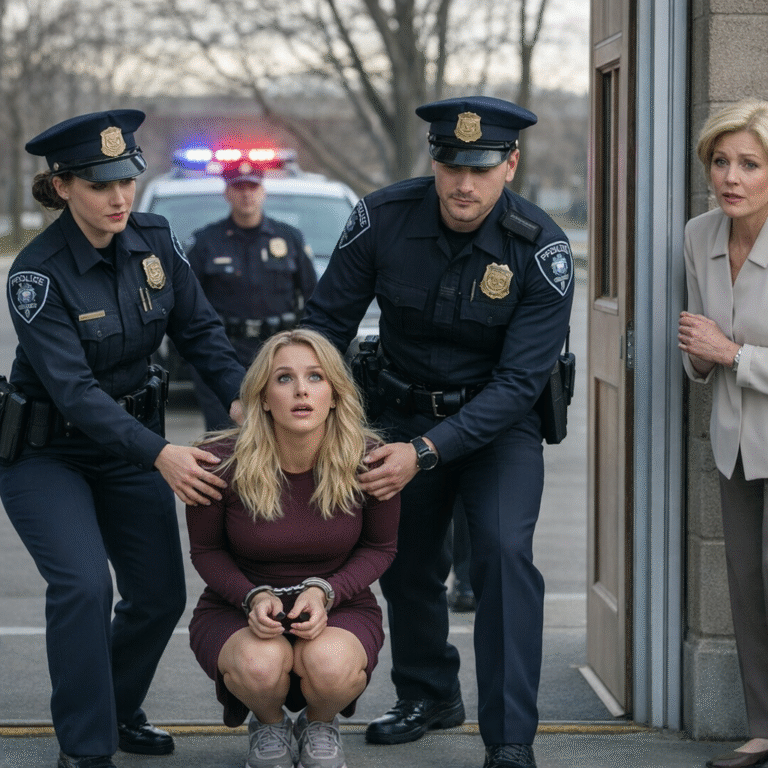
The patrol car arrived within twenty minutes, white with blue markings and the Columbus Police Department seal on the door. A female officer stepped out, her uniform crisp despite the early hour, her expression professional but not unkind. She looked to be roughly my age, perhaps a few years older, with dark hair pulled back in a neat bun and intelligent eyes that took in the situation with a single sweep.
“Good morning,” she said, extending her hand. “I’m Officer Bradley. You called about a stolen vehicle?”
“Yes.” I shook her hand, grateful for the steadiness of her grip. “My car was taken from this parking space sometime last night.”
She pulled out a small notebook, pen poised. “Can you walk me through what happened?”
I told her everything. The empty space when I came out this morning. The phone call to my mother. The revelation that my parents had given my spare key to my sister without my knowledge or permission. The fact that my sister had a documented history of destroying vehicles.
Officer Bradley listened without interruption, occasionally making notes, her expression remaining neutral throughout. When I finished, she looked up from her notebook.
“So let me make sure I understand correctly,” she said. “Your parents came to your residence last night, accessed a spare key that you kept somewhere, and gave it to your sister. Your sister then drove away in your vehicle without your knowledge or consent.”
“Yes,” I confirmed.
“And you’re the sole owner of this vehicle? Your name is on the title and registration?”
“Yes. I bought it three months ago from a dealership in Dublin.” I gestured toward my apartment building. “I have all the paperwork inside.”
She made another note. “And you didn’t give anyone permission to take your vehicle? Not your parents, not your sister, not anyone else?”
“No one,” I said firmly. “I didn’t even know the car was gone until I walked out here this morning to go to work.”
Officer Bradley studied me for a moment, her expression thoughtful. “I need to ask you something important, and I want you to think carefully before you answer. Are you certain you want to file an official police report? Once we enter this into the system, your sister will be flagged for vehicle theft. That’s a serious charge, and it’s not something that can easily be undone.”
I thought about my mother’s laugh on the phone. That casual dismissal of my panic, my property, my boundaries.
I thought about Felicity’s history—the wrecked cars, the excuses, the pattern of destruction that my parents had enabled and funded for years.
I thought about my own history—working two jobs through college while Felicity dropped out after one semester. Saving for years to afford a down payment while Felicity burned through marriages and maxed-out credit cards. Building my life carefully, responsibly, only to have it undermined by people who were supposed to support me.
“I’m certain,” I said.
Officer Bradley nodded. “All right. Let me get some additional information from you, and then I’ll start the official report.”
She asked for my driver’s license, the vehicle’s make and model, the plate number, when I’d last seen it, where I’d parked it. I answered each question, my voice growing steadier as we worked through the details. There was something clarifying about the process, something that made everything feel more real, more valid.
My panic wasn’t an overreaction. My anger wasn’t unjustified.
I had been the victim of a crime, and the system was treating it as such.
As Officer Bradley filled out her paperwork, my phone buzzed. My father’s name appeared on the screen. I let it go to voicemail. Then my mother called again. Voicemail. A text message from Felicity—the first direct communication I’d had from her in months.
Heard you’re freaking out about the car. Chill. I’m just borrowing it for the week. I’ll bring it back Sunday. Stop being so dramatic.
I showed the text to Officer Bradley. Her eyebrow arched slightly.
“Well,” she said, “that certainly makes things easier from an evidentiary standpoint. She’s essentially admitting she has the vehicle.” She pulled out her phone and photographed my screen. “I’m going to enter this information into our system right now. Your vehicle will be flagged as stolen. Any officer who runs the plates will be notified immediately.”
Something twisted in my chest—not guilt, exactly, but something adjacent to it. This was my sister, after all. My family. Wasn’t I supposed to protect them, cover for them, keep their secrets?
But then I remembered the empty parking space. The dismissive laugh. The years of being treated like my needs didn’t matter because I was “capable” and “independent” and didn’t need the help they freely gave to Felicity.
“Do it,” I said.
Officer Bradley made the entry, her fingers moving quickly over her phone’s screen. “Done,” she said. “Your car is now officially registered as stolen property. If your sister is pulled over for any reason, she’ll be detained.”
My phone rang again. This time it was Felicity calling directly.
I hesitated, then answered.
“Jasmine, what the hell is wrong with you?” My sister’s voice came through sharp and angry, no greeting, no preamble. “Mom said you’re acting insane about the car. It’s just a car. I needed it for work. You weren’t even using it.”
“You took my car without asking me, Felicity,” I said, surprised by how calm I sounded. “You didn’t call, you didn’t text, you just took it.”
“I did ask,” she shot back. “I asked Mom and Dad, and they said it would be fine. They said you’d understand because you’re always so understanding about everything.”
“They don’t own my car, Felicity. They can’t give permission for something that doesn’t belong to them.”
“Oh my God, you’re so uptight.” I could hear the eye-roll in her voice. “This is exactly why nobody likes you. You’re always obsessed with rules and ownership and making sure everything is exactly perfect. Meanwhile, I’m actually trying to get my life together, and you can’t even let me borrow a stupid car for one week.”
Officer Bradley watched me, her expression carefully neutral, but I knew she could hear every word through the phone.
“Felicity, where are you right now?” I asked.
“None of your business,” she snapped. “I’ll bring the car back when I’m ready to bring it back, and not a minute before. You can wait.”
“That car is currently registered as stolen with the Columbus Police Department,” I said quietly. “If you’re pulled over for any reason—any reason at all—you’ll be arrested immediately.”
Silence on the other end.
Then, after a long pause, she laughed. It sounded eerily like our mother’s dismissive chuckle.
“You’re bluffing,” she said. “You would never actually call the cops on your own sister. You don’t have the spine for it.”
“I already did,” I said. “The officer is standing next to me right now.”
The silence that followed was different—heavier, uncertain.
“You’re lying,” she said, but the conviction had drained from her voice.
“I’m not.”
Another pause. When she spoke again, her tone had shifted into something uglier, more vicious.
“You know what, Jasmine? You’re unbelievable. You’ve always been jealous of me, and now you’re trying to ruin my life because I finally have a chance at something good. You can’t stand that Mom and Dad love me more than you. You’ve always resented that I’m the favorite.”
The words should have hurt. They were designed to hurt, aimed at wounds that had never quite healed. But standing there in the cold morning air, with Officer Bradley as a witness to this dysfunction, I felt something unexpected.
Distance.
The words landed, but they didn’t penetrate. They bounced off something that had formed inside me overnight—a shell, a boundary, a line I had finally learned to draw.
“Felicity,” I said, “I don’t care if Mom and Dad love you more. I stopped caring about that a long time ago. What I care about is that you stole my car, and now you’re going to face consequences for it.”
“I didn’t steal it,” she insisted. “They gave me the key. That’s not stealing.”
“They gave you a key they had no right to give. You took a car that doesn’t belong to you. That’s the definition of theft.”
“I needed it for work!”
“Then you should have asked me first.”
“I shouldn’t have to ask you for anything!” The anger in her voice was building now, spiraling into something close to rage. “You’re my sister. Sisters help each other. But you’ve always been selfish, always worried about your precious things and your precious rules, and you don’t care about anyone but yourself.”
“That’s not true, Felicity, and you know it.” My voice remained steady, almost eerily calm. “I’ve helped you dozens of times over the years. I’ve loaned you money you never paid back. I’ve covered for you when you were late or missed commitments. I’ve made excuses to Mom and Dad for your behavior. But helping you doesn’t mean letting you steal from me.”
“Just bring the car back to my apartment,” I continued, “and we can resolve this without police involvement. That’s all you have to do. Bring it back, and this stops.”
“No,” she said flatly. “I need it for work. You can take the bus or get a ride or figure something out. That’s what responsible people do—they figure things out.”
The irony of Felicity lecturing me about responsibility was so profound I nearly laughed.
“All right,” I said. “Then I’ll see you when the police find you.”
I ended the call before she could respond.
Officer Bradley closed her notebook. “She’s not going to bring it back voluntarily.”
“No,” I agreed. “She thinks I’m bluffing. She thinks I’ll back down like I always have.”
“We’ll put out a bulletin with the vehicle description, plate number, and last known location,” she said. “Columbus is a big city, but cars are easier to find than people think. We’ll locate it.”
I nodded, feeling a strange mixture of emotions—anxiety, determination, and underneath it all, a growing sense of rightness. For the first time in my life, I was standing up for myself against my family, and the sky hadn’t fallen. The world hadn’t ended.
I had simply drawn a line and refused to let anyone cross it.
“What happens when you find her?” I asked.
“If she’s driving the vehicle, she’ll be pulled over and detained. If the car is parked somewhere, we’ll impound it and contact you. Either way, she’ll have to answer for taking your property without permission.”
“Thank you,” I said.
Officer Bradley’s expression softened slightly. “These situations are more common than you’d think—family members taking property without permission, assuming everything will be forgiven because of the relationship. It rarely ends well, but I think you’re doing the right thing by establishing boundaries now rather than letting this pattern continue.”
After she left, I stood in the parking lot a while longer, watching the morning commute build on nearby East Broad Street. Cars passing, people going about their normal lives, the world continuing to turn regardless of personal drama.
I called work and explained I’d be late. My supervisor, a patient man who’d worked at Crestwell Electric for twenty years, asked if everything was okay.
“Family emergency,” I said, which was technically true, just not in the way he probably imagined.
“Take the time you need,” he said. “We’ll manage.”
I went back inside my apartment, made another cup of coffee, and waited.
The call came four hours later.
I was sitting at my desk at work, trying to focus on inventory reports and supply chain logistics while my mind kept drifting back to the empty parking space, the police report, the choice I’d made. My coworker Denise had noticed something was off the moment I arrived, an hour late and wearing yesterday’s anxious expression.
“You okay?” she’d asked, setting a gas station coffee on my desk—not Starbucks, but the local chain near the warehouse, the kind with the bright orange logo that every Columbus native recognized.
“Family stuff,” I’d said. “I don’t want to talk about it yet.”
She’d nodded and squeezed my shoulder, respecting the boundary in a way my actual family never had.
When my phone finally rang and Officer Bradley’s number appeared, I stood so abruptly I knocked my coffee over. Lukewarm liquid spread across a stack of purchase orders, creating a brown stain that looked vaguely like the state of Ohio.
“This is Jasmine,” I answered, frantically grabbing paper towels from the break room.
“Jasmine, it’s Officer Bradley. We found your vehicle.”
My heart lurched. “Where is it? Is Felicity—”
“The car is at a city impound lot on the west side,” she said. “It was found abandoned in a no-parking zone about three hours ago. Looks like your sister ditched it when she realized we were actively searching for it.”
“What condition is it in?” I asked, though part of me already knew the answer wouldn’t be good.
There was a pause. “You should probably come see it yourself. Are you able to get away from work?”
The impound lot sat on West Broad Street, surrounded by chain-link fence topped with coils of barbed wire. Behind it, I could see the skyline of downtown Columbus, glass towers catching the afternoon light. The lot itself was full of vehicles in various states of distress—cars with smashed windows, vehicles with expired registrations, a few that looked like they’d been pulled from crime scenes.
Officer Bradley was waiting when I arrived in a borrowed car—Denise’s beat-up sedan that smelled like vanilla air freshener and old french fries.
“Thank you for coming,” she said, then gestured toward the lot. “Your car is over here.”
I followed her through the gate, past rows of damaged vehicles, until she stopped beside something I almost didn’t recognize.
My Honda Accord—my beautiful, pristine, three-month-old car—looked like it had been through a war.
The front bumper was crumpled inward, dented and scraped with paint transfer from another vehicle. The driver’s side mirror hung at a broken angle, held on by what looked like a single screw. Long, deliberate scratches ran the length of the passenger door, deep grooves that went all the way down to the metal. The rear window had a crack running diagonally across it, a spiderweb of broken glass that caught the light in fractured patterns.
I couldn’t speak. My throat had closed up completely.
“The bumper damage suggests she rear-ended someone at low speed,” Officer Bradley said quietly. “Probably didn’t stop to exchange information. The scratches look deliberate—someone keyed the car. And the rear window…” She paused. “That crack pattern suggests impact from the inside, not the outside. Like someone kicked it or threw something at it.”
I walked slowly around the car, my hand hovering over the damage but not quite touching it, as if contact might somehow make it more real. With each new dent, each scratch, each sign of my sister’s carelessness, something inside me hardened.
“We found the interior full of fast-food trash,” Officer Bradley continued. “Wrappers, empty cups, bags stuffed under the seats. There’s also a stain on the back seat that you’ll want to have professionally cleaned. We’re not sure what it is.”
My phone rang. My mother’s name flashed across the screen.
This time, I answered.
“Jasmine.” Her voice was tight, controlled in that way that meant she was furious but trying not to show it. “Felicity just called me crying. She says the police are after her because you filed some kind of report. Please tell me this is all a misunderstanding.”
I looked at my destroyed car—at thousands of dollars in damage, at the physical manifestation of years of my sister’s recklessness and my family’s enablement.
“It’s not a misunderstanding, Mom,” I said. “She stole my car, and now she’s dealing with the consequences.”
“‘Stole’ is a very harsh word,” my mother said. “She borrowed it. There’s a difference.”
“She took it without permission, drove it for less than a day, and destroyed it,” I said flatly. “I’m standing in an impound lot right now looking at what’s left of my three-month-old car. The bumper is smashed. The door is keyed. The rear window is cracked. The interior is trashed. This isn’t borrowing, Mom. This is theft and destruction of property.”
Silence on the other end.
“Destroyed it?” she finally said, her voice smaller. “What do you mean destroyed? Felicity didn’t mention any damage.”
“Of course she didn’t,” I said. “When has Felicity ever told you the truth about anything? She probably doesn’t even realize she hit something. She was probably texting or doing her makeup or any of the hundred things she does instead of actually paying attention to the road.”
“Well…” My mother’s voice shifted, taking on that familiar placating tone. “Even if there was some minor damage, it was probably an accident. You know Felicity has always had trouble with cars. That doesn’t mean she should be treated like a criminal by her own sister.”
“Trouble with cars?” I repeated, my voice rising despite my best efforts. “Mom, she’s destroyed four vehicles in five years. Four. That’s not bad luck. That’s not ‘trouble with cars.’ That’s a pattern of reckless, negligent behavior that you and Dad have enabled every single time by paying her legal fees and buying her new cars and making excuses.”
“We supported our daughter when she needed help,” she said defensively. “That’s what parents do.”
“And what about me?” The words burst out before I could stop them. “What about all the times I needed help? When I was working two jobs to pay for college while Felicity dropped out after one semester and you paid for her apartment anyway? When I was saving every single penny for years to afford this car while you bought Felicity three different vehicles that she wrecked? When did you ever support me the way you’ve always supported her?”
The question hung in the air between us, sharp and jagged.
“You never needed help, Jasmine,” my mother said quietly. “You were always so capable, so independent. Felicity needed more support because she struggled more. That’s just how it is with children who have different needs.”
“Different needs or different standards?” I asked. “Because from where I’m standing, it looks like you held me to an impossible standard my entire life while letting Felicity get away with literally anything.”
“That’s not true”
“It’s completely true,” I interrupted. “The proof is that you thought it was perfectly acceptable to sneak into my apartment complex in the middle of the night and give away my car without even asking me. You would never have done that to Felicity. You would never have violated her boundaries like that. But with me? You didn’t even hesitate.”
Officer Bradley was pretending to examine the car’s undercarriage, giving me privacy for this conversation I probably should have had years ago.
“Jasmine, I think you’re overreacting because you’re upset,” my mother tried. “Why don’t you take some time to calm down, and then we can discuss this like reasonable adults?”
“I am perfectly calm, Mom,” I said, and it was true—beneath the anger was a cold, clear certainty I’d never felt before. “And here’s what’s going to happen: Felicity is going to face consequences for stealing my car. Real, legal consequences. Because clearly our family is completely incapable of holding her accountable for anything.”
“You can’t be serious.” My mother’s voice dropped to a horrified whisper. “You’re actually going to let the police arrest your own sister over a car?”
“She stole my property and destroyed it,” I said. “Those are her choices, not mine. I’m just responding appropriately to a crime that was committed against me.”
“This will destroy our family,” she said. “Is that what you want? To tear this family apart?”
I looked at my ruined car—at the dents and scratches and broken glass that told the story of my family’s dysfunction more clearly than words ever could.
“Mom,” I said slowly, “the family was already broken. I was just the only one pretending it wasn’t.”
She gasped like I’d physically struck her.
“How dare you speak to me this way after everything we’ve done for you,” she said.
“What exactly have you done for me?” I asked. “Help me understand. Did you pay for my college? No, I worked two jobs and took out loans. Did you help me buy my car? No, I saved for years completely on my own.
Did you support me emotionally? No, you were too busy cleaning up Felicity’s endless messes to even notice I existed. So please, tell me—what have you actually done for me besides criticize me for not being more understanding of my sister’s problems?”
The silence that followed was so complete I could hear traffic on West Broad Street, cars passing on their way to wherever normal people went when their families hadn’t just imploded.
“I think you need to take some time,” my mother said finally, her voice ice-cold, “and reflect on what you’re doing to this family.”
“I think you need to do the same,” I replied.
I ended the call and immediately blocked her number.
“That sounded difficult,” Officer Bradley said gently, straightening from her examination of the car.
“Twenty-nine years of difficult,” I said. “But I think it’s finally over.”
She nodded. “These family situations are more common than most people realize. And they rarely resolve without firm boundaries.”
“How do I proceed with pressing charges?” I asked.
She explained the process—formal statements, evidence documentation, working with the prosecutor’s office. She warned me that family cases could get complicated, that once we moved forward it would be difficult to undo.
“Are you certain you want to continue?” she asked.
I looked one more time at my destroyed car.
“I’ve never been more certain of anything in my life,” I said.
Two weeks later
The insurance adjuster’s name was Gerald. He arrived on a Thursday morning, carrying a clipboard and wearing an expression that suggested he’d seen every possible variation of human misfortune involving vehicles.
“Vehicle theft by a family member,” he said, walking around my car in the apartment parking lot. “We see this more than you’d think. Usually it’s teenagers taking their parents’ cars, but sometimes…” He gestured at the damage. “Sometimes it’s situations like this.”
I’d already retrieved the car from the impound lot, paying three hundred dollars in fees that I couldn’t really afford but had no choice about. It now sat in my parking space like a monument to my family’s betrayal, dented and scratched and broken.
“So this bumper damage,” Gerald crouched down, running his fingers along the crumpled metal. “She hit something—another vehicle, most likely. See this dark paint transfer? That’s from whatever she rear-ended. And she didn’t stop.”
“She probably didn’t even notice,” I said.
“That happens.” He moved to the passenger door, examining the deep scratches. “These are deliberate. Someone took a key—or something similar—and dragged it along the full length of the door. You can see how uniform the depth is. This was intentional vandalism.”
“Vandalism?” I repeated. “Why would someone vandalize my car?”
He shrugged. “Could’ve been someone with a grudge against your sister. Could’ve been random. Could’ve been…” He paused. “Could’ve even been your sister herself, if she was angry enough.”
The thought settled in my stomach like a stone. Would Felicity have deliberately damaged my car out of spite? The sister I’d grown up with wouldn’t have. But the woman who’d stolen my car and then laughed about it on the phone? Maybe.
Gerald examined the cracked rear window, the stained interior, the fast-food debris that I’d already spent an hour cleaning out. When he finished his inspection, he straightened and met my eyes.
“Here’s the situation,” he said. “The damage is extensive. Between the body work, the window replacement, the interior detailing, and the mechanical inspection you’ll need because we don’t know how she drove it… we’re looking at repairs that will likely exceed seventy percent of the vehicle’s current value.”
“Which means?”
“Which means you qualify for a total loss payout,” he said. “Your insurance will pay you the full market value of the vehicle minus your deductible. Given that it’s only three months old and was in excellent condition before the theft, that should be very close to what you originally paid.”
I did the math in my head. The car had cost twenty-eight thousand. My deductible was five hundred.
“So I’d get a check for around twenty-seven thousand five hundred?” I asked.
“Approximately, yes. We’ll have the exact figure once we finalize the market value assessment. The check should arrive within two weeks of you signing the paperwork.”
For the first time since finding that empty parking space, I felt something close to relief.
“What happens to the car?” I asked.
“We take possession of it and sell it for salvage,” he said. “The title will be marked as a total loss. But you’ll have the funds to buy a new vehicle.”
After he left, I sat in the driver’s seat one last time, looking at the damage Felicity had inflicted in less than twenty-four hours. The cracked windshield. The torn upholstery. The lingering smell of old french fries and cigarette smoke even though I’d never allowed smoking in my car.
This wasn’t just about the vehicle anymore.
It was about respect. About boundaries. About whether I was going to continue allowing people to treat me like I didn’t matter.
My phone buzzed with a voicemail notification. I’d been getting them regularly from blocked numbers—family members trying to reach me, relatives who’d been enlisted to plead Felicity’s case.
This one was from Felicity herself. Her voice was slurred, angry, the sound of someone who’d been drinking.
“So you actually did it,” she said. “You actually called the cops on your own sister. I hope you’re happy, Jasmine. Mom and Dad are devastated. They can’t believe you would do this to the family. And for what? A stupid car. You always cared more about things than people. That’s why you’re going to die alone, you know that? Nobody wants to be around someone as cold and selfish as you.”
I saved the voicemail. Officer Bradley had told me to document everything.
There was another message—this one from my father. His voice was different than my mother’s, quieter, more disappointed than angry, which somehow felt worse.
“Jasmine, this is Dad,” he began. “I heard about what happened with the car and with the police report. I understand you’re upset, but I think you’re taking this too far. Felicity made a mistake, but she’s still your sister. Family forgives family—that’s how we’ve always done things. I think you should drop the charges and apologize to your mother for the things you said. She’s very hurt.”
I deleted it.
There was a third message from an unknown number. When I played it, I heard Felicity’s voice again, but different this time—laughing, almost gleeful.
“Hey, Jasmine, guess what? I found another car to use. My friend Britney is letting me borrow hers, so you can have your piece-of-shit Honda back. What’s left of it anyway. Hope you enjoy driving around in a wrecked car, just like the wrecked person you are. Have a great life, sister.”
She was still laughing when she hung up.
I sat in my ruined car, surrounded by evidence of my sister’s carelessness and my family’s complete inability to hold anyone accountable, and felt something shift inside me.
I’d spent twenty-nine years trying to earn love and respect from people who were fundamentally incapable of giving it. I’d worked hard, followed rules, been responsible and dependable, the daughter who never caused problems because I was too busy cleaning up everyone else’s messes.
And what had it gotten me?
A stolen car. A pile of repair bills. And a family that blamed me for their own choices.
I called Officer Bradley.
“I want to proceed with pressing charges,” I said. “Whatever the maximum penalty is for what she did, I want to pursue it.”
Three months later
The Franklin County Courthouse downtown was a imposing stone building, all columns and marble and the weight of justice. American flags flanked the entrance, snapping in the cold November wind. I’d driven past this building hundreds of times in my life, never imagining I’d walk through those doors as a plaintiff in a criminal case against my own sister.
“You don’t have to attend the hearing,” Detective Hernandez had told me over the phone the week before. He was the detective who’d taken over my case after the initial police report, a patient man with kind eyes and a practical demeanor. “You’ve already given your statement. The evidence is solid. But you have the right to be there if you want to see how it plays out.”
I wanted to see.
I needed to see.
The courtroom filled slowly—lawyers with briefcases, defendants in various states of distress, families sitting in clusters whispering to each other. My parents arrived about ten minutes before Felicity’s case was called. My mother wore black, like she was attending a funeral. My father wore a suit I’d never seen before, probably purchased specifically for this occasion.
They saw me immediately.
My mother’s face went through a rapid series of expressions—surprise, hope, anger, and finally resignation when I didn’t acknowledge her at all. She started to move toward me, but my father put a hand on her arm and shook his head. They sat on the opposite side of the gallery, as far from me as they could be while still being in the same room.
Felicity was brought in by a bailiff, wearing an orange jumpsuit, her hair pulled back in a messy ponytail. She looked smaller than I remembered, diminished somehow, like the last few months had taken something from her. She didn’t look at me. Didn’t look at our parents. Just kept her eyes down as she was led to stand beside her public defender.
The judge was a woman in her sixties with steel-gray hair and an expression that suggested she’d heard every excuse and manipulation in the book.
“The defendant is charged with unauthorized use of a motor vehicle, three counts of failure to appear on traffic citations, driving with a suspended license, and destruction of property valued at over one thousand dollars,” the judge read. “How does the defendant plead?”
Felicity’s lawyer leaned over and whispered in her ear. Felicity glanced at our parents. For just a second, her eyes found mine.
“Guilty, Your Honor,” she said quietly.
The sentencing phase lasted about twenty minutes. The judge reviewed Felicity’s driving record in detail—each accident, each citation, each second chance. She listened to the public defender argue for leniency, citing Felicity’s recent divorce, her difficult circumstances, her willingness to plead guilty.
Then the judge looked directly at my sister.
“Ms. Harper,” she said, her voice firm but not cruel, “I have reviewed your file extensively. What I see is not a series of unfortunate accidents, but a consistent pattern of disregard—for the law, for other people’s property, for basic safety, and for the consequences of your actions. You have been given multiple opportunities to correct your behavior. You have been offered reduced sentences, payment plans, chances to make things right. You have squandered every single one of those opportunities.”
My mother made a small sound—half sob, half gasp.
“At some point,” the judge continued, “this court has to send a clear message that this behavior will not be tolerated. I am sentencing you to ninety days in county jail, with sixty days suspended pending successful completion of probation. You will serve thirty days beginning immediately. You will then be on supervised probation for two years. Your driver’s license is revoked indefinitely. You may petition for reinstatement after five years if you demonstrate sustained compliance with all court requirements.”
Felicity swayed slightly, gripping the table for support.
“You are ordered to pay restitution to the victim in the amount of three thousand dollars,” the judge said. “And you are prohibited from contacting the victim in any way, directly or indirectly. Any violation of these probation terms will result in the immediate imposition of the suspended sentence plus any new charges. Do you understand these terms?”
“Yes, Your Honor,” Felicity whispered.
The bailiff led her away. She kept her head down, shoulders hunched, looking nothing like the confident, careless woman who’d laughed about stealing my car just a few months earlier.
I felt… not satisfaction, exactly. Not vindication or triumph.
Relief.
Pure, simple relief.
The weight I’d been carrying—the weight of their expectations, their manipulations, their refusal to see me as anything but their backup plan—lifted.
My parents found me in the courthouse hallway afterward.
“Jasmine.” My father’s voice was quiet, bewildered. “How did it come to this? How did we get here?”
I looked at him—really looked at him. This man who had driven to my apartment in the middle of the night to hand over my property to someone who had no right to it. This man who had watched Felicity destroy everything in her path and always pulled out his wallet instead of saying no.
“You got here,” I said calmly, “by treating me like I didn’t matter. By treating Felicity like she couldn’t fail. By never holding anyone accountable for anything. You got here by deciding that my boundaries were less important than keeping the peace.”
My mother opened her mouth, but my father shook his head.
“I think,” he said slowly, “that we made a lot of mistakes. I don’t know how to fix them.”
“I don’t know either,” I said honestly. “And right now, I don’t want to try. Maybe someday. But not today.”
I walked away before either of them could respond, out of the courthouse and into the cold Columbus afternoon where my new car—a silver Toyota Camry I’d bought with the insurance payout—was waiting in the parking garage.
No one in my family had ever sat in it. No one had touched it. No one held a spare key.
It was entirely, completely mine.
One year later
Without my family’s constant drama, my life transformed in ways I hadn’t expected.
I joined a gym near my apartment—one of those 24-hour places with purple and yellow branding—and actually went. Three times a week, then four. I reconnected with friends I’d lost touch with over the years, people who lived in neighborhoods across Columbus I’d always been “too busy” to visit.
I started living my life for myself, maybe for the first time ever.
“You seem different,” Denise said one afternoon in the break room at Crestwell Electric, where the TV was quietly playing an Ohio State game. “Lighter. Like you put something down.”
“That’s exactly what happened,” I said. “I stopped carrying weight that wasn’t mine to carry.”
The restitution check from Felicity arrived about two months after the trial—a money order for three thousand dollars that must have cost her everything she’d managed to save. I deposited it without ceremony and moved on with my life.
According to cousins who still maintained contact with both sides of the family, Felicity served her thirty days in jail and moved into a small apartment with a roommate. She worked at a fast-food restaurant, taking buses and getting rides from friends. My parents, finally forced to watch their golden child face real consequences, stopped trying to rescue her.
I was promoted at work. I moved into a nicer apartment on the north side of Columbus, with a balcony view of the city skyline and enough space that it felt like an actual home instead of just a place to sleep. I started dating someone—Thomas, a healthcare administrator who worked at one of the big hospitals downtown. He was kind and patient and thoughtful, everything my family had never been.
When I told him the story about Felicity and the car, he listened without judgment.
“It sounds like you finally chose yourself,” he said. “That’s one of the hardest things a person can do.”
My parents faded into the background of my life, sending birthday cards and holiday texts that I acknowledged politely but didn’t invite deeper. The family I’d grown up in was gone, but I wasn’t mourning it.
I was relieved to finally be free of it.
On a quiet Sunday morning in my new apartment, I stood by the window with my coffee, watching Columbus wake up. The skyline glowed under a clear Midwest sky. Distant traffic hummed on the highways. Somewhere below, children laughed in the courtyard.
For the first time in my life, I understood what peace felt like.
This had never been just about a car.
It was about respect. About boundaries. About whether I was going to keep absorbing other people’s chaos and calling it love.
For twenty-nine years, I’d been the responsible one, the dependable one, the one who made everything okay for everyone else. And what had it gotten me? An empty parking space and a family that blamed me for noticing I’d been robbed.
Not anymore.
Now I had a life that was mine—built on my own terms, protected by boundaries I was no longer afraid to enforce. The car had been the catalyst, the breaking point that snapped a pattern I should have broken years earlier.
I would never be grateful for what Felicity did.
But I could acknowledge that her theft had given me something valuable: clarity.
The clarity to walk away from people who had never really deserved my loyalty in the first place.
The real victory wasn’t that Felicity had suffered consequences, though she had. It wasn’t that my parents might finally understand their mistakes, though they might.
The real victory was that I had stopped waiting for permission to put myself first—and simply done it.
That was the only revenge that ever truly mattered.