Golden Child Betrayal: How My Daughter Sold My Late Wife’s Necklace and Uncovered the Truth That Set Me Free
The morning I went looking for Eleanor’s necklace, the house felt like it was holding its breath.
Phoenix sunlight poured in through the west-facing windows, too bright for a day that already hurt. The air conditioner kicked on with its familiar groan, fighting the desert heat in that stubborn way it always had. Somewhere downstairs, the television blared a football rerun, the announcer’s voice rising and falling like waves. The sound should have been comforting. It used to be. Now it only made the house feel crowded and careless.
Today was Eleanor’s birthday.
Three years since I’d watched the hospital monitor flatten into a straight line and felt the weight of her hand go still in mine. Three years since I’d driven home alone, parked in the driveway, and sat behind the steering wheel until the sun went down because I couldn’t bring myself to walk into a house that no longer had her in it.
Every birthday since, I’d done the same small ritual. I’d go upstairs, open my top dresser drawer, lift out the velvet box, and lay the necklace across my palm. I’d let the cool heaviness of the gold settle into my skin. That little heart-shaped locket always brought her back in a way nothing else could. It held the imprint of her: the way she’d fasten it behind her neck with practiced fingers, the way it would catch the light when she laughed, the way she’d sometimes touch it absentmindedly while thinking.
It was the one thing I’d kept when she died.
Not the furniture. Not the china. Not the photo albums, not even the wedding rings tucked into a jewelry dish. Just the necklace. It wasn’t valuable in the way people mean when they talk about jewelry. It was valuable because it had been part of her body for forty years, resting against her collarbone like a promise she wore every day.
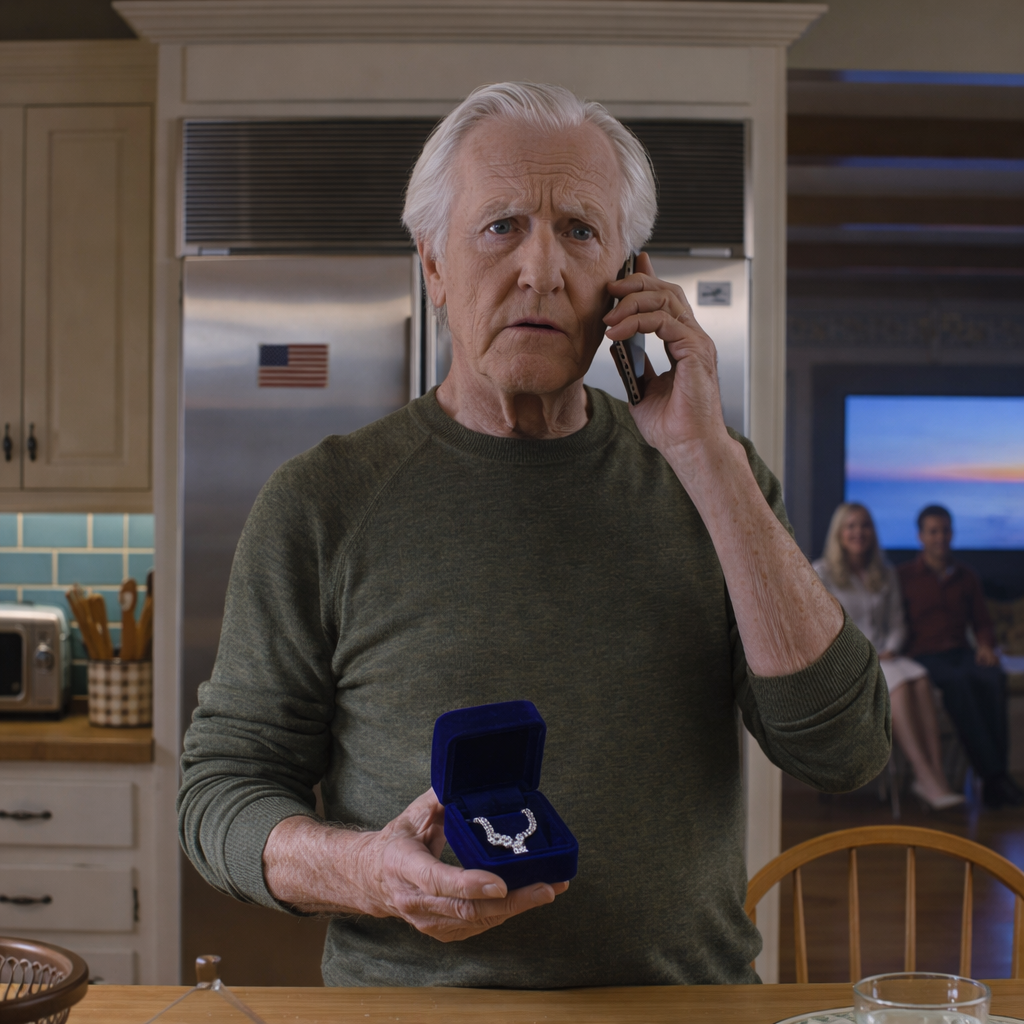
And that morning, when I pulled the velvet box from the drawer, the satin interior was empty.
At first I stared at it the way you stare at a word you’ve misspelled, as if looking harder will force it to rearrange itself into the truth. The box was old, edges worn to a dull red, the hinge squeaking faintly when I opened it. The cream satin lining held the faint outline where the locket had rested for decades, a soft depression like a memory pressed into fabric.
But there was no gold chain. No heart. No inscription hidden inside.
Nothing.
The panic didn’t come all at once. It rose slowly, like heat from pavement. I checked the drawer again as if the necklace might have slipped under something. I slid my fingers along the corners. I tipped the box, shook it gently. The tiny sound of nothing answered me.
Then I moved into motion.
I tore through the dresser drawers, pulling out folded shirts and socks. I checked pockets, even the ones I hadn’t worn in months. I moved to the closet, dragged shoeboxes into the light. I opened every little container, every tin, every envelope, as if I might have forgotten myself and tucked it somewhere strange. I dropped to my knees to peer under the bed. Dust clung to my fingertips. My back protested with a sharp ache, but I didn’t stop.
I went into the bathroom, opened the medicine cabinet, rifled through a mess of pill bottles and cotton swabs and toothpaste. I checked the top of the cabinet, behind the towels, inside the drawer where Eleanor used to keep her hairbrush.
Nothing.
By the time I came back to the bedroom, my hands were shaking. The walls seemed closer than they should have been. The air felt thin.
It wasn’t just a necklace. It was the last physical piece of her that I could hold. When I couldn’t sleep, I’d take it out and let the weight anchor me. When grief hit without warning, I’d touch it and remember the warmth of her skin, the scent of her hair, the quiet way she used to say my name.
And now it was gone.
I went downstairs with the empty velvet box in my hand like a piece of evidence. The sound of the TV grew louder, the football crowd roaring, the commentator laughing. The living room smelled faintly of chips and stale air.
Michael was sprawled across my couch, feet propped on the armrest like he’d been born there. A bag of chips rested on his chest. He didn’t glance away from the screen when I walked in.
Amber sat on the stairs with her phone pressed to her ear, one knee drawn up. She was laughing, the sound sharp and bright, her voice full of boredom as she complained to someone about how dull Phoenix was and how she couldn’t wait to get back to California. She gestured with her free hand as if she were performing for an audience.
Jennifer moved around my kitchen like she owned it. She had a knife in her hand, chopping vegetables with quick, angry movements, the blade thudding against the cutting board in a hard rhythm that made my nerves jump.
I stood in the doorway for a moment, gathering myself. I could feel my heart hammering, the thump loud in my ears.
“Jennifer,” I said.
She didn’t look up. The knife kept rising and falling.
“I’m busy, Dad,” she said, as if I’d interrupted something far more important than what I was about to say.
“Have you seen Eleanor’s necklace?” My voice sounded strange to me, too thin, too careful.
The knife paused for half a beat, then resumed. “Check your room. You probably forgot where you put it.”
“I did check my room,” I said. “I’ve checked everywhere. It’s gone.”
Her shoulders lifted in a long, practiced sigh. A sigh I’d heard nearly every day since she and her family moved in after Eleanor’s death. A sigh that said: Here we go again. You’re making things difficult. You’re the problem.
“No one wants your old stuff, Dad,” she said. “You’re always misplacing things.”
“It was your mother’s,” I said. The words scraped my throat. “It’s the only thing I kept.”
“Then you should’ve been more careful,” she replied, her tone flat and almost bored.
I watched her cut celery into brutal little pieces, as if she could chop her way out of the conversation. Something inside me shifted. Not a burst of anger, not heat, but cold. The quiet kind of cold that arrives before a storm.
“Jennifer,” I said again, softer this time. “I need to know what happened to it.”
For the first time, she set the knife down. She wiped her hands on a dish towel slowly, deliberately, and turned to face me fully.
Her eyes had no warmth. Maybe they hadn’t for years. Maybe I’d kept imagining it because the alternative was too painful.
“The necklace has been sold,” she said, in the same voice she might use to tell me a carton of milk had expired. “I needed the money for a vacation.”
I didn’t understand at first. The words didn’t connect to reality. Sold. Vacation. Like listening to an announcement on a plane during turbulence, hearing sound without meaning.
Then the meaning landed.
Sold.
Eleanor’s necklace.
My fingers tightened around the velvet box until the edges bit into my palm.
“You… what?” I whispered.
Jennifer shrugged. “We needed eight hundred dollars for Hawaii. You said no when I asked, so I found another way.”
The room didn’t tilt, didn’t spin. It simply became sharper, every sound suddenly too clear: the crunch of chips in Michael’s mouth, the faint buzz of Amber’s phone speaker, the knife handle clicking against the counter as Jennifer tossed it aside.
Michael finally looked away from the TV just long enough to offer his opinion, voice lazy. “It was just sitting there, Wilbur. Dead people don’t need jewelry.”
He went right back to the game, reaching for another handful of chips. Crumbs fell onto my couch like confetti.
Amber laughed, still half turned toward her phone. “Grandpa, you’re being dramatic,” she said. “It’s just a necklace. Mom got us an awesome vacation.”
I looked at her and felt an ache so deep it almost made me dizzy. Eleanor’s cheekbones lived in Amber’s face. Eleanor’s eyes did too, the same shape, the same dark lashes. But the gentleness, the quiet attention, the softness that made Eleanor Eleanor… none of it was there.
“Your grandmother wore that every day for forty years,” I said. My voice came out raw.
Amber shrugged, already losing interest. “Well, now somebody else gets to wear it. Circle of life, or whatever.”
The words hit like sandpaper. I stood there in my own kitchen, in the house Eleanor and I bought in 1985, listening to my family talk about her necklace like it was an old lamp left on the curb.
They watched me with the blank expression of people waiting for an inconvenience to resolve itself.
I didn’t raise my voice. I didn’t shout. I didn’t cry in front of them.
I turned and walked upstairs.
The bedroom felt hotter than it had earlier. Sunlight cut through the blinds in harsh stripes, dust floating in the beams like tiny drifting sparks. I closed the door behind me, the soft click sounding final in a way I couldn’t explain.
The velvet box sat on the dresser. I picked it up, opened it, closed it, opened it again.
The simple motion steadied my hands. But it didn’t comfort me. It hardened something.
I wasn’t breaking. That had happened three years ago in a hospital room when Eleanor’s last breath left her body and I realized I would never hear her voice again.
This was something else.
This was clarity.
They had gone into my private drawer, taken the only thing I treasured, and turned it into spending money.
I set the velvet box down with careful precision. Then I reached for my phone.
I opened my browser and typed: pawn shops Phoenix.
The screen filled with names and addresses, red pins scattered across the city I’d lived in for four decades. Strip malls. Desert roads. Old neighborhoods baking under the sun.
I started calling.
The first shop didn’t have it. The woman sounded bored, like she’d answered the same question ten times already that day.
The second put me on hold for six minutes, then came back with a curt no.
The third had closed down.
The fourth didn’t answer.
With each call, I kept my voice steady, even as my chest felt tight. “Gold chain, heart-shaped locket,” I repeated. “Engraving inside: Forever W & E. Sold yesterday.”
Downstairs, Michael’s game continued, the announcer shouting, the crowd roaring. Jennifer’s voice drifted up now and then, complaining about dishes, electricity, how she did everything in this house.
On the sixth call, a man answered on the second ring.
“Desert Gold Pawn,” he said. “This is Harold.”
“I’m looking for a gold necklace with a heart-shaped locket,” I said. My mouth was dry. “I believe it was sold to you yesterday.”
There was a pause. A few seconds of silence that made my stomach clench.
“Oh,” he said slowly. “Yes. I remember that piece. Beautiful craftsmanship.”
My pulse jumped. “I want to buy it back.”
“You the husband?” he asked, voice gentler now.
“I am,” I said. “My wife passed three years ago.”
“I’m very sorry,” Harold replied, and I believed him. He sounded like someone who understood that people didn’t bring jewelry to a pawn shop when life was going well.
Then his tone changed slightly. “Sir… this is a little unusual. You should come by.”
My grip tightened on the phone. “What do you mean?”
“When we opened the part of the pendant that can open,” he said, “we found something you need to see.”
My breath caught. “Opened? It opens?”
“Yes,” he said. “There’s a hidden compartment. Inside was a small note. We removed it carefully so it wouldn’t get lost. It has numbers on it. Looks like bank information.”
For a moment, the room felt too quiet. Even the TV downstairs seemed distant.
I didn’t even know it could open.
“I’ll be there today,” I said.
“Come before six,” Harold replied. “I’ll hold it for you. I won’t sell it.”
“Thank you,” I managed.
I ended the call and sat on the edge of the bed, phone still in my hand. The thought of Eleanor hiding something inside that locket, something she never told me about, made my throat tighten.
What had she been carrying against her heart all these years?
I stood, grabbed my wallet and keys, and went downstairs.
Michael didn’t look up. Amber barely glanced at me. Jennifer clattered pans in the kitchen as if the world existed to irritate her.
I stepped out into the bright Phoenix sun. The heat hit my face immediately, dry and relentless. The sky was a hard, cloudless blue. Palm fronds stirred lazily in a faint breeze. The neighborhood looked peaceful in that quiet suburban way, as if nothing inside my house could be wrong.
The drive to Midtown took about half an hour. I followed my phone’s navigation past auto shops and faded billboards, past parking lots shimmering with heat. Phoenix stretched flat and beige around me, mountains hazy in the distance.
Desert Gold Pawn sat in a small strip mall between a nail salon and a tax preparation office. Bars covered the windows, but they were clean and freshly painted. The sign above the door was simple and neat.
Inside, the air smelled faintly of metal polish and old leather. Fluorescent lights hummed overhead. Glass cases lined the walls, filled with watches, rings, electronics, old guitars leaning in a corner. Each item seemed to carry its own quiet story, whether anyone wanted to know it or not.
Behind the counter stood a small man in his fifties with neatly trimmed gray hair and reading glasses perched low on his nose. He looked up as the door chimed.
“Mr. Davis?” he asked.
“That’s me.”
“Harold Chen,” he said, stepping forward and extending his hand. His grip was firm, respectful. “Let me get your necklace.”
He disappeared into the back room. I stood there staring at the cases, at the rows of jewelry laid out under glass. Engagement rings that had once meant forever. Bracelets, pendants, watches. Little pieces of people’s lives turned into inventory.
Harold returned holding a small bundle wrapped in soft cloth. He unfolded it on the counter with care, like he was handling something fragile.
There it was.
Eleanor’s necklace glowed under the harsh shop lights, the gold chain coiled neatly, the heart-shaped locket resting on top like it was sleeping. The sight of it hit me like a wave. Relief and grief tangled together so tightly I could barely breathe.
Harold watched my face. “The young woman who sold it,” he said quietly. “Early forties. In a hurry. Didn’t want to negotiate. I gave her eight hundred. Fair value for the weight, but honestly, it’s worth more. The craftsmanship is excellent.”
“She’s my daughter,” I said, the words tasting bitter.
Harold’s mouth tightened, sympathy flickering across his face. He didn’t comment.
I pulled out my wallet. My fingers were steadier now, fueled by determination. I counted out twelve crisp hundred-dollar bills and placed them on the counter.
Harold accepted them and slid an envelope across the glass. “The note,” he said. “I put it in here so it wouldn’t get lost.”
“Thank you,” I said again, and meant it more than I could express.
He hesitated. “Take care of it,” he said softly.
“I will.”
I left the shop with the necklace in my pocket and the envelope in my hand. I made it three blocks before I had to pull into a grocery store parking lot, because my hands were shaking now that I was alone.
The Arizona sun poured through the windshield, turning the steering wheel hot under my palms. I took the necklace out, held it up to the light. The heart was smooth and warm from my touch.
I turned it slowly until I saw the tiny indentation along the side, so subtle I’d never noticed. I pressed it with my thumbnail.
The locket clicked and sprang open.
My breath left me in a quiet rush.
Inside, folded impossibly tight, was a piece of paper no bigger than my pinky nail. I coaxed it out carefully, afraid of tearing it, and unrolled it against my thigh.
Eleanor’s handwriting stared back at me.
Small. Precise. Familiar.
Bank of Arizona. Box 4782.
I sat there in the parking lot, the air conditioner roaring to life, staring at those words until they blurred. Eleanor had a safe-deposit box. Eleanor had set something aside. Eleanor had kept something from me.
The realization wasn’t anger. It was wonder, and a strange tenderness.
She’d been planning. Preparing. Protecting.
I drove home on autopilot. When I walked in, Michael was still on the couch, Amber still on her phone, Jennifer still moving around the kitchen with that restless impatience.
None of them noticed the envelope in my hand. None of them understood that something had shifted.
I went upstairs and shut my bedroom door.
That night, I barely slept. The necklace lay on my chest under my T-shirt the way it had on Eleanor, and the folded note sat on the nightstand beside my glasses. Each time I drifted off, I woke again with the same thought: 4782. 4782. 4782.
By morning, my decision was made.
I dressed carefully in the button-down Eleanor used to compliment, the one she said made my eyes look younger. I drove downtown to the Bank of Arizona’s main branch on Washington Street, where the building rose in glass and steel, reflecting the desert sky like a mirror.
Inside, the lobby was cool and hushed. Marble floors, soft footsteps, the faint scent of polished stone and paper. The sound of the city outside disappeared behind thick doors.
A young woman at the information desk wore a blazer and a gold name tag that read LISA.
“I need to access a safe-deposit box,” I said.
“Of course, sir,” she replied, professional but kind. “Do you have the box number and identification?”
I handed her the note, my driver’s license, and Eleanor’s death certificate, the paper edges slightly worn from being handled too many times.
Lisa studied them, then typed into her computer, her fingers moving quickly.
“Yes,” she said after a moment. “Box 4782. Opened in 2019. Last accessed that same year.”
- Eleanor had done this long before her illness, long before the hospital room, long before the grief that turned our lives into before and after.
Lisa looked up. “I’m very sorry for your loss,” she said quietly. “You are listed as the surviving spouse. We can take you back now. You’ll have privacy in the viewing room.”
She led me through a heavy steel door into the vault area. Rows of metal drawers lined the walls, each one sealed with two keyholes. The air felt colder here, denser, as if secrets changed the temperature.
Lisa used her bank key and a second key labeled 4782. The drawer slid out smoothly. She pulled a long metal container free and placed it into my hands.
It was heavier than it looked.
In a small viewing room, windowless and quiet, she set the container on the table.
“I’ll be right outside,” she said. “Take your time.”
The door closed. The silence pressed in.
I sat down slowly. My hands hovered over the box for a moment, as if I needed permission. I imagined Eleanor sitting here six years earlier, alone, placing something inside that she didn’t want anyone else to touch.
Finally, I lifted the lid.
Inside were neat stacks of envelopes secured with rubber bands. I slid one out, opened it, and felt my throat tighten.
Cash. Crisp hundred-dollar bills.
More envelopes. More cash.
Underneath, a sealed letter with my name written in Eleanor’s handwriting.
Wilbur.
I stared at it until my eyes stung. Then I picked it up, held it against my chest for a moment like it could transmit her warmth, and carefully broke the seal.
The paper inside crackled as I unfolded it. Two pages, filled with her careful script.
My dearest Wilbur,
if you’re reading this, I’m gone, and you’ve found what I hid.
The first line hit me so hard I had to close my eyes. I could hear her voice as if she were across the table, the slight rasp she’d developed in her fifties, the way she always sounded calm even when she was afraid.
I read on, my hands trembling.
She’d saved money over thirty years, she wrote, little bits at a time, because she loved me and because she knew what would happen after she was gone.
Jennifer has always been difficult…
The words blurred, not because I couldn’t see, but because something inside me twisted. Eleanor wrote about our daughter with a steadiness that wasn’t cruel, only clear. She wrote about Michael and the way he used people. She wrote about Amber learning from them. She apologized for saying it, but she needed me to see it.
And then she wrote about the money.
She’d set it aside for me. A safety net. A buffer against exactly what was happening in my house right now. She told me not to let them drain me out of guilt or obligation, not to let them turn me into a victim.
You are stronger than you know.
I reread that line three times.
At the end she signed it the way she always did, with the slight curl in the last letter of her name.
Forever yours,
Eleanor.
I sat there under the hum of the fluorescent light, surrounded by steel drawers full of strangers’ secrets, and let her words settle into my bones. The cash in the box was more than I expected. She had built this quietly over decades, piece by piece, without ever making me feel the weight of it.
Eleanor hadn’t just loved me. She’d protected me.
I folded the letter carefully and slid it into my jacket pocket over my heart. I closed the safe-deposit box with care and went back out to Lisa.
When I stepped into the bright Phoenix sun again, it felt harsher than before, but I felt steadier.
On the drive home, I pressed my palm against my pocket, feeling the crinkle of Eleanor’s letter. I stopped at a red light and stared at the cars around me, at a teenager in a pickup blasting music, at the shimmer of heat over the road.
When the light turned green, I drove.
Home looked different now. The same stucco walls, the same gravel yard, the same cul-de-sac. But the house felt like a place that needed defending.
Through the front window, I could see Michael in my recliner, the one Eleanor had bought for me on our thirtieth anniversary. He sat there like a king.
I walked in. Jennifer’s eyes snapped to the necklace chain glinting at my collar.
“Is that Mom’s necklace?” she demanded. “You got it back?”
“Yes,” I said.
Her face tightened. “Hand it over.”
The audacity of it almost made me laugh. Almost.
“I bought it back,” I said. “I paid twelve hundred dollars.”
Her cheeks flushed. “With whose money? You’re on a fixed income. That’s our inheritance you’re wasting.”
Our inheritance. As if I were already dead. As if my life was just a waiting room for her payoff.
Michael pushed himself up from the recliner and ambled closer, chewing slowly like he had all the time in the world.
“Jennifer’s right,” he said. “You’re old. This house is too big for you. You should sign it over now and make things easier.”
The room went quiet in a way that made the air feel heavy. Amber looked up from her phone for the first time, her eyes sharp.
“Grandpa,” she said, “you’re being selfish. Mom and Dad need stability.”
“Is that what this is?” I asked, voice quiet. “Stability?”
No one answered.
I walked past them and into my bedroom, shutting the door. The latch clicked softly, and the sound felt like a line being drawn.
I sat at the oak desk Eleanor had bought at an estate sale and pulled out a legal pad. My hand didn’t shake this time.
At the top of the page, I wrote: Document everything.
Over the next two weeks, I moved like a man putting his house back in order, not just physically but legally. I took photographs of the way they’d taken over my rooms. I saved bills. I printed bank statements and highlighted every “loan” that never came back. I organized it all the way an engineer organizes problems: evidence, dates, patterns.
Then I installed a camera disguised as a smoke detector in the living room, high enough to see the couch, the kitchen entrance, most of the main floor.
I didn’t feel guilty.
They had already proven what they were capable of.
The footage didn’t take long to give me what I needed.
Jennifer, furious about the necklace. Michael calling me selfish. Amber mocking me to someone on the phone, talking about how the house would be theirs soon. Their words were casual, unguarded, the way people speak when they believe the world belongs to them.
The night Michael shoved me in the kitchen, his hand flat against my chest, I felt my body snap back into the counter hard enough to knock the breath out of me. His beer breath hit my face as he leaned close.
“Careful,” he said. “Accidents happen at your age.”
I didn’t answer him. I didn’t give him the satisfaction.
I went upstairs, locked my door, and saved the clip.
The next morning, I sat in an attorney’s office downtown, across from Patricia Morrison, an elder law attorney with steel-gray eyes and a calm, razor-sharp voice.
I placed my binder on her desk.
She didn’t look surprised as she flipped through the tabs. She didn’t pity me. She assessed.
When she watched the video of the shove, her jaw tightened.
“This changes everything,” she said. “This is assault. Combined with financial exploitation and mail tampering, we can seek emergency relief.”
Emergency eviction. Restraining order. Court.
The words sounded like a storm breaking open, but underneath them was something calmer: a plan.
A way out.
When Jennifer tried to access my bank accounts after that, claiming she had authority, I got documentation and sent it straight to Patricia. When Amber posted online about her “confused grandpa,” trying to paint me as incompetent, I saved screenshots.
Jennifer brought her own attorney into my kitchen, a man named Robert Carlson who looked like he’d rather be anywhere else. He scanned the rental agreement Patricia drafted and didn’t even bother to pretend.
“Mr. Davis is within his rights,” he told Jennifer, his voice blunt. “You are not on the deed. You have no legal claim.”
Jennifer stared at him as if he’d betrayed her.
The emergency hearing moved fast.
In a courtroom cooled by heavy air conditioning, Judge Margaret Stone watched the video clips with an expression that hardened by the second.
“Assault is assault,” she said. “Family relationship doesn’t excuse it.”
She issued a temporary restraining order against Michael and granted emergency relief, setting a full eviction hearing for July 2.
Outside the courthouse, the sun was bright enough to hurt. Patricia closed her files.
“We’re winning,” she said.
On the drive home, I made another decision, the kind that feels like cutting a rope before you know exactly what’s on the other side.
I was going to sell the house.
Not because I wanted to leave the place Eleanor and I built, but because I could see the house had become a prize to them, and as long as it existed in their minds as a reward, they would never stop.
If the prize disappeared, so did their reason to circle me like vultures.
A real estate agent named Robert Santos walked through the rooms with a tablet, taking photos, measuring walls. Jennifer came into the backyard furious, her voice loud enough to carry through the neighborhood.
“You can’t do this,” she said. “This is our home.”
“It’s my home,” I replied. “And I’m doing it.”
The For Sale sign went up in the front yard. Neighbors slowed as they drove past. Jennifer stood at the window glaring as if sheer rage could make the sign vanish.
Offers came quickly. A young couple, Sarah and Marcus Chen, walked through with careful excitement, as if they could feel the life that had once filled the rooms. Michael glared at them from the couch without moving, trying to poison the atmosphere.
They made an offer anyway.
I accepted.
July 2 arrived with desert heat already pressing down before noon. I wore the suit I’d worn to Eleanor’s funeral. The fabric felt heavier now, as if it carried every moment since.
In court, Patricia laid out the evidence in clean order. Video. Bank logs. Mail tampering. Unpaid loans. Harassment. The judge listened without patience for excuses.
When the order came down, it was simple and final.
Eviction granted. Vacate by August 1. Sheriff enforcement if necessary.
In the hallway afterward, Jennifer blocked my path, tears on her cheeks.
“Dad, please,” she said. “We’ll change. Mom would be devastated.”
“Your mother left me a letter,” I told her. “She warned me.”
Her face twisted as if she couldn’t decide whether to be hurt or angry.
“She loved you,” Jennifer snapped.
“She did,” I said. “She loved you enough to see you clearly.”
Jennifer and her family moved out before the sheriff had to come. A rental truck rumbled in the driveway. Furniture scraped against floors. Boxes thudded down the hall. I stayed in my room, listening, letting the noise roll past me like weather.
When they were gone, the house felt strange in its quiet. The air seemed lighter, as if the walls were exhaling.
I walked through the rooms afterward and saw the damage: scratches gouged into hardwood, a hole punched in the wall, a cabinet door hanging crooked. I photographed it all. Not because I expected repayment, but because I needed the truth recorded to the end.
The SOLD sign went up.
On August 15, I sat in a title company office in Scottsdale across from Sarah and Marcus, signing my name until my wrist ached. The room smelled like coffee and toner. The title officer explained documents in a practiced voice.
Sarah slid an envelope toward me. “We wrote you a letter,” she said. “For later.”
When I opened it in my new place, their words were simple and kind. They promised to fill the house with laughter and love and to honor what Eleanor and I had built there. I folded their letter and placed it beside Eleanor’s.
My new home was a modest two-bedroom apartment in a 55-plus community in Scottsdale. Quiet. Secure. Clean desert landscaping. A distant view of the McDowell Mountains that turned purple at sunset.
I bought it outright using the money from the sale and what Eleanor had hidden away. No mortgage. No pressure. No one on my couch telling me what I owed them.
Jennifer called. I let it ring. Michael left a voicemail that said, “You owe us.” Amber texted, pretending concern, asking me to talk to her mother.
I blocked their numbers. Then I changed mine.
Late one afternoon, Jennifer showed up at my door anyway, her voice loud in the hallway.
“Dad, I know you’re in there,” she said. “We need to talk. We’re family.”
I stood on the other side of the door and listened as she tried different tones, different pleas, each one sliding into the next like a rehearsed script.
A neighbor down the hall, Bill, cracked open his door and looked at her.
“Ma’am,” he said, calm and firm, “if he’s not opening the door, you need to leave. Or I’ll call security.”
Jennifer tried to insist I was confused. Bill didn’t bite.
“He knows what he’s doing,” Bill said. “Move along.”
Her footsteps retreated down the hallway, sharp and angry.
Two days later, on the third anniversary of Eleanor’s death, I sat alone at my small kitchen table with a cup of coffee and her necklace resting in my palm. The apartment was quiet except for the soft hum of the air conditioner.
I had built a shadow box in my new workshop, oak sanded smooth, joints tight and clean. I hung the necklace inside it, protected but visible, no longer hidden away in a drawer where someone could reach in and take it.
I opened the locket one more time. The compartment where the note had been was empty now, but I could still see her handwriting in my mind, still feel the shape of her careful planning.
“I did it, Eleanor,” I said softly to the still air. “I’m free.”
The tears that came weren’t the desperate kind from the hospital room. They were quieter. Like rain after a long drought.
Later that week, I sat in Patricia’s office again and signed the updated will that reflected my new reality. My assets would go to charities. Jennifer would receive nothing. Patricia told me Jennifer had tried to file for guardianship, claiming I was incompetent, and that it had been dismissed after a geriatric specialist evaluated me.
“Cognitively intact,” Patricia quoted. “Fully capable of managing his own affairs.”
I walked out into the heat feeling something like vindication, but more than that, peace.
One evening not long after, I met an old friend, Dennis, for coffee. We talked about Eleanor and old work projects, about how time changes you without asking permission. When he suggested chess, I surprised myself by smiling.
Back in my apartment, the necklace caught the warm lamplight from across the room, throwing faint reflections on the wall. The TV was off. The air was quiet. The future felt open instead of trapped.
I turned off my workshop light, walked into my little kitchen, and made dinner for one.
Exactly enough.