Betrayal, Probate, and a Forged Will: How My Inheritance Fight Began After a Funeral
The house still carried the aftertaste of mourning when I unlocked the front door.
Wet earth clung to the soles of my shoes. The cemetery grass had been slick, and my coat smelled faintly of cold rain and lilies, the kind of floral perfume that always seems too bright for a day like that. Even my hands felt wrong, as if the chill had moved past my skin and settled inside the joints. I had been bracing myself for the quiet. For the emptiness of rooms that had once been filled with the steady, stubborn sound of Margaret’s life.
Instead, I walked into a scene that had the crisp stillness of a staged photograph.
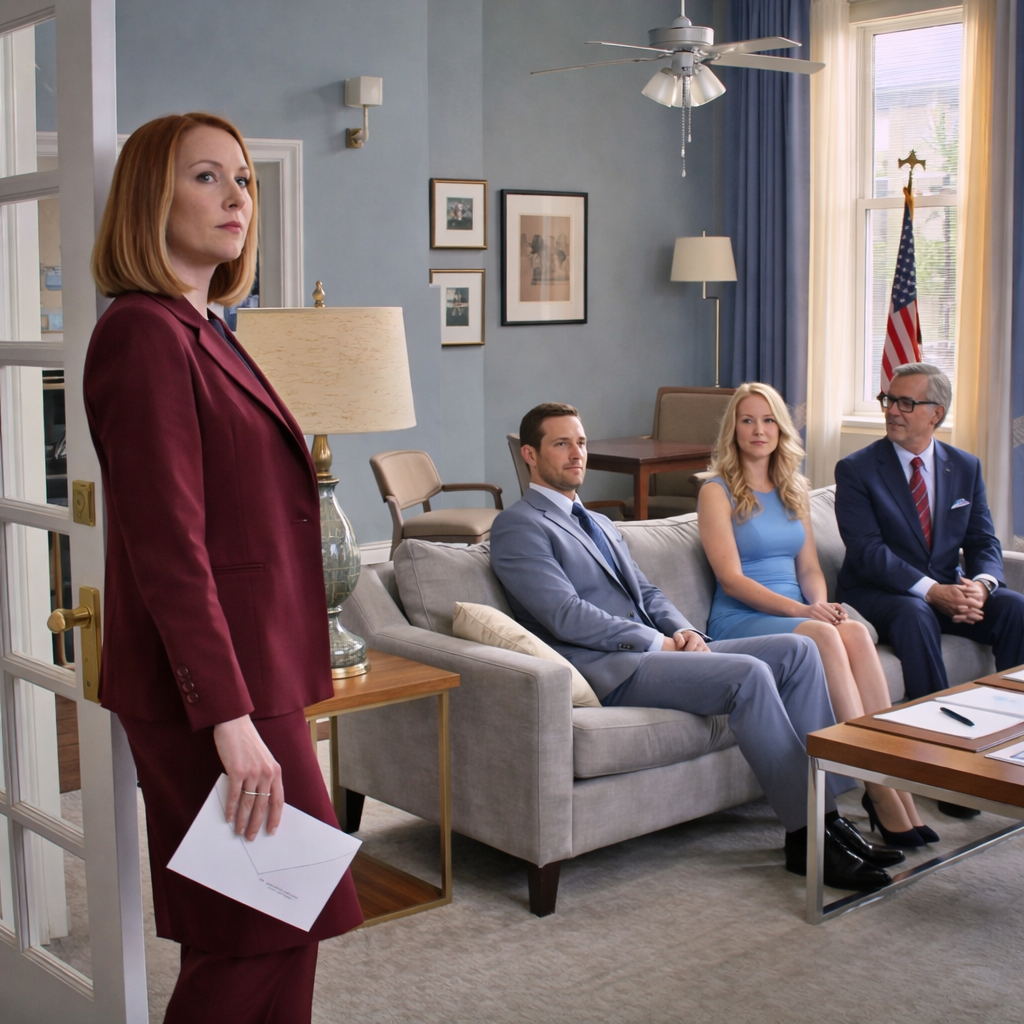
Ryan sat on the couch as if he’d been waiting for me to arrive on time for a meeting. Legs crossed, one arm draped along the back, his suit jacket already unbuttoned like he couldn’t be bothered to keep up appearances for long.
Lisa was beside him, upright and composed, her purse perched on her lap like a prop. And in Margaret’s favorite chair, the one near the window where the light turned honey-colored in late afternoon, there was a man in a gray suit I’d never seen before.
On the coffee table: a neat stack of papers, squared like a deck of cards, aligned so perfectly it made my stomach tighten. There was something about the precision that felt cruel. A paper napkin at a funeral is allowed to be crumpled. Grief is messy. But this looked like someone had practiced.
No one stood.
No one asked if I’d eaten. No one said, “I’m sorry.” No one even offered the simplest kindness of a chair.
I closed the door slowly, the latch clicking with a sound that seemed too loud. My keys were still in my hand. I didn’t set them down. I didn’t take off my coat.
Ryan looked at me the way you look at a stranger who’s wandered into the wrong room.
“Don’t bother sitting,” he said.
His voice was flat, precise, emptied of warmth. It didn’t sound like the voice that had once whispered jokes into my ear at weddings, or the voice that had promised we’d build a life that belonged to us. It sounded like a voice that had already made peace with being cruel.
I blinked once, like it might clear the air.
“Ryan,” I managed, but it came out thin.
He nodded toward the coffee table. “Mom left everything to me.”
Lisa’s mouth twitched, a small satisfied movement she tried to mask by shifting her purse. Her eyes skimmed over me, quick and assessing, like she was already counting the hours until I was gone.
The man in the suit cleared his throat with the practiced delicacy of someone who’d been paid to make unpleasant things sound orderly.
“Mrs… Elena,” he said, checking a document as if my name could be corrected by ink. “I’m here to review the estate documents.”
Estate documents.
The phrase fell into the room like a cold coin.
I wanted to tell him this wasn’t a conference room. That this was a living room that still smelled faintly of lavender soap and the antiseptic wipes I’d used on the bathroom counters. That this was where Margaret had watched old movies with her tea, where she’d dozed with a blanket over her knees after chemo, where I had sat on the carpet at two in the morning, listening for the change in her breathing that meant I needed to get up.
But my tongue felt heavy. My body felt like it had been carrying weight for so long it didn’t know how to put it down.
The man opened his folder and began reading with the calm rhythm of a professional.
“The house,” he said, “goes to Ryan.”
I felt a strange tilt inside my chest, like a shelf had been knocked loose.
He continued, flipping a page. “Elena receives five thousand dollars for her help.”
For her help.
Ten years of my life condensed into a line that sounded like a tip.
A sound left Lisa’s throat, half laugh, half scoff, and she covered it quickly with a cough. Ryan didn’t look at her. He didn’t need to. They were aligned, two points on the same sharp blade.
“And,” the man added, voice still steady, “the current occupant has forty-eight hours to vacate the property.”
There was a moment when the words didn’t connect. Forty-eight hours floated in the air like a nonsense phrase. Then my mind caught up, and the room seemed to tighten.
I heard myself speak, almost politely. “Forty-eight hours.”
Ryan rose from the couch. He didn’t come toward me with hesitation. He came toward me with a kind of practiced certainty, stopping just far enough away that I couldn’t touch him, like he knew his own guilt might be contagious.
“You heard it,” he said. “You have two days to pack.”
His eyes were hard, but what broke me wasn’t the hardness. It was the ease. The fact that he could say it on the day we buried his mother, as if grief was an event on a schedule and this was the next appointment.
I stared at him, trying to find the man I married.
“I took care of her,” I said, and my voice surprised me. It didn’t tremble. It sounded tired. “I took care of her for ten years.”
Lisa leaned forward slightly, as if she didn’t want to miss a word. Her perfume cut through the room, bright and expensive, a sharp contrast to the faint chemical scent still living in the hallway from hospice.
Ryan’s mouth tightened. “And you got paid,” he said, nodding toward the papers. “Five thousand. More than generous, honestly.”
The man in the suit said something about legal procedure, about notices and compliance, words like “enforcement” and “vacate” and “property.” The language was meant to make this feel inevitable, like weather. As if a human life could be cleared out the way you clear out a garage.
I didn’t argue. Not because I agreed. Not because I was afraid. Because I’d learned something in those ten years with Margaret.
When a body is failing, you learn to conserve. You don’t waste energy on the fights you can’t win in that moment. You save your strength for what comes next.
So I nodded once. I turned away before they could see what was happening behind my eyes. I went upstairs.
The bedroom smelled faintly of laundry soap and the lotion I used on Margaret’s hands when her skin cracked in winter. I opened a drawer and pulled out a duffel bag. My hands moved without emotion, like muscle memory. A few clothes. Toiletries. My passport. A small folder of documents I’d kept safe out of habit.
I didn’t take much. It was strange, standing in the room where I’d spent so many nights waking up to Margaret’s calls, where I’d folded towels and counted pills and stared out the window while snow fell, thinking I could do this forever if it meant she didn’t have to be alone.
Downstairs, they were still there when I came back. Waiting, watching. The man in the suit had closed his folder, as if my life had been neatly concluded.
I walked past them without speaking and stepped outside.
The air hit my face, sharp and damp. The sky was the color of bruised steel. I stood on the porch for a moment with my duffel bag at my feet, staring at the front yard. The shrubs I’d trimmed last summer. The porch light Margaret liked because it made the steps feel safe at night.
It was the same yard, the same house, but suddenly it felt like I was looking at it through glass.
I didn’t cry. I didn’t scream. I didn’t plead.
I just walked to my car and drove until the neighborhood streets gave way to the highway and the world became a ribbon of wet asphalt and blurred taillights.
Only when I was far enough away that the house couldn’t pull at me anymore did the trembling start. It wasn’t dramatic. It was small and stubborn, an aftershock in my hands as I gripped the steering wheel. My jaw ached from clenching.
I kept driving because stopping felt worse.
The motel I chose was off an exit lined with fast-food signs and gas stations, the kind of place you don’t notice unless you need it. The neon vacancy sign buzzed weakly, one letter dimmer than the others, like it had its own exhaustion.
Inside, the lobby smelled like stale coffee and industrial cleaner. The man at the desk slid a clipboard toward me without curiosity. I wrote my name in careful letters, as if neatness could create stability. He handed me a key and told me the room number.
No one asked why my eyes were swollen. No one asked why my hands wouldn’t stop moving.
The room was small. The carpet was worn thin. The air smelled of bleach that had been used too often and never quite worked. A heater rattled in the corner, pushing out bursts of warm air that came in uneven waves.
I set my bag on the chair and sat on the edge of the bed, still in my coat, listening.
For ten years, my life had been measured by other people’s needs.
Morning medication alarms. Afternoon appointments. Nighttime fevers. Hospice schedules. A constant low-level readiness, like living beside a door that might open at any moment.
Now there was nothing to do.
The silence wasn’t peaceful. It was vacant.
I took off my shoes and lined them up against the wall, the way I did at home. The habit made my throat tighten. My body still believed there was a home to return to.
I ate half a packet of crackers from the vending machine and drank water from the bathroom sink. The simple ugliness of it made me angry in a distant, dull way, like anger was happening to someone else.
That night, I lay on the bed fully dressed and stared at the ceiling. The heater clanged. Cars hissed by outside, constant and indifferent.
When sleep finally came, it was shallow. I woke at every small sound, heart jumping as if I’d heard Margaret’s voice calling my name.
On the second day, I went to a grocery store nearby and bought the cheapest food I could find: bread, peanut butter, soup. Standing in line, watching the total climb, I felt the strange humiliation of needing to count. I had spent years handling medical bills and prescription co-pays without blinking. Now the price of groceries made my stomach twist.
Back in the room, I sat on the bed and stared at my duffel bag. My life fit inside it.
At the bottom, beneath my folded clothes, was an envelope.
Margaret had pressed it into my hand days before she died, during one of those rare moments of clarity when her eyes were sharp again and her voice sounded like herself, not like someone speaking through pain.
She had asked me to promise not to open it until after she was gone.
I had promised, because I couldn’t imagine saying no to a woman who had trusted me with the last years of her life.
I hadn’t touched it at the funeral. I hadn’t touched it when Ryan told me to leave. I hadn’t touched it when I drove away from the house. Keeping the promise felt like the last clean thing I could do.
But on the third day, sitting alone in that motel room with the air smelling of bleach and the heater rattling like old bones, I realized there was nothing left to protect but the truth.
My hands shook as I pulled the envelope out.
The paper was thick, worn at the corners where Margaret’s fingers must have held it. Her handwriting was faintly pressed into it, as if she had written hard, forcing the pen to obey even when her body didn’t.
I stared at it for a long time.
Opening it felt like crossing a line. It meant admitting Margaret had known something I didn’t, or had known something I refused to see.
I thought of her in her bed, the thin rise and fall of her chest, the way she’d squeezed my hand with what little strength she had left.
“Promise me,” she’d said, eyes locked on mine.
I slid my finger under the seal.
The paper tore with a soft sound that seemed too loud in the quiet room.
Inside was a small metal key, taped carefully to a folded sheet of paper.
The key was cold against my skin. Heavy for its size, the kind used for something secure, something old-fashioned. A white tag was attached, and the handwriting on it was neat.
First National Bank.
Safe deposit box.
My breath caught, sharp and shallow.
I unfolded the paper with slow care, afraid my hands would crumple it.
Elena, it began.
If you’re reading this, then I’m gone, and I need you to listen to me now the way you always have.
My eyes stung. I blinked hard, not wanting to cry in a motel room that had never witnessed anything worth grieving before me.
I know my children, she wrote. I have made excuses for them too long.
My throat tightened as if my body wanted to swallow the words back into me.
I know what they will try to do.
The will they show you is not the real one.
The real will is in the box.
There is also a video.
I did this to protect you.
A chill spread through my chest, not fear exactly, but recognition. Margaret hadn’t been guessing. She had been preparing.
Call Mr. Harris, the letter continued.
She wrote a phone number beneath it.
He helped me with everything. He knows. He has been waiting for you.
At the bottom, her writing grew smaller, the pen strokes a little shakier.
You deserve better than what comes next.
Please forgive me for not being braver sooner.
I love you.
I sat there, the letter trembling in my hands, the key resting on my palm like a small, undeniable fact.
The anger that had been hovering at the edges of me for days sharpened into something clearer. Not rage. Not a desire to scorch the earth. Something steadier and colder: the understanding that what Ryan and Lisa had done was not just cruel, it was planned.
Forgery. Fraud. Probate manipulation. A forged will is not an accident.
My mouth went dry.
I folded the paper carefully and placed the key back against it, wrapping it the way Margaret had. My hands moved with reverence, as if I was handling something sacred, because in a way I was.
For ten years, I had built my life around keeping Margaret safe. Even after she died, she was still doing it for me.
I didn’t sleep much that night, but the sleeplessness felt different. It wasn’t empty panic. It was motion without movement, my mind already stepping through doors I hadn’t known existed.
In the morning, I washed my face in the tiny motel bathroom and stared at myself in the mirror. My eyes looked older. My expression looked like someone who had survived something and hadn’t yet decided what it meant.
I sat on the bed with my phone and the letter beside me. The number seemed to stare back.
My thumb hovered.
Then I dialed.
The line rang twice. A calm voice answered, measured and clear.
I told him my name.
There was a pause, and in that pause I heard certainty.
“Yes,” the man said. “I was wondering when you’d call.”
He gave me an address downtown, in an older part of the city, and told me to come that afternoon. No fuss, no questions that required me to explain myself. Just instruction, like someone opening a gate that had been waiting.
When I hung up, my hands were steady.
The law office sat above a bakery on a quiet street. The smell of fresh bread drifted up the stairwell as I climbed, warm and ordinary, a reminder that the world kept doing simple things even when your life cracked open.
Inside, the office was modest. Dark wood, framed certificates, a quiet that felt intentional. A receptionist nodded and waved me toward an open door.
Mr. Harris stood when I entered. He was older than I expected, hair white, posture straight without strain. His eyes were kind in a way that didn’t feel rehearsed.
“Elena,” he said, extending his hand. His grip was firm, grounding. “I’m glad you came.”
He didn’t offer sympathy the way people do when they want to move past it quickly. He gestured to a chair and waited until I sat.
For a moment, neither of us spoke.
Then he looked at the envelope in my hands and nodded once, as if confirming something he already knew.
“Margaret came to see me eight months ago,” he said quietly. “She was very clear.”
I swallowed, my throat tight. “They told me I have forty-eight hours to be out.”
His face didn’t change, but something tightened around his eyes, like anger kept under control.
“She anticipated that,” he said.
I slid the envelope across his desk. The paper made a soft sound against the wood.
He opened a drawer, pulled out a set of keys, and stood. “Before we do anything else,” he said, “I want you to understand. What you are about to see will not undo the pain. But it will change who has the power.”
Power. The word sounded strange in my life, like a language I’d never studied.
He crossed the room to a metal cabinet and unlocked it. The click of the lock felt louder than it should have, like a switch flipping.
When he returned, he placed a folder and a small USB drive on the desk between us.
“This,” he said, resting his fingertips on the folder, “is Margaret’s executed will. Properly witnessed, properly notarized. Filed.”
My breath caught.
He looked at me steadily. “And there is a video. She wanted her voice preserved. She wanted there to be no confusion.”
My fingers curled around the edge of the chair. I felt suddenly weightless and heavy at the same time.
Mr. Harris opened the folder, drew out the first page, and turned it so I could see the official stamp and signatures.
“The document they showed you,” he said, voice calm and certain, “is not the will she executed with me.”
The room felt very quiet, as if even the building was listening.
He reached for the USB drive.
“We can watch it now,” he said gently. “Or we can begin with the will. Either way, Elena, you need to see what Margaret left for you.”
I stared at the drive, my chest tight with dread and gratitude braided together so closely I couldn’t separate them.
Mr. Harris slid the laptop closer, his hand steady as he prepared to open what Margaret had been saving for the moment everything finally fell apart.
And I realized, with a clarity that made my skin prickle, that Ryan’s certainty in my living room had been built on a lie that was about to collapse.
Mr. Harris didn’t press play immediately.
He watched me the way hospice nurses used to watch me when Margaret’s pain spiked, when they were deciding how much truth I could hold at once. His gaze flicked to my hands, to the way my fingers had wrapped around the edge of the chair as if the wood might keep me from tipping over.
“You’re cold,” he said quietly.
Only then did I realize I still had my coat on. The damp wool clung to my shoulders, heavy as grief. I slipped it off and folded it across my lap. My palms were faintly sweaty despite the chill that lived in my bones.
“I’m fine,” I lied out of habit.
He didn’t argue. He poured water into a glass and slid it across the desk. The sound of it on the wood was small but sharp, like punctuation.
“Let’s start with the will,” he said. “Paper first. Then the video.”
My throat tightened in relief. A document, at least, was something I could read. Something fixed. A video felt too alive.
He opened the folder and began to turn pages with careful hands, as if the paper itself deserved respect.
“This is the one Margaret executed with me,” he said. “Witnessed, notarized, all formalities observed. There is no ambiguity here.”
No ambiguity.
It was strange how much comfort there was in that phrase.
He cleared his throat and read the language that sounded like every legal document I’d ever signed: formal, distant, a structure built to hold human mess inside something stable.
And then, in the middle of the cold official words, came something that landed like heat.
“The residence located at—” he read the address aloud, our address, the one Ryan had just claimed as if he’d always been the rightful owner “—is devised to Elena.”
My stomach dropped, then rose, like an elevator reversing direction too quickly.
I stared at the page, at the letters that formed my name, black ink on white paper, like proof that I existed in someone’s mind as more than a caregiver.
Mr. Harris kept reading. A portion of the savings, a small investment account Margaret had opened years ago, was also designated to me. Not out of pity, not out of obligation. It was written plainly, as if the decision had been simple.
Ryan and Lisa were listed later. They were to receive smaller amounts, structured, measured. There were conditions attached, lines that hinted at Margaret’s awareness of what would happen if she left them too much freedom.
When Mr. Harris finished that section, he didn’t look triumphant. He looked tired, like someone who’d watched too many families break apart over paper.
I tried to speak and found my voice stuck in my throat.
“That… that’s real?” I asked finally, and hated how small I sounded.
He met my eyes. “As real as it gets.”
A tremor ran through me, and I pressed my palms flat against my thighs to steady them. The room felt too bright, too sharp around the edges. I could smell the bakery downstairs, warm yeast and sugar, and the contrast made my chest ache. Life outside that office was still ordinary. People were still buying pastries. Laughing. Going home to families that didn’t sit in living rooms with lawyers like executioners.
Mr. Harris slid another sheet toward me. “Margaret also wanted you to have this.”
It was a separate page, typed, signed, and notarized: a caregiver acknowledgment, a statement outlining the care I had provided, the responsibilities I’d taken on, the time frame. It was clinical, but it was also validation carved into legal stone.
“She was worried,” he said, “that they would try to paint you as a freeloader. Someone who took advantage.”
A hollow laugh slipped out of me, harsh and humorless. “They already did.”
“Yes,” he said simply. “And she anticipated that.”
He reached for the USB drive and inserted it into his laptop. The small click was loud in the stillness. The screen lit, then darkened again as a file opened.
My heart hammered against my ribs.
“I need you to know,” Mr. Harris said softly, “Margaret recorded this on her own terms. No one forced her. She wasn’t confused. She was angry, Elena. Angry in the way that comes when someone has been disappointed for too long.”
Angry.
I had never heard anyone describe Margaret that way. She had been stubborn, opinionated, sharp-tongued when provoked. But anger felt like a forbidden emotion for her, something she swallowed because she didn’t want to be unlovable.
Mr. Harris clicked play.
Margaret’s face appeared on the screen, closer than life, lit by soft window light. She sat upright in a chair I recognized immediately, her blue cardigan wrapped around her shoulders, her hands folded in her lap.
For a second, the sight of her made my lungs seize. My body responded before my mind could, as if she might speak and I’d need to answer, as if I should stand and adjust her pillow and ask if she was comfortable.
But she wasn’t there.
She was on a recording, preserved, deliberate.
“My name is Margaret,” she said, her voice steady though the effort showed in the way her jaw moved. “I am of sound mind.”
She paused, took a breath, and the sound of it made my eyes sting. It was the breath of someone measuring time.
“My body is failing,” she continued, “but my mind is not.”
Her gaze was direct. Not pleading. Not apologizing.
“I am making this video because I know what happens when people die. People who were absent suddenly appear. People who did nothing suddenly claim everything.”
My stomach tightened.
She said Ryan’s name. She said Lisa’s name. Calmly, without flinching.
“My son and daughter have not been present in my care,” she said. “Elena has.”
My name sounded different in her mouth in that moment. It wasn’t the way she said it when she needed help, soft and tentative. It was the way you say someone’s name when you’re defending them.
“She has been my caregiver for ten years,” Margaret continued. “She has done what my children would not.”
The words should have felt like victory. Instead they felt like grief sharpened into a blade. I didn’t want Margaret to have had to say that. I didn’t want her final act to include disappointment.
“The house belongs to Elena,” she said. “The money belongs to Elena.”
She leaned closer to the camera. The movement was small but purposeful.
“If anyone produces a will that says otherwise,” she said, voice lowering, “it is forged. It is not mine. I am stating this plainly so there can be no confusion.”
Then she sat back, her breathing a little faster, eyes still fixed on the lens.
“This is my final decision.”
The video ended.
The screen went black.
For a moment, I couldn’t move. It felt as if my body had been pinned to the chair. My throat burned. I realized my cheeks were wet.
Mr. Harris didn’t rush to speak. He let the silence sit, heavy and complete. He slid a box of tissues toward me without comment, and I took one, wiping my face with quick, embarrassed swipes.
“Was she scared?” I whispered.
He shook his head. “Not of dying. She was scared of what they would do to you after she was gone.”
The words hit with a soft brutality. Margaret had been dying, and still her fear hadn’t been for herself. It had been for the person who stayed.
Mr. Harris opened another folder, thicker. He laid it on the desk like something he’d been reluctant to reveal because it held too much.
“These are Margaret’s notes,” he said.
He flipped it open and showed me pages filled with her handwriting. Dates. Times. Names. Short, sharp entries.
Ryan called. Asked about money. Didn’t ask about pain.
Lisa visited. Stayed twenty minutes. Took photos for Facebook.
Elena stayed all night. Fever. No sleep.
My throat tightened again, but this time the tears didn’t feel like grief. They felt like something close to being seen.
“She kept this for months,” Mr. Harris said. “She wanted a record. In case anyone tried to rewrite reality.”
He showed me statements from hospice nurses. Signed and dated. They described my presence, the absence of Ryan and Lisa. The notes were professional, understated, and that restraint made them more damning than any rant.
Primary caregiver present. Family not available.
It was all there, clean and undeniable.
“Why didn’t she confront them?” I asked, though I already knew the answer. I could hear Margaret’s voice in my head, the way she’d always smoothed things over.
Mr. Harris’s expression softened. “She tried,” he said. “In her way. But she also… loved them. People love their children even when they disappoint them. But she loved you too. And she was tired of watching you carry what should have been shared.”
He closed the folder gently.
“She told me,” he added, “that you wouldn’t fight. That you’d walk away before you’d make a scene. She asked me to keep this safe because she knew the only way you’d ever stand up for yourself is if you had something solid to stand on.”
I stared at the papers, at the evidence of my life turned into documentation. It made me feel exposed and protected at the same time.
“What do I do?” I asked, and my voice was stronger now, not because I was brave but because there was nowhere else to put the truth.
Mr. Harris leaned back in his chair, hands folded. “You have options,” he said. “Legally, you can petition the court to enforce this will immediately. We can seek an emergency order to prevent them from transferring assets or selling the house. And because they used a forged document to force you out, there may be criminal implications.”
Criminal.
The word buzzed in my ears.
In my mind, crimes were done by strangers, by people in news stories. Not by your husband and his sister in your own living room.
But then I saw again the way the papers had been placed on the coffee table. The way they’d sat waiting. The lack of shock, the lack of guilt. It had been planned.
“You’re saying…” I started.
“I’m saying,” Mr. Harris said carefully, “this is more than a family dispute. Forgery of estate documents is serious. Attempting to wrongfully take property based on a forged will is fraud. If there was coercion or manipulation involved while Margaret was vulnerable, there are additional charges that can apply.”
My stomach churned. I thought of Margaret’s thin hands, her body that had become so fragile at the end. The idea of someone trying to maneuver around her final wishes made something cold settle in my chest.
I stood up slowly, the movement making my knees wobble. “I want copies,” I said. “Of everything.”
Mr. Harris nodded once, as if he’d been waiting for that. “I’ll have my assistant prepare a packet. And Elena,” he added, voice low, “do not contact them. Do not warn them. Let them believe their story is working.”
The thought of Ryan in the house, believing it was his, made my skin prickle. But there was also a small, fierce satisfaction in the idea of him being wrong.
When I left the office, the afternoon sun was weak but bright enough to make me squint. The air smelled like bread and exhaust. People walked past me carrying bags, chatting, living their ordinary lives.
I sat in my car and held the packet of papers on the passenger seat like it was something alive.
Then I did the thing I’d never imagined I would do.
I drove to the police station.
The building was plain, functional. Inside, the air smelled of disinfectant and stale coffee, a scent that pulled me back to hospital corridors. My hands were cold as I approached the front desk.
The officer looked up. “Can I help you?”
I took a breath, forcing the words out in the correct order.
“I need to report fraud,” I said. “Forgery. A forged will.”
His expression shifted. He didn’t look amused. He didn’t look bored. He looked attentive in a way that made my spine straighten.
He asked me to sit. He made a call. A few minutes later, a detective stepped into the waiting area and called my name.
She led me into a small interview room with a table bolted to the floor. The chair was hard, the kind designed to keep you from getting comfortable.
She introduced herself, then asked, “Start from the beginning.”
So I did.
I told her about the funeral. The living room. The lawyer. The papers. The forty-eight hours.
As I spoke, I watched her face for signs that she thought this was ridiculous, that she’d categorize it as a domestic squabble and send me home with advice to “handle it privately.”
But her expression stayed steady, focused. She asked questions that were specific, practical.
Do you have a copy of the document they showed you?
No.
Who was the lawyer?
I described him as best I could.
When did Margaret die?
I told her the date.
Did Ryan and Lisa have access to Margaret’s documents before she passed?
Yes. They visited, they’d been in the house, they’d looked through drawers under the guise of “helping.”
The detective took notes, then looked up.
“This isn’t a civil matter,” she said. “This is potentially felony fraud.”
The phrase felony fraud echoed in my head like something from a crime show.
“And because this involves a vulnerable adult and an attempt to override her wishes,” she continued, “we may also be looking at elder abuse statutes. Especially if there’s any evidence of coercion or exploitation.”
I swallowed. My hands were clenched in my lap.
“I don’t want revenge,” I said quietly.
The detective’s gaze softened slightly. “Most people don’t. They want accountability. And they want their lives back.”
I nodded, because that was exactly it.
She told me not to contact Ryan or Lisa. Not to confront them. Not to go back to the house on my own.
“We’ll do this by the book,” she said. “And if they’re confident in their forged document, they’ll keep it. That’s good for us.”
When I walked out of the station, the sky had deepened into early evening. The air was colder, and my breath came out in small white bursts.
For the first time since the funeral, I felt something that wasn’t numbness.
I felt steadiness.
Not because I knew how it would end, but because I had finally stepped into the truth and refused to be pushed back out.
That night at the motel, I lined my shoes up again out of habit, but the gesture felt different.
It wasn’t a placeholder for a home I’d lost.
It was a ritual of someone who was preparing to return.
The next morning, I woke before my alarm, heart already beating hard. My phone sat on the bedside table like it might bite.
I expected a call from Ryan. A text. Something furious, accusing, manipulative.
Nothing came.
The silence from him was its own kind of message. It meant he believed he’d won. He believed I’d disappear quietly, the way I always had, the way people like him count on.
I sat on the edge of the bed and held Margaret’s key in my hand, turning it slowly between my fingers. The metal caught the light.
I thought about the last days with Margaret, how she’d watched me with that calm intensity, as if she’d been trying to impress something into me without saying it outright.
You don’t have to be quiet anymore.
Three days after the funeral, the detective called.
Her voice was calm, professional. “We’re going to the house today,” she said. “I wanted you to know.”
The words made my stomach flip.
“Are you asking me to be there?” I asked.
“I’m not asking,” she said carefully. “But if you want to be nearby, that’s your choice. Just don’t approach them. Let us handle it.”
I thanked her and hung up.
My hands were steady as I put on my coat. I drove back toward the neighborhood with the careful focus of someone returning to a place that had been taken and was now being reclaimed.
When I turned onto the street, everything looked the same, which felt surreal. The same quiet houses, the same trimmed lawns, the same sidewalks that had carried me back and forth between home and hospital and pharmacy for a decade.
I parked across the street, far enough away to be unnoticed.
Ryan’s car was in the driveway. Lisa’s behind it.
The front door was open.
Boxes sat in the entryway, some already sealed, some half-open with contents spilling out like they’d been in a hurry. Labels in Lisa’s handwriting.
KITCHEN.
DECOR.
MARGARET’S.
My throat tightened.
Then the police cruisers arrived, rolling up without lights or sirens. Two cars. Doors opened. Officers stepped out with the unhurried confidence of people who already knew what mattered.
They walked up the path and knocked.
Ryan appeared in the doorway almost immediately. From across the street I couldn’t hear what was said, but I saw his posture: loose, cocky, the posture of a man who believed the law was on his side.
Then, as the officers spoke, his shoulders stiffened.
Confusion came first. Then irritation. Then something like panic, quick and ugly.
Lisa moved into view behind him, her mouth working fast, her hands gesturing in sharp motions, like she was trying to shove the truth away with her body.
One officer raised a hand, stopping her mid-sentence.
Another stepped forward and asked them to come outside.
Ryan hesitated.
Just a second.
Then he stepped onto the porch, still talking, still arguing.
And then the handcuffs appeared.
The metal glinted in the daylight.
The click when they closed around Ryan’s wrists was faint from across the street, but my body heard it anyway. My skin prickled. My stomach clenched.
Ryan’s mouth fell open, his words finally failing him.
Lisa’s face drained of color. She made a sound I couldn’t quite hear, but I recognized the shape of it. Shock turning into desperate disbelief.
The officers guided them down the steps.
Lisa cried, loud and sudden, her body folding in a way that looked dramatic even from a distance.
Ryan tried to straighten, tried to reclaim his dignity, but the cuffs held him in a posture that told the truth.
They were not in control.
For a moment, Ryan’s eyes swept the street, searching. He looked left, then right, scanning for someone who would step forward and fix this.
His gaze didn’t land on me.
I stayed still, hands resting on the steering wheel, breath shallow.
It wasn’t satisfaction I felt. It wasn’t joy.
It was a quiet, heavy confirmation.
They had done something real.
And now reality was answering.
Neighbors began to appear. Curtains shifted. A man stepped onto his porch with his phone in his hand. A woman across the street covered her mouth.
The officers opened the cruiser doors, helped Ryan and Lisa inside, closed them.
The sound of the doors shutting was final, like a period at the end of a sentence.
As the cars pulled away, leaving the street to settle back into its ordinary quiet, the front door of the house swung slightly in the breeze, still open, still waiting.
For the first time since I’d been forced out, the house looked less like a prison and more like a place that belonged to the truth.
I sat there for a long moment, watching the door move gently back and forth.
I didn’t go inside.
Not yet.
I didn’t need to.
I had seen enough to know the story was changing, and this time, it wasn’t being written without me.
I turned the key in the ignition and drove away, my hands steady, my jaw unclenched.
Behind me, the house stood with its door open.
Waiting.
And the next step was no longer theirs to decide.
The waiting was the hardest part.
Not the loud kind of waiting filled with arguments and confrontation, but the quiet administrative stretch where everything that matters happens in rooms you are not in. Days measured by envelopes in the mail, by phone calls scheduled a week out, by phrases like pending review and procedural timeline.
I moved through it carefully, as if sudden motion might undo what had finally begun to hold.
Mr. Harris called first.
“They have retained counsel,” he said, his voice calm, unsurprised. “And they have seen the evidence.”
I sat at the small table in the motel room, my coffee cooling beside me, the steam already gone.
“They know the video exists,” he continued. “They know the will is valid. They know the forged document will not stand.”
I closed my eyes. Relief came, but it was muted, careful, like my body had learned not to trust sudden peace.
“What happens now?” I asked.
“They are seeking a plea agreement,” he said. “Forgery and fraud. Reduced sentencing in exchange for cooperation and restitution.”
Restitution.
The word sounded clinical, but it carried weight. It meant acknowledgment. It meant the law had named what they did for what it was.
When the call ended, I sat still for a long time. I thought I might feel triumphant. Vindicated. Hungry for justice in the way movies portray it.
Instead, I felt tired.
Not exhausted the way I had been during Margaret’s illness, not the bone-deep fatigue of caregiving, but a different tiredness. The kind that comes after holding yourself together for too long.
The court dates came next.
I did not attend the preliminary hearings. Mr. Harris advised against it, gently but firmly. He told me there was nothing I needed to prove anymore.
“You’ve already done the hard part,” he said. “Now let the facts speak.”
So I stayed away.
I walked the neighborhood near the motel instead. I went to the same diner every morning and ordered the same eggs. I watched people come and go, watched ordinary life continue in ways that no longer felt cruel but grounding.
Weeks passed.
Then the sentencing date was set.
I decided to go.
Not because I wanted to watch them fall, but because I wanted to see the end of the story as it was told in public, under oath, with witnesses and record.
The courtroom was colder than I expected. The benches were hard. The air smelled faintly of paper and old polish.
I sat in the back, unnoticed, my hands folded neatly in my lap.
Ryan entered first, flanked by his attorney. He looked smaller than I remembered. His shoulders were rounded now, his movements cautious. The certainty he once wore like armor was gone.
Lisa followed. Her eyes darted around the room, sharp and nervous, like she was still searching for a way out.
Neither of them looked at me.
I was grateful for that.
When the judge spoke, his voice was steady, unadorned. He outlined the charges plainly. Forgery. Fraud. Attempted unlawful transfer of property. Exploitation of a vulnerable adult.
There was no embellishment. No moral lecture. Just facts.
Ryan pleaded guilty.
Lisa pleaded guilty.
The words were barely audible, but they carried.
When the sentences were handed down, I listened without reaction. Months in custody, fines, probation, restitution. The details mattered, but they did not stir me.
What mattered was the language.
“This court recognizes the harm done,” the judge said. “Not only financially, but emotionally.”
Harm.
Named.
Acknowledged.
When the gavel came down, there was no drama. No collapse. No apology offered across the room.
Just an ending.
Afterward, Mr. Harris met me outside the courtroom. The afternoon sun was pale, winter-thin.
“It’s over,” he said.
I nodded.
I expected to feel something bigger. Something cinematic.
Instead, I felt quiet.
The legal transfer of the house happened quickly after that. Deeds signed. Accounts released. Documents filed and stamped.
When I held the final paperwork in my hands, my name printed cleanly at the top, it did not feel like winning.
It felt like returning something to its rightful place.
The first time I went back to the house, I went alone.
I parked in the driveway and sat there for a moment, engine off, keys resting in my palm. The house looked unchanged. Same pale siding. Same steps. Same front door.
But I was different.
I unlocked the door and stepped inside.
The air was stale, closed up from weeks of disuse. Dust motes floated in the light. Boxes still sat where Ryan and Lisa had left them, half-packed, abandoned mid-claim.
I walked through each room slowly.
In the kitchen, I ran my fingers along the counter where I had prepared Margaret’s meals, measured portions, crushed pills into applesauce. I opened the cabinet and saw her favorite mug still there, untouched.
In the living room, the chair by the window sat empty, its cushion slightly indented from years of use. I rested my hand on its back and stood there longer than I intended.
Upstairs, my room felt strange. Familiar but hollow. I sat on the edge of the bed and let the quiet settle.
I did not cry.
Instead, I opened the windows.
Cold air rushed in, sharp and clean. The house seemed to exhale.
I spent the first few weeks doing very little.
I unpacked slowly. I washed sheets. I rearranged furniture not for necessity but for preference, something I had not done in a decade.
There was no schedule anymore.
No alarms.
No medication charts taped to the refrigerator.
At first, the absence felt like freefall. My body woke up at odd hours, alert, waiting for a call that never came. My ears strained for sounds that belonged to another life.
But slowly, the silence changed.
It stopped feeling like loss.
It started feeling like space.
Ryan and Lisa asked to meet once, through their attorneys. A neutral office. Door open. No raised voices.
I agreed.
Ryan spoke first. He apologized. The words were practiced, careful, shaped by consequence rather than insight. Lisa followed, quieter, eyes fixed on the table.
I listened.
When they finished, I said only this.
“I hear you. But I am not ready to forgive.”
It was not said with anger. It did not need to be.
Forgiveness is not a demand. It is not currency owed to those who harm you.
They nodded. The meeting ended.
I did not feel guilty.
That was new.
As word spread, people began to talk. Neighbors stopped me on walks. Distant relatives sent messages filled with advice and opinions I did not ask for.
You should sell the house.
You should move on.
You should start fresh.
I listened politely. Then I did nothing.
Selling the house felt like erasure.
This place was not a symbol of betrayal to me. It was a record. Of endurance. Of love given without witness.
I stayed.
In the spring, I planted a garden in the backyard. Roses, mostly. Margaret had loved them. I worked the soil with my own hands, feeling the ache in my arms, the honest fatigue of chosen labor.
Neighbors waved. Some asked questions. Some did not.
I liked that.
The idea came quietly, the way meaningful things often do.
One afternoon at the pharmacy, a woman noticed the caregiver support pamphlet in my bag. She asked if I knew anything about respite care. Her voice dropped when she spoke, as if exhaustion was something to be ashamed of.
“I do,” I said.
She exhaled like she had been holding her breath for years.
Word spread slowly.
People started coming by the house once a week. Just to talk. To sit. To say the things that never fit into polite conversation.
I put out folding chairs. Made tea. Listened.
They talked about parents with dementia. About spouses with terminal diagnoses. About siblings who disappeared when things got hard.
No one interrupted.
No one minimized.
We called it At Margaret’s House.
Not because it had been hers, but because she made it possible.
I did not position myself as an expert. I sat among them as someone who understood what it meant to stay when it would have been easier to leave.
The house filled with voices again. Not with urgency, not with pain, but with recognition.
I hung a photograph of Margaret in the living room. Not the hospital version. The one taken years earlier in the backyard, sunlight on her face, laughing at something unseen.
I spoke to her sometimes. Out loud. Told her about the group. About the woman who finally took a day off. About the man who admitted he was tired for the first time.
I thanked her.
Not just for the house or the money.
But for seeing me.
Forgiveness still comes and goes.
Some days it feels possible. Other days it feels premature.
I no longer force it.
What I know is this.
Silence is not the same as peace.
Loyalty does not require self-erasure.
And love does not mean surrendering your life to those who would take it without asking.
The house is quiet at night now, but it is a good quiet. The kind that rests instead of waits.
I sleep through until morning.
And when I wake, the day belongs to me.