At My Son’s Luxury Wedding, I Was Sent to Row Fourteen — and That’s Where Everything Changed
“You’ll be in row fourteen, right beside the service area.”
The wedding coordinator didn’t look up when she said it. Her pen hovered over a clipboard, her voice flat, practiced, as if she were telling me where the restrooms were. Beside her, my future daughter-in-law smiled, her lips curved just enough to look pleasant to anyone watching.
Row fourteen.
For a second, I thought I’d misheard.
“I’m the groom’s mother,” I said quietly, not offended yet, just confused. “There must be some mistake.”
The coordinator finally glanced up, irritation flickering across her face before smoothing back into professional indifference. Before she could answer, Camille leaned in, close enough that her breath brushed my ear.
“Please,” she whispered, still smiling for the room, “don’t make us look bad today.”
Her tone was soft. Polite. Deadly.
“My family will lose face if your… situation shows,” she added under her breath. “I’m sure you understand.”
I didn’t. Not really. But I nodded anyway, because forty years of teaching teenagers had trained me to absorb disrespect without reacting. Because ten years of widowhood had taught me how to keep my face still when something inside cracked.
I looked past her, searching instinctively for my son.
Bryce stood a few steps away in his tailored navy suit, hands clasped, shoulders straight. He looked handsome. Confident. Like someone who had learned how to belong in rooms like this.
Our eyes met.
For a brief moment, I waited. For a frown. A question. Anything that said, Mom, this isn’t right.
Instead, he lowered his gaze.
No protest.
No explanation.
Not even a kind look.
That was the moment something hollow opened in my chest.
The Devon Estate glittered around us like a museum exhibit of wealth. Crystal chandeliers spilled warm light across marble floors. White roses climbed the pillars in perfect symmetry. A string quartet played softly, the notes floating above the hum of expensive conversation.
And I, the groom’s mother, was being quietly escorted to the far end of it all.
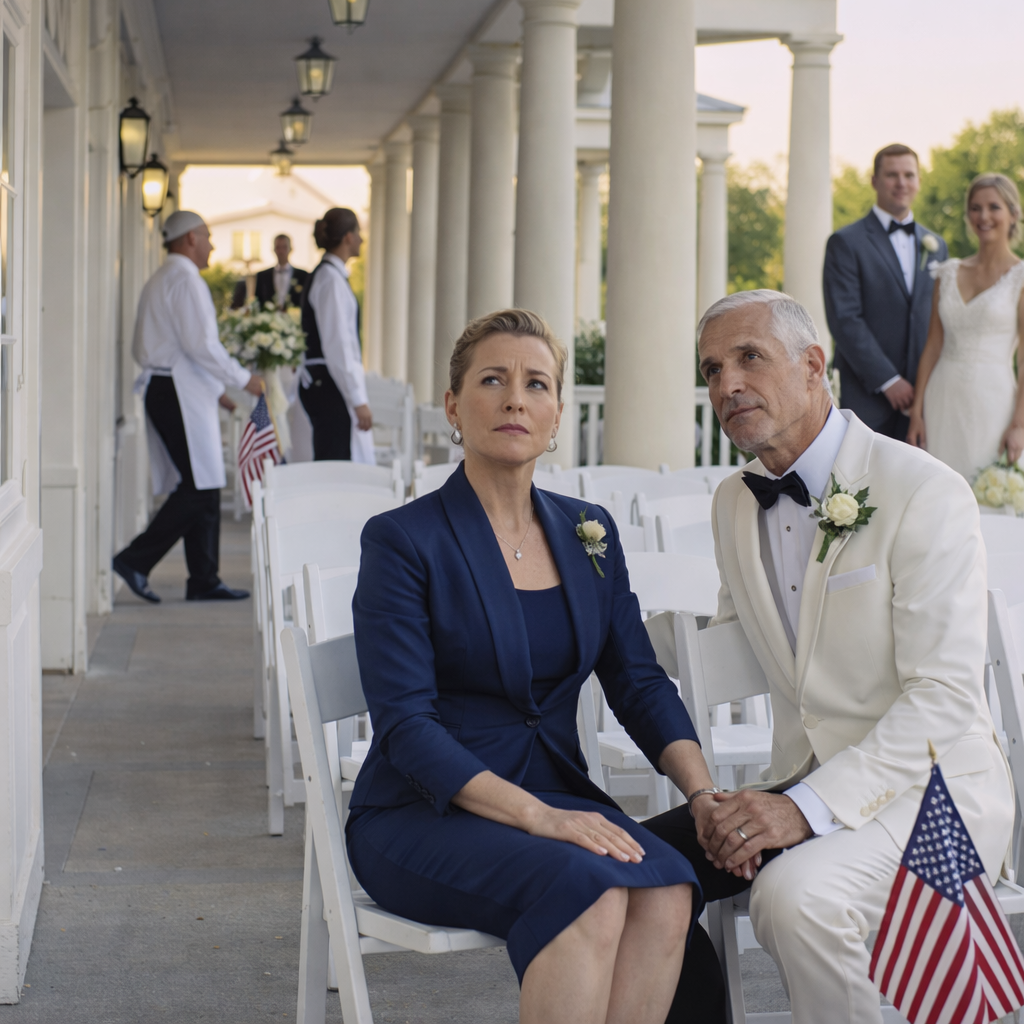
Row fourteen sat behind the photographers. Behind the flower handlers. Directly beside the swinging doors of the service corridor. I could see waiters slipping in and out, trays of champagne flashing past, the smell of warm food drifting in waves.
It wasn’t just distant.
It was hidden.
I walked there slowly, my navy dress brushing my calves, my sensible heels echoing too loudly in my ears. Each step felt heavier than the last, as if I were crossing not a room but the full weight of my life.
Forty-two years teaching English on the South Side of Chicago.
Decades grading essays late into the night.
Raising a child on a public-school salary.
Burying my husband after cancer hollowed him out piece by piece.
And this was where I was placed.
I sat down carefully, folding my hands in my lap so no one would see them tremble. A champagne flute had already been set on the chair beside me, forgotten by someone who assumed no one important would sit there.
I picked it up, then immediately set it back down when I felt the glass shake between my fingers.
Up front, Camille’s mother, Patricia Devon, sat among a row of women draped in pearls and silk. Their hair was perfectly arranged, their laughter soft and measured. When their eyes landed on me, the conversation didn’t stop — it simply lowered.
“I heard she taught at a public school,” one murmured, not bothering to hide it.
“Poor thing. That must have been rough,” another replied.
“I heard she even worked extra shifts at a library to survive,” a third added, amused.
Their words floated back to me like smoke.
I kept my spine straight.
I told myself not to cry. Not here. Not today.
From where I sat, I could see Bryce clearly. He stood at the altar, posture easy, smile practiced. He looked nothing like the boy who used to come home with grass stains on his knees and hand me dandelions from an empty lot, declaring they were “the prettiest flowers in the world.”
I remembered that boy vividly.
The way he used to sit at the kitchen table doing homework while I cooked soup. The way he’d fall asleep on the couch while I graded papers. The way he once told me, at eight years old, “Mom, when I grow up, I’ll always take care of you.”
Where had that promise gone?
The music shifted.
Camille appeared at the entrance, her wedding gown spilling across the floor like a white river. Two attendants struggled with the length of the train. Diamonds at her throat caught the light, sharp enough to make me squint.
She never looked in my direction.
Not once.
I lowered my eyes, willing myself to disappear, when the chair beside me slid back.
The sound was subtle, but close enough that I felt it rather than heard it. A presence settled next to me, calm and deliberate. A whisper of bergamot and cedar reached me, clean and familiar in a way I couldn’t place.
A man’s hand covered mine.
Gently. Steadily. As if it had always belonged there.
“Let’s pretend we came together,” he murmured.
My heart stuttered.
I turned my head slowly, afraid of what I might see, afraid of embarrassing myself further. The man beside me was tall, silver-haired, dressed in a perfectly cut black suit that didn’t shout for attention but commanded it anyway. A Swiss watch rested at his wrist. His posture was relaxed, assured, the posture of someone who had never needed to ask for permission to exist in a room.
He smiled at me — not politely, not curiously.
Warmly.
As if he knew me.
As if he had always known me.
Before I could speak, I felt the atmosphere shift. Heads turned. Whispers stopped mid-sentence. The pity that had hung over me like a damp coat evaporated, replaced by curiosity… then caution.
A woman two rows ahead leaned toward her husband.
“Who is that with the groom’s mother?”
“He looks… important,” the man replied.
I didn’t answer. I couldn’t. My mind was racing too fast.
Up front, Bryce glanced down.
His eyes landed on us.
The color drained from his face so quickly it startled me. His mouth parted slightly, as if he’d forgotten how to breathe. I saw recognition there — not of the man, but of what this moment meant.
Camille followed his gaze.
Her expression froze.
For the first time since I’d met her, her composure slipped. Just for a heartbeat. Her fingers tightened around Bryce’s hand, her smile turning brittle as glass.
The man beside me leaned closer, his voice barely audible.
“Smile,” he said softly. “Your son’s about to look again.”
I did.
When Bryce glanced down a second time, he looked as if the ground had shifted beneath him. The humiliation he had so carefully arranged had transformed into something unpredictable. Dangerous.
“Perfect,” the man murmured, giving my hand the slightest squeeze. “Now they don’t know where to place you in their picture anymore.”
I swallowed, my throat tight with emotion I didn’t fully understand yet.
“Who are you?” I whispered.
He finally turned his face toward me fully, and when our eyes met, the world narrowed to that single point of recognition.
“Someone you should have crossed paths with again a long time ago,” he said.
The ceremony continued around us — vows spoken, music swelling — but I barely heard it. I felt suspended, as if time itself had paused to let something unfinished return.
Applause rose as the couple was pronounced married. People stood. I stood too, almost without realizing it.
The man beside me leaned in once more.
“Let them wonder,” he said.
I did more than wonder.
I breathed.
For the first time in years, I didn’t feel invisible.
And as the light shifted across his face, catching the familiar blue of his eyes — eyes I had memorized half a century ago — a single name surfaced in my mind, uninvited and undeniable.
Sebastian.
The sound of it echoed through me like a door opening that I had long believed was sealed forever.
And I knew, with a certainty that steadied my shaking hands, that the person being pushed aside today would not be me.
The applause rolled through the hall like waves, people rising, chairs scraping softly against polished floors. A curtain of camera flashes popped from the front rows. The string quartet shifted into brighter music, the kind meant to send everyone drifting toward cocktails with the pleased, rosy glow of witnessing something beautiful.
I stood with everyone else because it was what you do, because the body follows old rules even when the heart is off-balance.
Beside me, the man in the black suit remained close, his hand still lightly covering mine, as if he understood that if he let go too soon I might fall back into whatever smallness they had tried to assign me.
I kept my eyes on Bryce as he turned to Camille, smiling for the room.
His smile looked different now.
Stretched.
Careful.
Like something taped together.
Camille’s expression remained composed, but the muscles around her mouth worked too hard. Her gaze flicked toward row fourteen again and again, quick glances meant to be invisible. Each time she saw the man beside me, her eyes sharpened.
People began to move toward the garden doors, toward the cocktail hour set among manicured hedges and lavender, where champagne would flow and everyone would pretend this was just a flawless day.
The coordinator approached my row, clipboard pressed to her chest, her voice suddenly sweeter.
“Mrs. Carter,” she said, and I noticed the change immediately. The respectful title. The careful tone. “We’re going to have immediate family photos in ten minutes. We’ll need you near the front.”
Ten minutes ago, I had been treated like an inconvenience.
Now I was suddenly necessary.
I didn’t answer right away. I glanced at the man beside me, searching his face for some hint of explanation, some clue that would help me understand what kind of current I’d been caught in.
His eyes stayed on the coordinator. Calm. Unimpressed.
“Thank you,” he said before I could speak, his voice smooth and low. “We’ll be there.”
The coordinator blinked as if startled that he had spoken at all, then nodded quickly and backed away.
We walked out of the ceremony hall with the crowd, moving slowly down the aisle. Camille’s friends fluttered around her like white birds, adjusting her train, touching her veil, laughing too loudly.
As Bryce passed my row, his eyes met mine for a split second.
There was something in them I had never seen in my son before.
Fear.
Not of losing me.
Of losing control.
The man’s hand shifted to the small of my back, guiding me gently through the flow of guests.
“I’m going to need you to keep breathing,” he murmured.
I let out a shaky laugh that didn’t sound like me. “I’m trying.”
He glanced down at me with the faintest smile, then looked away again as if he didn’t want to make a scene with tenderness.
We reached the wide foyer where French doors stood open to the gardens. Cold air mixed with the scent of roses and freshly cut greenery. Waiters moved through the crowd with trays of champagne, and the Devon family’s friends began clustering in glossy knots, their faces turned toward the most important people.
Patricia Devon stood near the entrance, holding a flute of champagne like it was part of her anatomy. Her pearls gleamed against her throat. Her eyes swept the room with quiet authority.
When her gaze landed on me, she stiffened slightly.
When her gaze landed on the man at my side, something flickered behind her eyes.
Recognition.
Or fear.
She recovered quickly, the way women like her always do. Her smile sharpened into something polite.
She started toward us.
The man beside me leaned in, his voice so low I barely caught it.
“Don’t speak first,” he said. “Let her show herself.”
Patricia reached us, smile intact. “Mabel,” she said, pronouncing my name like she’d always done, as if it were something slightly outdated. Then her eyes shifted to the man. “And you are…?”
He offered her a hand, not hurried, not eager. Power never reaches first. It waits to be approached.
“Sebastian Whitmore,” he said.
Patricia’s fingers froze around her champagne flute.
Her smile tightened. “Of course. Mr. Whitmore. How… unexpected.”
He smiled faintly, the expression warm only on the surface. “Unexpected days have a way of showing what people really value.”
I watched Patricia Devon calculate, her mind moving behind her eyes like a chess player.
“Well,” she said smoothly, “we’re delighted to have you here. I wasn’t aware you were acquainted with Bryce’s mother.”
The way she said Bryce’s mother felt pointed, as if she couldn’t bring herself to say my name with respect.
Sebastian’s hand settled over mine again, casual, unmistakable.
“Mabel and I go back a long way,” he said.
Patricia’s gaze cut to me.
I felt the room’s attention turning, subtle but real, like wind shifting direction. Conversations slowed. People glanced over their champagne flutes. A few faces leaned closer, hungry for gossip.
Camille had appeared nearby, her dress now arranged perfectly for photos. She approached with Bryce at her side, both of them wearing expressions too controlled to be natural.
Camille’s smile was bright enough to blind. “Mabel,” she said warmly, as if we’d just spent the last year exchanging holiday cookies. “I’m so glad you’re here. I hope you’re comfortable.”
I stared at her for a second, letting myself take in the performance. The false sweetness. The slight tension at the edge of her eyes.
“Comfortable?” I repeated softly.
Bryce’s jaw tightened.
Sebastian’s voice stayed calm. “Mrs. Carter has always been comfortable with herself. That’s not the issue, is it?”
Camille’s smile faltered. “I’m not sure what you mean.”
Sebastian tipped his head slightly. “You do. But this is your wedding day. We don’t need to discuss manners in public.”
Camille’s cheeks flushed under her makeup.
Bryce shifted beside her, stepping in quickly, his voice too eager. “Mr. Whitmore, it’s an honor. I didn’t know you’d be here.”
Sebastian looked at him, and the warmth in his expression vanished completely, replaced by something cool and assessing.
“I wasn’t invited,” he said simply.
A beat of silence.
Bryce blinked. “I… I’m sorry. There must have been an oversight.”
“No,” Sebastian replied, still quiet. “It’s fine. I’m not here for an invitation.”
He glanced down at me, and for a moment his face softened again. “I’m here because I saw someone being erased.”
The words landed like a stone.
Camille’s smile strained harder. Patricia’s posture stiffened. Bryce looked as if he’d swallowed something sharp.
“We should take photos,” Camille said quickly, voice bright, desperate to regain control. “Family photos. People are waiting.”
Sebastian’s eyes returned to her. “Then let’s take them.”
He didn’t ask. He didn’t negotiate.
We moved toward the photo area set up near a wall of white roses. Photographers arranged lighting, assistants adjusted reflectors, people shuffled into place according to social hierarchy.
The coordinator approached again, her tone careful. “Mrs. Carter, you’ll stand… just here.”
She positioned me on the edge.
Of course.
Not too visible. Not too central.
Sebastian stepped forward and placed himself beside me, his shoulder nearly touching mine.
“No,” he said, and his voice wasn’t loud, but it carried. “She stands here.”
He guided me gently toward the center, directly beside Bryce.
The coordinator opened her mouth, then shut it again.
Bryce’s eyes widened. Camille’s face tightened.
I stood where Sebastian placed me, feeling my heart thump hard against my ribs. I could smell roses, strong and sweet, mixed with expensive perfume and camera flash heat.
The photographer lifted his camera. “All right, everyone. Smile.”
Bryce’s smile looked like agony.
Camille’s was perfect, but her eyes were furious.
Sebastian’s hand rested lightly at my elbow, steadying me, as if he could feel the way my body wanted to shrink back into old habits.
The camera clicked.
“Beautiful,” the photographer said.
We shifted for another shot.
From the corner of my eye, I saw guests watching, whispering behind flutes. The same women who had murmured about my public-school job now stared at Sebastian with cautious curiosity.
“Is that really Whitmore?” someone whispered.
“I think so,” someone else breathed. “He looks like the man from the business papers.”
Patricia Devon’s face remained composed, but her fingers had tightened around her glass so hard her knuckles looked pale.
The photos ended. People scattered again, relief flooding the air.
Camille stepped close to Bryce, her voice low and sharp, but I still caught it.
“What is he doing here?” she hissed.
Bryce’s voice came back strained. “I don’t know.”
Camille’s nails dug into his sleeve. “Fix it.”
I watched my son stand there, caught between his wife’s rage and whatever fear Sebastian’s presence had awakened in him. For a moment, Bryce looked younger, not powerful at all, just cornered.
Sebastian leaned close to my ear.
“Walk with me,” he murmured. “You need air.”
I nodded.
He guided me toward the garden doors. The moment we stepped outside, the cool breeze hit my cheeks, and I inhaled deeply. Lavender and damp earth, roses heavy in the air. Somewhere nearby, water trickled from a fountain.
We walked along a stone path away from the crowd, past trimmed hedges and rows of pale purple flowers that swayed gently.
My hands were shaking now that I wasn’t forcing them still.
Sebastian glanced down at me. “You’re doing well.”
“I don’t understand what’s happening,” I whispered. “I don’t even understand why you’re here.”
His jaw tightened slightly, as if he were choosing his next words carefully.
“I saw you sitting back there,” he said. “And I remembered you.”
My throat closed. “That doesn’t explain why you walked in now. After all this time.”
He stopped near a small garden pond, its surface reflecting the sky and the estate’s white columns. He looked out at the water for a long moment before turning back to me.
“I looked for you,” he said. His voice was quieter now, rougher. “For years.”
The sentence hit me like a wave.
I stared at him, and suddenly the polished man in the black suit blurred into the young man I had once loved so fiercely it frightened me.
My voice came out thin. “I never heard from you.”
Pain flickered across his face. “I wrote. Dozens of letters. When I went to London for that program, I wrote constantly. I thought you were getting them.”
“I didn’t,” I said, my hands cold despite the sun. “Not one.”
He closed his eyes briefly, as if the truth physically hurt.
“When I came back,” he said, “I called. Your mother answered once. Then suddenly no one did. I went to your house and they said you’d moved.”
My chest tightened with old confusion, old grief. My mother’s voice rose in my memory, sharp and certain: He’s not serious. Men like that only care about money. You need stability.
“She hid them,” I whispered, almost to myself. “She hid everything.”
Sebastian’s eyes opened, and the sadness in them was so deep it made me look away.
“I suspected,” he said quietly. “But I couldn’t prove it. I was young. I thought maybe you’d chosen someone else.”
I swallowed hard. “I did. I married Harold.”
Sebastian nodded slowly, no bitterness, only resignation. “I know. I saw the announcement years later. I told myself you must have been happy.”
“I was,” I said, and I meant it. “Harold was kind. Steady. He loved me. He never hurt me.”
Sebastian’s lips pressed together. “And yet you still looked lonely back there.”
The words stung because they were true.
I stared down at the pond, at the faint ripples spreading across its surface. “Harold died three years ago,” I said softly. “Lung cancer. I thought I’d made peace with loneliness. But today… today I realized a different kind of loneliness exists.”
Sebastian’s hand brushed my forearm, gentle. “Being denied respect by people who are alive.”
I nodded, throat tight.
We stood there, two older people held in a moment that felt impossible. Fifty years collapsed into a garden path and a pond reflecting sky.
Footsteps crunched on gravel behind us.
I turned, and my stomach tightened again.
Bryce and Camille were striding toward us, their faces tense, moving like people who feared losing control of a situation they didn’t understand.
“Mom,” Bryce called, voice low and urgent. “We need to talk.”
Camille reached us first. Her gaze locked on Sebastian. “Who are you?” she demanded.
Sebastian straightened slightly, adjusting his tie with calm precision, the movement of a man stepping into a boardroom rather than a garden confrontation.
“I’m someone who once mattered a great deal to Mabel,” he said evenly.
Camille’s eyes narrowed. “This is my wedding. Not a place for strangers.”
I felt something in me shift, a small internal click. I had spent too long being polite in the face of cruelty.
“He’s not a stranger,” I said calmly. “He’s my guest.”
Camille turned to Bryce, voice sharp. “Are you hearing this?”
Bryce looked rattled, eyes flicking between me and Sebastian as if he couldn’t decide where to land.
“Mom,” he said, quieter now, “this isn’t the time.”
Sebastian’s gaze stayed on Bryce. “When is the time,” he asked, “to treat your mother with basic dignity?”
Bryce’s face flushed. “It was a seating mistake,” he said quickly. “Staff put the rows wrong.”
I held my son’s eyes. “Was it a mistake, Bryce? Or a choice?”
His mouth opened, then closed. The answer lived in his silence.
Camille stepped closer, voice dropping into a hiss. “Mabel, you’re being sensitive. We had to protect our family’s reputation.”
Sebastian’s tone remained polite, but there was iron underneath it. “If your reputation depends on humiliation, you should reconsider what it’s worth.”
Color rose under Camille’s makeup. Rage or shame, it didn’t matter. Bryce’s shoulders sagged slightly, as if he could no longer hold all the lies up at once.
Sebastian slipped a hand into his suit pocket and spoke with the same calm, measured cadence.
“As it happens,” he said, “Whitmore Capital recently acquired the downtown commercial building where Devon Realty Group has its headquarters.”
The garden went still.
Even the fountain’s trickle seemed suddenly louder.
Camille’s face drained. Bryce’s eyes widened. Patricia Devon, who had followed them at a distance, stopped short on the path, her expression tightening into something close to alarm.
Sebastian’s voice stayed gentle, almost conversational. “The deal closed last week. I recognized the Devon logo today.”
Camille swallowed. “You… you bought the Michigan Avenue building?”
Sebastian nodded once. “Yes.”
Bryce’s gaze snapped to Camille, then back to Sebastian. The fear in his face returned, sharper now, because it wasn’t social embarrassment anymore. It was financial.
Sebastian turned slightly toward me, and the hard edge in his expression softened into warmth.
“Mabel,” he said, “it’s been a long day. Let’s leave. There’s a place by the lake I’d like to take you to dinner, if you’re willing.”
I didn’t hesitate.
“I’d like that,” I said.
Camille’s voice shot out, strained. “You’re leaving during the reception? People are waiting for family photos.”
I turned toward her, my voice steady. “Family photos,” I repeated. “Is that what you wanted today? A picture of a mother parked near the service doors?”
Camille’s mouth tightened.
Bryce took a step forward, desperate. “Mom, please…”
I looked at him, really looked. Not at the suit. Not at the groom smile. At my son, the boy I raised, the man who had chosen silence when it mattered most.
“I’m not an obligation you manage anymore,” I said quietly. “From now on, I choose my own place.”
Sebastian held out his hand.
I placed mine in his.
We walked away along the stone path, leaving the estate behind us. The evening air cooled as the sun lowered, the scent of lavender rising. Behind us, I heard whispers ripple through the crowd, curiosity sharp with newly discovered respect.
“Is that really Sebastian Whitmore?”
“And he’s with the groom’s mother?”
“If so, the Devons are in trouble.”
I didn’t look back.
For the first time in years, my chest felt lighter.
Not because someone had finally noticed me.
But because I had finally stopped agreeing to be invisible.
The gravel crunched beneath our steps as we walked away from the estate, the sound steady and grounding. I could still feel eyes on my back, could still sense the ripple we’d left behind us, but with every step the noise softened. The Devon Estate, with all its glass and roses and silent hierarchies, began to recede like a stage set being dismantled behind us.
Sebastian opened the door of his dark sedan for me, the gesture unhurried, familiar in a way that startled me. I slid into the seat, smoothing my dress, my hands finally still. When he settled behind the wheel and pulled away, the mansion lights blurred into streaks of gold in the side mirror.
Neither of us spoke at first.
Outside, trees lined the drive, their leaves whispering in the late-afternoon breeze. I watched them pass and felt something loosen inside my chest, as if a cord I hadn’t known was there had finally been cut.
“I’m sorry,” Sebastian said quietly after a few minutes. “If I’d known today was your son’s wedding, I might have come sooner. Or not at all.”
I turned to him. “You don’t owe me an apology, Seb. If you hadn’t come when you did… I think I would’ve gone home believing that was all I deserved.”
He glanced at me, his jaw tightening briefly. “You deserved better then. You deserve better now.”
The road curved, and Lake Michigan came into view, wide and calm, reflecting the soft pinks and golds of the setting sun. The sight caught in my throat. I’d lived near this water for decades, walked its edge in grief after Harold died, but tonight it looked different. Less like a witness to loss. More like an open door.
Seb pulled into the parking lot of a glass-fronted restaurant overlooking the lake. The sign read Lake View Terrace. Warm light spilled from inside, silhouettes moving slowly behind tall windows.
As he parked, I exhaled. “I feel like I should be shaking more than this.”
He smiled faintly. “Shock does that. It gives you a kind of borrowed calm.”
Inside, the restaurant was quiet, refined without being showy. Soft jazz floated through the room, the low murmur of conversation threading beneath it. Seb led us to a table by the window, where the lake stretched out endlessly, dotted with the faint outlines of sailboats drifting home.
He pulled out my chair. “You always liked the window seats.”
I laughed softly. “I always liked knowing where I was.”
The server came and went, Seb ordering without consulting a menu, and when he listed my preferences—no onions, a light pour of red, nothing chilled—I stared at him.
“You remember all that?”
He met my eyes, unashamed. “I remember you.”
We ate slowly. The food was rich and comforting, but it was the conversation that filled me. He asked about my years teaching, about the students who’d stayed in touch, about Harold. I told him the truth—that Harold had been kind, steady, and good, even if our love had been quiet instead of electric.
Seb listened without jealousy, without regret clouding his face.
“I used to wonder,” he admitted at one point, staring out at the lake, “if you’d been happy. I hoped you were.”
“I was,” I said. “And I still am, in my own way. But today… today reminded me how much of myself I’d learned to hide.”
He nodded slowly. “I never married. Not because I didn’t want to. But because I kept comparing everyone to the girl who read poetry to me on her front steps.”
I smiled at the memory. “You were terrible at pretending not to like Whitman.”
“I liked the way you read Whitman,” he corrected.
The words settled between us, not heavy, just honest.
When my phone buzzed for the first time, I ignored it. When it buzzed again, I glanced down.
Bryce.
Seven missed calls. Three messages.
I turned the phone face down.
Seb noticed but didn’t comment. He just reached across the table and rested his fingers over mine, not possessive, not urgent. Present.
“Tomorrow,” I said softly, more to myself than to him, “I’ll have to face them again.”
“Only if you choose to,” he replied. “You’re allowed to decide what access people have to you now.”
The thought felt radical. Liberating.
When we left the restaurant, the sky had deepened to indigo, the lake now a dark mirror scattered with lights. Seb drove me home in silence that felt companionable rather than awkward.
At my small brick house, he walked me to the door.
“I’m not asking for anything tonight,” he said gently. “Just… don’t disappear again.”
I smiled, touched by the care in his restraint. “I won’t.”
After he left, I stood in my living room for a long time, still in my wedding shoes, listening to the quiet. The house felt different. Not empty. Awake.
That night, I slept deeply, without replaying the humiliation in my mind.
Three days later, I was watering the geraniums on my front porch when my phone rang again.
“Mom,” Bryce said, his voice strained but controlled. “Are you free tonight? Camille and I want to take you to dinner. Riverhouse.”
Riverhouse. Expensive. Strategic.
I wiped my hands on my apron and smiled faintly. “All right.”
That evening, the restaurant glowed with candlelight and polished wood. When I arrived, Bryce looked tired, the confidence from the wedding gone. Camille greeted me with a smile so bright it felt rehearsed.
“You look wonderful,” she said. “You’re glowing.”
“Good manners tend to do that,” I replied lightly.
Seb joined us moments later, calm and impeccably dressed. He took the seat beside me without ceremony, his presence steadying.
The conversation stayed polite until the main course arrived. Then Bryce set down his fork.
“Mom,” he said, “I wanted to talk about work.”
I took a sip of wine. “Of course you do.”
Camille jumped in smoothly. “Whitmore Capital owns our building now. We were hoping to keep the current lease. Surely there’s room for flexibility.”
Seb didn’t look at her. “Business doesn’t bend for convenience,” he said evenly. “It bends for principle.”
The tension thickened.
I set my glass down. “Before business,” I said, “let’s talk about respect.”
Bryce swallowed. “I know there was a misunderstanding at the wedding—”
“It wasn’t a misunderstanding,” I said calmly. “It was a choice.”
Camille’s smile faltered. “I didn’t mean to hurt you.”
“Are you sorry you said it,” I asked gently, “or sorry it has consequences?”
Silence.
Seb spoke quietly. “Whitmore Capital isn’t interested in favors. But we are interested in ethics.”
The meal ended with strained politeness. When we stood to leave, Seb pulled out my chair.
“Let’s go, Mabel,” he said. “This isn’t a negotiation.”
Outside, the city lights reflected off the river, and for the first time, I didn’t feel diminished walking away from my own child.
The next morning, the doorbell rang.
Patricia Devon stood on my porch in a cream coat and pearls, her smile sharp.
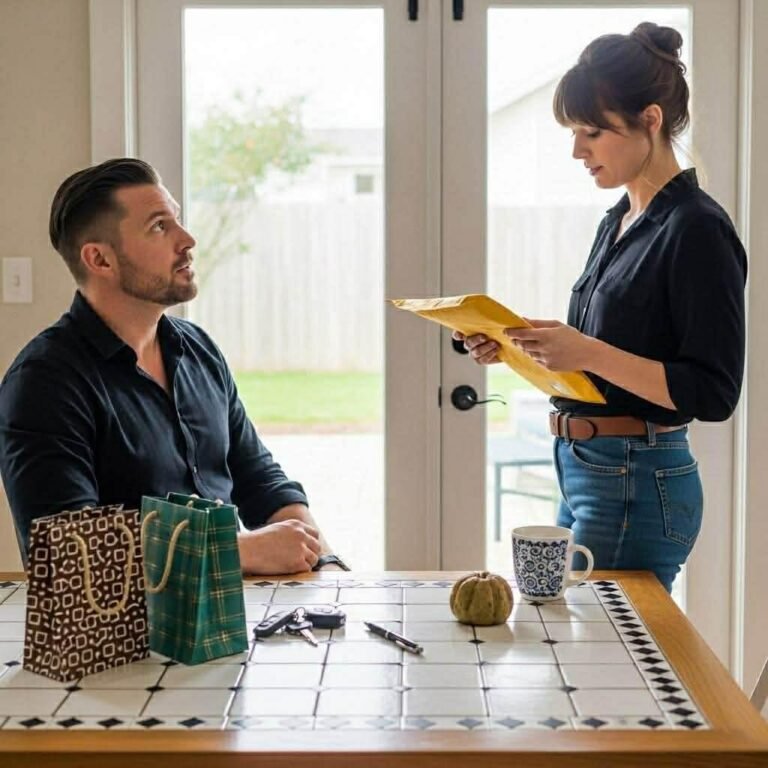
She sat at my table and slid a check across the surface. Fifty thousand dollars.
“An arrangement,” she said coolly. “Convince Mr. Whitmore to be reasonable.”
I looked at the check, then at the rose bushes Harold had planted years ago, still blooming stubbornly.
“My worth isn’t for sale,” I said, and tore the check in half. Then quarters. Then eighths.
Patricia stared, stunned.
I opened the door. “Good day.”
After she left, I washed my hands and felt something old finally dissolve.
That afternoon, I went with Seb to his office. Glass and steel rose around us, but inside the conference room, Nora Patel explained everything in clear, patient language.
Devon Realty was overleveraged. Desperate.
The new lease terms were simple: higher rent, shorter term, and public accountability. A public apology. A contribution to the Chicago Elder Justice Fund. And a scholarship in Harold’s name.
When I saw Harold Carter Memorial Scholarship in print, my eyes burned.
“I’ll sign,” I said.
Seb squeezed my hand. “You’re not punishing them,” he said softly. “You’re correcting the balance.”
Two days later, the Devons accepted every term.
The apology came at a fundraiser, under bright lights and cameras. Camille stood on stage and spoke the truth she’d tried to bury. Her voice shook. The room was silent.
When I stepped forward to respond, my voice was steady.
“I acknowledge your apology,” I said. “Forgiveness takes time. But truth is a beginning.”
Applause followed—not loud, but sincere.
Later that night, Bryce texted: Mom, can we talk?
I replied: Tomorrow. You start.
The next morning, Bryce came alone. No Camille. No armor.
“I forgot you,” he said, voice breaking. “And I don’t want to anymore.”
I listened. I didn’t rush him. I didn’t rescue him.
“I’m not asking you to be perfect,” I told him. “I’m asking you to be decent.”
He nodded. “I will try.”
That was enough for now.
Weeks later, Seb and I stood in a glass corridor overlooking Chicago. He spoke about Tuscany, about a project there, about leaving room in life for joy.
“Come with me,” he said.
I smiled, the answer already in my chest. “Yes.”
That night, I packed a small suitcase and placed my passport on the table. I stood by the window, looking out at the lake, and saw not a woman pushed to the last row, but a woman standing fully in her own life.
Row fourteen had been where they tried to shrink me.
But it turned out to be the place where I stood up.
And I never sat down again.