A Daughter’s Tribute: How Honoring Her Father Changed Everything at the Dance
For as long as I could remember, it had always been just the two of us. My father and me, navigating life together as a team.
My mother passed away on the day I was born, which meant my dad had to figure out how to be everything all at once.
He packed my school lunches before heading to his early morning shift. He made pancakes every Sunday without fail. Somewhere around second grade, he even taught himself how to braid hair by watching video tutorials late into the night.
His job was working as a custodian at the same school I attended.
That detail shaped much of my childhood in ways both big and small.
Growing Up Different
I grew up hearing exactly what other students thought about my situation. The comments were never said directly to my face, but they carried through hallways and cafeterias with perfect clarity.
“Her dad cleans our bathrooms.”
“That’s the custodian’s daughter.”
I learned early not to cry at school. I held everything inside until I got home, where I could finally let my guard down.
Somehow, Dad always knew when I’d had a rough day. He’d slide a plate of dinner toward me, study my face quietly for a moment, and then speak in that calm voice of his.
“You know what I think about people who make themselves feel important by making others feel small?”
I’d shrug, fighting back tears. “What?”
“Not much, sweetheart. Not much at all.”
And somehow, those simple words were always enough to help me feel better.
Dad believed deeply in the value of honest work. He used to tell me there was real dignity in taking care of the things other people overlooked or took for granted.
I believed him completely. By my sophomore year, I’d made a quiet promise to myself that one day I would make him so proud that none of those cruel whispers would matter anymore.
Then our whole world shifted.
When Everything Changed
Last year, Dad was given a difficult medical diagnosis. The kind that changes everything overnight and makes you reconsider all your assumptions about the future.
Even after receiving the news, he kept going to work for as long as the doctors would permit. Honestly, he worked longer than they wanted him to, pushing himself beyond what was probably wise.
Sometimes I’d find him leaning against the supply closet in the school hallway, his shoulders slumped with exhaustion he couldn’t quite hide.
The moment he noticed me, though, he’d straighten up and manage a smile.
“Don’t give me that worried look, honey,” he’d say with forced cheerfulness. “I’m doing just fine.”
But we both knew the truth. Neither of us wanted to say it out loud, but we both understood.
Still, there was one thing he kept bringing up during our quiet dinners at the kitchen table after his shifts.
“I just need to make it to your special dance,” he said more than once, rubbing his tired eyes. “And then your graduation ceremony. I want to see you walk out that door all dressed up like you own the whole world, princess.”
“You’re going to see so much more than that,” I promised him every single time.
But a few months before the dance, we lost him.
He passed away before I could even make it to say goodbye. I found out while standing in the school hallway with my backpack still on my shoulder.
I remember staring down at those floors—the same ones he used to clean every evening—and then everything else became a blur of grief and disbelief.
Moving Forward Without Him
The week after we laid him to rest, I moved into my aunt’s house. Her spare bedroom smelled like cedar wood and fresh laundry, nothing like the small house Dad and I had shared for so many years.
It was kind and comfortable, but it wasn’t home.
Then the season for the big dance arrived at school.
Girls in my classes compared designer gowns and shared photos of expensive dresses that cost more than my father made in an entire month. I listened from the edges of these conversations, feeling like I was floating somewhere outside of real life.
The dance had always been something Dad and I talked about together. Him standing by our front door with his phone, taking too many pictures while pretending he understood how formal events worked.
Without him there, the whole thing felt hollow and meaningless.
Finding a Way to Bring Him Along
One quiet evening, I opened the box of personal items that had been returned to us. His worn wallet. His old watch with the cracked face. And at the bottom, folded neatly the way he folded everything, several of his work shirts.
Blue. Gray. And one faded green one I remembered from years back.
I held one of those shirts for a long time, feeling the familiar fabric between my fingers. Then suddenly an idea came to me so clearly it felt like it had been waiting all along.
If Dad couldn’t physically be there with me at the dance, I would find a way to bring him with me anyway.
My aunt didn’t dismiss the idea when I nervously explained what I was thinking.
“I barely know how to sew,” I admitted.
“I know,” she replied gently. “I’ll teach you.”
That weekend we spread his shirts across her kitchen table and opened her old sewing kit. The project took much longer than either of us initially expected.
I cut the fabric incorrectly more than once. One frustrating night I had to completely rip out an entire section and start over from scratch.
My aunt never criticized my mistakes. She just patiently guided my hands and reminded me to breathe through the difficult moments.
Some nights I cried while I worked on the dress.
Other nights I talked to Dad out loud as if he could hear me.
Every Piece Held a Memory
Each section of fabric carried its own specific memory attached to it.
The shirt he wore on my first day of high school, when he told me I was going to be amazing at whatever I tried. The faded green one from that afternoon he ran beside my bicycle until his knees finally gave out.
The gray one he wore when he hugged me after my worst day of junior year without asking a single question about what happened.
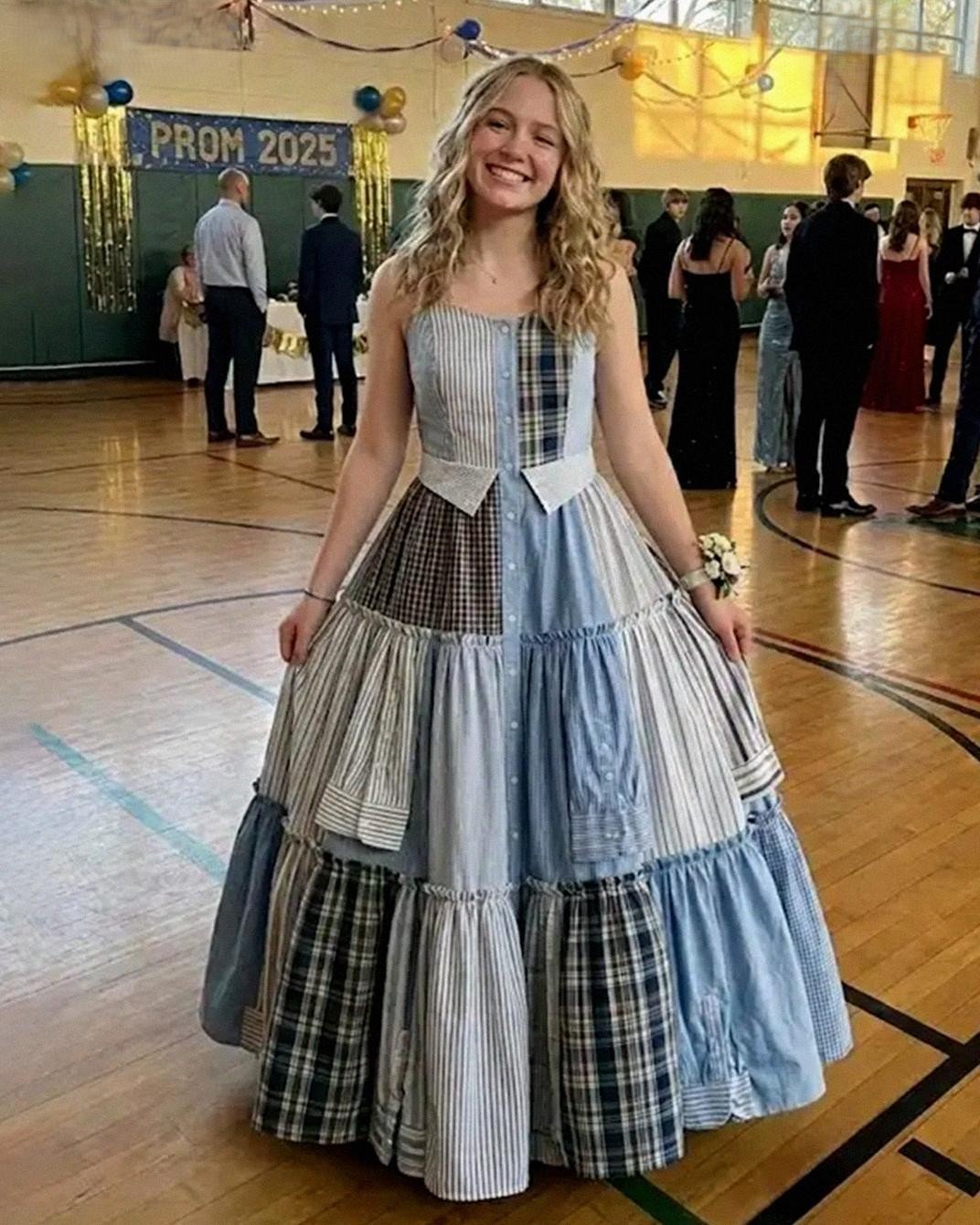
The dress slowly became a patchwork quilt of everything he had been to me. Every color my father had ever worn stitched carefully into one garment.
The night before the dance, I finally finished it.
When I put it on and looked at myself in the mirror, I knew it wasn’t anything like a designer creation. Not even close to the expensive gowns other girls would be wearing.
But every single color my father had ever worn was stitched into this dress.
For the first time since that awful phone call, I didn’t feel quite so empty inside.
I felt like he was right there with me.
The Night of the Dance
The big evening arrived in what felt like a blur of bright lights and loud music.
The whispers started almost immediately, before I’d even reached the center of the decorated room.
“Is that thing made from cleaning rags?”
A boy nearby laughed loudly. “I guess that’s what you wear when you can’t afford something real.”
The mocking laughter spread through sections of the crowd like ripples on water.
My face burned with humiliation and anger.
“I made this dress from my father’s work shirts,” I said, trying desperately to keep my voice from shaking. “He passed away a few months ago. This is how I chose to honor his memory.”
Someone nearby rolled their eyes dramatically.
“Nobody asked for the sad backstory.”
Suddenly I was eleven years old again, standing in a school hallway overhearing people say my father cleaned their bathrooms for a living.
I found an empty chair at a table near the edge of the room and sat down, trying with everything I had to hold myself together.
Then the music suddenly stopped playing.
When Everything Shifted
The person managing the music stepped back from the equipment.
Our principal, Mr. Bradley, walked purposefully to the center of the room holding a microphone in his hand.
“Before we continue with tonight’s festivities,” he said in a calm but firm voice, “there’s something important I need to address.”
The entire room fell completely silent. You could have heard a pin drop.
“For eleven years,” he continued clearly, “Nicole’s father took care of this school and everyone in it. He repaired lockers so students wouldn’t lose their belongings. He fixed torn backpacks and returned them quietly without ever mentioning it.”
He paused, looking around the room.
“He washed athletic uniforms before important competitions so no student would have to admit they couldn’t manage the cost themselves.”
No one in the room made a sound.
“That dress,” Mr. Bradley said with emphasis, “is not made from cleaning rags. It is made from the shirts of a man who genuinely cared for every single person in this building, whether they noticed it or not.”
Then he added something that changed everything.
“If Nicole’s father ever helped you in some way—fixed something broken, repaired something damaged, did something kind you didn’t fully notice at the time—I’d like you to please stand up.”
A Room Full of Gratitude
For a long moment, absolutely nothing happened. The silence stretched out uncomfortably.
Then a teacher near the back stood up from her seat.
Then a boy from the track team rose to his feet.
Then two girls standing by the photo display area.
One by one, people throughout the room began standing.
Teachers. Students. Parent chaperones who’d come to help supervise.
Within what felt like less than a minute, more than half the room was standing in respectful acknowledgment.
Someone in the crowd began clapping. The applause spread through the decorated hall the same way the cruel laughter had spread just minutes earlier.
Except this time, I wasn’t standing alone against mockery.
When Mr. Bradley walked over and handed me the microphone, I could barely manage more than a few words.
“I made a promise to myself a long time ago that I would make my dad proud,” I said, my voice breaking slightly. “I hope I managed to do that. And if he’s somehow watching tonight, I want him to know that everything I’ve ever done right is because of what he taught me.”
The applause continued for what felt like forever.
A Quiet Moment of Completion
Later that night, after the dance ended, my aunt drove me to the cemetery where Dad was buried.
The grass was damp from earlier rain, and the sunset painted the evening sky in shades of gold and pink. I knelt down beside his headstone and rested both my hands on the cool marble.
“I did it, Dad,” I whispered into the quiet evening air. “You were with me the whole time, just like I planned.”
He never got to see me walk into that decorated hall on such an important night.
But I made absolutely certain he was dressed for the occasion anyway.
Understanding What Really Matters
That evening taught me lessons I’ll carry for the rest of my life. About the value of honest work. About how small kindnesses ripple outward in ways we can’t always see.
About how the people who mock others for circumstances beyond their control often reveal far more about themselves than about anyone else.
My father spent his working life taking care of a building and the people in it. He never sought recognition or praise for the countless small acts of service he performed.
He just showed up day after day and did what needed doing, whether anyone noticed or not.
The dress I wore wasn’t expensive. It wasn’t fashionable by any conventional standard. It didn’t come from a boutique or carry a designer label.
But it represented something far more valuable than any of those things. It represented love, sacrifice, dedication, and the quiet dignity of a man who believed deeply in the importance of his work.
When People Finally See Clearly
What struck me most that evening was how many people stood up when given the chance to acknowledge what my father had done for them.
Students who probably never thought twice about the repaired locker or the returned backpack. Teachers who benefited from his quiet efficiency. Parents who appreciated the care he took with the building their children occupied.
All those small acts of kindness had added up over eleven years into something profound. A legacy of service that touched far more lives than I’d ever fully realized.
The students who laughed at my dress saw only someone who couldn’t afford what they considered appropriate. They made snap judgments based on surface appearances and economic circumstances.
But they’d completely missed what was actually happening. They’d failed to see that the dress represented something money couldn’t buy.
Carrying Him Forward
In the weeks following the dance, something shifted in how other students interacted with me. The cruel comments stopped. Some people who’d never spoken to me before made a point of saying kind things.
A few even apologized for their earlier reactions.
I like to think that evening helped some of my classmates see things differently. Not just about me or my father, but about how they evaluate people in general.
About looking beyond surface judgments to understand the fuller story.
My father’s death left a hole in my life that will never completely heal. There are still moments when I forget he’s gone and think about calling him to share something that happened.
But that dress, hanging now in my closet at my aunt’s house, reminds me that he’s still with me in all the ways that truly matter.
In the values he taught me. In the example he set. In the quiet strength he demonstrated every single day.
The Real Meaning of Honor
Some people asked me afterward if I was angry about the initial reactions to my dress. If I felt bitter about the mocking laughter.
Honestly, I don’t. Those reactions came from ignorance and thoughtlessness, not genuine malice. And they were so completely overshadowed by what happened next that they barely matter now.
What I felt instead was gratitude. Gratitude that Mr. Bradley had the courage to speak up and redirect the entire room’s attention.
Gratitude for all those people who stood to acknowledge what my father had done for them over the years.
Gratitude that I’d thought of this way to carry him with me to an event he’d so desperately wanted to attend.
The dance wasn’t what I’d imagined it would be when Dad was still alive and we talked about it together. But in its own way, it became something even more meaningful.
It became a public acknowledgment of everything he’d been and everything he’d given to that school community.
Moving Forward With His Legacy
Graduation is coming up in a few months. I’ve been thinking about what to wear for that ceremony too.
Part of me wants to create something new from the remaining shirts I kept. Another way to bring him along to an important milestone he wanted so badly to witness.
My aunt thinks it’s a beautiful idea. She’s already offered to help me with the sewing again.
This time it’ll be easier. I know what I’m doing now, at least a little better. And I know without any doubt that honoring my father’s memory in visible, tangible ways is something I’ll never regret.
Some people express grief quietly and privately. That’s completely valid and right for them.
But I’ve found that carrying him visibly, literally wearing his memory, brings me comfort in a way nothing else quite does.
Lessons in Unexpected Places
If there’s anything I hope others take from my story, it’s this: Don’t judge people based on their job titles or economic circumstances. Don’t assume you understand someone’s value based on surface appearances.
The person cleaning your office building or serving your food or maintaining your neighborhood might be someone’s entire world. They might be performing countless small kindnesses you never notice.
They deserve respect and dignity regardless of how much money they make or what work they do.
My father never needed expensive clothes or impressive job titles to be an extraordinary person. He was extraordinary because of how he treated people, how he showed up every day, and how he quietly served his community.
That’s the legacy I’m proud to carry forward. Not wealth or status or recognition, but genuine care for others and dedication to doing good work regardless of who’s watching.
A Promise Kept
That promise I made to myself in sophomore year—to make my father proud—feels like it’s being fulfilled in ways I never quite expected.
Not through academic achievements or career success, though those things matter too. But through honoring his memory publicly and refusing to feel ashamed of who he was or what he did.
Through standing in that decorated hall wearing a dress made from his work shirts and saying clearly that I was proud to be his daughter.
That took more courage than I knew I had. But it also brought more healing than I could have imagined.
Every time I look at that dress now, I don’t see the initial mockery or the uncomfortable moments. I see all those people standing. I hear the applause. I remember feeling like he was right there beside me.
And I know, somehow, that he was.
The Comfort of Small Rituals
I still talk to him sometimes, usually late at night when the house is quiet. I tell him about my day, about the decisions I’m facing, about the things that worry or excite me.
It’s not the same as having him here. Nothing could ever replace his physical presence, his actual voice, his real hugs.
But it brings a kind of comfort anyway. A sense of continuity and connection that helps bridge the gap between past and present.
The dress hangs in my closet as a tangible reminder that love doesn’t end when someone passes away. It transforms and continues in different forms.
In memories. In lessons learned. In values passed down. In the ways we choose to honor those we’ve lost.
Looking Toward the Future
I don’t know yet what my future holds. What career I’ll pursue, where I’ll end up living, what kind of life I’ll build for myself.
But I know it will be built on the foundation my father laid. The belief in honest work. The commitment to treating people with dignity. The understanding that true worth has nothing to do with economic status.
Those lessons will guide me regardless of where life takes me.
And when I face difficult moments or important milestones, I’ll find ways to bring him along. Maybe not always as literally as that dress, but in spirit and in memory.
Because he earned the right to be part of those moments through years of sacrifice and love.
Final Thoughts
The dance turned out to be one of the most important nights of my life, though not for the reasons anyone typically expects their formal dance to be meaningful.
It wasn’t about the music or the decorations or the social experience. It was about standing up for someone I loved. About refusing to be ashamed. About discovering that my father’s impact reached far wider than I’d ever fully understood.
That dress made from work shirts represents everything I want to remember about him. The dedication. The quiet service. The unconditional love.
It represents who he was when no one was watching and who he remained even when facing his own mortality.
I wore his colors that night. I carried his memory. I spoke his worth out loud.
And in doing so, I kept the promise I’d made years earlier. I made him proud.
Not through anything fancy or expensive or conventionally impressive. But through something far more valuable.
Through love. Through loyalty. Through honoring him exactly as he was, without apology or shame.
And I’ll carry that forward for the rest of my life.